
Journal of Inorganic Materials ›› 2026, Vol. 41 ›› Issue (4): 519-526.DOI: 10.15541/jim20250265
Special Issue: 【能源环境】金属有机框架材料MOF(202512)
• RESEARCH ARTICLE • Previous Articles Next Articles
ZHU Kaihuang1,2( ), YANG Shijie2,3, LI Xinge2,3, SONG Guanqing2,3, SHI Gansheng2, WANG Yan2, REN Xiaomeng4, LU Yao1, XU Xinhong4(), SUN Jing2()
Received:2025-06-23
Revised:2025-09-04
Published:2026-04-20
Online:2025-09-11
Contact:
SUN Jing, professor. E-mail: jingsun@mail.sic.ac.cn;About author:ZHU Kaihuang (2000-), male, Master candidate. E-mail: ZHUkaihuang_11@outlook.com
CLC Number:
ZHU Kaihuang, YANG Shijie, LI Xinge, SONG Guanqing, SHI Gansheng, WANG Yan, REN Xiaomeng, LU Yao, XU Xinhong, SUN Jing. Graphene Oxide Modified UiO-66 Based Metal Organic Framework Gel: Preparation and Efficient Toluene Adsorption Performance[J]. Journal of Inorganic Materials, 2026, 41(4): 519-526.
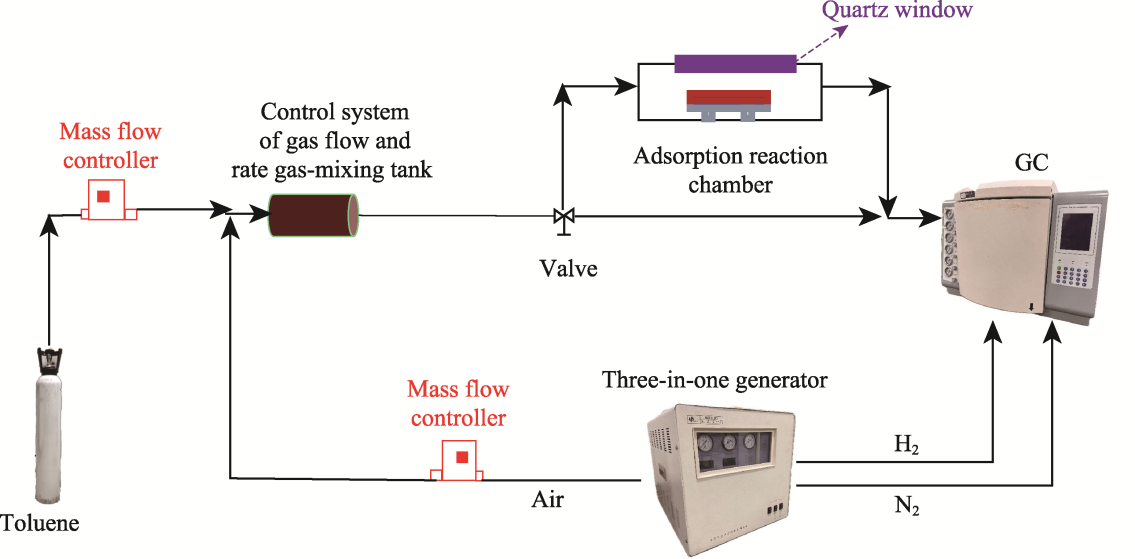
Fig. 1 Experiment flow diagram of the toluene breakthrough adsorption
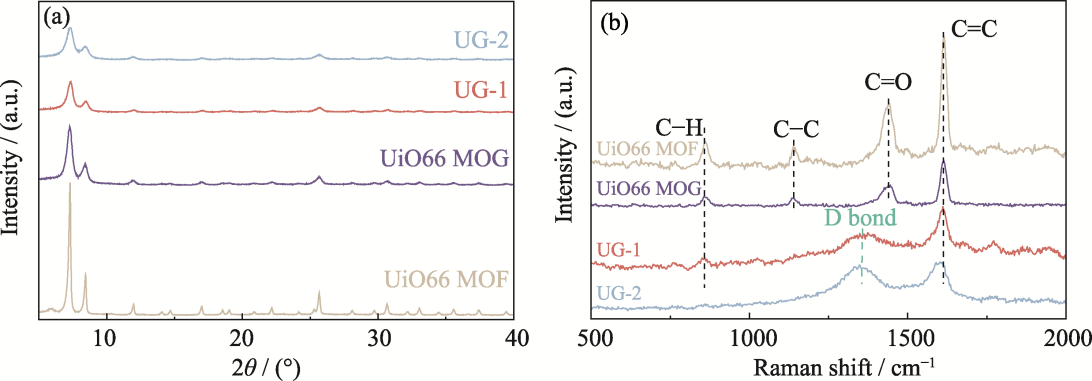
Fig. 2 (a) XRD patterns and (b) Raman spectra of UiO66 MOF, UiO66 MOG, UG-1, and UG-2
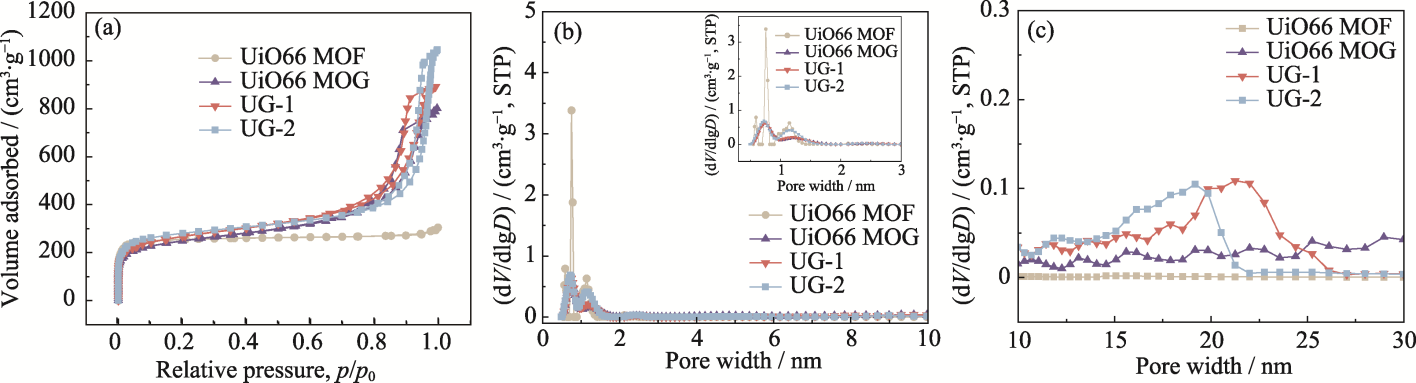
Fig. 3 (a) N2 adsorption-desorption isotherms, and pore size distribution curves in the ranges of (b) 0-10 nm and (c) 10-30 nm of UiO66 MOF, UiO66 MOG, UG-1, and UG-2 with inset in (b) showing magnified view for the 0.5-3 nm range
| Sample | SBET/(m2·g-1) | Smicro/(m2·g-1) | Smeso/(m2·g-1) |
|---|---|---|---|
| UiO66 MOF | 1020.9 | 945.2 | 75.7 |
| UiO66 MOG | 909.8 | 511.1 | 398.7 |
| UG-1 | 973.8 | 536.8 | 437.0 |
| UG-2 | 1062.4 | 749.5 | 312.9 |
Table 1 Specific surface area and pore structure parameters of UiO66 MOF, UiO66 MOG and UG-x
| Sample | SBET/(m2·g-1) | Smicro/(m2·g-1) | Smeso/(m2·g-1) |
|---|---|---|---|
| UiO66 MOF | 1020.9 | 945.2 | 75.7 |
| UiO66 MOG | 909.8 | 511.1 | 398.7 |
| UG-1 | 973.8 | 536.8 | 437.0 |
| UG-2 | 1062.4 | 749.5 | 312.9 |
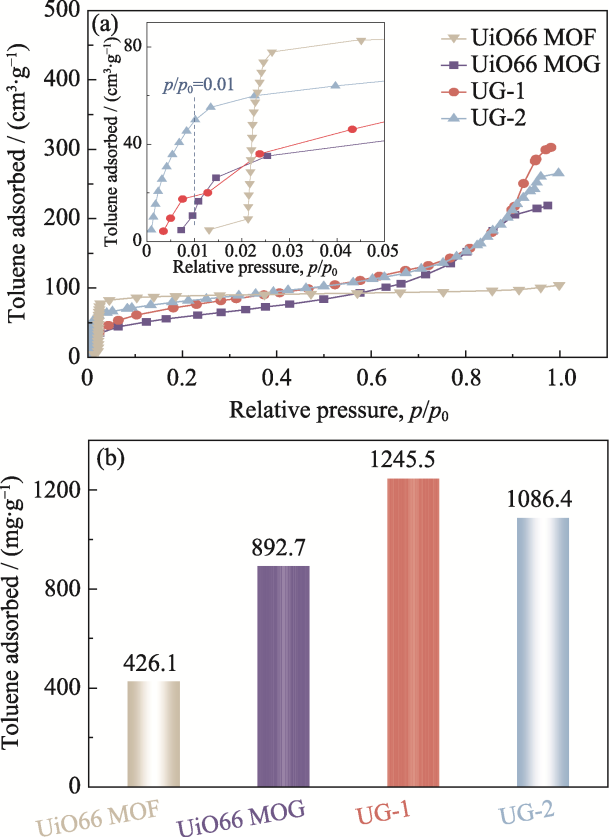
Fig. 4 (a) Toluene vapor adsorption isotherms and (b) saturated toluene adsorption capacities of UiO66 MOF, UiO66 MOG, UG-1, and UG-2 with inset in (a) showing adsorption isotherms in a low-pressure region p/p0=0-0.05
| Adsorbent | p/p0 | Temperature/K | q/(mg·g-1) |
|---|---|---|---|
| AC[ | 1.0 | 298 | 530.4 |
| Silica gel[ | 1.0 | 298 | 437.4 |
| UiO-66-NH2@ABP[ | 0.9 | 298 | 178.9 |
| MIL-125-NH2[ | 0.94 | 298 | 293 |
| MIL-100(Fe)_A2[ | 1.0 | 298 | 523.3 |
| HKUST-1[ | 0.9 | 298 | 516 |
| MSN-100[ | 0.94 | 298 | 461 |
| UG-1 | 1.0 | 298 | 1245.5 |
Table 2 Toluene saturation adsorption capacities of various adsorbents[2,18 -22]
| Adsorbent | p/p0 | Temperature/K | q/(mg·g-1) |
|---|---|---|---|
| AC[ | 1.0 | 298 | 530.4 |
| Silica gel[ | 1.0 | 298 | 437.4 |
| UiO-66-NH2@ABP[ | 0.9 | 298 | 178.9 |
| MIL-125-NH2[ | 0.94 | 298 | 293 |
| MIL-100(Fe)_A2[ | 1.0 | 298 | 523.3 |
| HKUST-1[ | 0.9 | 298 | 516 |
| MSN-100[ | 0.94 | 298 | 461 |
| UG-1 | 1.0 | 298 | 1245.5 |
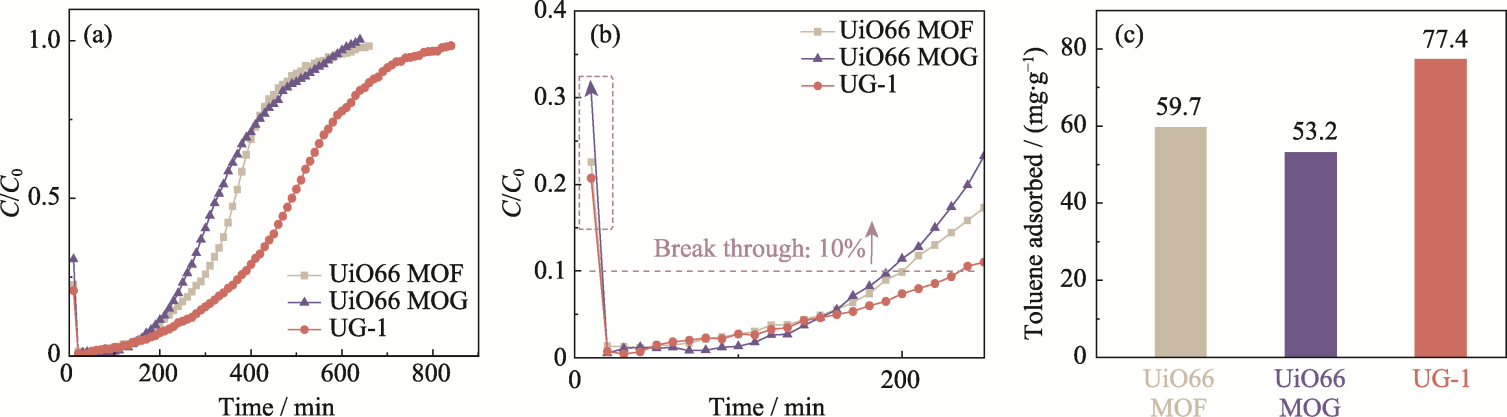
Fig. 5 Dynamic breakthrough curves for toluene adsorption within (a) 800 and (b) 250 min, and (c) equilibrium toluene adsorption capacities of UiO66 MOF, UiO66 MOG and UG-1
| Sample | tb/min | te/min | q/(mg·g-1) |
|---|---|---|---|
| UiO66 MOF | 200 | 580 | 59.7 |
| UiO66 MOG | 200 | 590 | 53.2 |
| UG-1 | 240 | 750 | 77.4 |
Table 3 Breakthrough time, equilibrium time and equilibrium adsorption capacities of UiO66 MOF, UiO66 MOG and UG-1
| Sample | tb/min | te/min | q/(mg·g-1) |
|---|---|---|---|
| UiO66 MOF | 200 | 580 | 59.7 |
| UiO66 MOG | 200 | 590 | 53.2 |
| UG-1 | 240 | 750 | 77.4 |
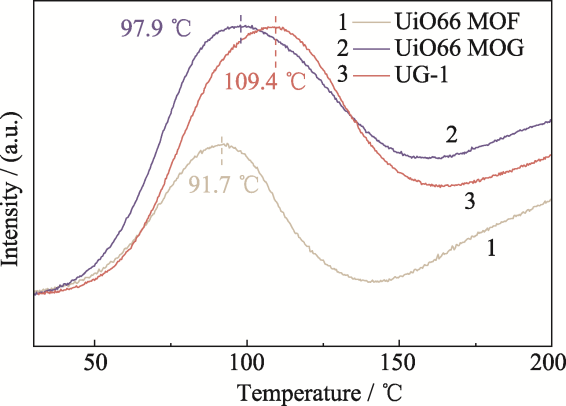
Fig. 6 TPD curves of toluene for UiO66 MOF, UiO66 MOG and UG-1
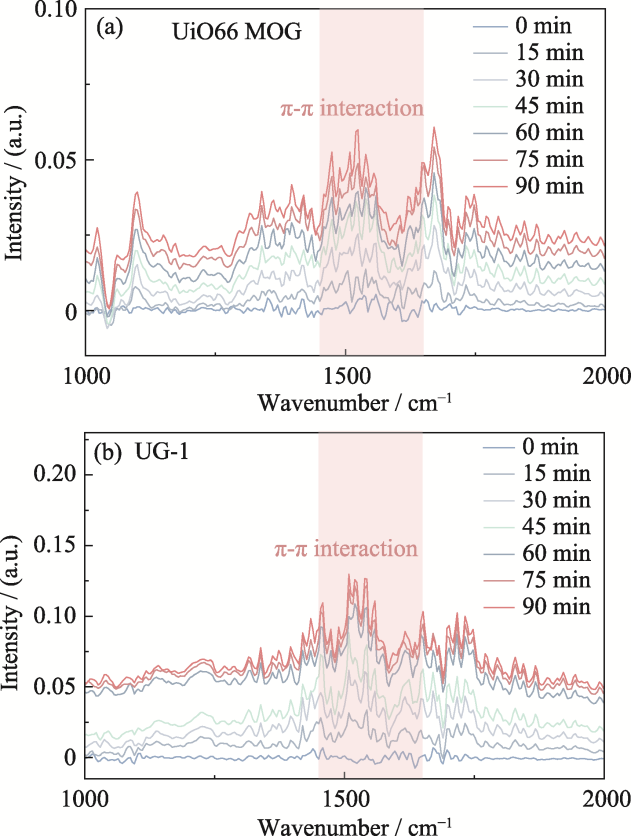
Fig. 7 In-situ DRIFTS spectra of toluene adsorption for (a) UiO66 MOG and (b) UG-1 Colorful figures are available on website
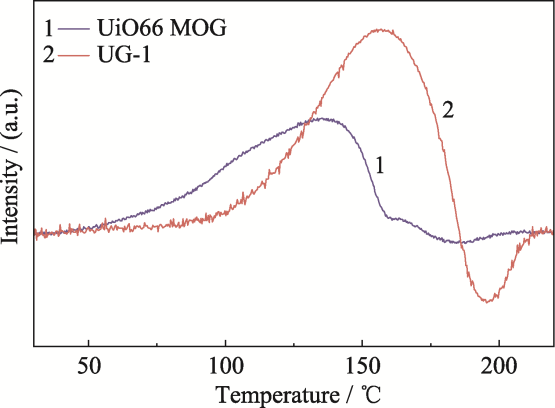
Fig. 8 NH3-TPD curves of UiO66 MOG and UG-1
| [1] |
QU F, ZHU L Z, YANG K. Adsorption behaviors of volatile organic compounds (VOCs) on porous clay heterostructures (PCH). Journal of Hazardous Materials, 2009, 170(1): 7.
DOI PMID |
| [2] |
KIM B, LEE Y R, KIM H Y, et al. Adsorption of volatile organic compounds over MIL-125-NH2. Polyhedron, 2018, 154: 343.
DOI URL |
| [3] |
ZHANG X Y, GAO B, CREAMER A E, et al. Adsorption of VOCs onto engineered carbon materials: a review. Journal of Hazardous Materials, 2017, 338: 102.
DOI PMID |
| [4] |
LI X Q, ZHANG L, YANG Z Q, et al. Adsorption materials for volatile organic compounds (VOCs) and the key factors for VOCs adsorption process: a review. Separation and Purification Technology, 2020, 235: 116213.
DOI URL |
| [5] |
YANG S J, WANG X, SONG G Q, et al. Ti-O-Mo bond-bridged PMA@MIL-125-NH2 photocatalyst for gas acetone photocatalytic degradation. Applied Catalysis B: Environment and Energy, 2025, 367: 125112.
DOI URL |
| [6] |
FU Y, ZHANG P Y, WANG X J. Feasible defect and hydrophobic modification of MIL-100(Cr) for efficient toluene removal from air. Chemical Engineering Journal, 2024, 482: 149163.
DOI URL |
| [7] |
VALENZANO L, CIVALLERI B, CHAVAN S, et al. Disclosing the complex structure of UiO-66 metal organic framework: a synergic combination of experiment and theory. Chemistry of Materials, 2011, 23(7): 1700.
DOI URL |
| [8] |
ZHANG X D, LV X T, SHI X Y, et al. Enhanced hydrophobic UiO-66 (University of Oslo 66) metal-organic framework with high capacity and selectivity for toluene capture from high humid air. Journal of Colloid and Interface Science, 2019, 539: 152.
DOI PMID |
| [9] |
LI Y J, MIAO J P, SUN X J, et al. Mechanochemical synthesis of Cu-BTC@GO with enhanced water stability and toluene adsorption capacity. Chemical Engineering Journal, 2016, 298: 191.
DOI URL |
| [10] |
HOU J W, SAPNIK A F, BENNETT T D. Metal-organic framework gels and monoliths. Chemical Science, 2019, 11(2): 310.
DOI URL |
| [11] |
CHEN L, WANG X, SHI G S, et al. The regulation of Lewis acid/ basic sites in NaFe bimetal MOXs for the controllable photocatalytic degradation of electron-rich/deficient VOCs. Applied Catalysis B: Environmental, 2023, 334: 122850.
DOI URL |
| [12] |
QIN H J, SUN J W, YANG X B, et al. Defective UiO-66 metal- organic gels for optimizing gaseous toluene capture. Journal of Colloid and Interface Science, 2024, 655: 23.
DOI URL |
| [13] |
TIAN T, ZENG Z X, VULPE D, et al. A Sol-Gel monolithic metal-organic framework with enhanced methane uptake. Nature Materials, 2018, 17(2): 174.
DOI PMID |
| [14] |
YU J J, WANG X, CHEN L, et al. Enhanced adsorption and visible-light photocatalytic degradation of toluene by CQDs/UiO- 66 MOG with hierarchical pores. Chemical Engineering Journal, 2022, 435: 135033.
DOI URL |
| [15] |
YOST B T, GIBBONS B, WILSON A, et al. Vibrational spectroscopy investigation of defects in Zr- and Hf-UiO-66. RSC Advances, 2022, 12(35): 22440.
DOI PMID |
| [16] |
JI W L, LI W W, WANG Y, et al. Zr-doped MIL-101(Fe)/ graphene oxide nanocomposites: an efficient and water-stable MOF-based adsorbent for As(V) adsorption in aqueous solution. Separation and Purification Technology, 2024, 339: 126681.
DOI URL |
| [17] |
CONNOLLY B M, ARAGONES-ANGLADA M, GANDARA- LOE J, et al. Tuning porosity in macroscopic monolithic metal- organic frameworks for exceptional natural gas storage. Nature Communications, 2019, 10: 2345.
DOI |
| [18] |
SUI H, LIU H X, AN P, et al. Application of silica gel in removing high concentrations toluene vapor by adsorption and desorption process. Journal of the Taiwan Institute of Chemical Engineers, 2017, 74: 218.
DOI URL |
| [19] |
XIAO Y T, WU Y, SUN C, et al. UiO-66-NH2 incorporated nanofibrous membranes by direct electrospinning/in-situ growth for toluene adsorption. Journal of Environmental Chemical Engineering, 2025, 13(1): 115198.
DOI URL |
| [20] |
DUAN C X, YU Y, YANG P F, et al. Engineering new defects in MIL-100(Fe) via a mixed-ligand approach to effect enhanced volatile organic compound adsorption capacity. Industrial & Engineering Chemistry Research, 2020, 59(2): 774.
DOI URL |
| [21] | XU F, XIAN S K, XIA Q B, et al. Effect of textural properties on the adsorption and desorption of toluene on the metal-organic frameworks HKUST-1 and MIL-101. Adsorption Science & Technology, 2013, 31(4): 325. |
| [22] |
HU Q, DOU B J, TIAN H, et al. Mesoporous silicalite-1 nanospheres and their properties of adsorption and hydrophobicity. Microporous and Mesoporous Materials, 2010, 129(1/2): 30.
DOI URL |
| [23] |
DU Y K, CHEN H Y, XU X, et al. Surface modification of biomass derived toluene adsorbent: hierarchically porous characterization and heteroatom doped effect. Microporous and Mesoporous Materials, 2020, 293: 109831.
DOI URL |
| [24] |
ALIVAND M S, TEHRANI N H M H, ASKARIEH M, et al. Defect engineering-induced porosity in graphene quantum dots embedded metal-organic frameworks for enhanced benzene and toluene adsorption. Journal of Hazardous Materials, 2021, 416: 125973.
DOI URL |
| [25] |
CAO J W, LI Y X, MA X B, et al. Constructing binuclear sites to modulate the charge distribution of MIL-101 for enhanced toluene adsorption performance: experimental and theoretical studies. Separation and Purification Technology, 2025, 354: 129400.
DOI URL |
| [26] |
CHEN L, WANG X, RAO Z P, et al. One-pot synthesis of the MIL-100 (Fe) MOF/MOX homojunctions with tunable hierarchical pores for the photocatalytic removal of BTXS. Applied Catalysis B: Environmental, 2022, 303: 120885.
DOI URL |
| [27] |
YE L L, CHEN X, CHEN Y, et al. Improvement of membrane- forming ability and separation performance of hydroxylated BN membrane by GO via π-π interaction. Desalination, 2023, 565: 116824.
DOI URL |
| [1] | CHEN Xiaochen, WANG Yang, YANG Bin, WANG Min, A Bohan, WANG Man, ZHANG Lingxia. Ligand-hydroxylated UiO-66 for Enhanced Photothermally Catalytic VOCs Oxidation [J]. Journal of Inorganic Materials, 2026, 41(5): 663-672. |
| [2] | FAN Yuzhu, WANG Yuan, WANG Linyan, XIANG Meiling, YAN Yuting, LI Benhui, LI Min, WEN Zhidong, WANG Haichao, CHEN Yongfu, QIU Huidong, ZHAO Bo, ZHOU Chengyu. Graphene Oxide-based Adsorbents for Pb(II) Removing in Water: Progresses on Synthesis, Performance and Mechanism [J]. Journal of Inorganic Materials, 2026, 41(1): 12-26. |
| [3] | LIU Jiangping, GUAN Xin, TANG Zhenjie, ZHU Wenjie, LUO Yongming. Research Progress on Catalytic Oxidation of Nitrogen-containing Volatile Organic Compounds [J]. Journal of Inorganic Materials, 2025, 40(9): 933-943. |
| [4] | ZHU Wenjie, TANG Lu, LU Jichang, LIU Jiangping, LUO Yongming. Research Progress on Catalytic Oxidation of Volatile Organic Compounds by Perovskite Oxides [J]. Journal of Inorganic Materials, 2025, 40(7): 735-746. |
| [5] | JIANG Zongyu, HUANG Honghua, QING Jiang, WANG Hongning, YAO Chao, CHEN Ruoyu. Aluminum Ion Doped MIL-101(Cr): Preparation and VOCs Adsorption Performance [J]. Journal of Inorganic Materials, 2025, 40(7): 747-753. |
| [6] | GAO Chenguang, SUN Xiaoliang, CHEN Jun, LI Daxin, CHEN Qingqing, JIA Dechang, ZHOU Yu. SiBCN-rGO Ceramic Fibers Based on Wet Spinning Technology: Microstructure, Mechanical and Microwave-absorbing Properties [J]. Journal of Inorganic Materials, 2025, 40(3): 290-296. |
| [7] | WANG Yue, WANG Xin, YU Xianli. Room-temperature Ferromagnetic All-carbon Films Based on Reduced Graphene Oxide [J]. Journal of Inorganic Materials, 2025, 40(3): 305-313. |
| [8] | QU Mujing, ZHANG Shulan, ZHU Mengmeng, DING Haojie, DUAN Jiaxin, DAI Henglong, ZHOU Guohong, LI Huili. CsPbBr3@MIL-53 Nanocomposite Phosphors: Synthesis, Properties and Applications in White LEDs [J]. Journal of Inorganic Materials, 2024, 39(9): 1035-1043. |
| [9] | DONG Yiman, TAN Zhan’ao. Research Progress of Recombination Layers in Two-terminal Tandem Solar Cells Based on Wide Bandgap Perovskite [J]. Journal of Inorganic Materials, 2023, 38(9): 1031-1043. |
| [10] | MA Xiaosen, ZHANG Lichen, LIU Yanchao, WANG Quanhua, ZHENG Jiajun, LI Ruifeng. 13X@SiO2: Synthesis and Toluene Adsorption [J]. Journal of Inorganic Materials, 2023, 38(5): 537-543. |
| [11] | JIANG Runlu, WU Xin, GUO Haocheng, ZHENG Qi, WANG Lianjun, JIANG Wan. UiO-67 Based Conductive Composites: Preparation and Thermoelectric Performance [J]. Journal of Inorganic Materials, 2023, 38(11): 1338-1344. |
| [12] | SUN Ming, SHAO Puzhen, SUN Kai, HUANG Jianhua, ZHANG Qiang, XIU Ziyang, XIAO Haiying, WU Gaohui. First-principles Study on Interface of Reduced Graphene Oxide Reinforced Aluminum Matrix Composites [J]. Journal of Inorganic Materials, 2022, 37(6): 651-659. |
| [13] | DONG Shurui, ZHAO Di, ZHAO Jing, JIN Wanqin. Effect of Ionized Amino Acid on the Water-selective Permeation through Graphene Oxide Membrane in Pervaporation Process [J]. Journal of Inorganic Materials, 2022, 37(4): 387-394. |
| [14] | LIANG Fengqing, WEN Zhaoyin. MOF/Poly(Ethylene Oxide) Composite Polymer Electrolyte for Solid-state Lithium Battery [J]. Journal of Inorganic Materials, 2021, 36(3): 332-336. |
| [15] | LI Hao, TANG Zhihong, ZHUO Shangjun, QIAN Rong. High Performance of Room-temperature NO2 Gas Sensor Based on ZIF8/rGO [J]. Journal of Inorganic Materials, 2021, 36(12): 1277-1282. |
| Viewed | ||||||
|
Full text |
|
|||||
|
Abstract |
|
|||||
