
Journal of Inorganic Materials ›› 2026, Vol. 41 ›› Issue (7): 955-964.DOI: 10.15541/jim20250489
• RESEARCH ARTICLE • Previous Articles Next Articles
CUI Kaimin( ), LI Duan(), ZENG Lei, PENG Jiangshan, WANG Yanfei, LIU Rongjun
Received:2025-12-10
Revised:2026-01-08
Published:2026-07-20
Online:2026-01-21
Contact:
LI Duan, associate professor. E-mail: duan_li_2016@163.comAbout author:CUI Kaimin (2000-), female, Master candidate. E-mail: 1850712227@qq.com
Supported by:CLC Number:
CUI Kaimin, LI Duan, ZENG Lei, PENG Jiangshan, WANG Yanfei, LIU Rongjun. Rapid and Low-temperature Fabrication of Mullite Ceramics with Dual-mode Radar/Infrared Transmission Characteristics[J]. Journal of Inorganic Materials, 2026, 41(7): 955-964.
| Sample | Heating rate/ (℃·min-1) | Sintering temperature/℃ | Dwell time/ min | Pressure/ MPa | Density/ (g·cm-3) | Open porosity/% |
|---|---|---|---|---|---|---|
| AS-1 | 300 | 1150 | 2 | 30 | 2.44 | 21.1 |
| AS-2 | 300 | 1150 | 2 | 50 | 2.45 | 21.1 |
| AS-3 | 300 | 1150 | 2 | 70 | 2.58 | 16.4 |
| AS-4 | 300 | 1200 | 2 | 70 | 2.78 | 10.5 |
| AS-5 | 200 | 1200 | 2 | 70 | 2.80 | 9.0 |
| AS-6 | 100 | 1200 | 5 | 70 | 3.06 | 1.6 |
Table 1 Sintering parameters, density and open porosity of ceramics
| Sample | Heating rate/ (℃·min-1) | Sintering temperature/℃ | Dwell time/ min | Pressure/ MPa | Density/ (g·cm-3) | Open porosity/% |
|---|---|---|---|---|---|---|
| AS-1 | 300 | 1150 | 2 | 30 | 2.44 | 21.1 |
| AS-2 | 300 | 1150 | 2 | 50 | 2.45 | 21.1 |
| AS-3 | 300 | 1150 | 2 | 70 | 2.58 | 16.4 |
| AS-4 | 300 | 1200 | 2 | 70 | 2.78 | 10.5 |
| AS-5 | 200 | 1200 | 2 | 70 | 2.80 | 9.0 |
| AS-6 | 100 | 1200 | 5 | 70 | 3.06 | 1.6 |
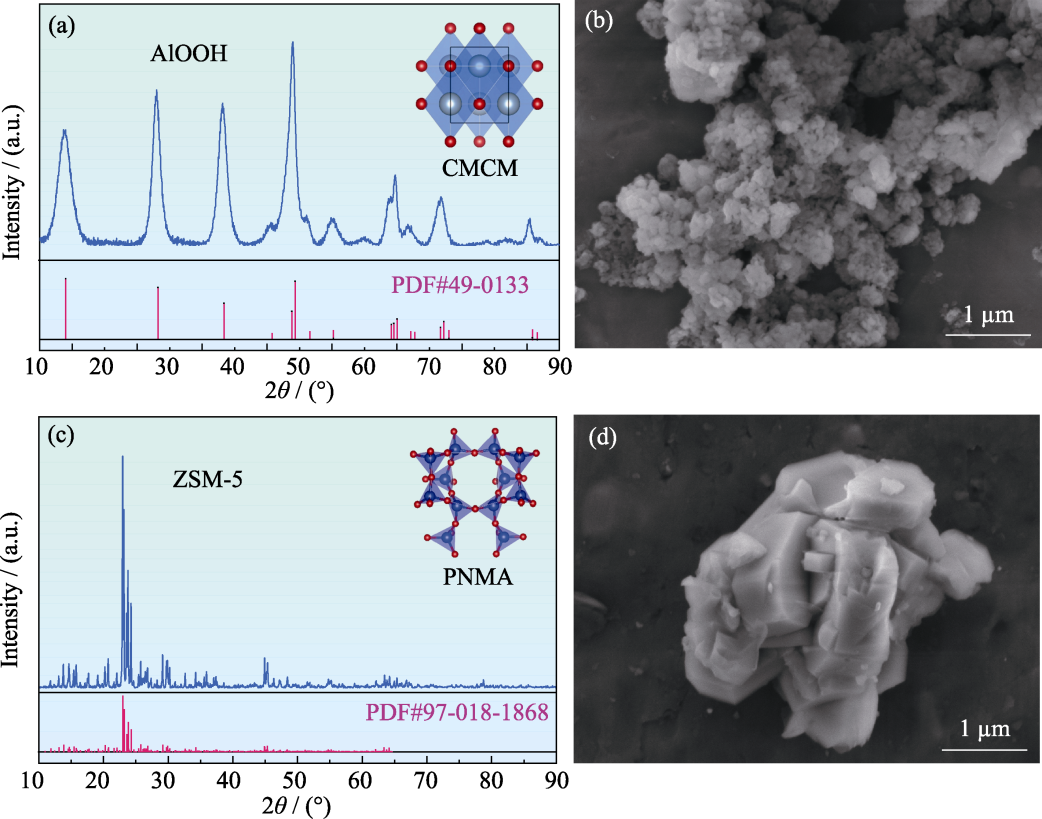
Fig. 1 (a, c) XRD patterns and (b, d) SEM images of the raw powders (a, b) AlOOH; (c, d) ZSM-5
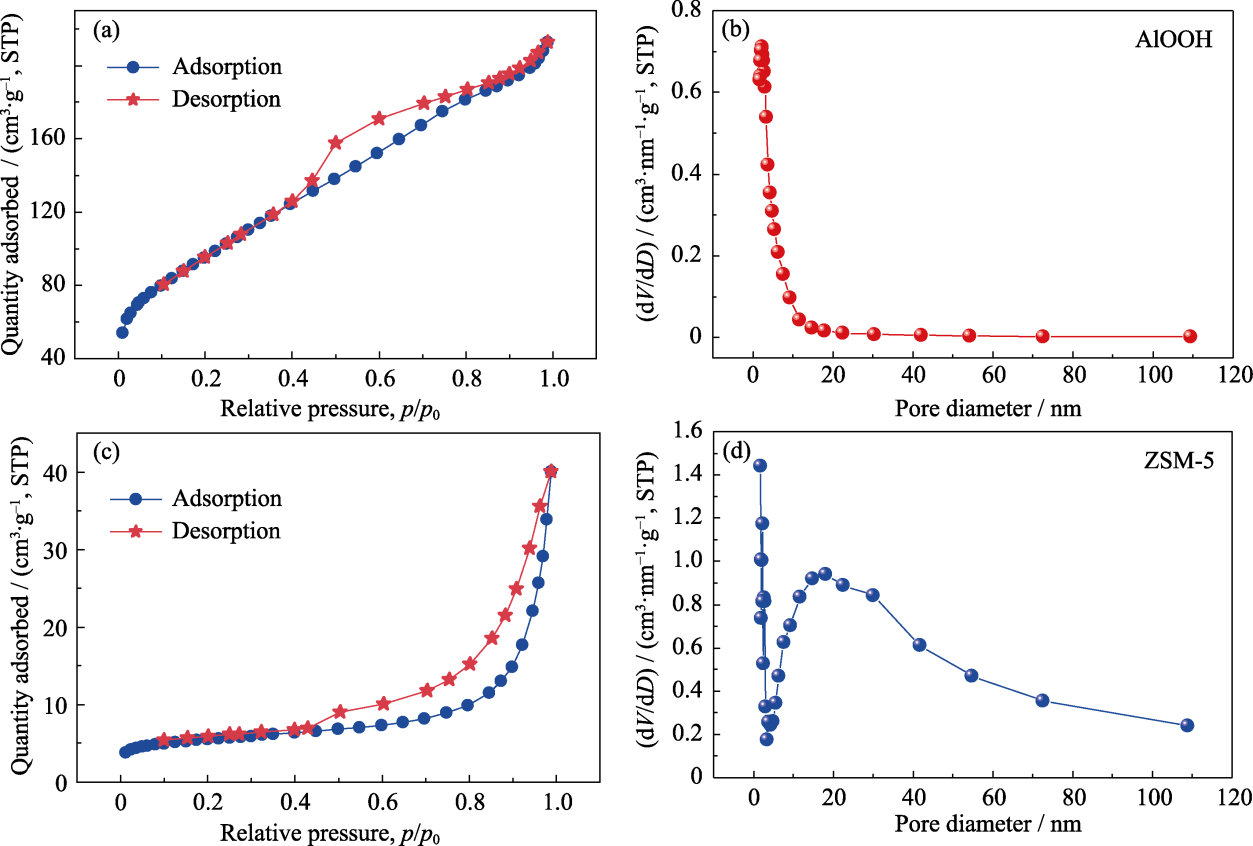
Fig. 2 (a, c) N2 adsorption-desorption isotherms and (b, d) pore size distributions of the raw powders (a, b) AlOOH; (c, d) ZSM-5
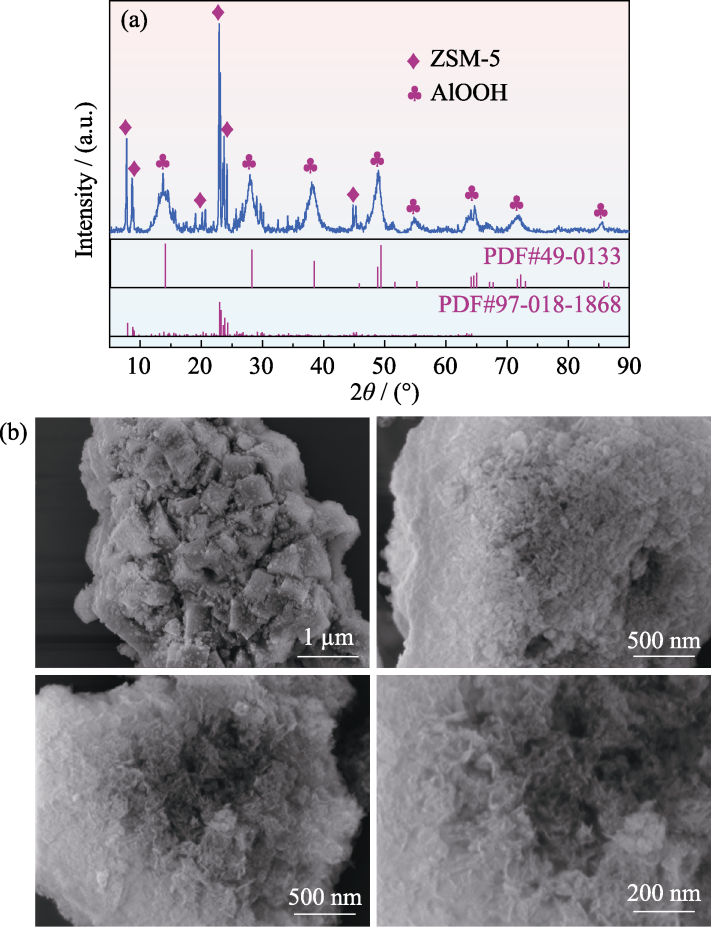
Fig. 3 (a) XRD pattern and (b) SEM images of the dry-mixed raw powders
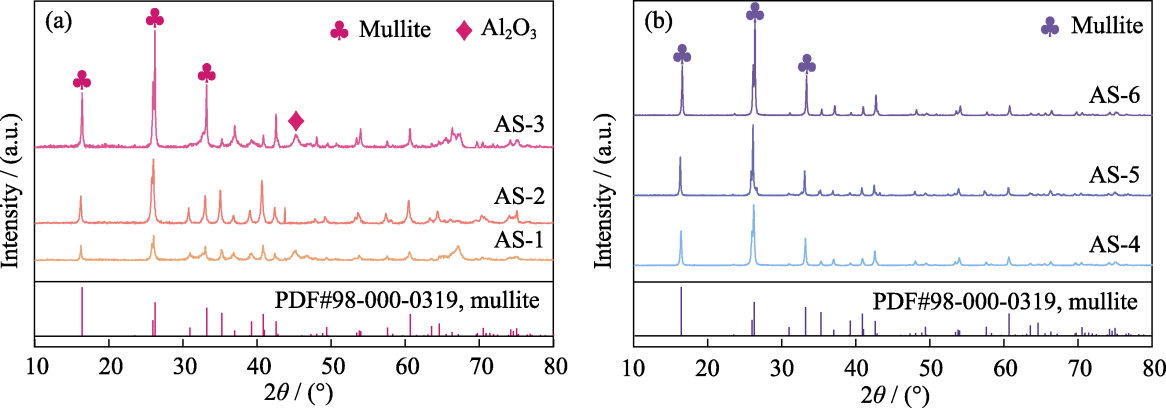
Fig. 4 XRD patterns of the obtained mullite ceramics under different sintering parameters (a) AS-1, AS-2, and AS-3; (b) AS-4, AS-5, and AS-6
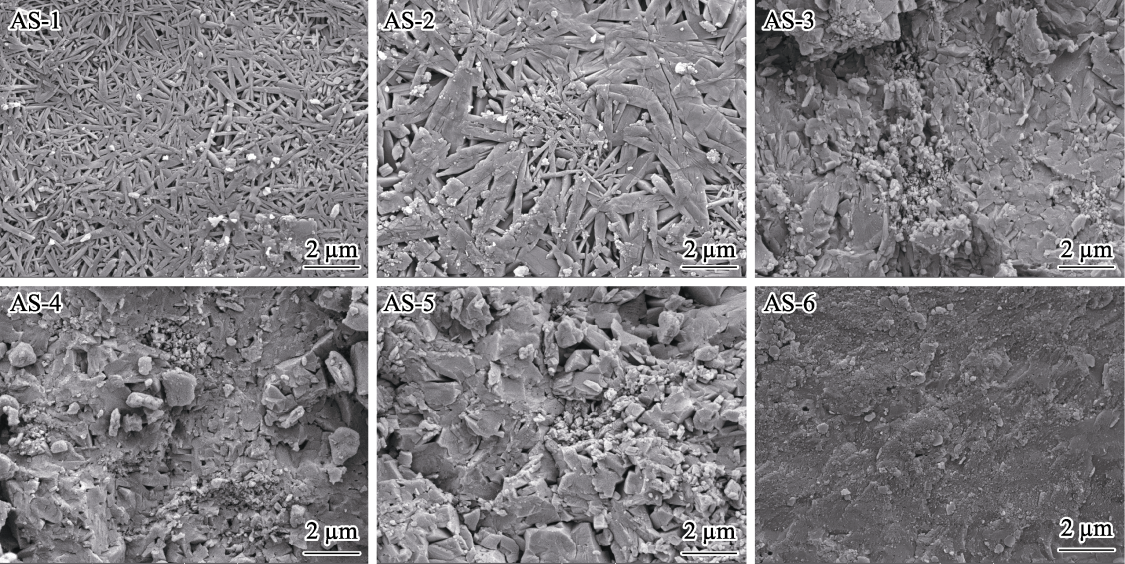
Fig. 5 SEM images of the obtained mullite ceramics under different sintering parameters
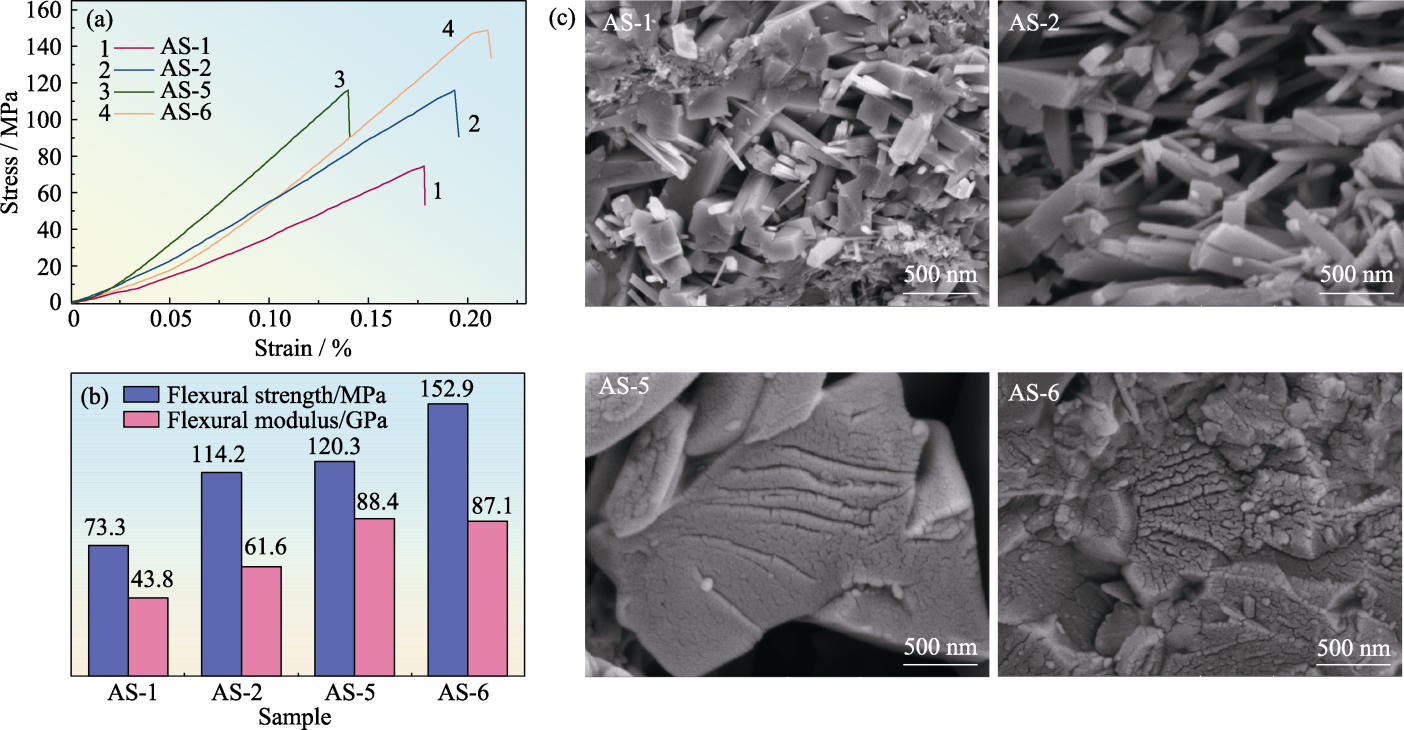
Fig. 6 Mechanical characterization and fracture morphologies of the obtained mullite ceramics under different sintering parameters (a) Stress-strain curves; (b) Flexural strength and modulus; (c) SEM images of fracture surfaces
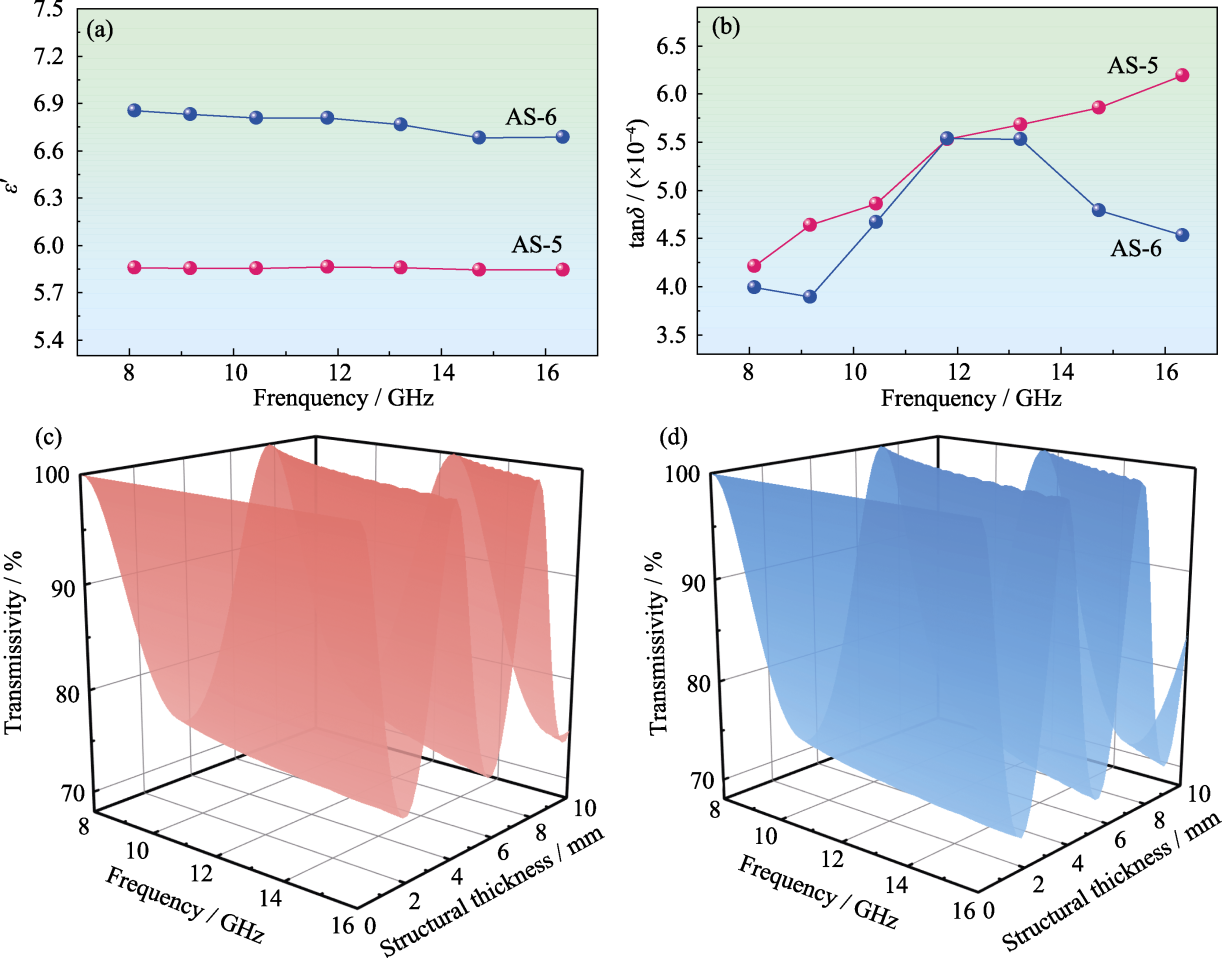
Fig. 7 Dielectric properties of the obtained mullite ceramics under different sintering parameters (a) ${\epsilon }^{\prime }$; (b) $\mathrm{tan}\delta $; (c, d) Microwave transmittance of (c) AS-5 and (d) AS-6
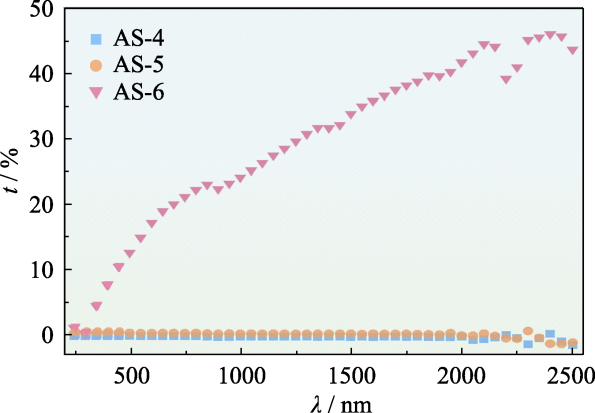
Fig. 8 Infrared transmittance spectra of mullite ceramic samples
| [1] |
KOČÍ J, HAMÁČEK J, MACHÁČEK J, et al. Effect of long-term high-temperature exposure in a controlled atmosphere on mullite- corundum ceramics for advanced applications in nuclear power technology. Ceramics International, 2024, 50(13): 24273.
DOI URL |
| [2] |
ROY S. Properties and advanced applications of porous ceramic composites. Open Ceramics, 2025, 21: 100714.
DOI URL |
| [3] |
LIN Y W, JING Z, CHEN H T, et al. Ablative properties of SiCp doped Cf/Li2O-Al2O3-SiO2 composites. Journal of Inorganic Materials, 2025, 40(10): 1153.
DOI URL |
| [4] |
CHENG X T, LIU Y T, SI Y, et al. Direct synthesis of highly stretchable ceramic nanofibrous aerogels via 3D reaction electrospinning. Nature Communications, 2022, 13: 2637.
DOI |
| [5] |
WANG Y L, PENG Z W, TIAN R, et al. Microwave-transparent refractory materials for high-temperature metallurgical applications. Journal of Alloys and Compounds, 2025, 1033: 181063.
DOI URL |
| [6] |
ZHU Z X, WANG F, YAO H J. High-temperature insulation property of opacifier-doped Al2O3-SiO2 aerogel/mullite fiber composites. Journal of Inorganic Materials, 2018, 33(9): 969.
DOI URL |
| [7] |
SYAMKUMAR K, BABU N, GOVINDARAJAN S, et al. Hot corrosion behaviour of mullite thermal barrier coatings for marine diesel engines. Ceramics International, 2024, 50(2): 2808.
DOI URL |
| [8] |
GAO J M, WANG B, DU Z Y, et al. Molten salt synthesis of mullite whiskers entirely derived from fly ash for electronic packaging toughening ceramic applications. Journal of Materials Research and Technology, 2022, 21: 3719.
DOI URL |
| [9] |
ZHANG J X, ZHANG M J, GU H Z, et al. Processing and properties of Al-Si microcapsules with a biomimetic-corrugated structure and corundum-mullite composite shell. Journal of Materiomics, 2025, 11(3): 100906.
DOI URL |
| [10] |
LI X, HU C, LIU Q, et al. Fluoride transparent ceramics for solid-state lasers: a review. Journal of Advanced Ceramics, 2024, 13(12): 1891.
DOI URL |
| [11] |
XU J, SHAO Y Q, FENG X Y, et al. Low sintering shrinkage porous ceramics: principles, progress, and perspectives. Journal of Advanced Ceramics, 2025, 14(2): 9221015.
DOI URL |
| [12] |
SHAO J H, BAI C Y, LI X Y, et al. Open-cell mullite ceramic foams derived from porous geopolymer precursors with tailored porosity. Journal of Advanced Ceramics, 2023, 12(2): 279.
DOI URL |
| [13] | GREGOROVIČOVÁ E, POSPÍŠIL J. Ceramic filters for high-temperature flue gas filtration and their regeneration: a review of the current state of knowledge. Process Safety and Environmental Protection, 2024, 190: 688. |
| [14] |
DUN Y H, LIU Y F, XU J, et al. Advancements in rare earth mullite oxides (AMn2O5) for catalytic oxidation: structure, activity and design strategies. Applied Catalysis A: General, 2024, 685: 119872.
DOI URL |
| [15] |
GUO X Z, LI W Y, NAKANISHI K, et al. Preparation of mullite monoliths with well-defined macropores and mesostructured skeletons via the Sol-Gel process accompanied by phase separation. Journal of the European Ceramic Society, 2013, 33(10): 1967.
DOI URL |
| [16] |
SANAD M M S, RASHAD M M, ABDEL-AAL E A, et al. Synthesis and characterization of nanocrystalline mullite powders at low annealing temperature using a new technique. Journal of the European Ceramic Society, 2012, 32(16): 4249.
DOI URL |
| [17] |
XU H Q, LI D X, LUO R W, et al. Low-temperature synthesis of mullite and its structural evolution during mullitization. Ceramics International, 2025, 51(6): 7100.
DOI URL |
| [18] |
KAYA C, HE J Y, GU X, et al. Nanostructured ceramic powders by hydrothermal synthesis and their applications. Microporous and Mesoporous Materials, 2002, 54(1/2): 37.
DOI URL |
| [19] |
LIU R P, XIANG D P. Recycling photovoltaic silicon waste for fabricating porous mullite ceramics by low-temperature reaction sintering. Journal of the European Ceramic Society, 2021, 41(12): 5957.
DOI URL |
| [20] |
HUO W L, ZHANG X Y, CHEN Y G, et al. Novel mullite ceramic foams with high porosity and strength using only fly ash hollow spheres as raw material. Journal of the European Ceramic Society, 2018, 38(4): 2035.
DOI URL |
| [21] |
MA B Y, SU C, REN X M, et al. Preparation and properties of porous mullite ceramics with high-closed porosity and high strength from fly ash via reaction synthesis process. Journal of Alloys and Compounds, 2019, 803: 981.
DOI URL |
| [22] |
AKPINAR S, KUSOGLU I M, ERTUGRUL O, et al. In situ mullite foam fabrication using microwave energy. Journal of the European Ceramic Society, 2012, 32(4): 843.
DOI URL |
| [23] |
HAN L, DENG X G, LI F L, et al. Preparation of high strength porous mullite ceramics via combined foam-gelcasting and microwave heating. Ceramics International, 2018, 44(12): 14728.
DOI URL |
| [24] |
LÜ Q K, DONG X F, ZHU Z W, et al. Environment-oriented low- cost porous mullite ceramic membrane supports fabricated from coal gangue and bauxite. Journal of Hazardous Materials, 2014, 273: 136.
DOI URL |
| [25] |
VIJAYAN S, WILSON P, PRABHAKARAN K. Ultra low-density mullite foams by reaction sintering of thermo-foamed alumina- silica powder dispersions in molten sucrose. Journal of the European Ceramic Society, 2017, 37(4): 1657.
DOI URL |
| [26] |
FUKUSHIMA M, YOSHIZAWA Y. Fabrication and morphology control of highly porous mullite thermal insulators prepared by gelation freezing route. Journal of the European Ceramic Society, 2016, 36: 2947.
DOI URL |
| [27] |
HOU Z P, ZHANG B, ZHANG R, et al. Fabrication of highly porous mullite microspheres via oil-drop molding accompanied by freeze casting. Ceramics International, 2017, 43(12): 8809.
DOI URL |
| [28] |
LI J S, ZENG L, LIU R J, et al. Functional strontium tantalum oxynitride ceramics: efficient synthesis, densification and dielectric performance. Journal of Inorganic Materials, 2023, 38(8): 885.
DOI URL |
| [29] |
IRSHAD H M, HAKEEM A S, AHMED T, et al. Tribological and thermomechanical behaviour of alumina-based hybrid nanocomposites. Materials Chemistry and Physics, 2025, 341: 130828.
DOI URL |
| [30] |
YANG J W, LEI L W, ZHANG J Y. Preparation of alumina ceramics via a two-step sintering process. Materials, 2025, 18(8): 1789.
DOI URL |
| [31] |
MAJIDIAN H, NIKZAD L, FARVIZI M, et al. Reactive spark plasma sintering of alumina-mullite-zirconia composites. Ceramics International, 2025, 51(23): 38636.
DOI URL |
| [32] | REN L, FU Z Y, WANG Y C, et al. Fabrication of transparent mullite ceramic by spark plasma sintering from powders synthesized via Sol-Gel process combined with pulse current heating. Materials & Design, 2015, 83: 753. |
| [33] |
LIU Y, ZHANG K Y, LI T Y, et al. Electric-field assisted joining technology for the ceramics materials: current status and development trend. Journal of Inorganic Materials, 2023, 38(2): 113.
DOI |
| [34] |
HUANG P, ZHOU B Y, ZHENG Q, et al. Nano wave plates structuring and index matching in transparent hydroxyapatite-YAG: Ce composite ceramics for high luminous efficiency white light- emitting diodes. Advanced Materials, 2020, 32(1): 1905951.
DOI URL |
| [35] | FARBER E M, SERAPHIM N M, TAMAKUWALA K, et al. Porous materials: the next frontier in energy technologies. Science, 2025, 390(6772): 9391. |
| [36] |
LI X Q, CHEN F Y, ZHANG L L, et al. Preparation of low- dielectric porous silica ceramics by sintering mesoporous silica. Integrated Ferroelectrics, 2012, 135(1): 144.
DOI URL |
| [37] |
YU S Y, LI Z F, CUI J P, et al. Preparation of pressureless-sintered dense cordierite ceramics with high flexural strength by mesoporous powder. Ceramics International, 2025, 51(17): 24202.
DOI URL |
| [38] |
FANG H L, GU S J, FAN S J, et al. Rapidly fabricating Y2O3 transparent ceramics at low temperature by SPS with mesoporous powder. Journal of the American Ceramic Society, 2023, 106(4): 2491.
DOI URL |
| [39] |
HENNING L M, MÜLLER J T, SMALES G J, et al. Hierarchically porous and mechanically stable monoliths from ordered mesoporous silica and their water filtration potential. Nanoscale Advances, 4(18): 3892.
DOI URL |
| [40] |
PÉREZ J M, RINCÓN J M, ROMERO M. Effect of moulding pressure on microstructure and technological properties of porcelain stoneware. Ceramics International, 2012, 38(1): 317.
DOI URL |
| [41] |
HSIUNG C H H, PYZIK A J, DE CARLO F, et al. Microstructure and mechanical properties of acicular mullite. Journal of the European Ceramic Society, 2013, 33(3): 503.
DOI URL |
| [42] |
XIA L, YANG Y N, ZHANG X Y, et al. Crystal structure and wave-transparent properties of lithium aluminum silicate glass- ceramics. Ceramics International, 2018, 44(12): 14896.
DOI URL |
| [43] |
SHANG X B, ZHAI D, LIU M H, et al. Dielectric properties and electromagnetic wave transmission performance of aluminium silicate fibreboard at 915 MHz and 2450 MHz. Ceramics International, 2021, 47(6): 7539.
DOI URL |
| [44] |
TU G S, XU P Y, CHEN B W, et al. Reaction-sintered highly transparent MgGa2O4 ceramics with enhanced dielectric properties. Journal of the European Ceramic Society, 2025, 45(3): 117024.
DOI URL |
| [45] |
AHMADI S, YEKTA B E, SARPOOLAKY H, et al. Preparation of monolithic transparent mullite-based glass-ceramics by the Sol-Gel method. Journal of Non-Crystalline Solids, 2022, 575: 121186.
DOI URL |
| [46] |
YE J H, ZHOU Z Z, HU C, et al. Yb:Sc2O3 transparent ceramics fabricated from co-precipitated nano-powders: microstructure and optical property. Journal of Inorganic Materials, 2025, 40(2): 215.
DOI URL |
| [47] |
HŘÍBALOVÁ S, PABST W. Modeling light scattering by spherical pores for calculating the transmittance of transparent ceramics-all you need to know. Journal of the European Ceramic Society, 2021, 41(4): 2169.
DOI URL |
| [48] |
PABST W, HŘÍBALOVÁ S. Light scattering models for describing the transmittance of transparent and translucent alumina and zirconia ceramics. Journal of the European Ceramic Society, 2021, 41(3): 2058.
DOI URL |
| [49] | 张桂敏, 王玉成, 傅正义, 等. 单相胶的化学组成对莫来石微观结构及红外透波性能的影响. 硅酸盐学报, 2009, 37(6): 987. |
| [50] |
SHEPILOV M, DYMSHITS O, ALEKSEEVA I, et al. Structure and anomalous light scattering of Er-doped transparent glass- ceramics containing ZnO nanocrystals. Journal of Non-Crystalline Solids, 2021, 571: 121067.
DOI URL |
| [1] | LI Wenyuan, XU Jianan, DENG Han'ao, CHANG Aimin, ZHANG Bo. Effect of V5+ Substitution on Microstructure and Microwave Dielectric Properties of LaTaO4 Ceramics [J]. Journal of Inorganic Materials, 2025, 40(6): 697-703. |
| [2] | HUANG Zipeng, JIA Wenxiao, LI Lingxia. Crystal Structure and Terahertz Dielectric Properties of (Ti0.5W0.5)5+ Doped MgNb2O6 Ceramics [J]. Journal of Inorganic Materials, 2025, 40(6): 647-655. |
| [3] | YIN Changzhi, CHENG Mingfei, LEI Weicheng, CAI Yiyang, SONG Xiaoqiang, FU Ming, LÜ Wenzhong, LEI Wen. Effect of Ga3+ Doping on Crystal Structure Evolution and Microwave Dielectric Properties of SrAl2Si2O8 Ceramic [J]. Journal of Inorganic Materials, 2025, 40(6): 704-710. |
| [4] | XIONG Siyu, MO Chen, ZHU Xiaowei, ZHU Guobin, CHEN Deqin, LIU Laijun, SHI Xiaodong, LI Chunchun. Low-temperature Sintering of LiBxAl1-xSi2O6 Microwave Dielectric Ceramics with Ultra-low Permittivity [J]. Journal of Inorganic Materials, 2025, 40(5): 536-544. |
| [5] | MIAO Pengcheng, WANG Lijun, SHEN Ziyi, HUANG Li, YUAN Ningyi, DING Jianning. Micro-spherical Ag2Se: Solvothermal Synthesis and Thermoelectric Properties [J]. Journal of Inorganic Materials, 2025, 40(12): 1373-1378. |
| [6] | LI Junsheng, ZENG Liang, LIU Rongjun, WANG Yanfei, WAN Fan, LI Duan. Functional Strontium Tantalum Oxynitride Ceramics: Efficient Synthesis, Densification and Dielectric Performance [J]. Journal of Inorganic Materials, 2023, 38(8): 885-892. |
| [7] | CHEN Lei, HU Hailong. Evolution of Electric Field and Breakdown Damage Morphology for Flexible PDMS Based Dielectric Composites [J]. Journal of Inorganic Materials, 2023, 38(2): 155-162. |
| [8] | CHAN Siyi, TU Juping, HUANG Ke, SHAO Siwu, YANG Zhiliang, LIU Peng, LIU Jinlong, CHEN Liangxian, WEI Junjun, AN Kang, ZHENG Yuting, LI Chengming. Uniform Growth of Two-inch MPCVD Optical Grade Diamond Film [J]. Journal of Inorganic Materials, 2023, 38(12): 1413-1419. |
| [9] | ZOU Shun, HE Xiyun, ZENG Xia, QIU Pingsun, LING Liang, SUN Dazhi. Microstructure and Properties of Bi-doped Yttrium Iron Garnet Magneto-optical Ceramics Prepared by Hot-pressing Sintering Process [J]. Journal of Inorganic Materials, 2022, 37(7): 773-779. |
| [10] | YE Fen, JIANG Xiangping, CHEN Yunjing, HUANG Xiaokun, ZENG Renfen, CHEN Chao, NIE Xin, CHENG Hao. Dielectric and Energy Storage Property of (0.96NaNbO3-0.04CaZrO3)-xFe2O3 Antiferroelectric Ceramics [J]. Journal of Inorganic Materials, 2022, 37(5): 499-506. |
| [11] | SUN Yangshan, YANG Zhihua, CAI Delong, ZHANG Zhengyi, LIU Qi, FANG Shuqing, FENG Liang, SHI Lifen, WANG Youle, JIA Dechang. Crystallization Kinetics, Properties of α-cordierite Based Glass-ceramics Prepared by Glass Powder Sintering [J]. Journal of Inorganic Materials, 2022, 37(12): 1351-1357. |
| [12] | ZHANG Xiaoyan, LIU Xinyue, YAN Jinhua, GU Yaohang, QI Xiwei. Preparation and Property of High Entropy (La0.2Li0.2Ba0.2Sr0.2Ca0.2)TiO3 Perovskite Ceramics [J]. Journal of Inorganic Materials, 2021, 36(4): 379-385. |
| [13] | BAI Jiawei, YANG Jing, LÜ Zhenfei, TANG Xiaodong. Magnetic and Dielectric Properties of Ti 4+-doped M-type Hexaferrite BaFe12-xTixO19 Ceramics [J]. Journal of Inorganic Materials, 2021, 36(1): 43-48. |
| [14] | WAN Peng, LI Mian, HUANG Qing. Molten Salt Assisted Synthesis of Dy3Si2C2 Coated SiC Powders and Sintering Behavior of SiC Ceramics [J]. Journal of Inorganic Materials, 2021, 36(1): 49-54. |
| [15] | WANG Tong,WANG Yuanhao,YANG Haibo,GAO Shuya,WANG Fen,LU Yawen. Dielectric and Energy Storage Property of BaTiO3-ZnNb2O6 Ceramics [J]. Journal of Inorganic Materials, 2020, 35(4): 431-438. |
| Viewed | ||||||
|
Full text |
|
|||||
|
Abstract |
|
|||||
