无机材料学报 ›› 2026, Vol. 41 ›› Issue (10): 1533-1540.DOI: 10.15541/jim20260081
• 研究快报 • 上一篇
高智欣1,2( ), 付帅1,2, 包亦望1,2, 吕奎霖1,2(), 刘小根1,2()
收稿日期:2026-02-27
修回日期:2026-04-30
出版日期:2026-10-20
网络出版日期:2026-05-08
通讯作者:
吕奎霖, 高级工程师. E-mail: lvkuilin@ctc.ac.cn;作者简介:高智欣(1998-), 女, 博士. E-mail: gaozhixin0705@foxmail.com
GAO Zhixin1,2(), FU Shuai1,2, BAO Yiwang1,2, LÜ Kuilin1,2(), LIU Xiaogen1,2()
Received:2026-02-27
Revised:2026-04-30
Published:2026-10-20
Online:2026-05-08
Contact:
Lü Kuilin, senior engineer. E-mail: lvkuilin@ctc.ac.cn;About author:GAO Zhixin (1998-), female, PhD. E-mail: gaozhixin0705@foxmail.com
Supported by:摘要:
在追求高推重比航空发动机的应用背景下, 热障涂层材料在具备优异隔热性能的同时, 还必须具有能够抵抗高温燃气中熔融盐(如V2O5和硫酸盐)“热腐蚀”的能力。本研究通过固相烧结法合成了RE2Ti2O7 (RE=Dy, Yb)陶瓷, 并通过热重-差示扫描量热(TG-DSC)分析检测了其相稳定性和分解行为, 并系统研究了该陶瓷在900、1000和1100 ℃下在V2O5及Na2SO4+V2O5熔盐中的腐蚀行为。TG-DSC结果显示, RE2Ti2O7在1100 ℃下未出现明显分解峰, 表现出良好的热稳定性。在纯V2O5熔盐环境中, 陶瓷表面生成颗粒状的稀土钒酸盐(REVO4), 并伴随柱状TiO2析出; 腐蚀产物呈致密层状分布, 有效限制了腐蚀介质的进一步侵蚀。引入Na2SO4后, 体系中形成的NaVO3降低了局部熔体黏度, 显著提高离子迁移率, 从而加速了稀土元素和钛元素的溶出与再沉淀过程, 使腐蚀产物以柱状REVO4和TiO2为主。基于相图分析与吉布斯自由能(ΔG)计算, 提出了V2O5与RE2Ti2O7之间的反应以氧化还原和离子交换为主, 并运用路易斯酸碱理论解释了加入Na+对溶剂化与络合行为的影响机制, 进而揭示了整体腐蚀动力学机制。综上, RE2Ti2O7陶瓷表现出优异的高温熔盐耐腐蚀性, 具备作为热障涂层候选材料的应用潜力。
中图分类号:
高智欣, 付帅, 包亦望, 吕奎霖, 刘小根. RE2Ti2O7陶瓷在V2O5和Na2SO4+V2O5熔盐中的热腐蚀行为与机理[J]. 无机材料学报, 2026, 41(10): 1533-1540.
GAO Zhixin, FU Shuai, BAO Yiwang, LÜ Kuilin, LIU Xiaogen. Thermal Corrosion Behavior and Mechanism of RE2Ti2O7 Ceramics in V2O5 and Na2SO4+V2O5 Molten Salts[J]. Journal of Inorganic Materials, 2026, 41(10): 1533-1540.
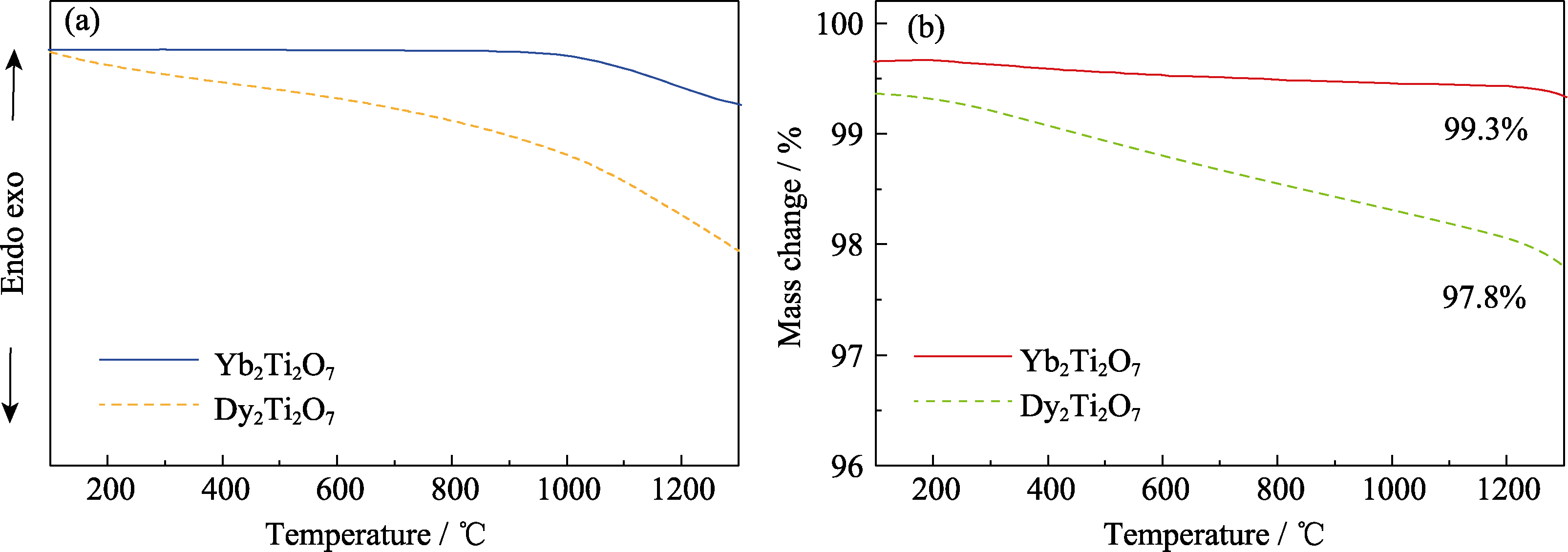
Fig. 1 (a) DSC and (b) TG curves of RE2Ti2O7 samples in the temperature range of 100-1300 ℃
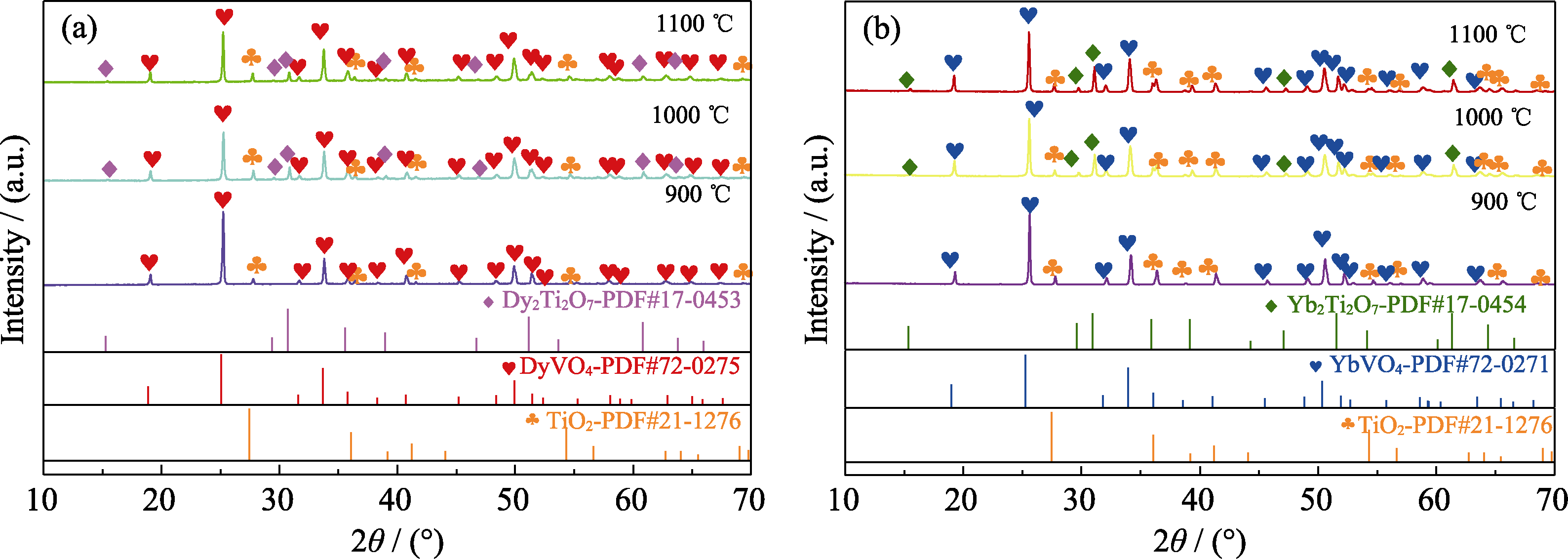
Fig. 2 XRD patterns of V2O5 salt and RE2Ti2O7 samples after 10 h exposure at 900, 1000, and 1100 ℃ (a) Dy2Ti2O7; (b) Yb2Ti2O7
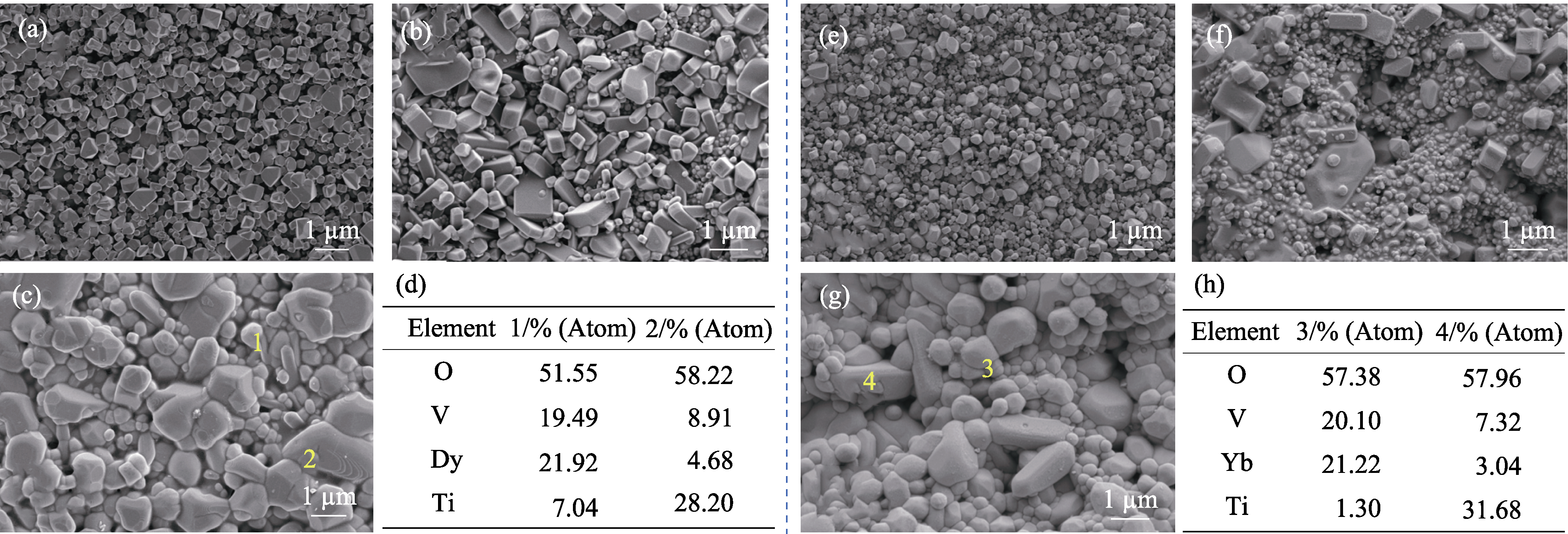
Fig. 3 (a-c, e-g) SEM images and corresponding (d, h) elemental distributions at marked points of RE2Ti2O7+V2O5 after 10 h exposure at 900, 1000, and 1100 ℃ (a-d) Dy2Ti2O7; (e-h) Yb2Ti2O7
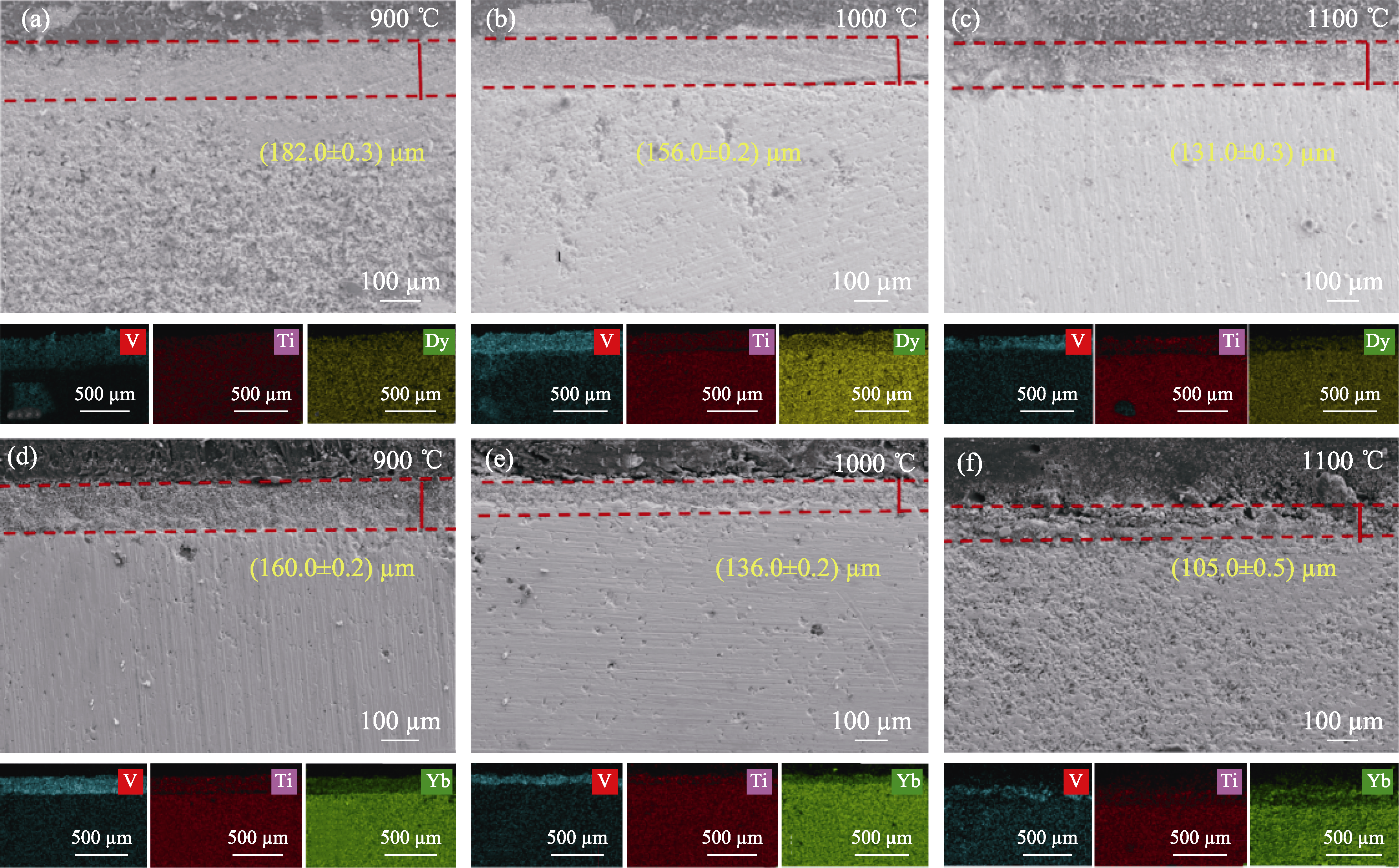
Fig. 4 SEM cross-sectional images of RE2Ti2O7+V2O5 after 10 h exposure at 900, 1000, and 1100 ℃ (a-c) Dy2Ti2O7; (d-f) Yb2Ti2O7
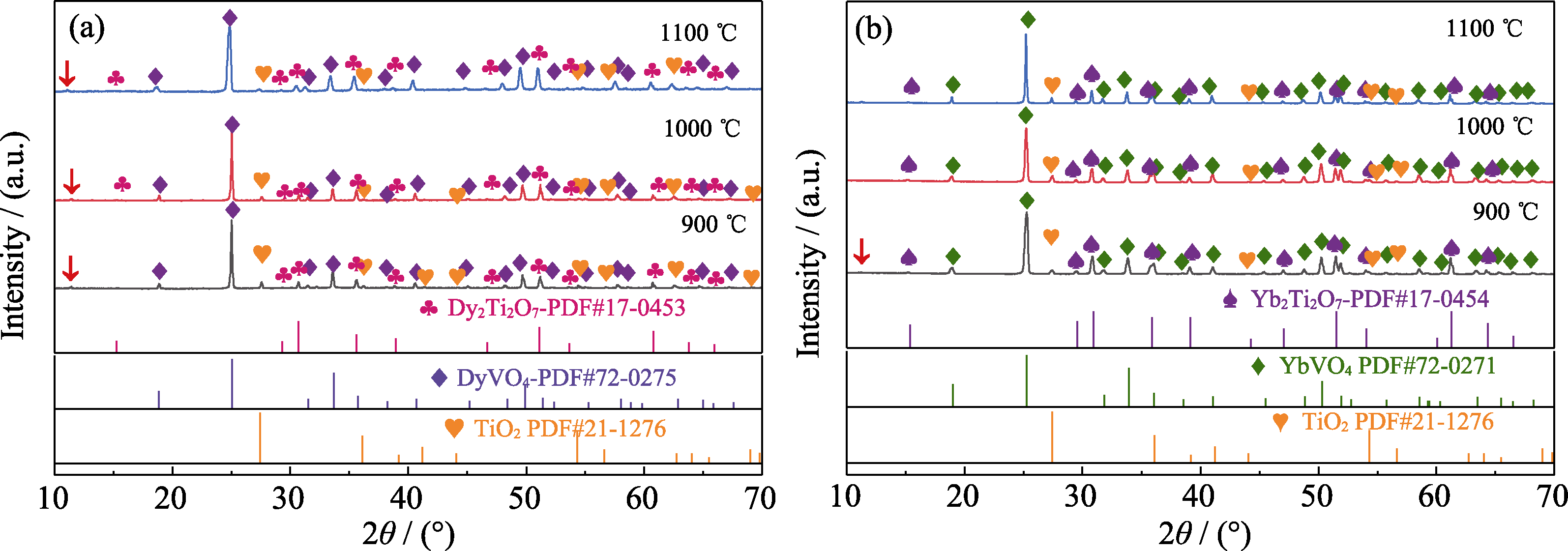
Fig. 5 XRD patterns of 50% Na2SO4 + 50% V2O5 and RE2Ti2O7 ceramics after 10 h exposure at different temperatures (a) Dy2Ti2O7; (b) Yb2Ti2O7
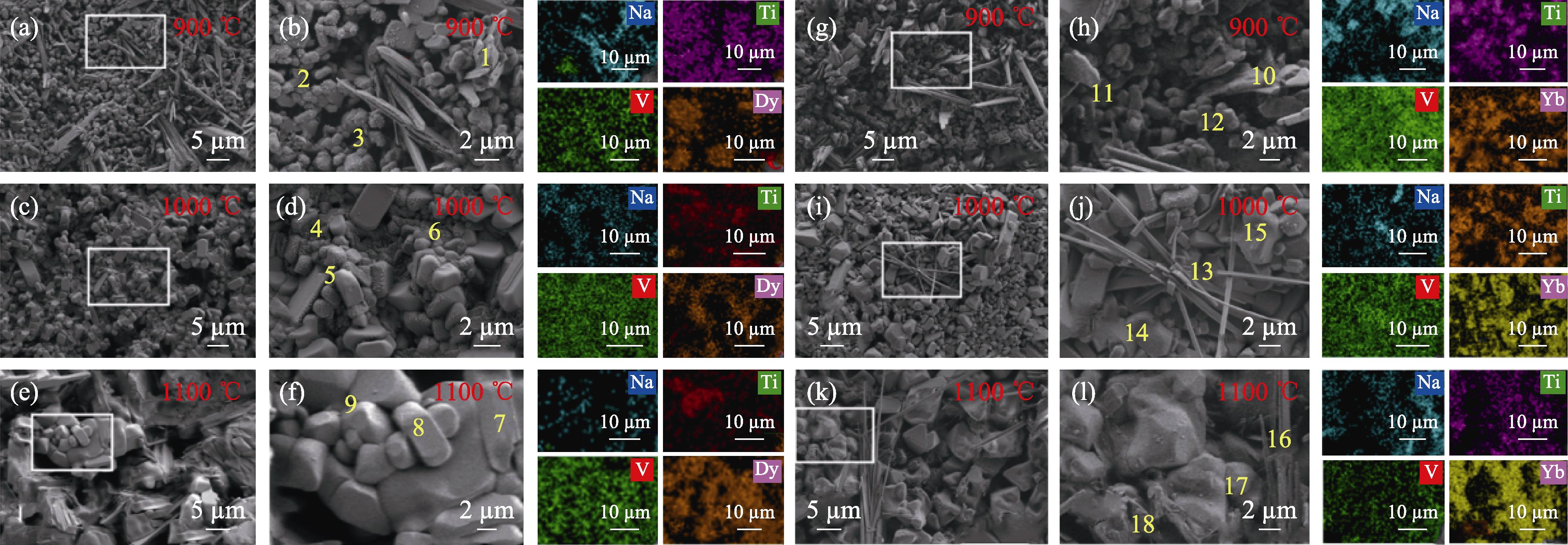
Fig. 6 (a-f) SEM images and elemental distributions of Dy2Ti2O7 reacting with 50% V2O5+50% Na2SO4 salt for 10 h at different temperatures; (g-l) SEM images and elemental distributions of Yb2Ti2O7 reacting with 50% V2O5+50% Na2SO4 salt for 10 h at different temperatures (a, b, g, h) 900 ℃; (c, d, i, j) 1000 ℃; (e, f, k, l) 1100 ℃
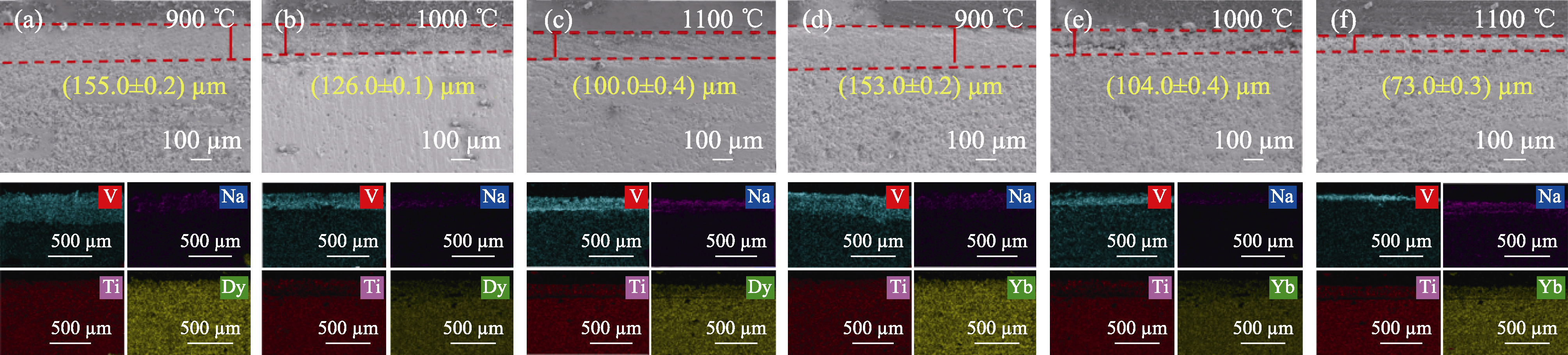
Fig. 7 SEM cross-sectional images and elemental distributions of RE2Ti2O7 and 50% Na2SO4+50% V2O5 reacted for 10 h at 900, 1000, and 1100 ℃ (a-c) Dy2Ti2O7; (d-f) Yb2Ti2O7
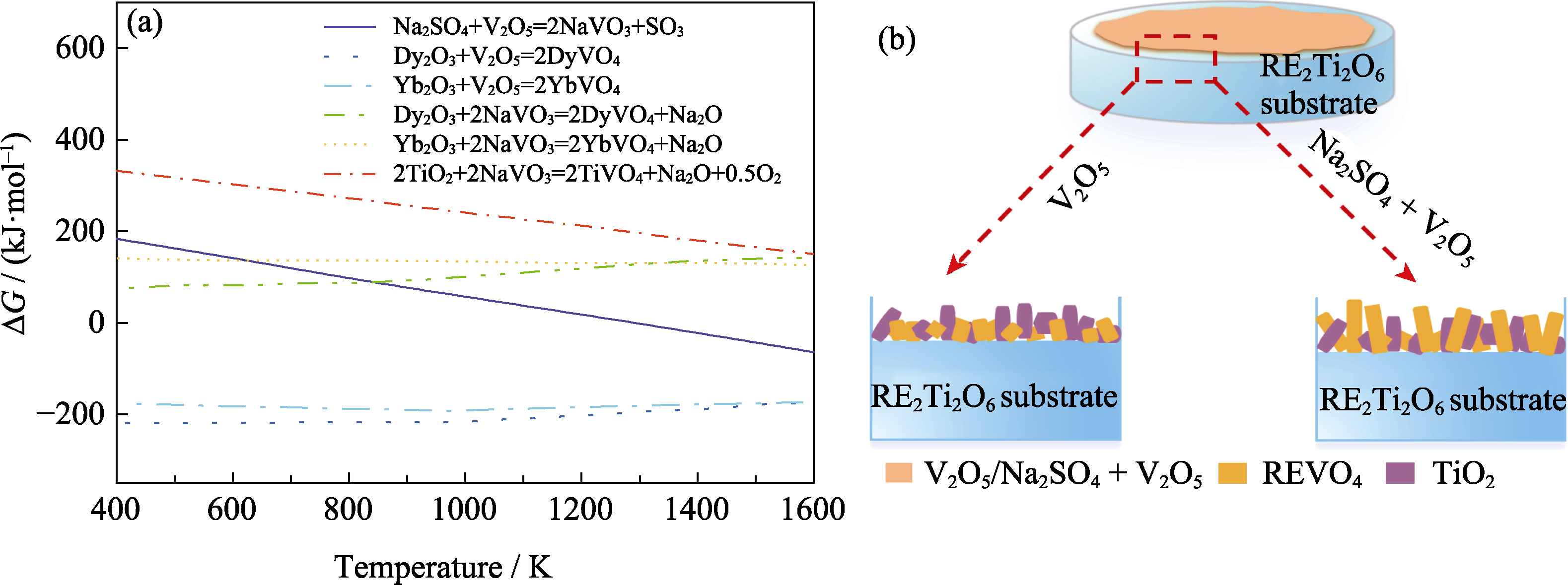
Fig. 8 (a) Gibbs free energy between various compounds; (b) Schematic diagram of the reaction between RE2Ti2O7 and V2O5/50% Na2SO4+50% V2O5
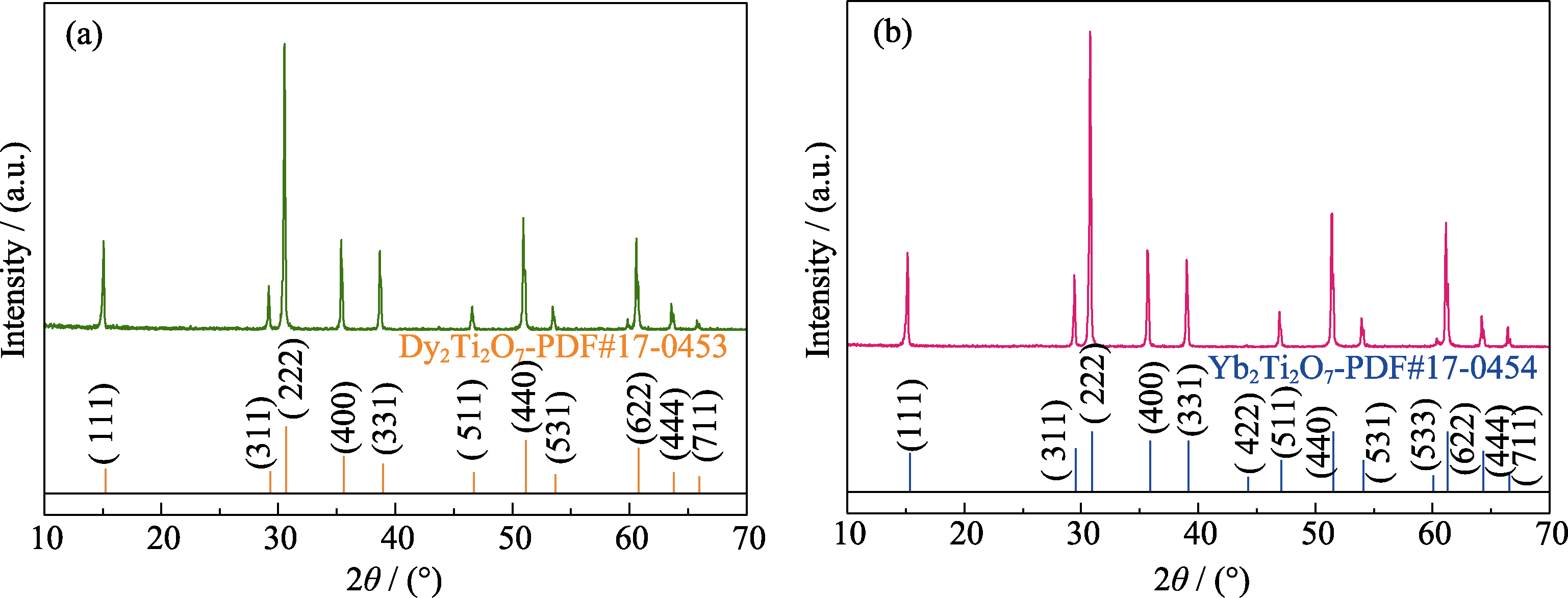
Fig. S1 XRD patterns of RE2Ti2O7 samples (a) Dy2Ti2O7; (b) Yb2Ti2O7
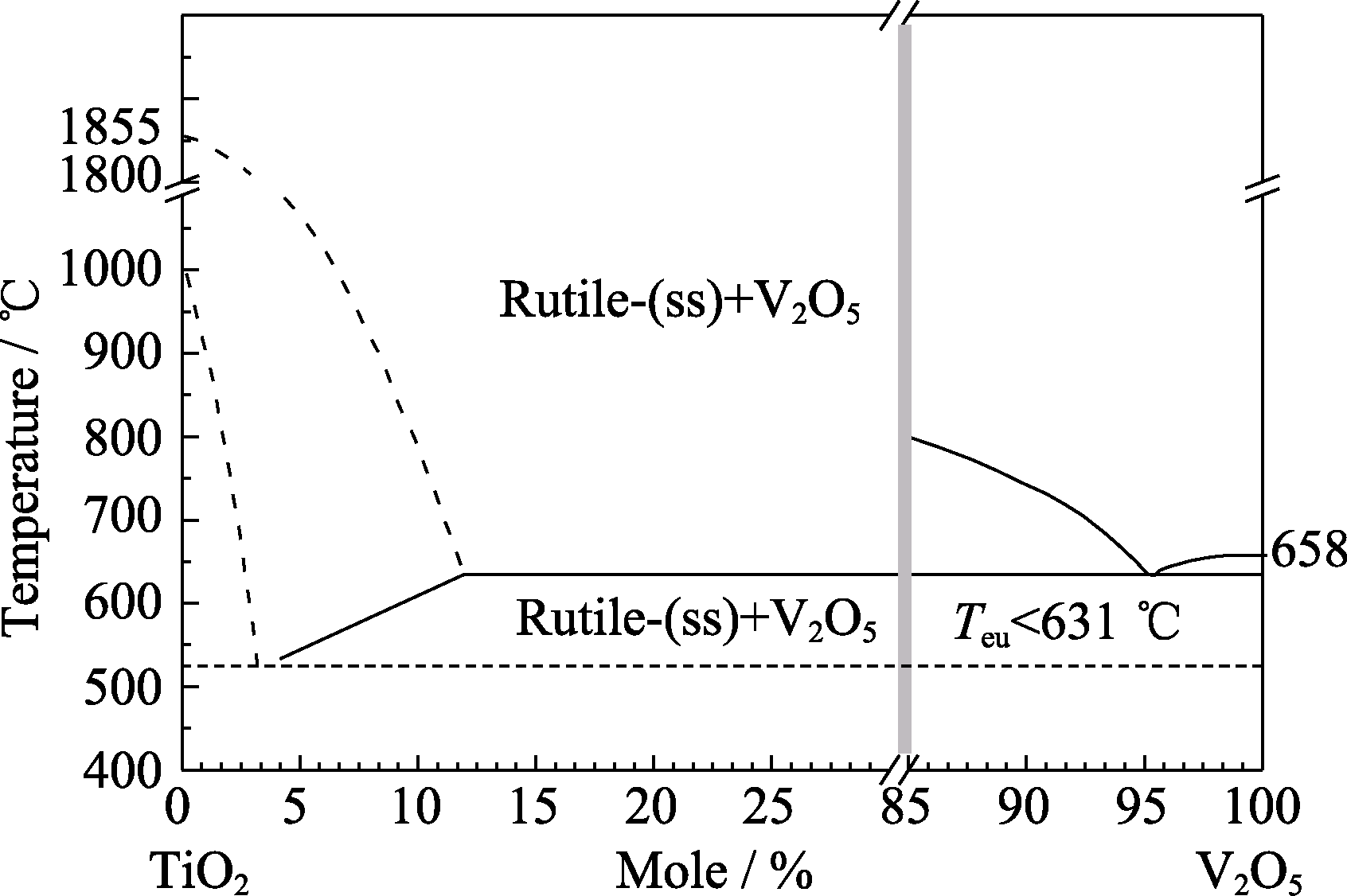
Fig. S2 Phase diagram of TiO2 and V2O5 at high temperatures[22]
| Temperature/℃ | Point | Product | Composition/(%, in atom) | |||||
|---|---|---|---|---|---|---|---|---|
| O | S | Na | V | Ti | Dy | |||
| 900 | 1 | Na salt | 57.16±0.15 | 0.36±0.05 | 24.12±0.11 | 13.56±0.05 | 4.65±0.12 | 0.15±0.01 |
| 2 | DyVO4 | 51.69±0.13 | 0.83±0.02 | 3.80±0.10 | 22.90±0.25 | 1.90±0.13 | 19.59±0.31 | |
| 3 | TiO2 | 57.65±0.16 | 0.68±0.04 | 8.69±0.10 | 1.91±0.11 | 30.85±0.28 | 0.23±0.08 | |
| 1000 | 4 | Na salt | 62.02±0.12 | 0.32±0.06 | 25.63±0.19 | 6.39±0.13 | 1.16±0.02 | 4.48±0.11 |
| 5 | DyVO4 | 59.64±0.11 | / | 1.70±0.02 | 20.71±0.14 | 0.79±0.06 | 17.15±0.12 | |
| 6 | TiO2 | 64.12±0.13 | 0.63±0.05 | 0.14±0.01 | 0.58±0.08 | 34.16±0.23 | 0.37±0.04 | |
| 1100 | 7 | Na salt | 62.02±0.14 | 0.41±0.07 | 23.18±0.25 | 7.48±0.11 | 3.46±0.09 | 3.45±0.11 |
| 8 | DyVO4 | 58.41±0.04 | 0.43±0.05 | / | 23.25±0.21 | 0.38±0.03 | 17.54±0.12 | |
| 9 | TiO2 | 52.49±0.05 | 0.20±0.01 | 0.29±0.01 | 1.99±0.03 | 33.45±0.25 | 1.16±0.04 | |
Table S1 Elemental mapping of SEM image marked points showing the reaction between Dy2Ti2O7 and 50% V2O5+50% Na2SO4 salt at different temperatures in Fig. 6(b, d, f)
| Temperature/℃ | Point | Product | Composition/(%, in atom) | |||||
|---|---|---|---|---|---|---|---|---|
| O | S | Na | V | Ti | Dy | |||
| 900 | 1 | Na salt | 57.16±0.15 | 0.36±0.05 | 24.12±0.11 | 13.56±0.05 | 4.65±0.12 | 0.15±0.01 |
| 2 | DyVO4 | 51.69±0.13 | 0.83±0.02 | 3.80±0.10 | 22.90±0.25 | 1.90±0.13 | 19.59±0.31 | |
| 3 | TiO2 | 57.65±0.16 | 0.68±0.04 | 8.69±0.10 | 1.91±0.11 | 30.85±0.28 | 0.23±0.08 | |
| 1000 | 4 | Na salt | 62.02±0.12 | 0.32±0.06 | 25.63±0.19 | 6.39±0.13 | 1.16±0.02 | 4.48±0.11 |
| 5 | DyVO4 | 59.64±0.11 | / | 1.70±0.02 | 20.71±0.14 | 0.79±0.06 | 17.15±0.12 | |
| 6 | TiO2 | 64.12±0.13 | 0.63±0.05 | 0.14±0.01 | 0.58±0.08 | 34.16±0.23 | 0.37±0.04 | |
| 1100 | 7 | Na salt | 62.02±0.14 | 0.41±0.07 | 23.18±0.25 | 7.48±0.11 | 3.46±0.09 | 3.45±0.11 |
| 8 | DyVO4 | 58.41±0.04 | 0.43±0.05 | / | 23.25±0.21 | 0.38±0.03 | 17.54±0.12 | |
| 9 | TiO2 | 52.49±0.05 | 0.20±0.01 | 0.29±0.01 | 1.99±0.03 | 33.45±0.25 | 1.16±0.04 | |
| Temperature/℃ | Point | Product | Composition/(%, in atom) | |||||
|---|---|---|---|---|---|---|---|---|
| O | S | Na | V | Ti | Yb | |||
| 900 | 10 | Na salt | 61.89±0.36 | 0.31±0.02 | 23.64±0.15 | 13.97±0.16 | 0.19±0.02 | / |
| 11 | YbVO4 | 56.97±0.23 | 0.52±0.08 | 1.16±0.15 | 24.50±0.14 | 0.80±0.05 | 16.05±0.15 | |
| 12 | TiO2 | 63.68±0.33 | 0.40±0.03 | 2.67±0.13 | 3.55±0.11 | 28.21±0.23 | 1.48±0.09 | |
| 1000 | 13 | Na salt | 59.42±0.35 | 0.89±0.07 | 17.24±0.14 | 16.05±0.22 | 2.23±0.09 | 4.17±0.14 |
| 14 | YbVO4 | 50.18±0.28 | 0.92±0.09 | 2.75±0.12 | 21.12±0.16 | 2.40±0.07 | 19.46±0.22 | |
| 15 | TiO2 | 63.11±0.31 | 0.69±0.04 | 2.59±0.08 | 3.57±0.10 | 28.24±0.24 | 1.84±0.21 | |
| 1100 | 16 | Na salt | 68.34±0.36 | 0.43±0.05 | 15.71±0.21 | 4.78±0.23 | 6.66±0.14 | 4.02±0.17 |
| 17 | YbVO4 | 69.69±0.38 | 0.65±0.01 | / | 14.91±0.18 | 0.69±0.03 | 14.06±0.20 | |
| 18 | TiO2 | 66.53±0.34 | 0.44±0.03 | 2.12±0.10 | 1.51±0.12 | 25.23±0.24 | 1.36±0.08 | |
Table S2 Elemental mapping of SEM image marked points showing the reaction between Yb2Ti2O7 and 50% V2O5+50% Na2SO4 salt at different temperatures in Fig. 6(h, j, l)
| Temperature/℃ | Point | Product | Composition/(%, in atom) | |||||
|---|---|---|---|---|---|---|---|---|
| O | S | Na | V | Ti | Yb | |||
| 900 | 10 | Na salt | 61.89±0.36 | 0.31±0.02 | 23.64±0.15 | 13.97±0.16 | 0.19±0.02 | / |
| 11 | YbVO4 | 56.97±0.23 | 0.52±0.08 | 1.16±0.15 | 24.50±0.14 | 0.80±0.05 | 16.05±0.15 | |
| 12 | TiO2 | 63.68±0.33 | 0.40±0.03 | 2.67±0.13 | 3.55±0.11 | 28.21±0.23 | 1.48±0.09 | |
| 1000 | 13 | Na salt | 59.42±0.35 | 0.89±0.07 | 17.24±0.14 | 16.05±0.22 | 2.23±0.09 | 4.17±0.14 |
| 14 | YbVO4 | 50.18±0.28 | 0.92±0.09 | 2.75±0.12 | 21.12±0.16 | 2.40±0.07 | 19.46±0.22 | |
| 15 | TiO2 | 63.11±0.31 | 0.69±0.04 | 2.59±0.08 | 3.57±0.10 | 28.24±0.24 | 1.84±0.21 | |
| 1100 | 16 | Na salt | 68.34±0.36 | 0.43±0.05 | 15.71±0.21 | 4.78±0.23 | 6.66±0.14 | 4.02±0.17 |
| 17 | YbVO4 | 69.69±0.38 | 0.65±0.01 | / | 14.91±0.18 | 0.69±0.03 | 14.06±0.20 | |
| 18 | TiO2 | 66.53±0.34 | 0.44±0.03 | 2.12±0.10 | 1.51±0.12 | 25.23±0.24 | 1.36±0.08 | |
| [1] |
GUO Y, SONG W, GUO L, et al. Molten-volcanic-ash-phobic thermal barrier coating based on biomimetic structure. Advanced Science, 2023, 10: 2205156.
DOI URL |
| [2] |
ZHOU Y, ZHOU Y, WU P, et al. Thermal properties of Y1-xMgxTaO4-x/2 ceramics via anion sublattice adjustment. Rare Metals, 2020, 39: 545.
DOI URL |
| [3] |
JIANG C, FENG M, YU C, et al. Thermal cycling behavior of nanostructured and conventional yttria-stabilized zirconia thermal barrier coatings via air plasma spray. Rare Metals, 2023, 42: 3859.
DOI URL |
| [4] |
FU S, JIA Z J, WAN D T, et al. Synthesis, microstructure and thermophysical properties of (La0.2Y0.2Sm0.2Eu0.2Gd0.2)2Zr2O7 high-entropy oxide ceramic. Ceramics International, 2024, 50: 5510.
DOI URL |
| [5] |
HUANG L, LIU M J, YANG G J, et al. Treelike PS-PVD coating: hierarchical branching by shading and sintering. Acta Materialia, 2024, 280: 120321.
DOI URL |
| [6] |
LI J, TONG Z, YANG Q, et al. Non-destructive evaluation of defects in thermal barrier coating system using combined electromagnetic and thermographic signals. Nature Communications, 2025, 16: 8697.
DOI |
| [7] |
HABIBI M H, GUO S M. The hot corrosion behavior of plasma sprayed zirconia coatings stabilized with yttria, ceria, and titania in sodium sulfate and vanadium oxide. Materials & Corrosion, 2015, 66: 270.
DOI URL |
| [8] |
FANG Y, CUI X, JIN G, et al. Microstructural evolution and hot corrosion behavior of La0.8Ba0.2TiO3-δYSZ double-layer thermal barrier coatings in Na2SO4 + V2O5 molten salt at 900 ℃. Surface and Coatings Technology, 2020, 399: 126175.
DOI URL |
| [9] | GUO L, YAN Z, YU J, et al.Hot corrosion behavior of TiO2 doped, Yb2O3 stabilized zirconia exposed to V2O5 + Na2SO4 molten salt at700-1000 ℃. Ceramics International, 2018, 44: 261. |
| [10] |
SINGH Y, KUMAR V, SHARMA S K, et al. Investigations of thermal conductivity in nano-crystalline Gd2Ti2O7 pyrochlore. Journal of Alloys and Compounds, 2024, 990: 174249.
DOI URL |
| [11] |
GAO Z, FU S, ZHANG L, et al. Thermodynamic characterization of RE2Ti2O7 (RE = Ho, Er, Tm and Yb) ceramics as thermal barrier coating materials. Materials Today Physics, 2025, 57: 101801.
DOI URL |
| [12] |
GAO Z, FU S, ZHANG X Y, et al. Investigation of the mechanical and thermal properties of RE2Ti2O7 (RE = Y, Dy, Sm) ceramics with a pyrochlore structure. Journal of the European Ceramic Society. 2025, 45: 117661.
DOI URL |
| [13] |
GAO Z, FU S, ZHANG L, et al. Study on CMAS corrosion resistance and wettability of rare-earth titanate ceramics at 1350 ℃. Applied Materials Today, 2026, 48: 103041.
DOI URL |
| [14] |
TAN Z Y, PAN T T, NIE M, et al. Exceptional hot corrosion resistance behavior and mechanism of double layered Zr6Ta2O17/ YSZ thermal barrier coatings exposed to Na2SO4-V2O5 salt. Corrosion Science, 2025, 246: 112761.
DOI URL |
| [15] |
WANG J, WANG Y, CHEN M, et al. Degradation of CeO2 and TiO2 co-stabilized ZrO2 by the V2O5 molten salts and Na2SO4 + V2O5 molten salts. Surface and Coatings Technology, 2022, 437: 128352.
DOI URL |
| [16] |
DONG H, REN Y, WANG D, et al. Hot corrosion behaviors of SrZrO3 ceramic co-doped with Y2O3 and Yb2O3 in molten Na2SO4, V2O5, and Na2SO4+V2O5 salts mixture. Journal of the European Ceramic Society, 2014, 34: 3917.
DOI URL |
| [17] |
GU S, ZHANG S, JIA Y, et al. Evaluation of hot corrosion behavior of SrHfO3 ceramic in the presence of molten sulfate and vanadate salt. Journal of Alloys and Compounds, 2017, 728: 10.
DOI URL |
| [18] |
WANG J, CHEN L, CHEN M, et al. Phase and microstructure evolution of Sc2O3-CeO2-ZrO2 ceramics in Na2SO4+V2O5 molten salts. Ceramics International, 2021, 47: 22965.
DOI URL |
| [19] |
SINGH P, PANDIT N, KESHRI A K. Plasma-sprayed GNP/CNT reinforced lanthanum-cerate coatings: hot corrosion assessment in Na2SO4-V2O5 environment. Surface and Coatings Technology, 2024, 481: 130676.
DOI URL |
| [20] |
YOKOKAWA H, SAKAI N, KAWADA T, et al. Chemical potential diagrams for rare earth-transition metal-oxygen systems: I, Ln-V-O and Ln-Mn-O System. Journal of the American Ceramic Society, 1990, 73: 649.
DOI URL |
| [21] |
LI S, LIU Z G, OUYANG J H. Growth of YbVO4 crystals evolved from hot corrosion reactions of Yb2Zr2O7 against V2O5 and Na2SO4+V2O5. Applied Surface Science, 2013, 276: 653.
DOI URL |
| [22] |
HABEL D, GOERKE O, TOVAR M, et al. Phase relations in the system TiO2-V2Ox under oxidizing and reducing conditions. Journal of Phase Equilibria and Diffusion, 2008, 29: 482.
DOI URL |
| [23] |
CAI J, WEI J, ZU Z, et al. Comparative hot corrosion performance of arc ion plated NiCoCrAlYSiHf coating in Na2SO4/NaCl/V2O5- media via high-current pulsed electron beam. Materials Characterization, 2022, 191: 112074.
DOI URL |
| [24] |
LI Z, LI X, ZHAO S, et al. Degradation of atmospheric plasma sprayed Gd4Al2O9 coating attacked by molten Na2SO4+V2O5 salt mixture at 700-950 ℃. Ceramics International, 2024, 50: 12701.
DOI URL |
| [25] |
GUO L, ZHANG C, HE Q, et al. Corrosion products evolution and hot corrosion mechanisms of REPO4 (RE= Gd, Nd, La) in the presence of V2O5 + Na2SO4 molten salt. Journal of the European Ceramic Society, 2019, 39: 1496.
DOI URL |
| [26] |
VENU D M, SREEDHAR G. Role of low-K Gd2Ti2O7 addition on the oxidation and hot corrosion behavior of DySZ thermal barrier coatings. Journal of Alloys and Compounds, 2025, 1049: 185231.
DOI URL |
| [27] |
LI Y, SUN Z, HE L, et al. Thermal corrosion behavior of Yb4Hf3O12 exposed to Na2SO4+V2O5 molten salt. Journal of Alloys and Compounds, 2024, 1008: 176501.
DOI URL |
| [28] |
YIN Q, SHEN K H, WANG Y, et al. Research progress of rare earth zirconate thermal barrier coating ceramic materials. Materials Today Communications, 2025, 42: 111579.
DOI URL |
| [29] |
SONG D, SONG T, PAIK U, et al. Hot corrosion behavior in thermal barrier coatings with heterogeneous splat boundary. Corrosion Science, 2020, 163: 108225.
DOI URL |
| [30] |
LI B, WU J, HE X, et al. Sc-doped Gd2Zr2O7 coating on YSZ thermal barrier coatings to resist CMAS + molten salt attack. Ceramics International, 2022, 48: 11662.
DOI URL |
| [31] | LANG N A. Lange’s handbook of chemistry. 16th ed. New York: McGraw-Hill Education, 2013. |
| [32] |
KIM J, SONG D, LU G, et al. Hot corrosion behavior of Yb2O3-Gd2O3-Y2O3 co-stabilized zirconia-based thermal barrier coatings covered with a Lewis neutral layer. Surface and Coatings Technology, 2021, 428: 127911.
DOI URL |
| [33] |
SHAMSIPOOR A, FARVIZI M, RAZAVI M, et al. Hot corrosion behavior of thermal barrier coating on Cr2AlC and CoNiCrAlY substrates at 950 ℃ in presence of Na2SO4+V2O5 molten salts. Surfaces and Interfaces, 2020, 21: 100679.
DOI URL |
| [1] | 许茗奕, 熊瑛, 王博, 张艺馨, 陈文博, 曹学强. 磁铅石型稀土六铝酸盐热障涂层材料的制备与性能[J]. 无机材料学报, 2026, 41(8): 1103-1109. |
| [2] | 王俊卜, 黄泽皑, 杨茗凯, 蒙颖, 周明炜, 周莹. 甲烷转化用抗积碳催化材料研究进展[J]. 无机材料学报, 2026, 41(6): 739-750. |
| [3] | 王禹贺, 罗颐秀, 郭会明, 张广珩, 张思岩, 孙鲁超, 王杰民, 王京阳. 高熵稀土氧化物热障涂层材料弹性及热物性的第一性原理研究[J]. 无机材料学报, 2026, 41(4): 445-454. |
| [4] | 邬博宇, 张深根, 张生杨, 刘波, 张柏林. CeO2对MnOx催化剂低温脱硝性能的影响及其机理研究[J]. 无机材料学报, 2026, 41(1): 87-95. |
| [5] | 刘江平, 管鑫, 唐振杰, 朱文杰, 罗永明. 含氮挥发性有机化合物催化氧化的研究进展[J]. 无机材料学报, 2025, 40(9): 933-943. |
| [6] | 张瑞阳, 王壹, 欧博文, 周莹. α-Ni(OH)2表面羟基协同Ni3+位点催化氧化甲醛机理研究[J]. 无机材料学报, 2023, 38(10): 1216-1222. |
| [7] | 安文然, 黄晶琪, 卢祥荣, 蒋佳宁, 邓龙辉, 曹学强. 热处理温度对LaMgAl11O19涂层热/力学性能的影响[J]. 无机材料学报, 2022, 37(9): 925-932. |
| [8] | 蔚海浪, 曹学强, 邓龙辉, 蒋佳宁. LaMeAl11O19/YSZ热障涂层热力学性能和热循环寿命[J]. 无机材料学报, 2022, 37(12): 1259-1266. |
| [9] | 高娃, 熊宇杰, 吴聪萍, 周勇, 邹志刚. 基于超薄纳米结构的光催化二氧化碳选择性转化[J]. 无机材料学报, 2022, 37(1): 3-14. |
| [10] | 郑燕宁, 季军荣, 梁雪玲, 赖正杰, 陈启帆, 廖丹葵. 氮掺杂中空碳球氧化物模拟酶性能研究[J]. 无机材料学报, 2021, 36(5): 527-534. |
| [11] | 朱嘉桐, 楼志豪, 张萍, 赵佳, 孟轩宇, 许杰, 高峰. 稀土钽酸盐(RETaO4)高熵陶瓷的制备与热学性能研究[J]. 无机材料学报, 2021, 36(4): 411-417. |
| [12] | 桑玮玮, 张红松, 陈华辉, 温斌, 李新春. (Sm0.2Gd0.2Dy0.2Y0.2Yb0.2)3TaO7高熵陶瓷的制备及热物理性能[J]. 无机材料学报, 2021, 36(4): 405-410. |
| [13] | 冀晓鹃,于月光,卢晓亮. 杂质对氧化锆热障涂层性能的影响[J]. 无机材料学报, 2020, 35(6): 669-674. |
| [14] | 许云青,王海增. EDTA辅助水热法制备不同形貌的氟化镁钠[J]. 无机材料学报, 2019, 34(9): 933-937. |
| [15] | 马伯乐, 马文, 黄威, 白玉, 贾瑞灵, 董红英. 单相双稀土改性SrZrO3热障涂层的热物理性能[J]. 无机材料学报, 2019, 34(4): 394-400. |
| 阅读次数 | ||||||
|
全文 |
|
|||||
|
摘要 |
|
|||||