无机材料学报 ›› 2026, Vol. 41 ›› Issue (11): 1711-1722.DOI: 10.15541/jim20260068
于谨硕1,2( ), 黄健3(), 杨义1, 杨群2, 王一丹2, 王亮2()
收稿日期:2026-02-09
修回日期:2026-03-25
出版日期:2026-05-19
网络出版日期:2026-05-19
通讯作者:
王 亮, 研究员. E-mail: L.Wang@mail.sic.ac.cn;作者简介:于谨硕(1999-), 女, 硕士研究生. E-mail: jinshuoyu_siccas@126.com
YU Jinshuo1,2(), HUANG Jian3(), YANG Yi1, YANG Qun2, WANG Yidan2, WANG Liang2()
Received:2026-02-09
Revised:2026-03-25
Published:2026-05-19
Online:2026-05-19
Contact:
WANG Liang, professor. E-mail: L.Wang@mail.sic.ac.cn;About author:YU Jinshuo (1999-), female, Master candidate. E-mail: jinshuoyu_siccas@126.com
Supported by:摘要:
固体电解质界面(SEI)的组成与微结构高度依赖电解液组成结构及其与无机相表面的相互作用, 但分子层面非共价相互作用(NCI)对SEI构筑规律仍缺乏统一认识。本研究基于密度泛函理论(DFT)计算和约化密度梯度(RDG)的非共价相互作用(NCI)分析方法, 系统分析了18种典型溶剂/添加剂分子及其在Li2CO3(001)、Li2O(111)、LiF(001)、LiOH(001)四类无机SEI表面的吸附体系, 结合RDG散点图、差分电荷密度与Bader电荷定量解析界面相互作用与电子重排。结果表明, 环状碳酸酯及磺酰基/磺内酯基团表现出强烈的定向吸引作用; 而链状碳酸酯则以弱范德瓦耳斯力为主导, 从而具有更高的结构柔性。Li2O表面对含氧(O)或含硫(S)的极性分子表现出最强的界面极化效应。Bader电荷分析显示, 体系的净电荷转移量(∆Q)介于0.440e~0.798e之间。具体而言, 亚硫酸乙烯酯和4,5-二甲基-1,3-二氧杂环戊烯-2-酮在Li2O表面上的电荷转移量最高(分别为0.796e和0.798e); 而碳酸二甲酯和碳酸丙烯酯在Li2CO3表面上的电荷转移量则显著较低(分别为0.440e和0.479e)。LiF表面的整体吸附作用较弱, 但与含氟分子(如氟代碳酸乙烯酯LiF体系, 为0.672e)表现出较高的相容性; 同时, LiOH表面则表现出中等程度的极化作用(0.618e~0.679e)。极性添加剂与稳定无机相(Li2O、LiF)之间强烈的定向非共价相互作用, 为致密且稳定的SEI结构提供了微观基础; 而链状碳酸酯则主要发挥促进界面润湿和缓冲应力的作用。本工作阐明了电解液与SEI的相容性机制, 为设计富含无机组分的SEI膜提供了理论指导。本研究数据集可通过
中图分类号:
于谨硕, 黄健, 杨义, 杨群, 王一丹, 王亮. 固态电解质界面非共价相互作用机制研究[J]. 无机材料学报, 2026, 41(11): 1711-1722.
YU Jinshuo, HUANG Jian, YANG Yi, YANG Qun, WANG Yidan, WANG Liang. Insights into Noncovalent Interaction Mechanisms within Solid Electrolyte Interfaces[J]. Journal of Inorganic Materials, 2026, 41(11): 1711-1722.
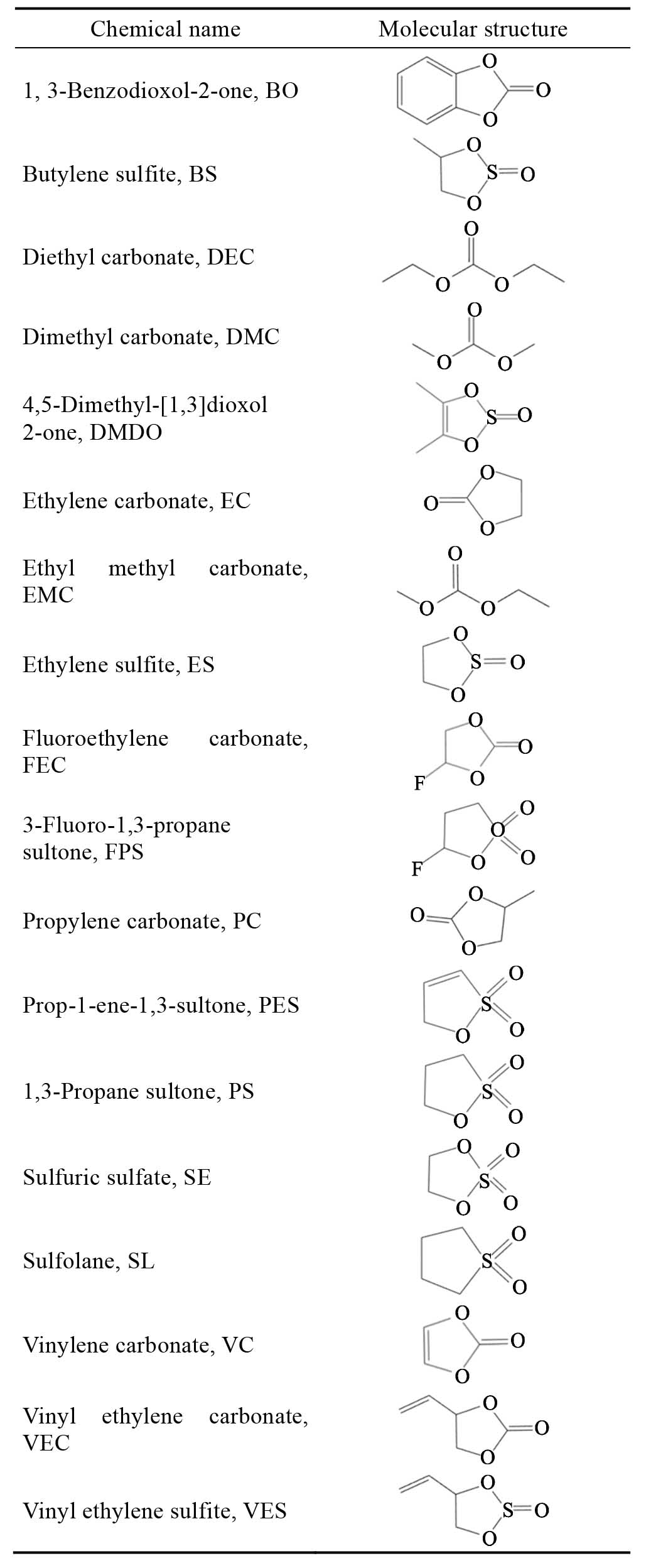 |
Table 1 Electrolyte solvent/additive molecules and their molecular structures
| |
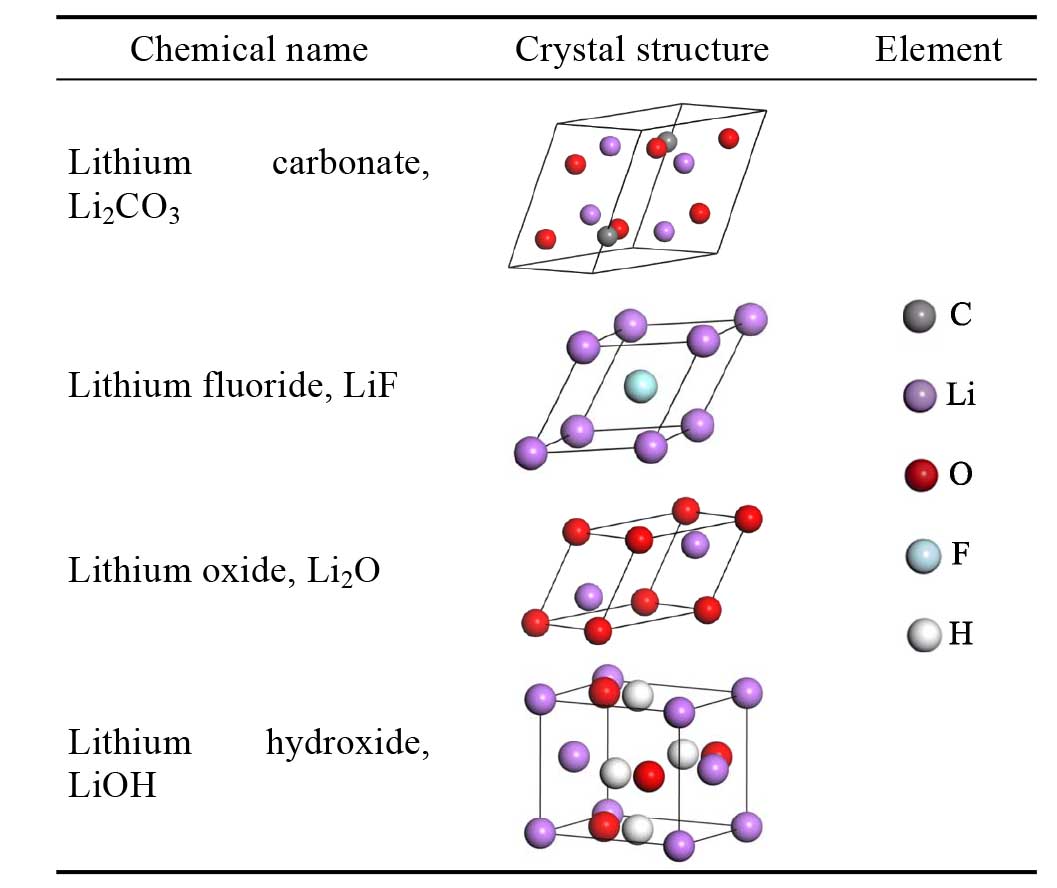 |
Table 2 Representative inorganic SEI components and their crystal structures
| |
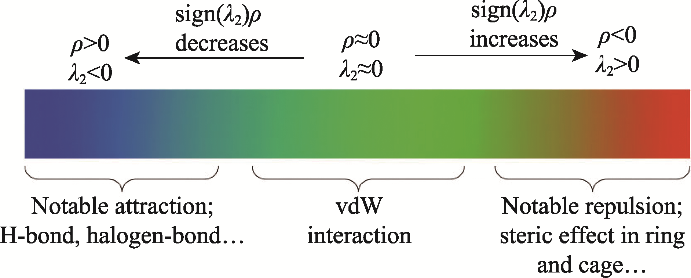
Fig. 1 Color scale for RDG-sign(λ2)ρ[48] Blue: notable attraction; Green: vdW interaction; Red: repulsive interaction. Colorful figure is available on website
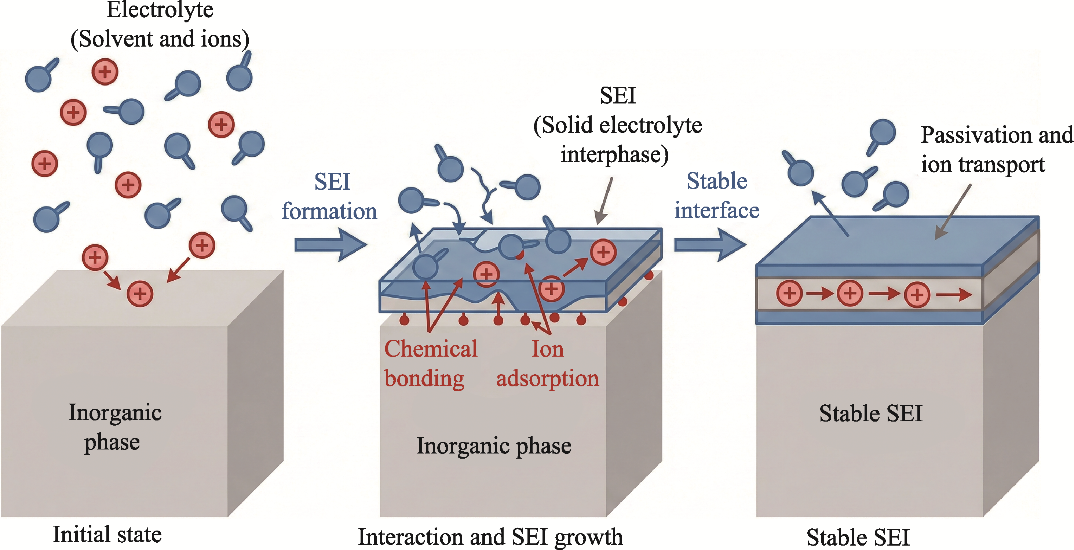
Fig. 2 Schematic illustration of the interaction between electrolyte components and inorganic phase surfaces, and the subsequent dynamic evolution into a stable SEI layer
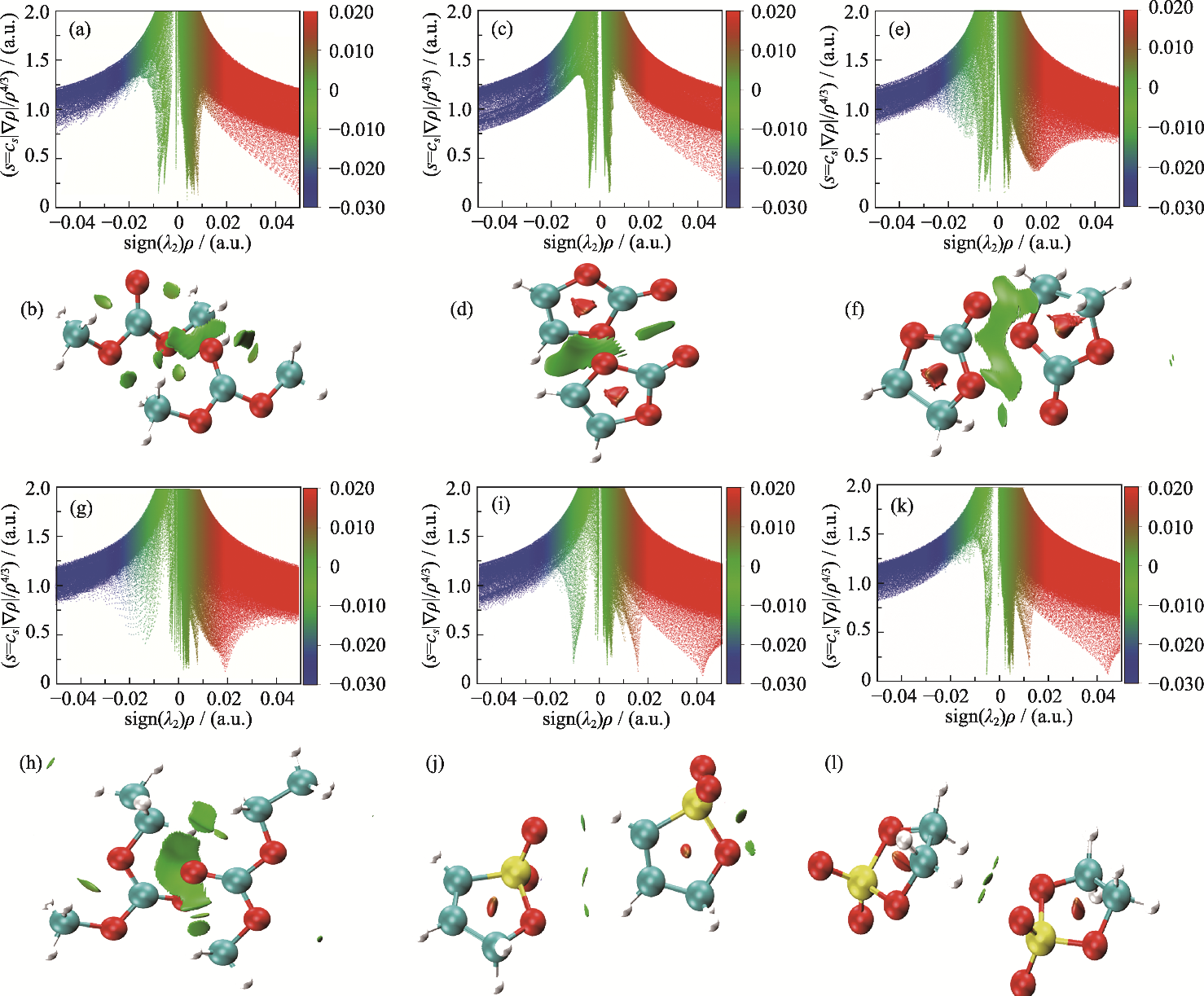
Fig. 3 NCI analysis of representative electrolyte molecules (EC, VC, DMC, EMC, PES and SE) RDG plots for (a) EC, (c) VC, (e) DMC, (g) EMC, (i) PES and (k) SE; NCI isosurfaces for (b) EC, (d) VC, (f) DMC, (h) EMC, (j) PES and (l) SE; RDG isovalue=0.5; Red: O; Yellow: S; White: H; Blue: C. Colorful figures are available on website
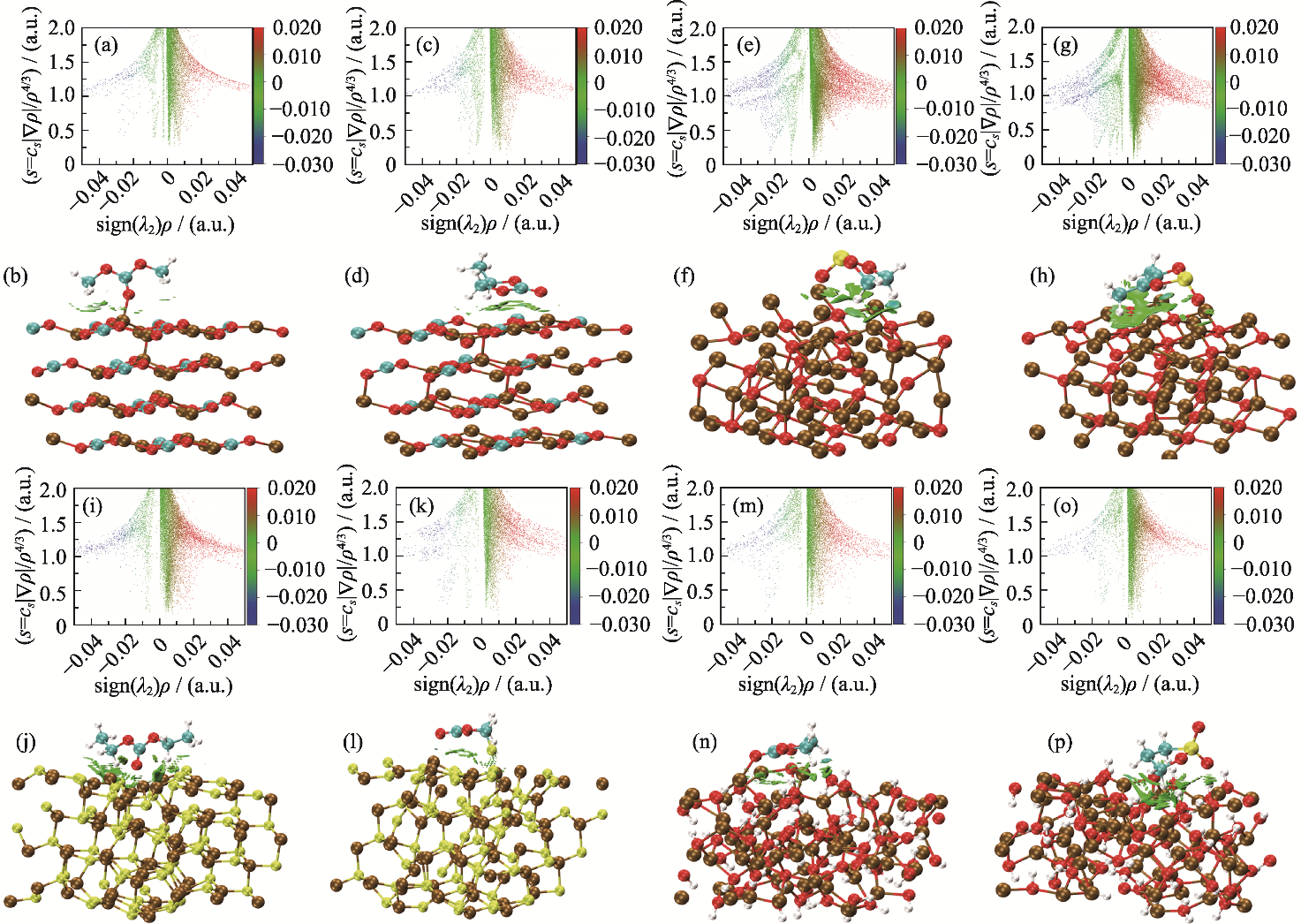
Fig. 4 NC-RDG analysis of representative electrolyte molecules adsorbed on typical inorganic SEI surfaces RDG plots for (a) DMC-Li2CO3(001), (c) PC-Li2CO3(001), (e) ES-Li2O(111), and (g) DMDO-Li2O(111); NCI isosurfaces for (b) DMC-Li2CO3(001), (d) PC-Li2CO3(001), (f) ES-Li2O(111), and (h) DMDO-Li2O(111); RDG plots for (i) DEC-LiF(001), (k) FEC-LiF(001), (m) EC-LiOH(001), and (o) PS-LiOH(001); NCI isosurfaces for (j) DEC-LiF(001), (l) FEC-LiF(001), (n) EC-LiOH(001), and (p) PS-LiOH(001); RDG isovalue=0.5; Red: O; Blue: C; Brown: Li; Yellow: S; White: H. Colorful figures are available on website
| System | DEC-LiF | DMDO-Li2O | DMC-Li2CO3 | PC-Li2CO3 | ES-Li2O | EC-LiOH | FEC-LiF | PS-LIOH |
|---|---|---|---|---|---|---|---|---|
| ∆Q | 0.536e | 0.798e | 0.440e | 0.479e | 0.796e | 0.618e | 0.672e | 0.679e |
Table 3 Net interfacial Bader charge transfer (ΔQ) for electrolyte molecules adsorbed on inorganic SEI surfaces
| System | DEC-LiF | DMDO-Li2O | DMC-Li2CO3 | PC-Li2CO3 | ES-Li2O | EC-LiOH | FEC-LiF | PS-LIOH |
|---|---|---|---|---|---|---|---|---|
| ∆Q | 0.536e | 0.798e | 0.440e | 0.479e | 0.796e | 0.618e | 0.672e | 0.679e |
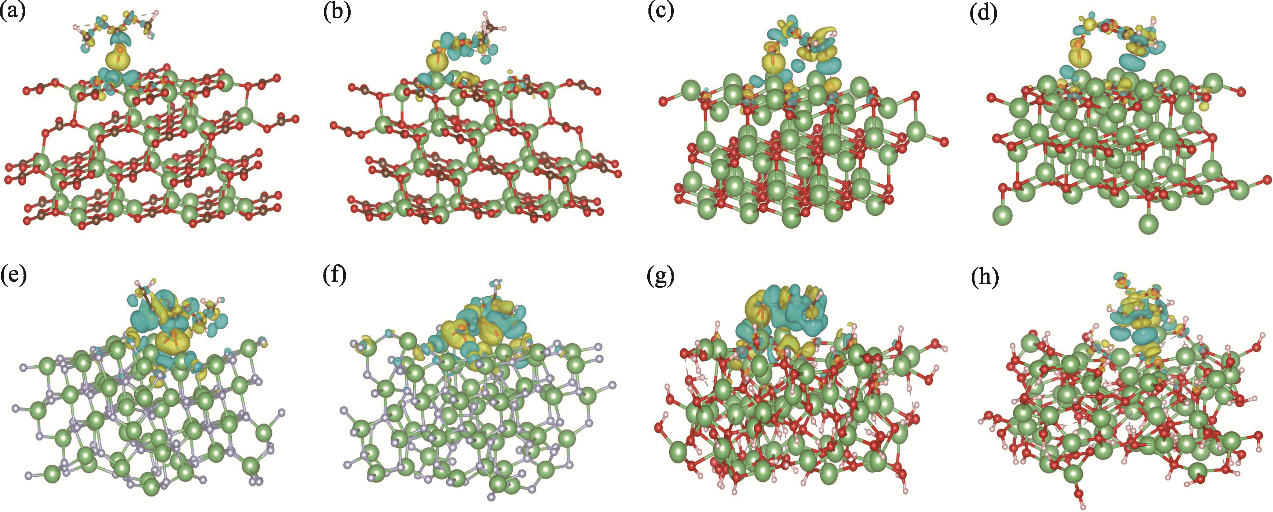
Fig. 5 Charge density difference analysis of electrolyte molecules adsorbed on typical inorganic SEI components (a) Li2CO3-DMC; (b) Li2CO3-PC; (c) Li2O-ES; (d) Li2O-DMDO; (e) LiF-DEC; (f) LiF-FEC; (g) LiOH-EC; (h) LiOH-PS; Isosurface level=0.009 e/Å; Yellow and cyan indicate electron accumulation and depletion, respectively. Colorful figures are available on website
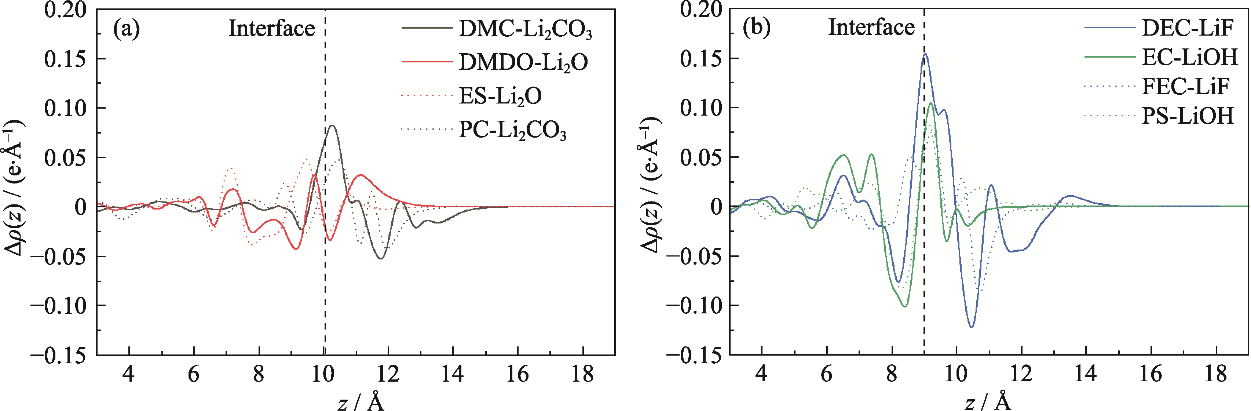
Fig. 6 Planar-averaged differential charge density (∆ρ(z)) along the z direction for the adsorption systems (a) DMC-Li2CO3(001), PC-Li2CO3(001), ES-Li2O(111) and DMDO-Li2O(111); (b) DEC-LiF(001), FEC-LiF(001), EC-LiOH(001) and PS-LiOH(001); Positive and negative values indicate electron accumulation and depletion, respectively. Colorful figures are available on website
| [1] | TARASCON J M, ARMAND M. Issues and challenges facing rechargeable lithium batteries. Nature, 2001, 414(6861):359. |
| [2] | ZU C X, LI H. Thermodynamic analysis on energy densities of batteries. Energy & Environmental Science, 2011, 4(8):2614. |
| [3] | GOODENOUGH J B, PARK K S. The Li-ion rechargeable battery: a perspective. Journal of the American Chemical Society, 2013, 135(4):1167. |
| [4] | WINTER M. The solid electrolyte interphase-the most important and the least understood solid electrolyte in rechargeable Li batteries. Zeitschrift für Physikalische Chemie, 2009, 223(10/11):1395. |
| [5] | LIU G, TIAN J, WAN J, et al. Revealing the high salt concentration manipulated evolution mechanism on the lithium anode in quasi-solid-state lithium-sulfur batteries. Angewandte Chemie International Edition, 2022, 61(52):e202212744. |
| [6] | ZHANG J, LIU G, ZHAI P, et al. Stabilizing the interface of Li1.3Al0.3Ti1.7(PO4)3 and lithium electrodes via an interlayer strategy in solid-state batteries. Chemical Communications, 2025, 61(14):2949. |
| [7] | PELED E, MENKIN S. Review-SEI: past, present and future. Journal of the Electrochemical Society, 2017, 164(7):A1703. |
| [8] | SU C, HE M, SHI J, et al. Solvation rule for solid-electrolyte interphase enabler in lithium-metal batteries. Angewandte Chemie International Edition, 2020, 59(41):18229. |
| [9] | LIU L, XIE F, LYU J, et al. Tin-based anode materials with well-designed architectures for next-generation lithium-ion batteries. Journal of Power Sources, 2016, 321: 11. |
| [10] | TIKEKAR M D, CHOUDHURY S, TU Z, et al. Design principles for electrolytes and interfaces for stable lithium-metal batteries. Nature Energy, 2016, 1(9):16114. |
| [11] | ZHAO Z, YE W, ZHANG F, et al. Revealing the effect of LiOH on forming a SEI using a Co magnetic “probe”. Chemical Science, 2023, 14(43):12219. |
| [12] | FAN X, JI X, HAN F, et al. Fluorinated solid electrolyte interphase enables highly reversible solid-state Li metal battery. Science Advances, 2018, 4(12):eaau9245. |
| [13] | YAN C, YAO Y, CHEN X, et al. Lithium nitrate solvation chemistry in carbonate electrolyte sustains high-voltage lithium metal batteries. Angewandte Chemie International Edition, 2018, 57(43):14055. |
| [14] | FANG C, LI J, ZHANG M, et al. Quantifying inactive lithium in lithium metal batteries. Nature, 2019, 572(7770):511. |
| [15] | ZHANG X, CHENG X, CHEN X, et al. Fluoroethylene carbonate additives to render uniform Li deposits in lithium metal batteries. Advanced Functional Materials, 2017, 27(10):1605989. |
| [16] | CHENG X, ZHANG R, ZHAO C, et al. A review of solid electrolyte interphases on lithium metal anode. Advanced Science, 2016, 3(3):1500213. |
| [17] | SHIN H, PARK J, HAN S, et al. Component-/structure-dependent elasticity of solid electrolyte interphase layer in Li-ion batteries: experimental and computational studies. Journal of Power Sources, 2015, 277: 169. |
| [18] | HOBOLD G M, WANG C, STEINBERG K, et al. High lithium oxide prevalence in the lithium solid-electrolyte interphase for high Coulombic efficiency. Nature Energy, 2024, 9(5):580. |
| [19] | ALVARADO J, SCHROEDER M A, ZHANG M, et al. A carbonate-free, sulfone-based electrolyte for high-voltage Li-ion batteries. Materials Today, 2018, 21(4):341. |
| [20] | ZHAO Y, ZHOU T, ASHIROV T, et al. Fluorinated ether electrolyte with controlled solvation structure for high voltage lithium metal batteries. Nature Communications, 2022, 13: 2575. |
| [21] | HUAI L, CHEN Z, LI J. Degradation mechanism of dimethyl carbonate (DMC) dissociation on the LiCoO2 cathode surface: a first-principles study. ACS Applied Materials & Interfaces, 2017, 9(41):36377. |
| [22] | BRENNAN M D, BREEDON M, BEST A S, et al. Surface reactions of ethylene carbonate and propylene carbonate on the Li(001) surface. Electrochimica Acta, 2017, 243: 320. |
| [23] | CHEN X, LI X, MEI D, et al. Reduction mechanism of fluoroethylene carbonate for stable solid-electrolyte interphase film on silicon anode. ChemSusChem, 2014, 7(2):549. |
| [24] | OTERO-DE-LA-ROZA A, JOHNSON E R, CONTRERAS-GARCÍA J. Revealing non-covalent interactions in solids: NCI plots revisited. Physical Chemistry Chemical Physics, 2012, 14(35):12165. |
| [25] | JOHNSON E R, KEINAN S, MORI-SÁNCHEZ P, et al. Revealing noncovalent interactions. Journal of the American Chemical Society, 2010, 132(18):6498. |
| [26] | VAN EKEREN W W A, ALBUQUERQUE M, EK G, et al. A comparative analysis of the influence of hydrofluoroethers as diluents on solvation structure and electrochemical performance in non-flammable electrolytes. Journal of Materials Chemistry A, 2023, 11(8):4111. |
| [27] | HOU T, WANG D, JIANG B, et al. Ion bridging enables high-voltage polyether electrolytes for quasi-solid-state batteries. Nature Communications, 2025, 16: 962. |
| [28] | GRIMME S, ANTONY J, EHRLICH S, et al. A consistent and accurate ab initio parametrization of density functional dispersion correction (DFT-D) for the 94 elements H-Pu. The Journal of Chemical Physics, 2010, 132(15):154104. |
| [29] | KRESSE G, FURTHMÜLLER J. Efficiency of ab-initio total energy calculations for metals and semiconductors using a plane-wave basis set. Computational Materials Science, 1996, 6(1):15. |
| [30] | MONKHORST H J, PACK J D.Special points for Brillouin-zone integrations. Physical Review B, 1976, 13(12):5188. |
| [31] | OTERO-DE-LA-ROZA A, JOHNSON E R, LUAÑA V. Critic2: a program for real-space analysis of quantum chemical interactions in solids. Computer Physics Communications, 2014, 185(3):1007. |
| [32] | CONTRERAS-GARCÍA J, JOHNSON E R, KEINAN S, et al. NCIPLOT: a program for plotting noncovalent interaction regions. Journal of Chemical Theory and Computation, 2011, 7(3):625. |
| [33] | BRUNO M, PRENCIPE M. Ab initio quantum-mechanical modeling of the (001), and (110) surfaces of zabuyelite (Li2CO3). Surface Science, 2007, 601(14):3012. |
| [34] | ISLAM M M, BREDOW T. Density functional theory study for the stability and ionic conductivity of Li2O surfaces. The Journal of Physical Chemistry C, 2009, 113(2):672. |
| [35] | SCHÜLLER A, WETHEKAM S, BLAUTH D, et al. Rumpling of LiF(001) surface from fast atom diffraction. Physical Review A, 2010, 82(6):062902. |
| [36] | KAMPHAUS E P, ANGARITA-GOMEZ S, QIN X, et al. Role of inorganic surface layer on solid electrolyte interphase evolution at Li-metal anodes. ACS Applied Materials & Interfaces, 2019, 11(34):31467. |
| [37] | WAGNER-HENKE J, KUAI D, GERASIMOV M, et al. Knowledge-driven design of solid-electrolyte interphases on lithium metal via multiscale modelling. Nature Communications, 2023, 14: 6823. |
| [38] | WANG A, KADAM S, LI H, et al. Review on modeling of the anode solid electrolyte interphase (SEI) for lithium-ion batteries. npj Computational Materials, 2018, 4: 15. |
| [39] | ZHAO Q, STALIN S, ARCHER L A. Stabilizing metal battery anodes through the design of solid electrolyte interphases. Joule, 2021, 5(5):1119. |
| [40] | NEUGEBAUER J, SCHEFFLER M. Adsorbate-substrate and adsorbate-adsorbate interactions of Na and K adlayers on Al(111). Physical Review B, 1992, 46(24):16067. |
| [41] | BENGTSSON L. Dipole correction for surface supercell calculations. Physical Review B, 1999, 59(19):12301. |
| [42] | KRESSE G, JOUBERT D. From ultrasoft pseudopotentials to the projector augmented-wave method. Physical Review B, 1999, 59(3):1758. |
| [43] | BLÖCHL P E. Projector augmented-wave method. Physical Review B, 1994, 50(24):17953. |
| [44] | GRIMME S, EHRLICH S, GOERIGK L. Effect of the damping function in dispersion corrected density functional theory. Journal of Computational Chemistry, 2011, 32(7):1456. |
| [45] | PERDEW J P, BURKE K, ERNZERHOF M. Generalized gradient approximation made simple. Physical Review Letters, 1996, 77(18):3865. |
| [46] | HUMPHREY W, DALKE A, SCHULTEN K. VMD: visual molecular dynamics. Journal of Molecular Graphics, 1996, 14(1):33. |
| [47] | HENKELMAN G, ARNALDSSON A, JÓNSSON H. A fast and robust algorithm for Bader decomposition of charge density. Computational Materials Science, 2006, 36(3):354. |
| [48] | LU T, CHEN Q. Interaction region indicator: a simple real space function clearly revealing both chemical bonds and weak interactions. Chemistry-Methods, 2021, 1(5):231. |
| [49] | ZHAO X, ZHUANG Q C, XU S D, et al. A new insight into the content effect of fluoroethylene carbonate as a film forming additive for lithium-ion batteries. International Journal of Electrochemical Science, 2015, 10(3):2515. |
| [50] | ZHANG Z, SMITH K, JERVIS R, et al. Operando electrochemical atomic force microscopy of solid-electrolyte interphase formation on graphite anodes: the evolution of SEI morphology and mechanical properties. ACS Applied Materials & Interfaces, 2020, 12(31):35132. |
| [51] | WEBER I, SCHNAIDT J, WANG B, et al. Model studies on the solid electrolyte interphase formation on graphite electrodes in ethylene carbonate and dimethyl carbonate: highly oriented pyrolytic graphite. ChemElectroChem, 2019, 6(19):4985. |
| [52] | LIU J, HAO W, FANG M, et al. Screening of F-containing electrolyte additives and clarifying their decomposition routes for stable Li metal anodes. Nature Communications, 2024, 15: 9356. |
| [53] | HAN B, ZHANG Z, ZOU Y, et al. Poor stability of Li2CO3 in the solid electrolyte interphase of a lithium-metal anode revealed by cryo-electron microscopy. Advanced Materials, 2021, 33(22):2100404. |
| [54] | YU Y, LIU G, CHEN R, et al. Constructing robust solid electrolyte interphase by coating Li6.4La3Zr1.4Ta0.6O12 on silicon anodes for high-performance lithium-ion batteries. Science China Technological Sciences, 2025, 68(11):2120101. |
| [55] | ZHU Z, TANG Y, LV Z, et al. Fluoroethylene carbonate enabling a robust LiF-rich solid electrolyte interphase to enhance the stability of the MoS2 anode for lithium-ion storage. Angewandte Chemie International Edition, 2018, 57(14):3656. |
| [56] | XU K. Nonaqueous liquid electrolytes for lithium-based rechargeable batteries. Chemical Reviews, 2004, 104(10):4303. |
| [1] | 胡扬, 谢敏, 张筱怡, 李想, 郭新伟, 姜南, 周文瀚, 张胜利, 曾海波. 计算与数据驱动环保型发光材料的研究进展[J]. 无机材料学报, 2026, 41(6): 704-722. |
| [2] | 李智, 张俊苗, 冯紫阳, 肖蓓蓓, 宋二红. 钼吸附二维硼氮单层材料催化氮还原反应的密度泛函理论计算[J]. 无机材料学报, 2026, 41(10): 1517-1524. |
| [3] | 刘磊, 郭瑞华, 王丽, 王艳, 张国芳, 关丽丽. Pt3Co高指数晶面氧还原过程的密度泛函理论研究[J]. 无机材料学报, 2025, 40(1): 39-46. |
| [4] | 李红兰, 张俊苗, 宋二红, 杨兴林. Mo/S共掺杂的石墨烯用于合成氨: 密度泛函理论研究[J]. 无机材料学报, 2024, 39(5): 561-568. |
| [5] | 吴光宇, 舒松, 张洪伟, 李建军. 接枝内酯基活性炭增强苯乙烯吸附性能研究[J]. 无机材料学报, 2024, 39(4): 390-398. |
| [6] | 谢天, 宋二红. 弹性应变对C、H、O在过渡金属氧化物表面吸附的影响[J]. 无机材料学报, 2024, 39(11): 1292-1300. |
| [7] | 王鹏, 靳遵龙, 陈宁光, 刘勇豪. Mo掺杂α-MnO2电催化析氧反应的理论研究[J]. 无机材料学报, 2022, 37(5): 541-546. |
| [8] | 李友兵, 秦彦卿, 陈科, 陈露, 张霄, 丁浩明, 李勉, 张一鸣, 都时禹, 柴之芳, 黄庆. 熔盐法合成纳米层状Sc2SnC MAX相[J]. 无机材料学报, 2021, 36(7): 773-778. |
| [9] | 张瑞鸿, 魏鑫, 卢占会, 艾玥洁. 基于机器学习训练金属离子吸附能预测模型的研究[J]. 无机材料学报, 2021, 36(11): 1178-1184. |
| [10] | 何俊龙, 宋二红, 王连军, 江莞. DFT方法研究一氧化氮在铬掺杂石墨烯上的吸附行为[J]. 无机材料学报, 2021, 36(10): 1047-1052. |
| [11] | 周子航, 王群, 葛翔, 李朝阳. 掺锶羟基磷灰石纳米颗粒的合成、表征及模拟研究[J]. 无机材料学报, 2020, 35(11): 1283-1289. |
| [12] | 齐欣欣, 宋广平, 尹维龙, 王明福, 赫晓东, 郑永挺, 王荣国, 柏跃磊. 新型三元层状硼化物Cr4AlB4的物相稳定性和力学行为分析[J]. 无机材料学报, 2020, 35(1): 53-60. |
| [13] | 谷峰, 王有伟, 郑智慧, 刘建军, 陆文聪. 钯催化剂对锂空气电池氧析出和氧还原反应的催化机理的研究[J]. 无机材料学报, 2018, 33(10): 1131-1135. |
| [14] | 王军凯, 张远卓, 李俊怡, 张海军, 李发亮, 韩 磊, 宋述鹏. 微波加热催化反应低温制备β-SiC粉体[J]. 无机材料学报, 2017, 32(7): 725-730. |
| [15] | 陈海涛, 黄雪飞, 黄维刚. 氮掺杂对Ca2SiO4: Eu2+电子结构和吸收光谱的影响[J]. 无机材料学报, 2017, 32(4): 443-448. |
| 阅读次数 | ||||||
|
全文 |
|
|||||
|
摘要 |
|
|||||