无机材料学报 ›› 2026, Vol. 41 ›› Issue (10): 1517-1524.DOI: 10.15541/jim20260021
李智1( ), 张俊苗1(), 冯紫阳1, 肖蓓蓓1, 宋二红2()
收稿日期:2026-01-14
修回日期:2026-04-10
出版日期:2026-10-20
网络出版日期:2026-04-16
通讯作者:
张俊苗, 讲师. E-mail: zjmin2001@just.edu.cn;作者简介:李 智(2000-), 男, 硕士研究生. E-mail: 19708893695@163.com
LI Zhi1(), ZHANG Junmiao1(), FENG Ziyang1, XIAO Beibei1, SONG Erhong2()
Received:2026-01-14
Revised:2026-04-10
Published:2026-10-20
Online:2026-04-16
Contact:
ZHANG Junmiao, lecturer. E-mail: zjmin2001@just.edu.cn;About author:LI Zhi (2000-), male, Master candidate. E-mail: 19708893695@163.com
摘要:
电催化氮还原反应被视为可持续合成氨的重要路径, 开发高活性、高选择性的催化剂是该技术的核心挑战。本研究通过密度泛函理论计算, 系统探究了钼修饰B2N、B3N及B4N单层材料的氮还原反应性能。钼与基底间的强相互作用确保了体系稳定性, Mo-B2N、Mo-B3N和Mo-B4N的结合能分别为-8.39、-5.91和-6.75 eV。研究表明, 钼活性位点能有效活化氮气分子, 吸附后N≡N键长由气相中的1.108 Å分别延长至1.128 Å (Mo-B2N)、1.132 Å (Mo-B3N)和1.132 Å (Mo-B4N)。自由能分析表明, Mo-B2N、Mo-B3N和Mo-B4N的热力学能垒分别为1.21、1.07和0.61 eV, 其中Mo-B4N展现出最优催化活性, 证实配位环境可有效调控钼的反应活性。电子结构分析揭示了N≡N键强度与热力学能垒的关联性, N≡N键越弱, 氮还原反应活性越强。此外, 300 K室温下的结构刚性保持验证了Mo-B4N优异的热力学稳定性。综上, Mo-B4N在电催化氮还原反应中兼具高活性与稳定性。本研究为氮还原电催化剂的设计提供了理论指导, 并提出了具有实验可行性的候选体系。本文数据集可在
中图分类号:
李智, 张俊苗, 冯紫阳, 肖蓓蓓, 宋二红. 钼吸附二维硼氮单层材料催化氮还原反应的密度泛函理论计算[J]. 无机材料学报, 2026, 41(10): 1517-1524.
LI Zhi, ZHANG Junmiao, FENG Ziyang, XIAO Beibei, SONG Erhong. Density Functional Theory Computation of Mo-adsorbed Two-dimensional Boron-nitrogen Monolayers for Nitrogen Reduction Reaction[J]. Journal of Inorganic Materials, 2026, 41(10): 1517-1524.
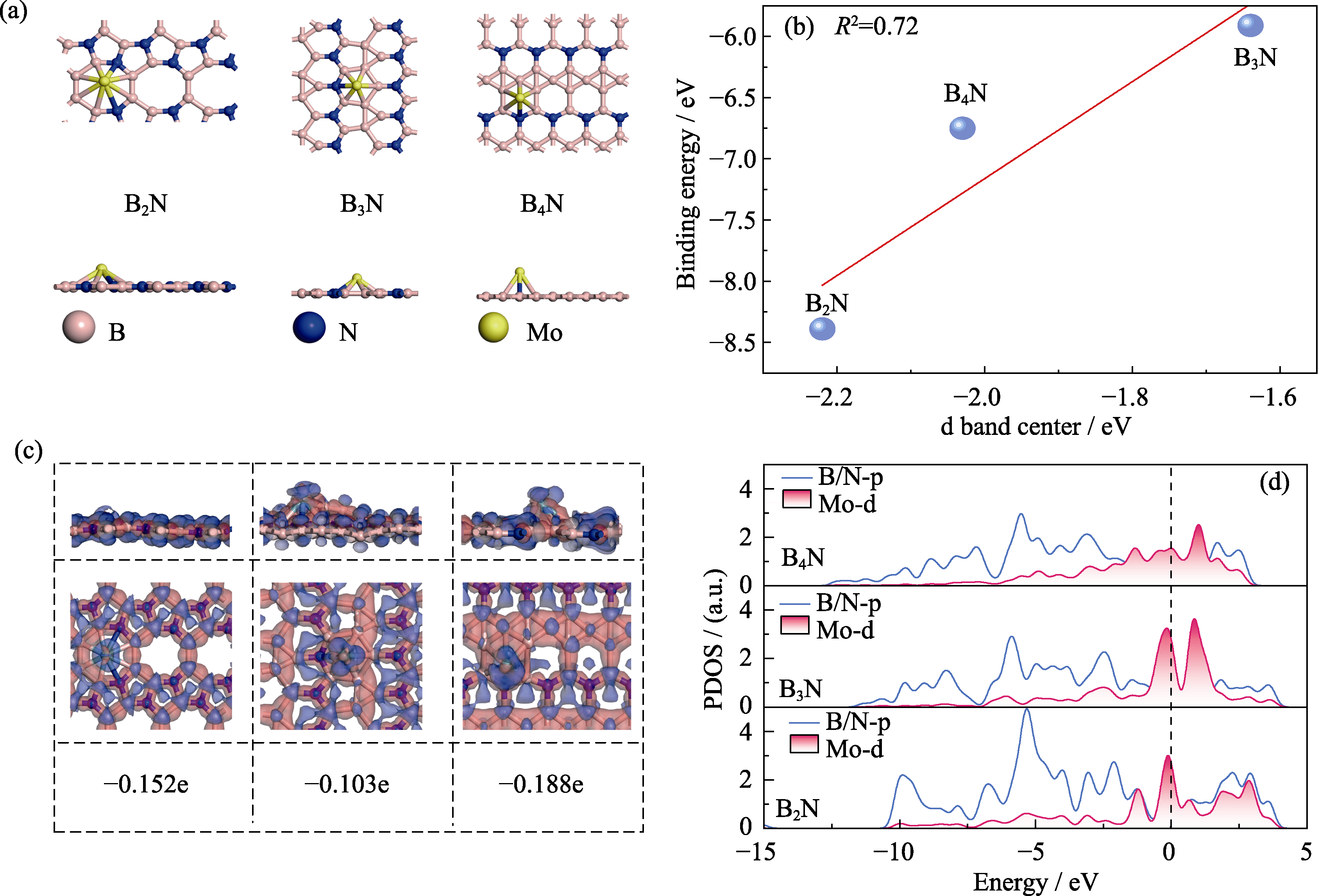
Fig. 1 (a) Model structures; (b) Linear relationship between d-band center and binding energy; (c) Iso-surface plots of the charge density difference (CDD) and charge transfer quantities; (d) Partial density of states (PDOS) analysis for Mo interacting with B2N, B3N and B4N substrates, respectively, with the p-band contributions from B2N, B3N and B4N represented the combined p-bands of B and N atoms directly bonded to metal atoms in each structure

Fig. 2 (a) Adsorption free energies of N2 under two adsorption configurations; (b) PDOS of Mo with N2 adsorbate; (c) Charge transfer quantity for N2 adsorbed on Mo-B4N; (d) Crystal orbital Hamilton population (COHP) analysis of N≡N bond in adsorbed *N2
| Structure | Mechanism | ΔG/eV | ΔGmax/eV | |||||
|---|---|---|---|---|---|---|---|---|
| Mo-B2N | Distal | 1.21 | −0.32 | −0.19 | −0.44 | −0.01 | −0.90 | 1.21 |
| Alternating | 1.21 | 0.08 | −0.07 | 1.25 | −2.29 | −0.82 | 1.25 | |
| Enzymatic | 1.75 | −0.43 | −0.65 | −0.67 | −0.01 | −0.50 | 1.75 | |
| Mo-B3N | Distal | 1.07 | 0.48 | −0.76 | −0.74 | 0.53 | −0.12 | 1.07 |
| Alternating | 1.07 | 1.23 | −1.28 | 0.44 | −1.71 | 0.70 | 1.23 | |
| Enzymatic | 0.64 | −0.03 | −0.65 | −1.51 | −0.32 | 1.34 | 1.34 | |
| Mo-B4N | Distal | 0.61 | −0.04 | −0.01 | −0.74 | −0.51 | 0.13 | 0.61 |
| Alternating | 0.61 | 0.63 | −0.88 | 0.82 | −2.35 | 0.61 | 0.82 | |
| Enzymatic | 0.98 | −0.07 | −0.63 | −1.33 | −0.34 | 0.66 | 0.98 | |
Table 1 Free energy changes ΔG of elementary steps and thermodynamic barriers ΔGmax
| Structure | Mechanism | ΔG/eV | ΔGmax/eV | |||||
|---|---|---|---|---|---|---|---|---|
| Mo-B2N | Distal | 1.21 | −0.32 | −0.19 | −0.44 | −0.01 | −0.90 | 1.21 |
| Alternating | 1.21 | 0.08 | −0.07 | 1.25 | −2.29 | −0.82 | 1.25 | |
| Enzymatic | 1.75 | −0.43 | −0.65 | −0.67 | −0.01 | −0.50 | 1.75 | |
| Mo-B3N | Distal | 1.07 | 0.48 | −0.76 | −0.74 | 0.53 | −0.12 | 1.07 |
| Alternating | 1.07 | 1.23 | −1.28 | 0.44 | −1.71 | 0.70 | 1.23 | |
| Enzymatic | 0.64 | −0.03 | −0.65 | −1.51 | −0.32 | 1.34 | 1.34 | |
| Mo-B4N | Distal | 0.61 | −0.04 | −0.01 | −0.74 | −0.51 | 0.13 | 0.61 |
| Alternating | 0.61 | 0.63 | −0.88 | 0.82 | −2.35 | 0.61 | 0.82 | |
| Enzymatic | 0.98 | −0.07 | −0.63 | −1.33 | −0.34 | 0.66 | 0.98 | |
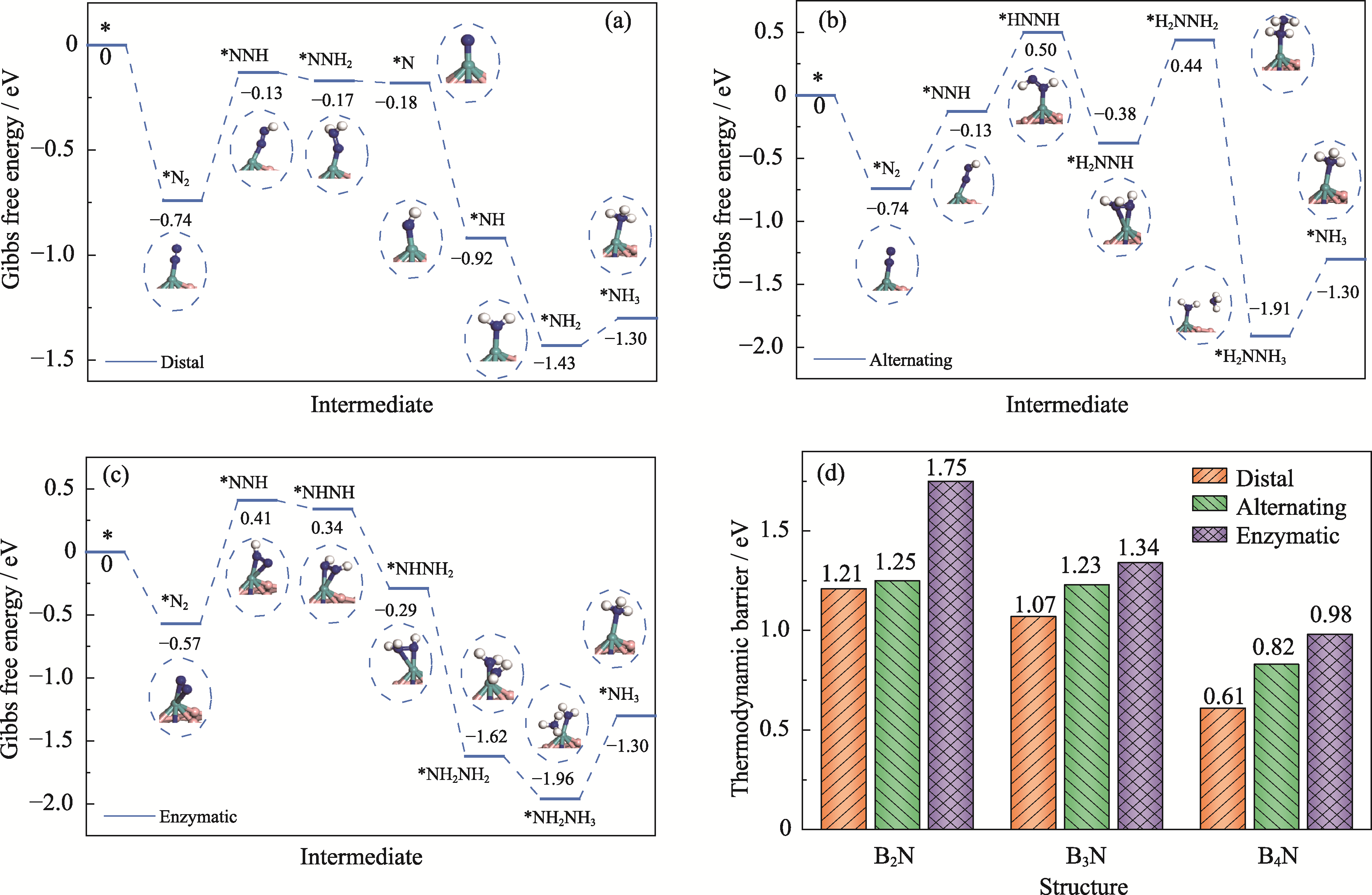
Fig. 3 (a) Distal pathway of Mo-B4N; (b) Alternating pathway of Mo-B4N; (c) Enzymatic pathway of Mo-B4N; (d) Thermodynamic barriers of Mo-B2N, Mo-B3N and Mo-B4N
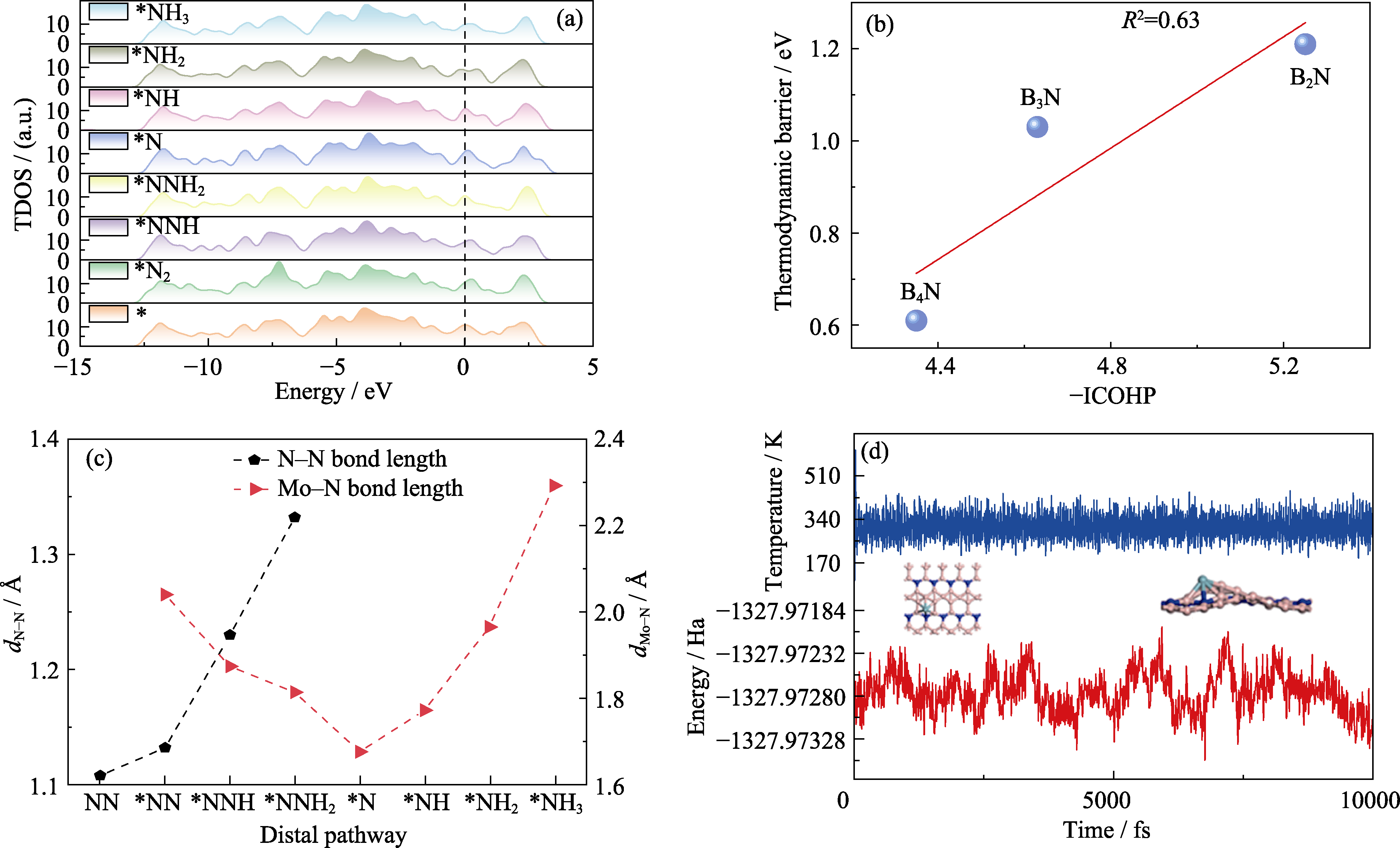
Fig. 4 (a) Total density of states (TDOS) of Mo-B4N with varied N-containing intermediates along the distal pathway; (b) Linear relationship between -ICOHP of N≡N bond and thermodynamic energy barrier; (c) Bond lengths of N-N and Mo-N; (d) AIMD simulation of Mo-B4N at room temperature of 300 K
| Time/ps | 0 | 1 | 2 | 3 | 4 | 5 | 6 | 7 | 8 | 9 | 10 | |
|---|---|---|---|---|---|---|---|---|---|---|---|---|
| Bond length/Å | Mo-B1 | 2.325 | 2.270 | 2.210 | 2.258 | 2.368 | 2.321 | 2.317 | 2.342 | 2.198 | 2.298 | 2.242 |
| Mo-B2 | 2.209 | 2.141 | 2.174 | 2.211 | 2.194 | 2.215 | 2.267 | 2.148 | 2.161 | 2.162 | 2.325 | |
| Mo-B3 | 2.249 | 2.245 | 2.209 | 2.317 | 2.148 | 2.277 | 2.239 | 2.204 | 2.261 | 2.181 | 2.257 | |
| Mo-B4 | 2.029 | 2.048 | 2.030 | 2.023 | 2.017 | 2.048 | 2.006 | 2.043 | 2.069 | 2.004 | 2.091 | |
| Mo-B5 | 2.081 | 2.087 | 2.178 | 2.179 | 2.111 | 2.053 | 2.082 | 2.084 | 2.188 | 2.089 | 2.102 | |
| Mo-N | 2.236 | 2.169 | 2.251 | 2.222 | 2.247 | 2.206 | 2.266 | 2.389 | 2.149 | 2.141 | 2.217 | |
Table 2 Bond length between Mo and B/N atom
| Time/ps | 0 | 1 | 2 | 3 | 4 | 5 | 6 | 7 | 8 | 9 | 10 | |
|---|---|---|---|---|---|---|---|---|---|---|---|---|
| Bond length/Å | Mo-B1 | 2.325 | 2.270 | 2.210 | 2.258 | 2.368 | 2.321 | 2.317 | 2.342 | 2.198 | 2.298 | 2.242 |
| Mo-B2 | 2.209 | 2.141 | 2.174 | 2.211 | 2.194 | 2.215 | 2.267 | 2.148 | 2.161 | 2.162 | 2.325 | |
| Mo-B3 | 2.249 | 2.245 | 2.209 | 2.317 | 2.148 | 2.277 | 2.239 | 2.204 | 2.261 | 2.181 | 2.257 | |
| Mo-B4 | 2.029 | 2.048 | 2.030 | 2.023 | 2.017 | 2.048 | 2.006 | 2.043 | 2.069 | 2.004 | 2.091 | |
| Mo-B5 | 2.081 | 2.087 | 2.178 | 2.179 | 2.111 | 2.053 | 2.082 | 2.084 | 2.188 | 2.089 | 2.102 | |
| Mo-N | 2.236 | 2.169 | 2.251 | 2.222 | 2.247 | 2.206 | 2.266 | 2.389 | 2.149 | 2.141 | 2.217 | |
| Energy | NN | NNH | NNH2 | N | NH | NH2 | NH3 |
|---|---|---|---|---|---|---|---|
| With corrections/eV | −1.235 | −2.925 | −3.920 | −8.270 | −5.318 | −4.230 | −1.882 |
| Without corrections/eV | −1.139 | −2.820 | −3.789 | −8.232 | −5.251 | −4.133 | −1.779 |
| Difference/eV | −0.096 | −0.105 | −0.131 | −0.038 | −0.067 | −0.097 | −0.103 |
Table S1 Comparison of adsorption energies with and without vdW corrections
| Energy | NN | NNH | NNH2 | N | NH | NH2 | NH3 |
|---|---|---|---|---|---|---|---|
| With corrections/eV | −1.235 | −2.925 | −3.920 | −8.270 | −5.318 | −4.230 | −1.882 |
| Without corrections/eV | −1.139 | −2.820 | −3.789 | −8.232 | −5.251 | −4.133 | −1.779 |
| Difference/eV | −0.096 | −0.105 | −0.131 | −0.038 | −0.067 | −0.097 | −0.103 |
| Catalyst | ΔGmax/eV | Ref. |
|---|---|---|
| Mo-B4N | 0.61 | This work |
| Mo3(HAB)2 | 0.66 | [ |
| Mo-C4N3 | 0.76 | [ |
| MoPc-TFPN | 0.21 | [ |
| Mo-C3N3 | 0.41 | [ |
| Mo-BN | 1.01 | [ |
| Mo-GR | 0.71 | [ |
| Mo-GDY | 0.43 | [ |
| Mo-C9N4 | 0.40 | [ |
Table S2 Comparison of ΔGmax cited from the previous reports
| Catalyst | ΔGmax/eV | Ref. |
|---|---|---|
| Mo-B4N | 0.61 | This work |
| Mo3(HAB)2 | 0.66 | [ |
| Mo-C4N3 | 0.76 | [ |
| MoPc-TFPN | 0.21 | [ |
| Mo-C3N3 | 0.41 | [ |
| Mo-BN | 1.01 | [ |
| Mo-GR | 0.71 | [ |
| Mo-GDY | 0.43 | [ |
| Mo-C9N4 | 0.40 | [ |
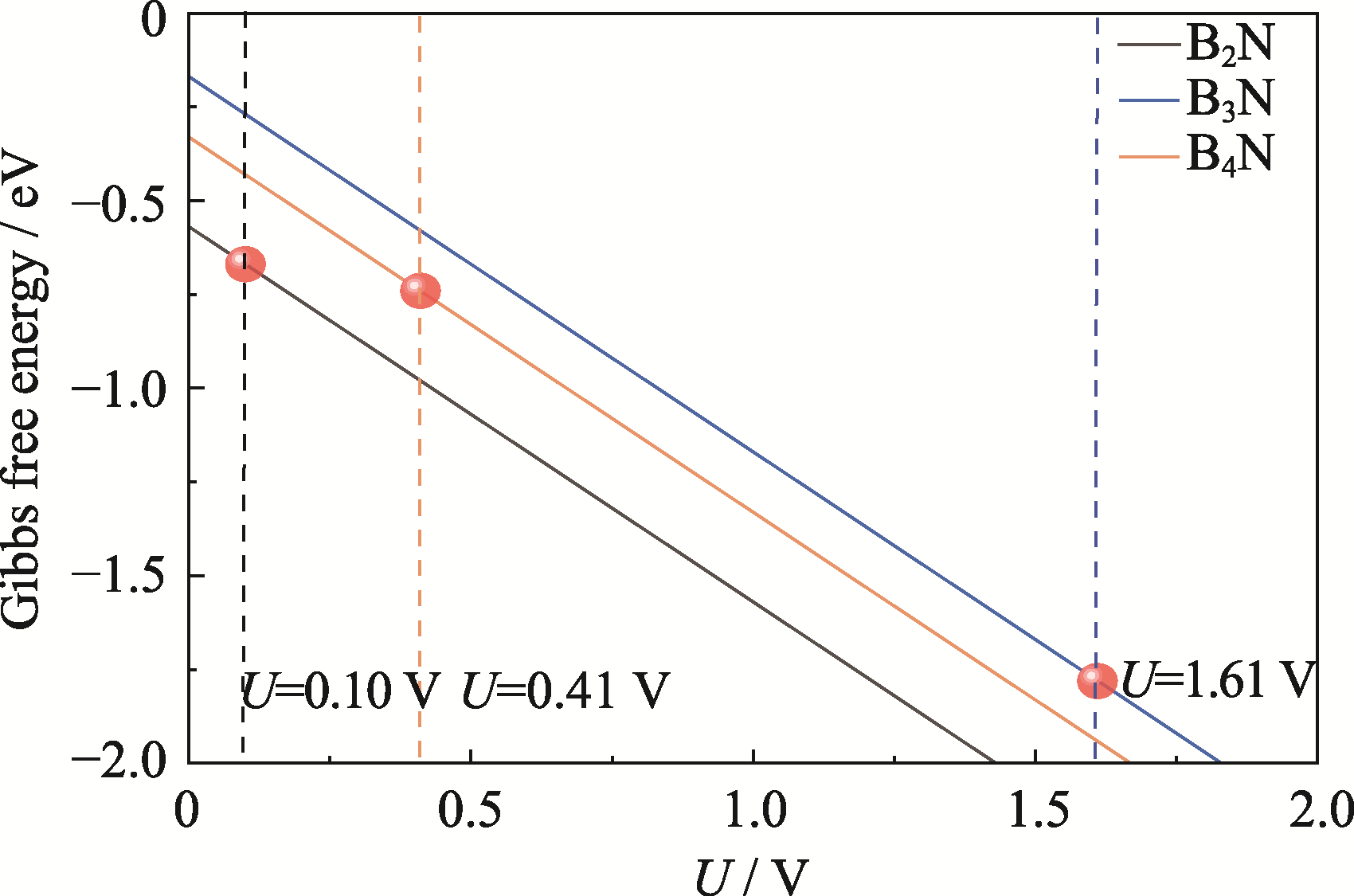
Fig. S1 Free energies of hydrogen adsorption ΔGH under different potentials
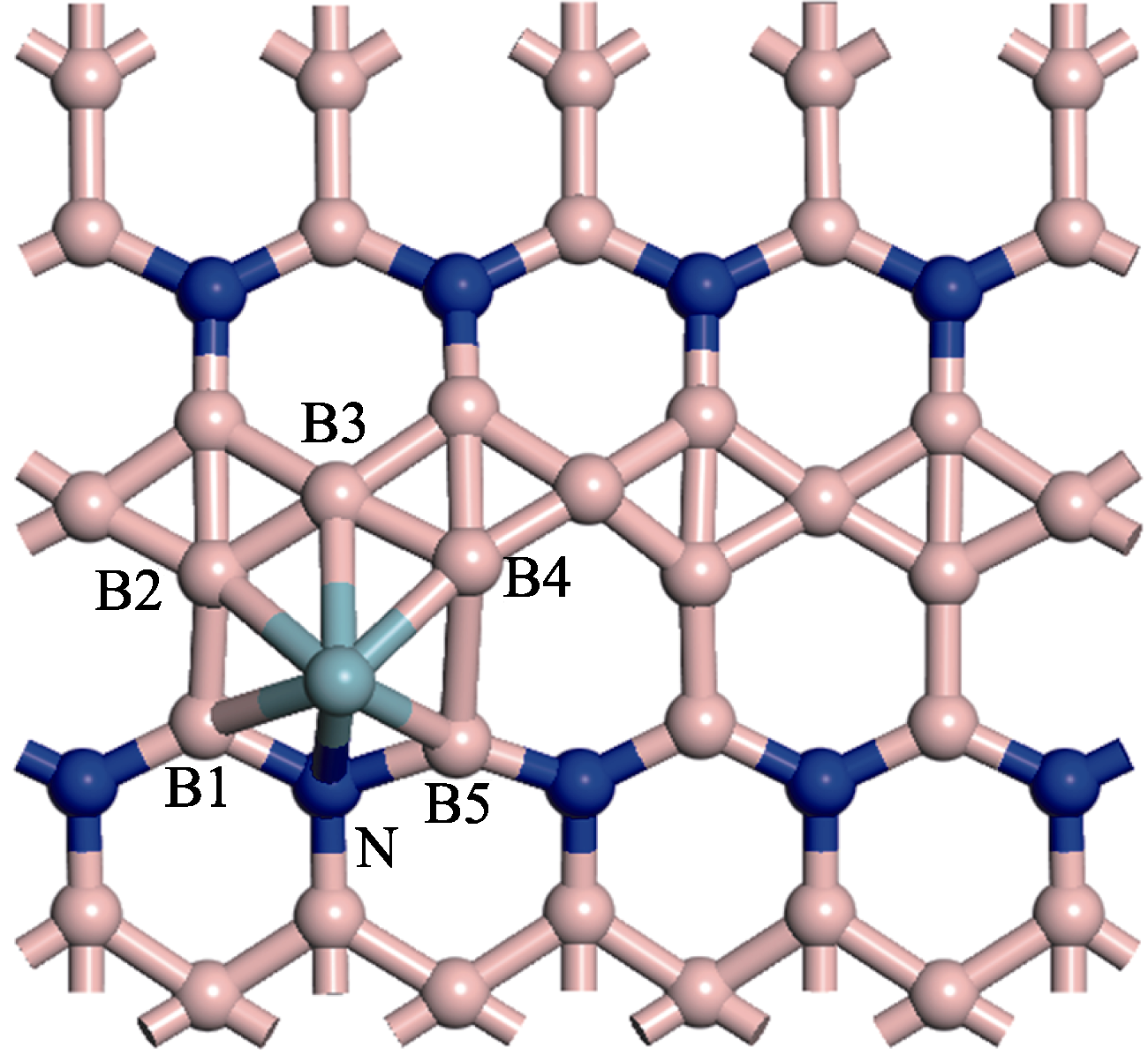
Fig. S2 Labeled coordination environment of Mo-B4
| [1] |
LIU K H, ZHONG H X, LI S J, et al. Advanced catalysts for sustainable hydrogen generation and storage via hydrogen evolution and carbon dioxide/nitrogen reduction reactions. Progress in Materials Science, 2018, 92: 64.
DOI URL |
| [2] |
BOULAMANTI A, MOYA J A. Production costs of the chemical industry in the EU and other countries: ammonia, methanol and light olefins. Renewable and Sustainable Energy Reviews, 2017, 68: 1205.
DOI URL |
| [3] |
YE T N, PARK S W, LU Y F, et al. Vacancy-enabled N2 activation for ammonia synthesis on an Ni-loaded catalyst. Nature, 2020, 583(7816): 391.
DOI |
| [4] |
QING G, GHAZFAR R, JACKOWSKI S T, et al. Recent advances and challenges of electrocatalytic N2 reduction to ammonia. Chemical Reviews, 2020, 120(12): 5437.
DOI URL |
| [5] | REN Y W, YU C, TAN X Y, et al. Strategies to activate inert nitrogen molecules for efficient ammonia electrosynthesis: current status, challenges, and perspectives. Energy & Environmental Science, 2022, 15(7): 2776. |
| [6] |
KWON Y I, KIM S K, KIM Y B, et al. Nitric oxide utilization for ammonia production using solid electrolysis cell at atmospheric pressure. ACS Energy Letters, 2021, 6(12): 4165.
DOI URL |
| [7] |
WANG J, JANG H, LI G K, et al. Efficient electrocatalytic conversion of N2 to NH3 on NiWO4 under ambient conditions. Nanoscale, 2020, 12(3): 1478.
DOI URL |
| [8] |
PAN Y, ZHANG C, LIU Z, et al. Structural regulation with atomic-level precision: from single-atomic site to diatomic and atomic interface catalysis. Matter, 2020, 2(1): 78.
DOI URL |
| [9] |
GUO J W, LIU H M, LI D Z, et al. A minireview on the synthesis of single atom catalysts. RSC Advances, 2022, 12(15): 9373.
DOI PMID |
| [10] |
CHEN L, WANG Q, GONG H R, et al. Single Mo atom supported on defective BC2N monolayers as promising electrochemical catalysts for nitrogen reduction reaction. Applied Surface Science, 2021, 546: 149131.
DOI URL |
| [11] | ZHAO M R, SONG B Y, YANG L M. Two-dimensional single-atom catalyst TM3(HAB)2 monolayers for electrocatalytic dinitrogen reduction using hierarchical high-throughput screening. ACS Applied Materials & Interfaces, 2021, 13(22): 26109. |
| [12] |
SHI K, CUI L X, ZHANG M Y, et al. DFT study the influence of active site structure on the electrocatalytic nitrogen reduction reaction. Fuel, 2025, 380: 133174.
DOI URL |
| [13] |
XU M M, JI Y J, QIN Y Y, et al. A universal descriptor for two-dimensional carbon nitride-based single-atom electrocatalysts towards the nitrogen reduction reaction. Journal of Materials Chemistry A, 2024, 12(41): 28046.
DOI URL |
| [14] |
LIANG H, WANG J, QIAO Z, et al. Machine-learning-assisted design of novel metallic 2D C3N3 supported single/double atom catalysts for nitrogen reduction reaction. Applied Surface Science 2025, 689: 162451.
DOI URL |
| [15] | WANG J, ZHANG Z H, LI Y Y, et al. Screening of transition- metal single-atom catalysts anchored on covalent-organic frameworks for efficient nitrogen fixation. ACS Applied Materials & Interfaces, 2022, 14(1): 1024. |
| [16] | ZHOU X Y, CHEN X F, SHU C Z, et al. Two-dimensional boron- rich monolayer BxN as high capacity for lithium-ion batteries: a first-principles study. ACS Applied Materials & Interfaces, 2021, 13(34): 41169. |
| [17] |
RAHIMI R, SOLIMANNEJAD M. Exploring the adsorption behavior of O-containing VOCs in human breath on a B2N monolayer using DFT simulations. Physical Chemistry Chemical Physics, 2024, 26(39): 25567.
DOI URL |
| [18] |
SREDOJEVIĆ D N, VUKOJE I, TRPKOV Đ, et al. A DFT study of CO2 electroreduction catalyzed by hexagonal boron-nitride nanosheets with vacancy defects. Physical Chemistry Chemical Physics, 2024, 26(10): 8356.
DOI URL |
| [19] |
WEI Y H, GAO F, DU J G, et al. Hydrogen storage on Li-decorated B4N: a first-principle calculation insight. Journal of Physics D: Applied Physics, 2021, 54(44): 445501.
DOI |
| [20] |
DELLEY B. An all-electron numerical method for solving the local density functional for polyatomic molecules. The Journal of Chemical Physics, 1990, 92(1): 508.
DOI URL |
| [21] |
DELLEY B. From molecules to solids with the DMol3 approach. The Journal of Chemical Physics, 2000, 113(18): 7756.
DOI URL |
| [22] |
PERDEW J, BURKE K, ERNZERHOF M. Generalized gradient approximation made simple. Physical Review Letters, 1996, 77(18): 3865.
DOI PMID |
| [23] |
GRIMME S, ANTONY J, EHRLICH S, et al. A consistent and accurate ab initio parametrization of density functional dispersion correction (DFT-D) for the 94 elements H-Pu. The Journal of Chemical Physics, 2010, 132(15): 154104.
DOI URL |
| [24] |
TODOROVA T, DELLEY B. Wetting of paracetamol surfaces studied by DMol3-COSMO calculations. Molecular Simulation, 2008, 34(10-15): 1013.
DOI URL |
| [25] |
LIM D H, WILCOX J. Mechanisms of the oxygen reduction reaction on defective graphene-supported Pt nanoparticles from first-principles. The Journal of Physical Chemistry C, 2012, 116(5): 3653.
DOI URL |
| [26] |
XUE Z, ZHANG X Y, QIN J Q, et al. Anchoring Mo on C9N4 monolayers as an efficient single atom catalyst for nitrogen fixation. Journal of Energy Chemistry, 2021, 57: 443.
DOI URL |
| [27] |
WU K Y, FENG Z Y, LI Z, et al. DFT insights into the stability of single-metal-atoms on Mo-based o-MXenes driven by the ligand effect. Physical Chemistry Chemical Physics, 2026, 28(10): 6501.
DOI URL |
| [28] |
XIAO B B, LIU H Y, YANG L, et al. Design of effective graphene with the TM/O moiety for the oxygen electrode reaction. ACS Applied Energy Materials, 2020, 3(1): 260.
DOI URL |
| [29] |
WAN Y C, WANG Z J, LI J, et al. Mo2C-MoO2 heterostructure quantum dots for enhanced electrocatalytic nitrogen reduction to ammonia. ACS Nano, 2022, 16(1): 643.
DOI URL |
| [30] |
WU T W, MELANDER M M, HONKALA K. Coadsorption of NRR and HER intermediates determines the performance of Ru-N4 toward electrocatalytic N2 reduction. ACS Catalysis, 2022, 12(4): 2505.
DOI URL |
| [31] |
GAO L Y, WANG F T, YU M G, et al. A novel phosphotungstic acid-supported single metal atom catalyst with high activity and selectivity for the synthesis of NH3 from electrochemical N2 reduction: a DFT prediction. Journal of Materials Chemistry A, 2019, 7(34): 19838.
DOI URL |
| [32] |
ANDERSEN S Z, ČOLIĆ V, YANG S, et al. A rigorous electrochemical ammonia synthesis protocol with quantitative isotope measurements. Nature, 2019, 570(7762): 504.
DOI |
| [33] |
CHENG Y M, CHEN W, HE C, et al. New insights into the long-range interaction mechanism of nitrogen reduction. Journal of Energy Chemistry, 2025, 106: 842.
DOI URL |
| [34] |
JIANG X Y, TAO B R, LI H D. Multistage construction of Gd-doped g-C3N4/Mo15S19 composites enabled both N2 activation and multiple electron transfer for an enhanced photocatalytic nitrogen reduction reaction. Inorganic Chemistry Frontiers, 2024, 11(24): 8866.
DOI URL |
| [35] |
QIU W B, XIE X Y, QIU J D, et al. High-performance artificial nitrogen fixation at ambient conditions using a metal-free electrocatalyst. Nature Communications, 2018, 9: 3485.
DOI PMID |
| [36] |
LING C Y, NIU X H, LI Q, et al. Metal-free single atom catalyst for N2 fixation driven by visible light. Journal of the American Chemical Society, 2018, 140(43): 14161.
DOI URL |
| [37] |
CUI Q Y, QIN G Q, WANG W H, et al. Mo-based 2D MOF as a highly efficient electrocatalyst for reduction of N2 to NH3: a density functional theory study. Journal of Materials Chemistry A, 2019, 7(24): 14510.
DOI URL |
| [38] |
JI S, WANG Z X, ZHAO J X. A boron-interstitial doped C2N layer as a metal-free electrocatalyst for N2 fixation: a computational study. Journal of Materials Chemistry A, 2019, 7(5): 2392.
DOI URL |
| [39] |
HE T W, MATTA S K, DU A J. Single tungsten atom supported on N-doped graphyne as a high-performance electrocatalyst for nitrogen fixation under ambient conditions. Physical Chemistry Chemical Physics, 2019, 21(3): 1546.
DOI PMID |
| [40] |
CAO Y Y, DENG S W, FANG Q J, et al. Single and double boron atoms doped nanoporous C2N-h2D electrocatalysts for highly efficient N2 reduction reaction: a density functional theory study. Nanotechnology, 2019, 30(33): 335403.
DOI |
| [41] |
ZHAI X W, LI L, LIU X Y, et al. A DFT screening of single transition atoms supported on MoS2 as highly efficient electrocatalysts for the nitrogen reduction reaction. Nanoscale, 2020, 12(18): 10035.
DOI URL |
| [42] |
LIU K, FU J W, ZHU L, et al. Single-atom transition metals supported on black phosphorene for electrochemical nitrogen reduction. Nanoscale, 2020, 12(8): 4903.
DOI PMID |
| [43] |
LI H Y, YANG L, WANG Z X, et al. N-heterocyclic carbene as a promising metal-free electrocatalyst with high efficiency for nitrogen reduction to ammonia. Journal of Energy Chemistry, 2020, 46: 78.
DOI URL |
| [1] | 胡扬, 谢敏, 张筱怡, 李想, 郭新伟, 姜南, 周文瀚, 张胜利, 曾海波. 计算与数据驱动环保型发光材料的研究进展[J]. 无机材料学报, 2026, 41(6): 704-722. |
| [2] | 孙树娟, 郑南南, 潘昊坤, 马猛, 陈俊, 黄秀兵. 单原子催化剂制备方法的研究进展[J]. 无机材料学报, 2025, 40(2): 113-127. |
| [3] | 刘磊, 郭瑞华, 王丽, 王艳, 张国芳, 关丽丽. Pt3Co高指数晶面氧还原过程的密度泛函理论研究[J]. 无机材料学报, 2025, 40(1): 39-46. |
| [4] | 靳宇翔, 宋二红, 朱永福. 3d过渡金属单原子掺杂石墨烯缺陷电催化还原CO2的第一性原理研究[J]. 无机材料学报, 2024, 39(7): 845-852. |
| [5] | 李红兰, 张俊苗, 宋二红, 杨兴林. Mo/S共掺杂的石墨烯用于合成氨: 密度泛函理论研究[J]. 无机材料学报, 2024, 39(5): 561-568. |
| [6] | 吴光宇, 舒松, 张洪伟, 李建军. 接枝内酯基活性炭增强苯乙烯吸附性能研究[J]. 无机材料学报, 2024, 39(4): 390-398. |
| [7] | 谢天, 宋二红. 弹性应变对C、H、O在过渡金属氧化物表面吸附的影响[J]. 无机材料学报, 2024, 39(11): 1292-1300. |
| [8] | 王鹏, 靳遵龙, 陈宁光, 刘勇豪. Mo掺杂α-MnO2电催化析氧反应的理论研究[J]. 无机材料学报, 2022, 37(5): 541-546. |
| [9] | 刘自若, 刘炜, 郝策, 胡金文, 史彦涛. 蜂窝状碳负载铁基单原子催化剂的制备及ORR催化性能研究[J]. 无机材料学报, 2021, 36(9): 943-949. |
| [10] | 郝策, 刘自若, 刘炜, 史彦涛. 用于氧还原反应的碳基负载金属单原子催化剂研究进展[J]. 无机材料学报, 2021, 36(8): 820-834. |
| [11] | 李友兵, 秦彦卿, 陈科, 陈露, 张霄, 丁浩明, 李勉, 张一鸣, 都时禹, 柴之芳, 黄庆. 熔盐法合成纳米层状Sc2SnC MAX相[J]. 无机材料学报, 2021, 36(7): 773-778. |
| [12] | 张瑞鸿, 魏鑫, 卢占会, 艾玥洁. 基于机器学习训练金属离子吸附能预测模型的研究[J]. 无机材料学报, 2021, 36(11): 1178-1184. |
| [13] | 何俊龙, 宋二红, 王连军, 江莞. DFT方法研究一氧化氮在铬掺杂石墨烯上的吸附行为[J]. 无机材料学报, 2021, 36(10): 1047-1052. |
| [14] | 周子航, 王群, 葛翔, 李朝阳. 掺锶羟基磷灰石纳米颗粒的合成、表征及模拟研究[J]. 无机材料学报, 2020, 35(11): 1283-1289. |
| [15] | 齐欣欣, 宋广平, 尹维龙, 王明福, 赫晓东, 郑永挺, 王荣国, 柏跃磊. 新型三元层状硼化物Cr4AlB4的物相稳定性和力学行为分析[J]. 无机材料学报, 2020, 35(1): 53-60. |
| 阅读次数 | ||||||
|
全文 |
|
|||||
|
摘要 |
|
|||||