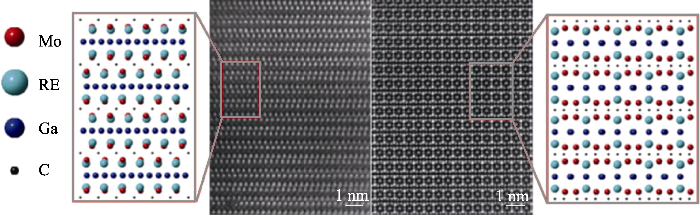
Progress in Structural Tailoring and Properties of Ternary Layered Ceramics
DING Haoming,1,2,3, LI Mian1,3, LI Youbing1,3, CHEN Ke1,3, XIAO Yukun1,3, ZHOU Jie4, TAO Quanzheng4, Johanna Rosen4, YIN Hang5, BAI Yuelei5, ZHANG Bikun6, SUN Zhimei6, WANG Junjie7, ZHANG Yiming1,3, HUANG Zhenying8, ZHANG Peigen9, SUN Zhengming9, HAN Meikang10, ZHAO Shuang11, WANG Chenxu11, HUANG Qing,1,3
1. Ningbo Institute of Materials Technology and Engineering, Chinese Academy of Sciences, Ningbo 315201, China
2. University of Chinese Academy of Sciences, Beijing 101408, China
3. Qianwan Institute of CHiTECH, Ningbo 315336, China
4. Department of Physics, Chemistry and Biology (IFM), Linköping University, Linköping SE-58183, Sweden
5. National Key Laboratory of Science and Technology on Advanced Composites in Special Environments and Center for Composite Materials and Structures, Harbin Institute of Technology, Harbin 150001, China
6. School of Materials Science and Engineering, Beihang University, Beijing 100191, China
7. School of Materials Science and Engineering, Northwestern Polytechnic University, Xi’an 710072, China
8. School of Mechanical, Electronic and Control Engineering, Beijing Jiaotong University, Beijing 100044, China
9. School of Materials Science and Engineering, Southeast University, Nanjing 211189, China
10. Institute of Optoelectronics and Shanghai Frontiers Science Research Base of Intelligent Optoelectronics and Perception, Fudan University, Shanghai 200433, China
11. State Key Laboratory of Nuclear Physics and Technology, Peking University, Beijing 100871, China
Key R&D Projects of Zhejiang Province(2022C01236) National Natural Science Foundation of China(12275009) National Natural Science Foundation of China(51972080) National Natural Science Foundation of China(52171033) National Natural Science Foundation of China(52272307) National Natural Science Foundation of China(21671195) National Natural Science Foundation of China(52172254) National Natural Science Foundation of China(U2004212) National Natural Science Foundation of China(52202325) Shanghai Pujiang Program(22PJ1400800) Leading Innovative and Entrepreneur Team Introduction Program of Zhejiang(2019R01003) Ten-Thousand Talents Plan of Zhejiang Province(2022R51007)
MAX/MAB phases are a series of non-van der Waals ternary layered ceramic materials with a hexagonal structure, rich in elemental composition and crystal structure, and embody physical properties of both ceramics and metals. They exhibit great potential for applications in extreme environments such as high temperature, strong corrosion, and irradiation. In recent years, two-dimensional (2D) materials derived from the MAX/MAB phase (MXene and MBene) have attracted enormous interest in the fields of materials physics and materials chemistry and become a new 2D van der Waals material after graphene and transition metal dichalcogenides. Therefore, structural modulation of MAX/MAB phase materials is essential for understanding the intrinsic properties of this broad class of layered ceramics and for investigating the functional properties of their derived structures. In this paper, we summarize new developments in MAX/MAB phases in recent years in terms of structural modulation, theoretical calculation, and fundamental application research and provide an outlook on the key challenges and prospects for the future development of these layered materials.
Keywords:MAX phase;
MAB phase;
MXene;
structural modulation;
theoretical calculation;
review
DING Haoming, LI Mian, LI Youbing, CHEN Ke, XIAO Yukun, ZHOU Jie, TAO Quanzheng, Johanna Rosen, YIN Hang, BAI Yuelei, ZHANG Bikun, SUN Zhimei, WANG Junjie, ZHANG Yiming, HUANG Zhenying, ZHANG Peigen, SUN Zhengming, HAN Meikang, ZHAO Shuang, WANG Chenxu, HUANG Qing. Progress in Structural Tailoring and Properties of Ternary Layered Ceramics. Journal of Inorganic Materials, 2023, 38(8): 845-884 DOI:10.15541/jim20230123
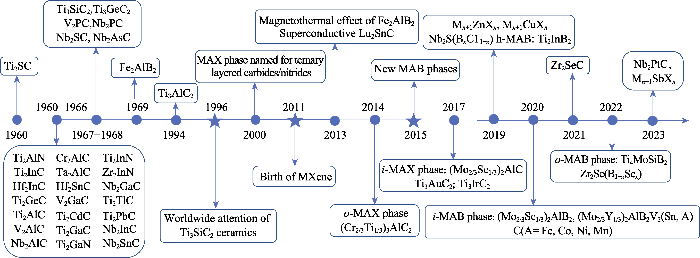
Fig. 1
Non-exhaustive chronicle of ternary layered materials
In 1960, Ti2SC was synthesized[40]; From 1960 to 1966, a large number of ternary layered carbides/nitrides (H-phases) with an M2AX formula (211 type) were synthesized[41-42]; From 1967 to 1968, Ti3SiC2 (312 type) and a set of 312 and 211 types H-phases were produced[41,43-44]; In 1969, a typical ternary layered boride Fe2AlB2 was synthesized[7]; In 1994, Ti3AlC2 was discovered[45]; In 1996, the high purity Ti3SiC2 was produced and exhibited excellent properties, thus triggering the research upsurge to these materials[46]; In 2000, Barsoum[1] renamed H-phases as Mn+1AXn phases, short for MAX phases; In 2011, the first MXene Ti3C2Tx was discovered[28]; In 2013, the discovery of magnetocaloric effect of Fe2AlB2 raised research upsurge on ternary layered borides[9]. Also, Lu2SnC was synthesized and found to be superconducting[47]; In 2014, an o-MAX (Cr2/3Ti1/3)3AlC2 was synthesized[48]; In 2015, ternary layered borides were named as MAB phases. In addition, the first Zr-based MAX phase was discovered[10,49]; In 2017, an i-MAX (Mo2/3Sc1/3)2AlC and two noble-metal MAX phases Ti3AuC2 and Ti3IrC2 were synthesized[22,50]; In 2019, a series of MAX phases containing Cu and Zn, and a hexagonal MAB phase Ti2InB2, as well as Nb2SBxC1-x (x=0-1) were synthesized[24⇓-26,51,52]; In 2020, two i-MAB phases (Mo2/3Sc1/3)2AlB2 and (Mo2/3Y1/3)2AlB2, as well as a variety of MAX phases containing Fe, Co, Ni, and Mn were synthesized[16,19]; In 2021, MAX phases having Se atoms at the A-site were produced[53]; In 2022, o-MAX phase Ti4MoSiB2, the first MBene, and Zr2Se(B1-xSex) were synthesized[20,54-55]; In 2023, a chemical scissor-mediated structural editing strategy was proposed, which extremely expands the diversity of MAX phases and MXene[56]
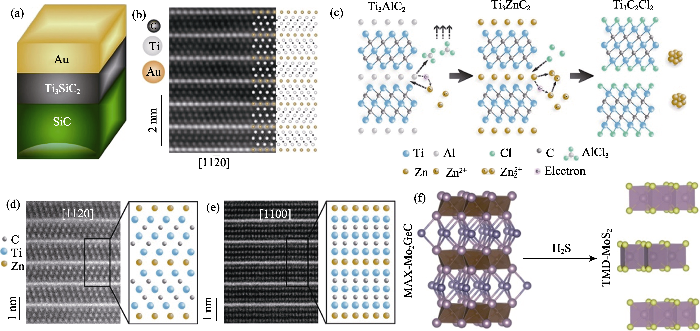
Fig. 2
Atomic and structural regulation of MAX phases
(a) Schematic illustration of Ti3SiC2 film covered by Au film on the SiC substrate[22]; (b) STEM image of Ti3SiC2 and its corresponding atomic model[22]; (c) Schematic illustration of preparing novel MAX phases and MXene based on a Lewis-acidic-molten-salt route[24]; (d) STEM image of Ti3ZnC2 and its corresponding atomic model[24]; (e) STEM image of Ti3C2Cl2 and its corresponding atomic model[24]; (f) Schematic illustration of the conversion from non-van der Waals solids to 2D transition-metal chalcogenides[57]
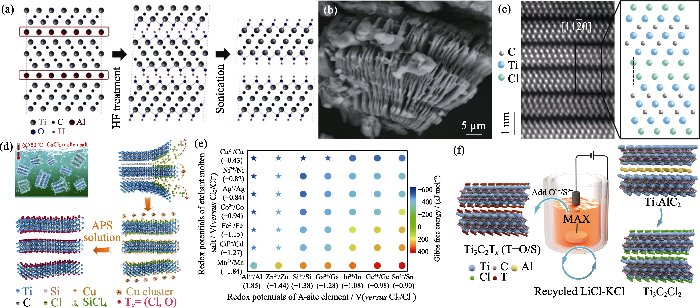
Fig. 3
Different methods for the synthesis of MXene
(a) Schematic illustration of preparing MXene using HF solution as etchant[28]; (b) SEM image of Ti3C2Tx prepared by HF solution, showing the typical accordion-like morpholorgy of MXene particle[28]; (c) STEM image of Ti3C2Cl2 prepared by Lewis-acidic-molten-salt route, and its corresponding atomic model[24]; (d) Schematic illustration of preparing Ti3C2Tx MXene via a reaction between Ti3SiC2 and CuCl2; (e) Redox potential/Gibbs free energy between Lewis acid cations and A-site atoms in molten salts[30]; (f) Schematic illustration of the electrochemistry etching strategy for the preparation of MXene in molten salt[72]
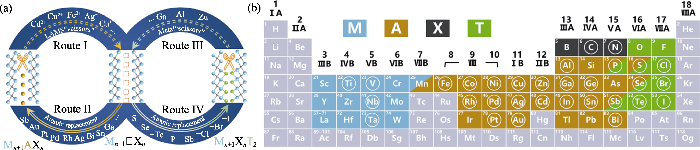
Fig. 4
Structural editing of MAX phases and MXene aided by chemical scissors
(a) Schematic illustration of chemical intercalation strategy aided by chemical scissors[56]; (b) Periodic table showing elements involved in the formation of MAX phases and MXenes. Light blue: M elements; Brown: A elements; Black: X elements; Green: ligand (T) elements; Circled: elements studied in the present work[56]
Fig. 5
Crystal structure and physical properties of novel chalcogenide MAX phases
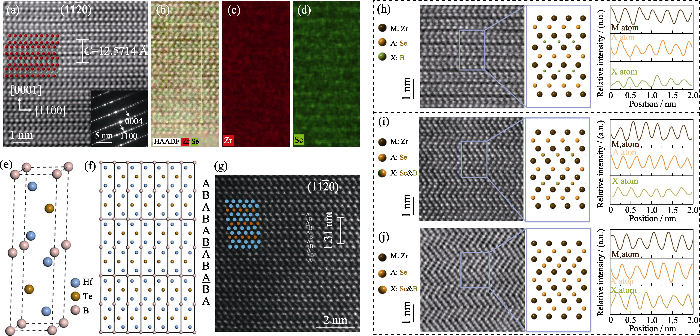
(a-d) First synthesized Se-containing MAX phase, Zr2SeC[53]; (e, f) First synthesized Te-containing MAX phase, Hf2TeB[93]; (h-j) First synthesized MAX phase with chalcogen at X site, Zr2Se(B1-xSex) with x at 0 (h), 0.60 (i), and 0.97 (j), respectively[20]
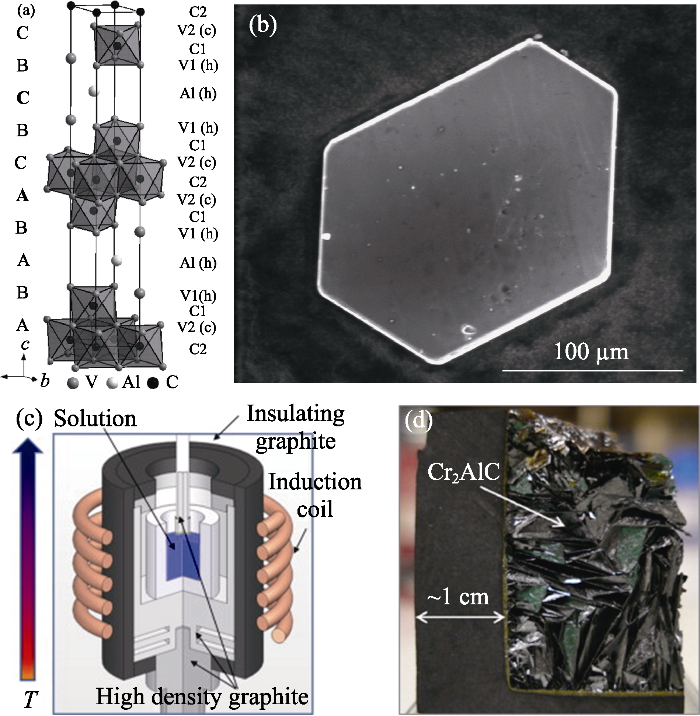
(a) Crystal structure of V4AlC3-x[106]; (b) SEM image of single MAX phase V4AlC3-x[106]; (c) Schematic of the experimental set-up used for high temperature solution growth[107]; (d) Photograph of part of the crucible cut after growth and dipping into dilute HCl, the Cr2AlC platelets are coalescing due to an unusually long growth time[107]
Fig. 7
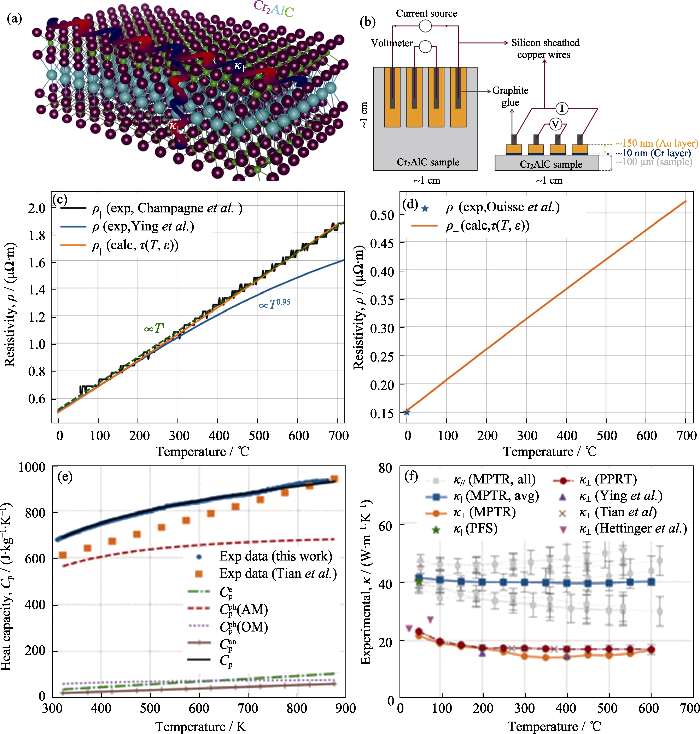
Heat capacity and anisotropic thermal conductivity in Cr2AlC single crystals at high temperatures[110]
(a) Atomic structure model of Cr2AlC; (b) Schematic of the in-plane resistivity measurements in Cr2AlC using a four-probe configuration with equidistant and parallel pads; (c) Temperature-dependence measurements of the in-plane resistivity for Cr2AlC single crystals (black line); (d) Predicted out-of-plane resistivity (orange line); (e) Heat capacity measurements of Cr2AlC single crystals measured experimentally (blue dots); (f) Measured in-plane (κ∥) and out-of-plane (κ⊥) thermal conductivities using various techniques
Fig. 8
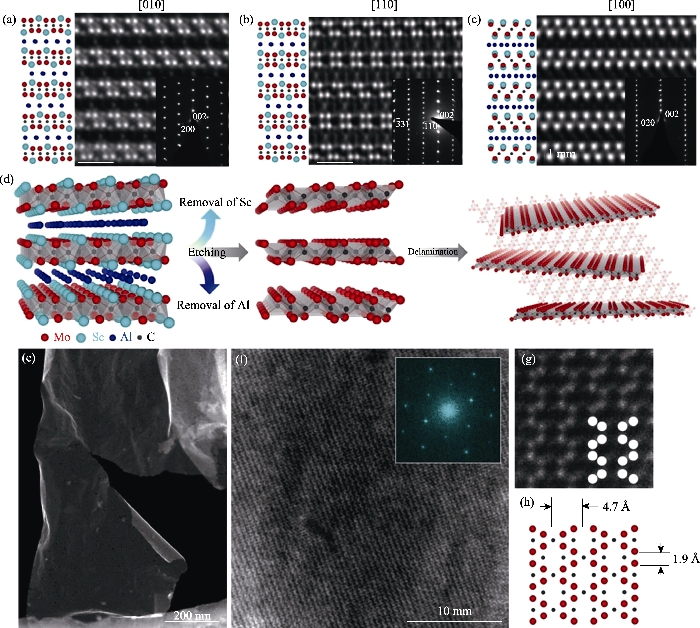
i-MAX phases and its derived two-dimensional product of i-MXene[50]
(a-c) i-MAX with in-plane chemical order, viewed from [100], [010] and [110] zone axes, respectively; (d) Schematic of the conversion from i-MAX to i-MXene; (e) Low-magnification STEM image of single flake of Mo1.33C i-MXene; (f) Higher magnification STEM image with the FFT result of Mo1.33C i-MXene; (g) Atomically resolved STEM image of Mo1.33C i-MXene; (h) Atomic structure model corresponding to (g)
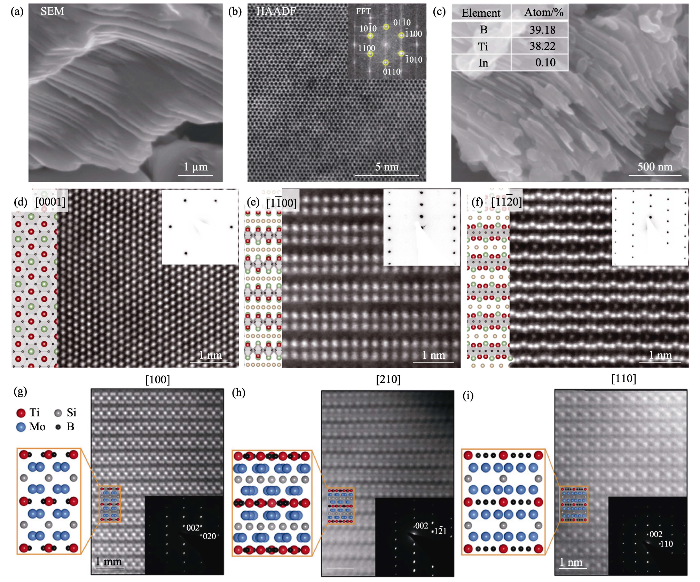
(a) SEM image of layered Ti2InB2; (b) STEM image of Ti2InB2 along the direction of [001] and corresponding FFT result in the inset image; (c) SEM image of 2D-TiB and its corresponding EDS semi-quantitative resultin inset table[52]; (d-f) STEM images of i-MAB phase (Mo2/3A1/3)2AlB2 and corresponding atomic model along the direction [0001], [$1\bar{1}00$] and [$11\bar{2}0$], respectively, and their corresponding FFT images[55]; (g-i) STEM images of o-MAB phase Ti4MoSiB2 and corresponding atomic model along the direction [100], [210] and [110], respectivly, and their corresponding FFT images[54]
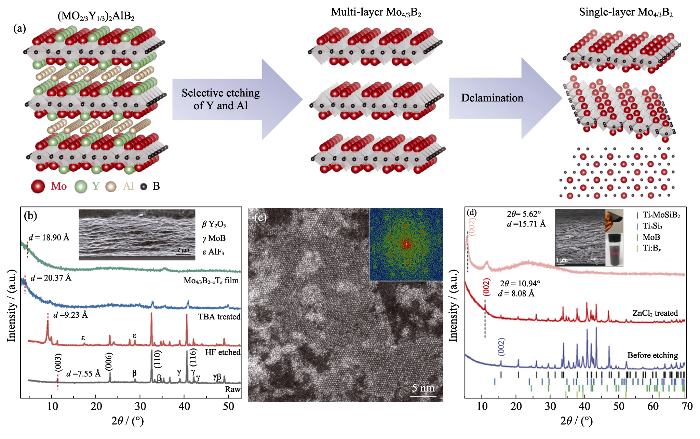
一系列新型MAB相固溶体则是该领域另一值得注意的进展。该固溶体包括面内有序的i-MAB相(in-plane ordered MAB phases)和面外有序o-MAB相(out-of-plane ordered MAB phases), 进一步丰富和扩展了MAB相化合物的数量, 展现出MAB相材料优异的结构和性能可调控性。这些固溶体可分为在M位、A位的无序固溶, 如(Mo1/2W1/2)AlB[142]、(Fe1/2Mn1/2)2AlB2[143]、(Mn1/3Cr2/3)3AlB4[144]、(Fe4/5Mn1/5)5SiB2[135]和MoAl0.97Si0.03B[145]等。i-MAB相的两种M位原子均占据同一平面并有序固溶, o-MAB相的两种M位原子则分别占据不同平面。Rosen等[55]合成了i-MAB相(Mo2/3A1/3)2AlB2 (A = Y, Sc)(图9(d~f))和o-MAB相Ti4MoSiB2(图9(g~i)), 并利用高分辨扫描透射电镜技术确认其原子结构[54]。以(Mo2/3A1/3)2AlB2 (A = Y, Sc)为前驱体成功刻蚀出了对应的二维材料Mo4/3B(图10), 通过实验证实存在二维MBenes[55,146]。总的来说, MAB相及其固溶体在化学成分和结构上的多样性为下一步的性能调节和实际应用提供了广阔的选择空间。
Fig. 10
Two-dimensional products derived from MAB phases through chemical etching
(a) Schematic of chemical etching i-MAB phase to prepare two-dimensional derivative[55]; (b) XRD patterns of prestine i-MAX (Mo2/3Y1/3)2AlB2, etched product Mo4/3B2-xTz, TBAOH intercalation product, and delamination film with SEM image (inset) showing the cross-sectional morphology of Mo4/3B2-xTz film [55]; (c) STEM image of monolayer Mo4/3B2-xTz and its FFT image (inset) [55]; (d) XRD patterns of o-MAX Ti4MoSiB2, product etched by ZnCl2 and two-dimensional TiOxCly after delamination and filtering with SEM image (inset) of cross-sectional morphology of a TiOxCly film[54]
Fig. 11
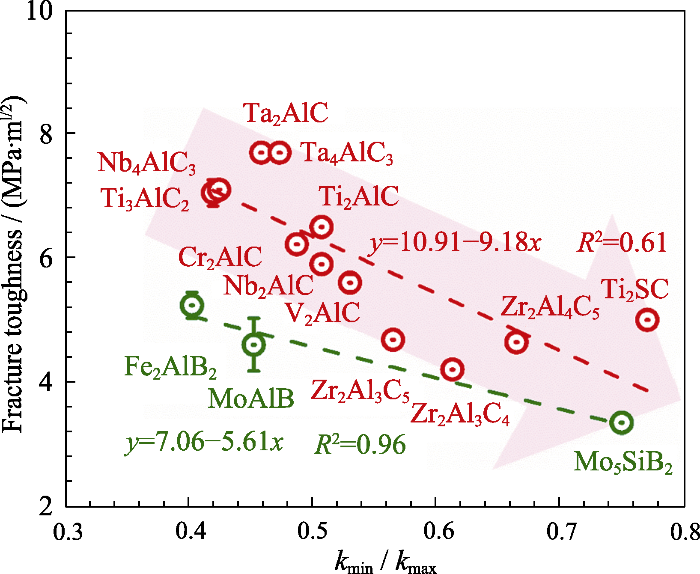
Experimentally measured unilateral notched beam fracture toughness as a function of the weakest to strongest chemical bond stiffness ratio kmin/kmax for some typical ternary layered compounds (MAX and MAB phases)[138]
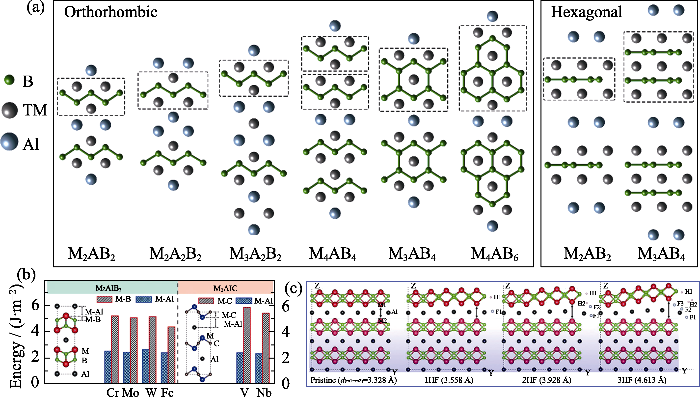
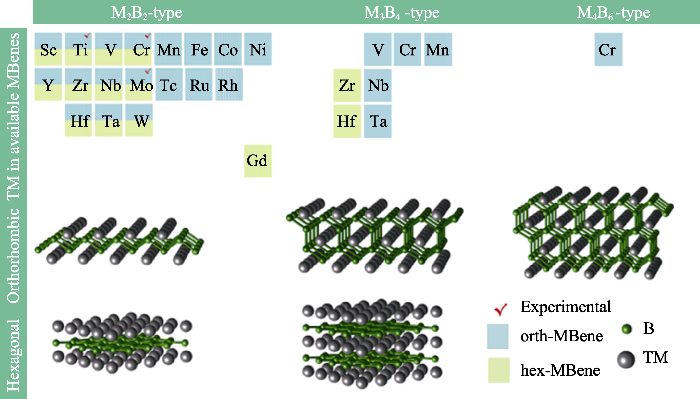
(a) Structures of orthorhombic and hexagonal MAB phases[163]; (b) Bonding energy of M2AlB2-type orthorhombic MAB and M2AlC-type MAX phases; (c) Simulated exfoliation process of orthorhombic M2AlB2 using HF, where the red, green, black, cyan, and pink balls represent Mo, B, Al, F, and H atoms, respectively[146]
Table 3 Theoretical mechanical properties of several MAB-phases, including bulk modulus (B), shear modulus (G), Young’s modulus (E), and Poisson ratio (ν)
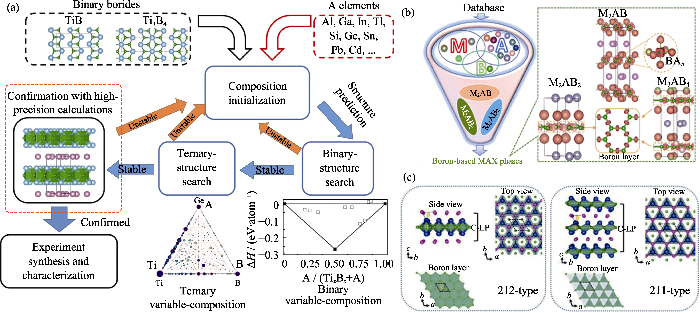
(a) Calculation-based approach to discovery of novel ternary phases Ti2InB2[52]; (b) High-throughput prediction of MAB phases[162]; (c) Crystal structures for the stable Nb2AB2 and Nb2AB (A: P or S)[183]
Fig. 15
Theoretical study of quaternary MAB phases
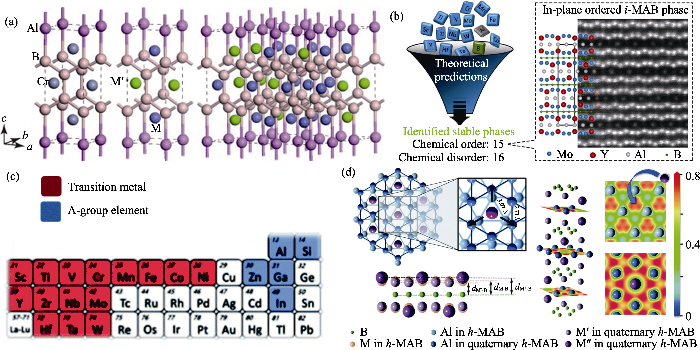
(a) Crystal structure of Cr3AlB4, ordered M2M'AlB4, and disordered M2M'AlB4[186]; (b) Prediction and synthesis of i-MAB phases Mo4/3Sc2/3AlB2 and Mo4/3Y2/3AlB2[16]; (c) Elemental mapping involved in this computational work; (d) Schematic illustration of the evolution of structure and electronic structure of h-MAB during the introduction of the fourth element M″[187]
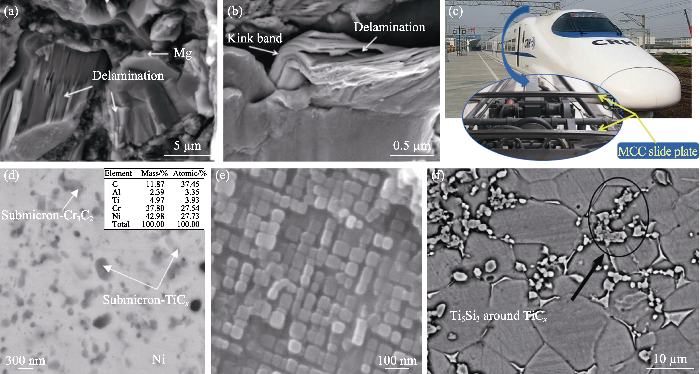
(a-b) Fracture morphology of MAX in Mg matrix composites undergoing microplastic deformation[213]; (c) MAX/Cu matrix composite MCC pantograph slide plate[215]; (d, e) Transformation of MAX to TiCx and Cr3C2 in Ni matrix composites and morphology of in situ authentic γ'[224]; (f) Morphology of the MAX transformation to TiCx and Ti5Si3 in Ti matrix composites[225]
Fig. 18
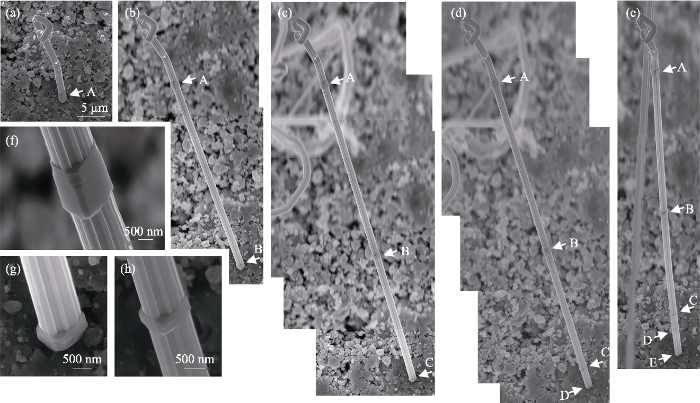
SEM images of a Sn whisker alternately cultivated in air and vacuum[259]
(a-e) For once, twice, 3 times, 4 times, and 5 times, respectively with faceted segments formed in vacuum being pointed by white arrows; (f-h) High magnification SEM images of the faceted segments indicated by arrow A in (b), arrow C in (c), and arrow C in (d), respectively
Fig. 19
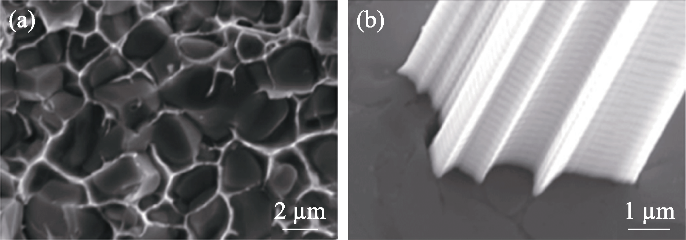
SEM images of fractured Zr2InC surface and an In whisker[243]
(a) Fractured Zr2InC surface showing In at grain boundaries (this surface being covered with thin In film); (b) An In whisker whose cross-sectional shape is determined by grain boundary geometry at the In/Zr2InC interface
Fig. 21
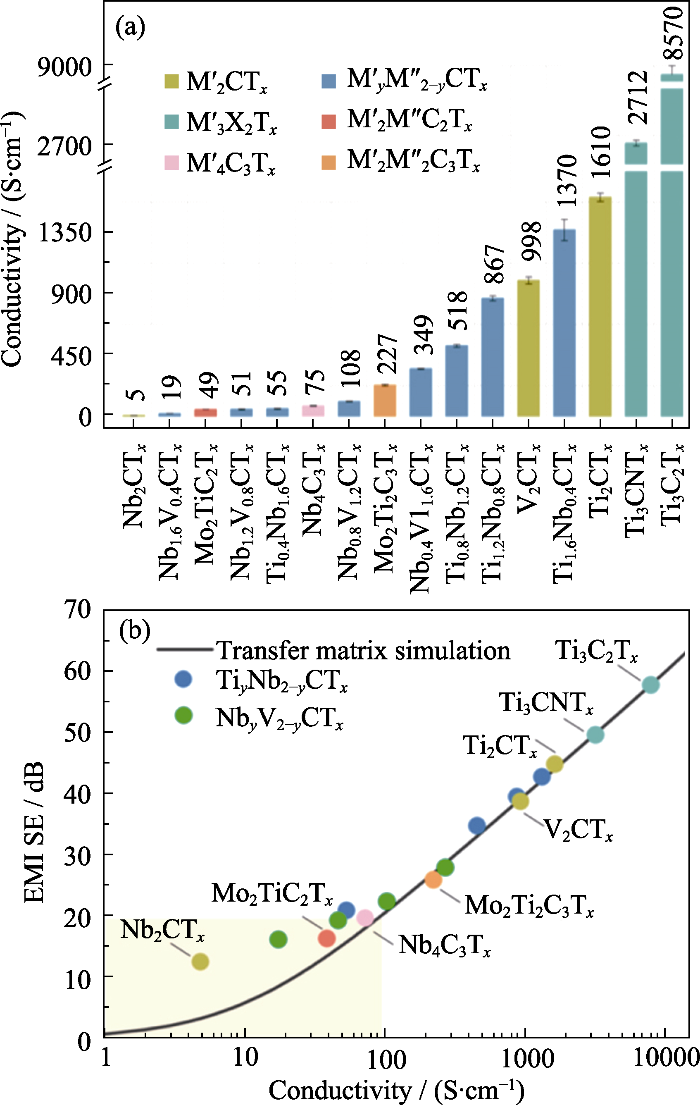
(a) Electrical conductivity of different MXene films and (b) conductivity-dependent electromagnetic interference shielding effectiveness of different MXenes[282]
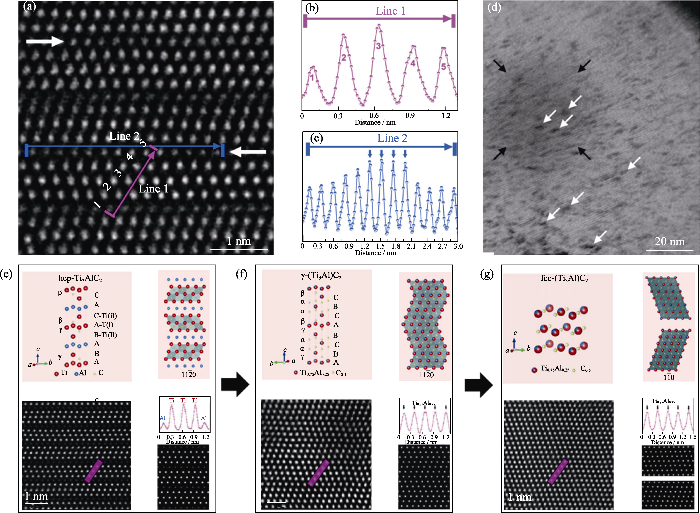
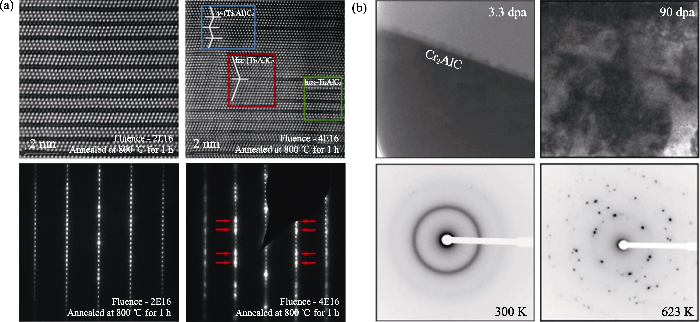
Fig. 22
Defect generation and microstructural transformation in MAX phase materials under irradiation
(a) STEM HAADF (high-angle annular dark-field) image along [11¯20] of Ti3AlC2 irradiated with 1 MeV Au ions, showing direct evidence of cation antisite defects. The white arrows indicate the initial Al layers, whose image contrast is altered when compared with the initial hexagonal structure[295]; (b, c) Contrast profiles along line 1 and line 2 in (a), respectively, which directly show the variation of contrast arising from the formation of TiAl-AlTi antisite defects produced by ion irradiation[295]; (d) TEM image of Ti3(Si,Al)C2 being irradiated at 0.2 dpa indicating a cluster of point defects (black dots)[296]; (e-g) Phase transformation (hcp to γ to fcc solid solution) processes with chemical disorder induced by ion irradiation in a typical MAX phase, Ti3AlC2 (hcp: hexagonal close packing; fcc: face-centered cubic)[295]
(a) Ti3AlC2 is completely recovered to initial phase (a dose of 2×1016 cm-2) or partially recovered to initial phase and γ-Ti3AlC2 phase (a dose of 4×1016 cm-2) after irradiation with 1 MeV Au ions and then annealed at 800 ℃ for 1 h[303]; (b) Cr2AlC films showing completely amorphous after irradiation with 320 keV Xe ions up to 3.3 dpa at 300 K, but not completely amorphized after irradiation up to 90 dpa at 623 K[306]
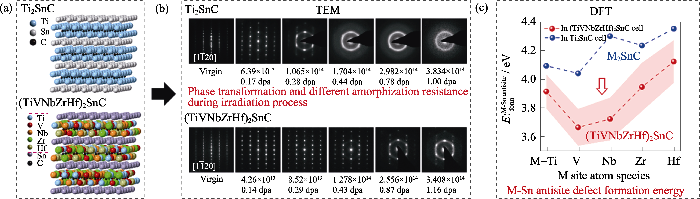
Fig. 24
Phase transformation and amorphization caused by irradiation of MAX phases[302]
(a) Schematic of atomic structure models of Ti2SnC and (TiVNbZrHf)2SnC; (b) In-situ selective area electron diffraction (SAED) micrographs of Ti2SnC and five-component (TiVNbZrHf)2SnC recorded during 800 keV Kr2+ irradiation, showing different phase transformation process and amorphization resistance; (c) M-Sn antisite defect formation energies calculated via DFT in the corresponding single-component M2SnC and the five-component (TiVNbZrHf)2SnC supercell
Ternary borides Cr2AlB2, Cr3AlB4, and Cr4AlB6: the first members of the series (CrB2)nCrAl with n= 1, 2, 3 and a unifying concept for ternary borides as MAB-phases
\n M\n \n n+1\n \n AX\n \n n\n \n phases are a family of inherently nanolaminated ternary compounds with hexagonal crystal structure (space group\n P\n \n 63\n \n /mmc\n,\n 194\n ). Here, M is vanadium element, and\n A\n is Fe, Co, Ni, Mn, or their binary/ternary/quaternary mixtures. Due to the elemental flexibility at A site, 15 nanolaminated V\n 2\n (\n A\n x\n Sn\n 1-x\n )C MAX phases are synthesized, including 1 high-entropy MAX phase that all Fe, Co, Ni, Mn, and Sn elements simultaneously occupied A site. Tailoring of individual single–atom-thick layers in nanolaminated MAX phases offers atomic-level control of material properties, such as their distinct magnetic behaviors. The alloying in 2-dimensional A layer of MAX phases provides a unique route to design their crystal structure and to discover unexploited properties, which would develop promising functional materials for microelectronic device.\n
LIZ, WUE, CHENK, et al.
Chalcogenide MAX phases Zr2Se(B1-xSex)(x=0-0.97) and their conduction behaviors
The exploration of two-dimensional solids is an active area of materials discovery. Research in this area has given us structures spanning graphene to dichalcogenides, and more recently 2D transition metal carbides (MXenes). One of the challenges now is to master ordering within the atomic sheets. Herein, we present a top-down, high-yield, facile route for the controlled introduction of ordered divacancies in MXenes. By designing a parent 3D atomic laminate, (Mo2/3Sc1/3)2AlC, with in-plane chemical ordering, and by selectively etching the Al and Sc atoms, we show evidence for 2D Mo1.33C sheets with ordered metal divacancies and high electrical conductivities. At ∼1,100 F cm−3, this 2D material exhibits a 65% higher volumetric capacitance than its counterpart, Mo2C, with no vacancies, and one of the highest volumetric capacitance values ever reported, to the best of our knowledge. This structural design on the atomic scale may alter and expand the concept of property-tailoring of 2D materials.
RACKLT, EISENBURGERL, NIKLAUSR, et al.
Syntheses and physical properties of the MAX phase boride Nb2SB and the solid solutions Nb2SBxC-x (x=0-1)
Mn+1AXn phases are a large family of compounds that have been limited, so far, to carbides and nitrides. Here we report the prediction of a compound, Ti2InB2, a stable boron-based ternary phase in the Ti-In-B system, using a computational structure search strategy. This predicted Ti2InB2 compound is successfully synthesized using a solid-state reaction route and its space group is confirmed as P$$\\bar 6$$\n \n \n 6\n \n ¯\n \n m2 (No. 187), which is in fact a hexagonal subgroup of P63/mmc (No. 194), the symmetry group of conventional Mn+1AXn phases. Moreover, a strategy for the synthesis of MXenes from Mn+1AXn phases is applied, and a layered boride, TiB, is obtained by the removal of the indium layer through dealloying of the parent Ti2InB2 at high temperature under a high vacuum. We theoretically demonstrate that the TiB single layer exhibits superior potential as an anode material for Li/Na ion batteries than conventional carbide MXenes such as Ti3C2.
CHENK, BAIX, MUX, et al.
MAX phase Zr2SeC and its thermal conduction behavior
Journal of the European Ceramic Society, 2021, 41(8):4447.
\n A range of two-dimensional (2D) materials, including graphene and hexagonal boron nitride, have been synthesized and studied because of the unusual properties that occur when one dimension becomes very small. MXenes are a family of materials made of layers of inorganic transition metal carbides and nitrides that are a few atoms thick and are manufactured by selective etching. Attempts to make similar boridene materials have been challenging because of the reactive nature of boride phases and because the parent materials tend to dissolve rather than selectively etch. Zhou\n et al\n. synthesized boridene in the form of single-layer 2D molybdenum boride sheets by selective etching in aqueous hydrofluoric acid to produce sheets with ordered metal vacancies, opening up an additional family of materials for study. —MSL\n
DINGH, LIY, LIM, et al.
Chemical scissor-mediated structural editing of layered transition metal carbides
Intercalated layered materials offer distinctive properties and serve as precursors for important two-dimensional (2D) materials. However, intercalation of non–van der Waals structures, which can expand the family of 2D materials, is difficult. We report a structural editing protocol for layered carbides (MAX phases) and their 2D derivatives (MXenes). Gap-opening and species-intercalating stages were respectively mediated by chemical scissors and intercalants, which created a large family of MAX phases with unconventional elements and structures, as well as MXenes with versatile terminals. The removal of terminals in MXenes with metal scissors and then the stitching of 2D carbide nanosheets with atom intercalation leads to the reconstruction of MAX phases and a family of metal-intercalated 2D carbides, both of which may drive advances in fields ranging from energy to printed electronics.
DUZ, YANGS, LIS, et al.
Conversion of non-van der Waals solids to 2D transition-metal chalcogenides
Nanolaminated ternary transition metal carbide (MAX phase)-derived core-shell structure electrocatalysts for hydrogen evolution and oxygen evolution reactions in alkaline electrolytes
The Journal of Physical Chemistry Letters, 2023, 14:481.
Organic-base-driven intercalation and delamination for the production of functionalized titanium carbide nanosheets with superior photothermal therapeutic performance
Angewandte Chemie International Edition, 2016, 128(47):14789.
Structural bidimensional transition-metal carbides and/or nitrides (MXenes) have drawn the attention of the material science research community thanks to their unique physical-chemical properties. However, a facile and cost-effective synthesis of MXenes has not yet been reported. Here, using elemental precursors, we report a method for MXene synthesis via titanium aluminium carbide formation and subsequent in situ etching in one molten salt pot. The molten salts act as the reaction medium and prevent the oxidation of the reactants during the high-temperature synthesis process, thus enabling the synthesis of MXenes in an air environment without using inert gas protection. Cl-terminated Ti3C2Tx and Ti2CTx MXenes are prepared using this one-pot synthetic method, where the in situ etching step at 700 °C requires only approximately 10 mins. Furthermore, when used as an active material for nonaqueous Li-ion storage in a half-cell configuration, the obtained Ti2CTx MXene exhibits lithiation capacity values of approximately 280 mAh g−1 and 160 mAh g−1 at specific currents of 0.1 A g−1 and 2 A g−1, respectively.
CHENJ, JINQ, LIY, et al.
Molten salt-shielded synthesis (MS3) of MXenes in air
Energy & Environmental Materials, 2023, 6(2): e12328.
Versatile chemical transformations of surface functional groups in\n two-dimensional transition-metal carbides (MXenes) open up a previously unexplored\n design space for this broad class of functional materials. We introduce a general\n strategy to install and remove surface groups by performing substitution and\n elimination reactions in molten inorganic salts. Successful synthesis of MXenes\n with oxygen, imido, sulfur, chlorine, selenium, bromine, and tellurium surface\n terminations, as well as bare MXenes (no surface termination), was demonstrated.\n These MXenes show distinctive structural and electronic properties. For example,\n the surface groups control interatomic distances in the MXene lattice, and\n Tin+1Cn\n (n = 1, 2) MXenes terminated with telluride\n (Te2−) ligands show a giant (>18%) in-plane lattice\n expansion compared with the unstrained titanium carbide lattice. The surface\n groups also control superconductivity of niobium carbide MXenes.
CUIS, FENGW, HUH, et al.
Hexagonal Ti2SC with high hardness and brittleness: a first-principles study
A comparative study the structural, mechanical, and electronic properties of medium- entropy MAX phase (TiZrHf)2SC with Ti2SC, Zr2SC, Hf2SC via first-principles
Journal of Materials Research and Technology, 2022, 19:2717.
In this paper, Zr2SB ceramic with purity of 82.95 wt% (containing 8.96 wt% ZrB2 and 8.09 wt% zirconium) and high relative density (99.03%) was successfully synthesized from ZrH2, sublimated sulfur, and boron powders by spark plasma sintering (SPS) at 1300 °C. The reaction process, microstructure, and physical and mechanical properties of Zr2SB ceramic were systematically studied. The results show that the optimum molar ratio to synthesize Zr2SB is n(ZrH2):n(S):n(B) = 1.4:1.6:0.7. The average grain size of Zr2SB is 12.46 µm in length and 5.12 µm in width, and the mean grain sizes of ZrB2 and zirconium impurities are about 300 nm. In terms of physical properties, the measured thermal expansion coefficient (TEC) is 7.64×10⁻⁶ K−1 from room temperature to 1200 °C, and the thermal capacity and thermal conductivity at room temperature are 0.39 J·g−1·K−1 and 12.01 W·m−1·K−1, respectively. The room temperature electrical conductivity of Zr2SB ceramic is measured to be 1.74×10⁶ Ω−1·m−1. In terms of mechanical properties, Vickers hardness is 9.86±0.63 GPa under 200 N load, and the measured flexural strength, fracture toughness, and compressive strength are 269±12.7 MPa, 3.94±0.63 MPa·m1/2, and 2166.74±291.34 MPa, respectively.
QINY, ZHOUY, FANL, et al.
Synthesis and characterization of ternary layered Nb2SB ceramics fabricated by spark plasma sintering
Journal of Alloys and Compounds, 2021, 878: 160344.
Herein we report on the room-temperature spontaneous growth of Ga freestanding nanoribbons from Cr2GaC surfaces. An oxidation-based model is proposed to explain the growth of the nanostructures. The nanoribbons present a unique opportunity to study the behavior of electrons confined to two dimensions. The production of these Ga nanostructures could be the first step in the manufacture of gallium arsenide or nitride devices with enhanced characteristics for photonic, electronic, and catalytic applications.
WANGX, ZHOUY.
Layered machinable and electrically conductive Ti2AlC and Ti3AlC2 ceramics: a review
Journal of Materials Science & Technology, 2010, 26(5):385.
Low temperature thermal expansion, high temperature electrical conductivity, and mechanical properties of Nb4AlC3 ceramic synthesized by spark plasma sintering
Journal of Alloys and Compounds, 2009, 487(1/2):675.
The ‘MAlB’ phases are nanolaminated, ternary transition metal borides that consist of a transition metal boride sublattice interleaved by monolayers or bilayers of pure aluminum. However, their synthesis and properties remain largely unexplored. Herein, we synthesized dense, predominantly single-phase samples of one such compound, MoAlB, using a reactive hot pressing method. High-resolution scanning transmission electron microscopy confirmed the presence of two Al layers in between a Mo-B sublattice. Unique among the transition metal borides, MoAlB forms a dense, alumina scale when heated in air. Like other alumina formers, the oxidation kinetics follow a cubic time-dependence. At room temperature, its resistivity is low (0.36–0.49 μΩm) and – like a metal – drops linearly with decreasing temperatures. It is also a good thermal conductor (35 Wm−1K−1 at 26 °C). In the 25–1300 °C temperature range, its thermal expansion coefficient is 9.5 × 10⁻⁶K−1. Preliminary results suggest the compound is stable to at least 1400 °C in inert atmospheres. Moderately low Vickers hardness values of 10.6 ± 0.3 GPa, compared to other transition metal borides, and ultimate compressive strengths up to 1940 ± 103 MPa were measured at room temperature. These results are encouraging and warrant further study of this compound for potential use at high temperatures.
LIN, BAIY, WANGS, et al.
Rapid synthesis, electrical, and mechanical properties of polycrystalline Fe2AlB2 bulk from elemental powders
Journal of the American Ceramic Society, 2017, 100(10):4407.
Synthesis, characterization, properties, first principles calculations, and X-ray photoelectron spectroscopy of bulk Mn5SiB2 and Fe5SiB2 ternary borides
Journal of Alloys and Compounds, 2021, 888: 161377.
The ternary or quaternary layered compounds called MAB phases are frequently mentioned recently together with the well-known MAX phases. However, MAB phases are generally referred to layered transition metal borides, while MAX phases are layered transition metal carbides and nitrides with different types of crystal structure although they share the common nano-laminated structure characteristics. In order to prove that MAB phases can share the same type of crystal structure with MAX phases and extend the composition window of MAX phases from carbides and nitrides to borides, two new MAB phase compounds Zr2SeB and Hf2SeB with the Cr2AlC-type MAX phase (211 phase) crystal structure were discovered by a combination of first-principles calculations and experimental verification in this work. First-principles calculations predicted the stability and lattice parameters of the two new MAB phase compounds Zr2SeB and Hf2SeB. Then they were successfully synthesized by using a thermal explosion method in a spark plasma sintering (SPS) furnace. The crystal structures of Zr2SeB and Hf2SeB were determined by a combination of the X-ray diffraction (XRD), scanning electron microscopy (SEM), and high-resolution transmission electron microscopy (HRTEM). The lattice parameters of Zr2SeB and Hf2SeB are a = 3.64398 Å, c = 12.63223 Å and a = 3.52280 Å, c = 12.47804 Å, respectively. And the atomic positions are M at 4f (1/3, 2/3, 0.60288 [Zr] or 0.59889 [Hf]), Se at 2c (1/3, 2/3, 1/4), and B at 2a (0, 0, 0). And the atomic stacking sequences follow those of the Cr2AlC-type MAX phases. This work opens up the composition window for the MAB phases and MAX phases and will trigger the interests of material scientists and physicists to explore new compounds and properties in this new family of materials.
QIX, HEX, YINW, et al.
Stability trend, weak bonding, and magnetic properties of the Al-and Si-containing ternary-layered borides MAB phases
Journal of the American Ceramic Society, 2022, 106(2):1513.
By performing high-throughput calculations, we have successfully screened out a novel class of metal oxides MTa2O6 (M = Mg, Ca) as promising candidate thermoelectric materials for high-temperature applications.
GANY, HUANGY, MIAON, et al.
Novel IV-V-VI semiconductors with ultralow lattice thermal conductivity
Journal of Materials Chemistry C, 2021, 9(12):4189.
Layered IV-V-VI semiconductors have immense potential for thermoelectric (TE) applications due to their intrinsically ultralow lattice thermal conductivity. However, it is extremely difficult to assess their TE performance via experimental trial-and-error methods. Here, we present a machine-learning-based approach to accelerate the discovery of promising thermoelectric candidates in this chalcogenide family. Based on a dataset generated from high-throughput ab initio calculations, we develop two highly accurate-and-efficient neural network models to predict the maximum ZT (ZTmax) and corresponding doping type, respectively. The top candidate, n-type Pb2Sb2S5, is successfully identified, with the ZTmax over 1.0 at 650 K, owing to its ultralow thermal conductivity and decent power factor. Besides, we find that n-type Te-based compounds exhibit a combination of high Seebeck coefficient and electrical conductivity, thereby leading to better TE performance under electron doping than hole doping. Whereas p-type TE performance of Se-based semiconductors is superior to n-type, resulting from large Seebeck coefficient induced by high density-of-states near valence band edges.
ALAMEDAL T, LORDR W, BARRJ A, et al.
Multi-step topochemical pathway to metastable Mo2AlB2 and related two- dimensional nanosheet heterostructures
Journal of the American Chemical Society, 2019, 141(27):10852.
The synthesis methods, properties and applications for energy storage and electrocatalysis of MBenes were summarized. Furthermore, discussions and perspectives on the existing problems, major challenges and future development of MBenes were provided.
XIANGH, FENGZ, LIZ, et al.
Theoretical investigations on mechanical and dynamical properties of MAlB (M= Mo, W) nanolaminated borides at ground-states and elevated temperatures
The investigation of electronic, anisotropic elastic and lattice dynamical properties of MAB phase nanolaminated ternary borides: M2AlB2 (M=Mn, Fe and Co) under spin effects
Journal of Alloys and Compounds, 2020, 838: 155436.
First-principle calculations on the structure, electronic property and catalytic activity for hydrogen evolution reaction of 2D transition-metal borides
Materials Chemistry and Physics, 2020, 253: 123334.
22 stable quaternary h-MAB phases were predicted and a stability mechanism was proposed. Theoretical simulations proved the possibility of exfoliating h-MBenes and show that the predicted bi-metal h-MBenes have a great advantage in HER.
Investigation of the preparation and tribological behavior of a frictional interface covered with sinusoidal microchannels containing SnAgCu and Ti3SiC2
In-situ TiC and γ′-Ni3(Al,Ti) triggered microstructural modification and strengthening of Ni matrix composite by reactive hot-press sintering pure Ni and Ti2AlC precursor
\n Bulk samples of the layered ternary nitride Cr\n 2\n GaN were observed to extrude filaments of pure elemental gallium at room temperature. This self-extrusion phenomenon is best described as a room-temperature deintercalation of gallium from the basal planes of porous Cr\n 2\n GaN samples. The extruded filaments are single crystals with 2- to 100-micrometer diameters and can be several centimeters long.\n
BARSOUMM W, HOFFMANE N, DOHERTYR D, et al.
Driving force and mechanism for spontaneous metal whisker formation
Low-temperature instability of Ti2SnC: a combined transmission electron microscopy, differential scanning calorimetry, and X-ray diffraction investigations
Transmission electron microscopy (TEM), differential scanning calorimetry (DSC), and x-ray diffraction (XRD) investigations were conducted on the hot-pressed Ti2SnC bulk ceramic. Microstructure features of bulk Ti2SnC ceramic were characterized by using TEM, and a needle-shaped β-Sn precipitation was observed inside Ti2SnC grains with the orientation relationship: (0001) Ti2SnC // (200) Sn and Ti2SnC // [001] Sn. With the combination of DSC and XRD analyses, the precipitation of metallic Sn was demonstrated to be a thermal stress-induced process during the cooling procedure. The reheating temperature, even as low as 400 °C, could trigger the precipitation of Sn from Ti2SnC, which indicated the low-temperature instability of Ti2SnC. A substoichiometry Ti2SnxC formed after depletion of Sn from ternary Ti2SnC phase. Under electron beam irradiation, metallic Sn was observed diffusing back into Ti2SnxC. Furthermore, a new Ti7SnC6 phase with the lattice constants of a = 0.32 and c = 4.1 nm was identified and added in the Ti-Sn-C ternary system.
ZHANGP, ZHANGY, SUNZ.
Spontaneous growth of metal whiskers on surfaces of solids: a review
Journal of Materials Science & Technology, 2015, 31(7):675.
KIRSCHM, GONZALEZO, AGUILARM, et al. NASA engineering and safety center technical assessment report: national highway traffic safety administration Toyota unintended acceleration investigation. (2011-01-18) [2023-04-24]. https://static.nhtsa.gov/odi/inv/2014/INRP-DP14003-61483.pdf
The microstructure dependent electromagnetic interference (EMI) shielding properties of nano-layered Ti3AlC2 ceramics were presented in this study by comparing the shielding properties of various Ti3AlC2 ceramics with distinct microstructures. Results indicate that Ti3AlC2 ceramics with dense microstructure and coarse grains are more favourable for superior EMI shielding efficiency. High EMI shielding effectiveness over 40 dB at the whole Ku-band frequency range was achieved in Ti3AlC2 ceramics by microstructure optimization, and the high shielding effectiveness were well maintained up to 600 °C. A further investigation reveals that only the absorption loss displays variations upon modifying microstructure by allowing more extensive multiple reflections in coarse layered grains. Moreover, the absorption loss of Ti3AlC2 was found to be much higher than those of highly conductive TiC ceramics without layered structure. These results demonstrate that nano-layered MAX phase ceramics are promising candidates of high-temperature structural EMI shielding materials and provide insightful suggestions for achieving high EMI shielding efficiency in other ceramic-based shielding materials.
TANY, LUOH, ZHANGH, et al.
High-temperature electromagnetic interference shielding of layered Ti3AlC2 ceramics
\n Materials with good flexibility and high conductivity that can provide electromagnetic interference (EMI) shielding with minimal thickness are highly desirable, especially if they can be easily processed into films. Two-dimensional metal carbides and nitrides, known as MXenes, combine metallic conductivity and hydrophilic surfaces. Here, we demonstrate the potential of several MXenes and their polymer composites for EMI shielding. A 45-micrometer-thick Ti\n 3\n C\n 2\n T\n x\n film exhibited EMI shielding effectiveness of 92 decibels (>50 decibels for a 2.5-micrometer film), which is the highest among synthetic materials of comparable thickness produced to date. This performance originates from the excellent electrical conductivity of Ti\n 3\n C\n 2\n T\n x\n films (4600 Siemens per centimeter) and multiple internal reflections from Ti\n 3\n C\n 2\n T\n x\n flakes in free-standing films. The mechanical flexibility and easy coating capability offered by MXenes and their composites enable them to shield surfaces of any shape while providing high EMI shielding efficiency.\n
HANM, YINX, WUH, et al.
Ti3C2 MXenes with modified surface for high-performance electromagnetic absorption and shielding in the X-band
Atomic disordering in materials alters their physical and chemical properties and can subsequently affect their performance. In complex ceramic materials, it is a challenge to understand the nature of structural disordering, due to the difficulty of direct, atomic-scale experimental observations. Here we report the direct imaging of ion irradiation-induced antisite defects in Mn+1AXn phases using double CS-corrected scanning transmission electron microscopy and provide compelling evidence of order-to-disorder phase transformations, overturning the conventional view that irradiation causes phase decomposition to binary fcc-structured Mn+1Xn. With the formation of uniformly distributed cation antisite defects and the rearrangement of X anions, disordered solid solution γ-(Mn+1A)Xn phases are formed at low ion fluences, followed by gradual transitions to solid solution fcc-structured (Mn+1A)Xn phases. This study provides a comprehensive understanding of the order-to-disorder transformations in Mn+1AXn phases and proposes a method for the synthesis of new solid solution (Mn+1A)Xn phases by tailoring the disorder.
LEFLEM M, LIUX, DORIOTS, et al.
Irradiation damage in Ti3(Si,Al)C2: a TEM investigation
International Journal of Applied Ceramic Technology, 2010, 7(6):766.
Ti3AlC2, a candidate structural material for innovative nuclear energy system: the microstructure phase transformation and defect evolution induced by energetic heavy-ion irradiation
Configurational disorder can be compositionally engineered into mixed oxide by populating a single sublattice with many distinct cations. The formulations promote novel and entropy-stabilized forms of crystalline matter where metal cations are incorporated in new ways. Here, through rigorous experiments, a simple thermodynamic model, and a five-component oxide formulation, we demonstrate beyond reasonable doubt that entropy predominates the thermodynamic landscape, and drives a reversible solid-state transformation between a multiphase and single-phase state. In the latter, cation distributions are proven to be random and homogeneous. The findings validate the hypothesis that deliberate configurational disorder provides an orthogonal strategy to imagine and discover new phases of crystalline matter and untapped opportunities for property engineering.
High-entropy ceramics (HECs) are solid solutions of inorganic compounds with one or more Wyckoff sites shared by equal or near-equal atomic ratios of multi-principal elements. Although in the infant stage, the emerging of this new family of materials has brought new opportunities for material design and property tailoring. Distinct from metals, the diversity in crystal structure and electronic structure of ceramics provides huge space for properties tuning through band structure engineering and phonon engineering. Aside from strengthening, hardening, and low thermal conductivity that have already been found in high-entropy alloys, new properties like colossal dielectric constant, super ionic conductivity, severe anisotropic thermal expansion coefficient, strong electromagnetic wave absorption, etc., have been discovered in HECs. As a response to the rapid development in this nascent field, this article gives a comprehensive review on the structure features, theoretical methods for stability and property prediction, processing routes, novel properties, and prospective applications of HECs. The challenges on processing, characterization, and property predictions are also emphasized. Finally, future directions for new material exploration, novel processing, fundamental understanding, in-depth characterization, and database assessments are given.
... In 1960, Ti2SC was synthesized[40]; From 1960 to 1966, a large number of ternary layered carbides/nitrides (H-phases) with an M2AX formula (211 type) were synthesized[41-42]; From 1967 to 1968, Ti3SiC2 (312 type) and a set of 312 and 211 types H-phases were produced[41,43-44]; In 1969, a typical ternary layered boride Fe2AlB2 was synthesized[7]; In 1994, Ti3AlC2 was discovered[45]; In 1996, the high purity Ti3SiC2 was produced and exhibited excellent properties, thus triggering the research upsurge to these materials[46]; In 2000, Barsoum[1] renamed H-phases as Mn+1AXn phases, short for MAX phases; In 2011, the first MXene Ti3C2Tx was discovered[28]; In 2013, the discovery of magnetocaloric effect of Fe2AlB2 raised research upsurge on ternary layered borides[9]. Also, Lu2SnC was synthesized and found to be superconducting[47]; In 2014, an o-MAX (Cr2/3Ti1/3)3AlC2 was synthesized[48]; In 2015, ternary layered borides were named as MAB phases. In addition, the first Zr-based MAX phase was discovered[10,49]; In 2017, an i-MAX (Mo2/3Sc1/3)2AlC and two noble-metal MAX phases Ti3AuC2 and Ti3IrC2 were synthesized[22,50]; In 2019, a series of MAX phases containing Cu and Zn, and a hexagonal MAB phase Ti2InB2, as well as Nb2SBxC1-x (x=0-1) were synthesized[24⇓-26,51,52]; In 2020, two i-MAB phases (Mo2/3Sc1/3)2AlB2 and (Mo2/3Y1/3)2AlB2, as well as a variety of MAX phases containing Fe, Co, Ni, and Mn were synthesized[16,19]; In 2021, MAX phases having Se atoms at the A-site were produced[53]; In 2022, o-MAX phase Ti4MoSiB2, the first MBene, and Zr2Se(B1-xSex) were synthesized[20,54-55]; In 2023, a chemical scissor-mediated structural editing strategy was proposed, which extremely expands the diversity of MAX phases and MXene[56] ...
... In 1960, Ti2SC was synthesized[40]; From 1960 to 1966, a large number of ternary layered carbides/nitrides (H-phases) with an M2AX formula (211 type) were synthesized[41-42]; From 1967 to 1968, Ti3SiC2 (312 type) and a set of 312 and 211 types H-phases were produced[41,43-44]; In 1969, a typical ternary layered boride Fe2AlB2 was synthesized[7]; In 1994, Ti3AlC2 was discovered[45]; In 1996, the high purity Ti3SiC2 was produced and exhibited excellent properties, thus triggering the research upsurge to these materials[46]; In 2000, Barsoum[1] renamed H-phases as Mn+1AXn phases, short for MAX phases; In 2011, the first MXene Ti3C2Tx was discovered[28]; In 2013, the discovery of magnetocaloric effect of Fe2AlB2 raised research upsurge on ternary layered borides[9]. Also, Lu2SnC was synthesized and found to be superconducting[47]; In 2014, an o-MAX (Cr2/3Ti1/3)3AlC2 was synthesized[48]; In 2015, ternary layered borides were named as MAB phases. In addition, the first Zr-based MAX phase was discovered[10,49]; In 2017, an i-MAX (Mo2/3Sc1/3)2AlC and two noble-metal MAX phases Ti3AuC2 and Ti3IrC2 were synthesized[22,50]; In 2019, a series of MAX phases containing Cu and Zn, and a hexagonal MAB phase Ti2InB2, as well as Nb2SBxC1-x (x=0-1) were synthesized[24⇓-26,51,52]; In 2020, two i-MAB phases (Mo2/3Sc1/3)2AlB2 and (Mo2/3Y1/3)2AlB2, as well as a variety of MAX phases containing Fe, Co, Ni, and Mn were synthesized[16,19]; In 2021, MAX phases having Se atoms at the A-site were produced[53]; In 2022, o-MAX phase Ti4MoSiB2, the first MBene, and Zr2Se(B1-xSex) were synthesized[20,54-55]; In 2023, a chemical scissor-mediated structural editing strategy was proposed, which extremely expands the diversity of MAX phases and MXene[56] ...
... In 1960, Ti2SC was synthesized[40]; From 1960 to 1966, a large number of ternary layered carbides/nitrides (H-phases) with an M2AX formula (211 type) were synthesized[41-42]; From 1967 to 1968, Ti3SiC2 (312 type) and a set of 312 and 211 types H-phases were produced[41,43-44]; In 1969, a typical ternary layered boride Fe2AlB2 was synthesized[7]; In 1994, Ti3AlC2 was discovered[45]; In 1996, the high purity Ti3SiC2 was produced and exhibited excellent properties, thus triggering the research upsurge to these materials[46]; In 2000, Barsoum[1] renamed H-phases as Mn+1AXn phases, short for MAX phases; In 2011, the first MXene Ti3C2Tx was discovered[28]; In 2013, the discovery of magnetocaloric effect of Fe2AlB2 raised research upsurge on ternary layered borides[9]. Also, Lu2SnC was synthesized and found to be superconducting[47]; In 2014, an o-MAX (Cr2/3Ti1/3)3AlC2 was synthesized[48]; In 2015, ternary layered borides were named as MAB phases. In addition, the first Zr-based MAX phase was discovered[10,49]; In 2017, an i-MAX (Mo2/3Sc1/3)2AlC and two noble-metal MAX phases Ti3AuC2 and Ti3IrC2 were synthesized[22,50]; In 2019, a series of MAX phases containing Cu and Zn, and a hexagonal MAB phase Ti2InB2, as well as Nb2SBxC1-x (x=0-1) were synthesized[24⇓-26,51,52]; In 2020, two i-MAB phases (Mo2/3Sc1/3)2AlB2 and (Mo2/3Y1/3)2AlB2, as well as a variety of MAX phases containing Fe, Co, Ni, and Mn were synthesized[16,19]; In 2021, MAX phases having Se atoms at the A-site were produced[53]; In 2022, o-MAX phase Ti4MoSiB2, the first MBene, and Zr2Se(B1-xSex) were synthesized[20,54-55]; In 2023, a chemical scissor-mediated structural editing strategy was proposed, which extremely expands the diversity of MAX phases and MXene[56] ...
Ternary borides Cr2AlB2, Cr3AlB4, and Cr4AlB6: the first members of the series (CrB2)nCrAl with n= 1, 2, 3 and a unifying concept for ternary borides as MAB-phases
... In 1960, Ti2SC was synthesized[40]; From 1960 to 1966, a large number of ternary layered carbides/nitrides (H-phases) with an M2AX formula (211 type) were synthesized[41-42]; From 1967 to 1968, Ti3SiC2 (312 type) and a set of 312 and 211 types H-phases were produced[41,43-44]; In 1969, a typical ternary layered boride Fe2AlB2 was synthesized[7]; In 1994, Ti3AlC2 was discovered[45]; In 1996, the high purity Ti3SiC2 was produced and exhibited excellent properties, thus triggering the research upsurge to these materials[46]; In 2000, Barsoum[1] renamed H-phases as Mn+1AXn phases, short for MAX phases; In 2011, the first MXene Ti3C2Tx was discovered[28]; In 2013, the discovery of magnetocaloric effect of Fe2AlB2 raised research upsurge on ternary layered borides[9]. Also, Lu2SnC was synthesized and found to be superconducting[47]; In 2014, an o-MAX (Cr2/3Ti1/3)3AlC2 was synthesized[48]; In 2015, ternary layered borides were named as MAB phases. In addition, the first Zr-based MAX phase was discovered[10,49]; In 2017, an i-MAX (Mo2/3Sc1/3)2AlC and two noble-metal MAX phases Ti3AuC2 and Ti3IrC2 were synthesized[22,50]; In 2019, a series of MAX phases containing Cu and Zn, and a hexagonal MAB phase Ti2InB2, as well as Nb2SBxC1-x (x=0-1) were synthesized[24⇓-26,51,52]; In 2020, two i-MAB phases (Mo2/3Sc1/3)2AlB2 and (Mo2/3Y1/3)2AlB2, as well as a variety of MAX phases containing Fe, Co, Ni, and Mn were synthesized[16,19]; In 2021, MAX phases having Se atoms at the A-site were produced[53]; In 2022, o-MAX phase Ti4MoSiB2, the first MBene, and Zr2Se(B1-xSex) were synthesized[20,54-55]; In 2023, a chemical scissor-mediated structural editing strategy was proposed, which extremely expands the diversity of MAX phases and MXene[56] ...
... In 1960, Ti2SC was synthesized[40]; From 1960 to 1966, a large number of ternary layered carbides/nitrides (H-phases) with an M2AX formula (211 type) were synthesized[41-42]; From 1967 to 1968, Ti3SiC2 (312 type) and a set of 312 and 211 types H-phases were produced[41,43-44]; In 1969, a typical ternary layered boride Fe2AlB2 was synthesized[7]; In 1994, Ti3AlC2 was discovered[45]; In 1996, the high purity Ti3SiC2 was produced and exhibited excellent properties, thus triggering the research upsurge to these materials[46]; In 2000, Barsoum[1] renamed H-phases as Mn+1AXn phases, short for MAX phases; In 2011, the first MXene Ti3C2Tx was discovered[28]; In 2013, the discovery of magnetocaloric effect of Fe2AlB2 raised research upsurge on ternary layered borides[9]. Also, Lu2SnC was synthesized and found to be superconducting[47]; In 2014, an o-MAX (Cr2/3Ti1/3)3AlC2 was synthesized[48]; In 2015, ternary layered borides were named as MAB phases. In addition, the first Zr-based MAX phase was discovered[10,49]; In 2017, an i-MAX (Mo2/3Sc1/3)2AlC and two noble-metal MAX phases Ti3AuC2 and Ti3IrC2 were synthesized[22,50]; In 2019, a series of MAX phases containing Cu and Zn, and a hexagonal MAB phase Ti2InB2, as well as Nb2SBxC1-x (x=0-1) were synthesized[24⇓-26,51,52]; In 2020, two i-MAB phases (Mo2/3Sc1/3)2AlB2 and (Mo2/3Y1/3)2AlB2, as well as a variety of MAX phases containing Fe, Co, Ni, and Mn were synthesized[16,19]; In 2021, MAX phases having Se atoms at the A-site were produced[53]; In 2022, o-MAX phase Ti4MoSiB2, the first MBene, and Zr2Se(B1-xSex) were synthesized[20,54-55]; In 2023, a chemical scissor-mediated structural editing strategy was proposed, which extremely expands the diversity of MAX phases and MXene[56] ...
... (a) Crystal structure of Cr3AlB4, ordered M2M'AlB4, and disordered M2M'AlB4[186]; (b) Prediction and synthesis of i-MAB phases Mo4/3Sc2/3AlB2 and Mo4/3Y2/3AlB2[16]; (c) Elemental mapping involved in this computational work; (d) Schematic illustration of the evolution of structure and electronic structure of h-MAB during the introduction of the fourth element M″[187] ...
High-entropy 2D carbide mxenes: TiVNbMoC3 and TiVCrMoC3
... In 1960, Ti2SC was synthesized[40]; From 1960 to 1966, a large number of ternary layered carbides/nitrides (H-phases) with an M2AX formula (211 type) were synthesized[41-42]; From 1967 to 1968, Ti3SiC2 (312 type) and a set of 312 and 211 types H-phases were produced[41,43-44]; In 1969, a typical ternary layered boride Fe2AlB2 was synthesized[7]; In 1994, Ti3AlC2 was discovered[45]; In 1996, the high purity Ti3SiC2 was produced and exhibited excellent properties, thus triggering the research upsurge to these materials[46]; In 2000, Barsoum[1] renamed H-phases as Mn+1AXn phases, short for MAX phases; In 2011, the first MXene Ti3C2Tx was discovered[28]; In 2013, the discovery of magnetocaloric effect of Fe2AlB2 raised research upsurge on ternary layered borides[9]. Also, Lu2SnC was synthesized and found to be superconducting[47]; In 2014, an o-MAX (Cr2/3Ti1/3)3AlC2 was synthesized[48]; In 2015, ternary layered borides were named as MAB phases. In addition, the first Zr-based MAX phase was discovered[10,49]; In 2017, an i-MAX (Mo2/3Sc1/3)2AlC and two noble-metal MAX phases Ti3AuC2 and Ti3IrC2 were synthesized[22,50]; In 2019, a series of MAX phases containing Cu and Zn, and a hexagonal MAB phase Ti2InB2, as well as Nb2SBxC1-x (x=0-1) were synthesized[24⇓-26,51,52]; In 2020, two i-MAB phases (Mo2/3Sc1/3)2AlB2 and (Mo2/3Y1/3)2AlB2, as well as a variety of MAX phases containing Fe, Co, Ni, and Mn were synthesized[16,19]; In 2021, MAX phases having Se atoms at the A-site were produced[53]; In 2022, o-MAX phase Ti4MoSiB2, the first MBene, and Zr2Se(B1-xSex) were synthesized[20,54-55]; In 2023, a chemical scissor-mediated structural editing strategy was proposed, which extremely expands the diversity of MAX phases and MXene[56] ...
... In 1960, Ti2SC was synthesized[40]; From 1960 to 1966, a large number of ternary layered carbides/nitrides (H-phases) with an M2AX formula (211 type) were synthesized[41-42]; From 1967 to 1968, Ti3SiC2 (312 type) and a set of 312 and 211 types H-phases were produced[41,43-44]; In 1969, a typical ternary layered boride Fe2AlB2 was synthesized[7]; In 1994, Ti3AlC2 was discovered[45]; In 1996, the high purity Ti3SiC2 was produced and exhibited excellent properties, thus triggering the research upsurge to these materials[46]; In 2000, Barsoum[1] renamed H-phases as Mn+1AXn phases, short for MAX phases; In 2011, the first MXene Ti3C2Tx was discovered[28]; In 2013, the discovery of magnetocaloric effect of Fe2AlB2 raised research upsurge on ternary layered borides[9]. Also, Lu2SnC was synthesized and found to be superconducting[47]; In 2014, an o-MAX (Cr2/3Ti1/3)3AlC2 was synthesized[48]; In 2015, ternary layered borides were named as MAB phases. In addition, the first Zr-based MAX phase was discovered[10,49]; In 2017, an i-MAX (Mo2/3Sc1/3)2AlC and two noble-metal MAX phases Ti3AuC2 and Ti3IrC2 were synthesized[22,50]; In 2019, a series of MAX phases containing Cu and Zn, and a hexagonal MAB phase Ti2InB2, as well as Nb2SBxC1-x (x=0-1) were synthesized[24⇓-26,51,52]; In 2020, two i-MAB phases (Mo2/3Sc1/3)2AlB2 and (Mo2/3Y1/3)2AlB2, as well as a variety of MAX phases containing Fe, Co, Ni, and Mn were synthesized[16,19]; In 2021, MAX phases having Se atoms at the A-site were produced[53]; In 2022, o-MAX phase Ti4MoSiB2, the first MBene, and Zr2Se(B1-xSex) were synthesized[20,54-55]; In 2023, a chemical scissor-mediated structural editing strategy was proposed, which extremely expands the diversity of MAX phases and MXene[56] ...
... (a-d) First synthesized Se-containing MAX phase, Zr2SeC[53]; (e, f) First synthesized Te-containing MAX phase, Hf2TeB[93]; (h-j) First synthesized MAX phase with chalcogen at X site, Zr2Se(B1-xSex) with x at 0 (h), 0.60 (i), and 0.97 (j), respectively[20] ...
... In 1960, Ti2SC was synthesized[40]; From 1960 to 1966, a large number of ternary layered carbides/nitrides (H-phases) with an M2AX formula (211 type) were synthesized[41-42]; From 1967 to 1968, Ti3SiC2 (312 type) and a set of 312 and 211 types H-phases were produced[41,43-44]; In 1969, a typical ternary layered boride Fe2AlB2 was synthesized[7]; In 1994, Ti3AlC2 was discovered[45]; In 1996, the high purity Ti3SiC2 was produced and exhibited excellent properties, thus triggering the research upsurge to these materials[46]; In 2000, Barsoum[1] renamed H-phases as Mn+1AXn phases, short for MAX phases; In 2011, the first MXene Ti3C2Tx was discovered[28]; In 2013, the discovery of magnetocaloric effect of Fe2AlB2 raised research upsurge on ternary layered borides[9]. Also, Lu2SnC was synthesized and found to be superconducting[47]; In 2014, an o-MAX (Cr2/3Ti1/3)3AlC2 was synthesized[48]; In 2015, ternary layered borides were named as MAB phases. In addition, the first Zr-based MAX phase was discovered[10,49]; In 2017, an i-MAX (Mo2/3Sc1/3)2AlC and two noble-metal MAX phases Ti3AuC2 and Ti3IrC2 were synthesized[22,50]; In 2019, a series of MAX phases containing Cu and Zn, and a hexagonal MAB phase Ti2InB2, as well as Nb2SBxC1-x (x=0-1) were synthesized[24⇓-26,51,52]; In 2020, two i-MAB phases (Mo2/3Sc1/3)2AlB2 and (Mo2/3Y1/3)2AlB2, as well as a variety of MAX phases containing Fe, Co, Ni, and Mn were synthesized[16,19]; In 2021, MAX phases having Se atoms at the A-site were produced[53]; In 2022, o-MAX phase Ti4MoSiB2, the first MBene, and Zr2Se(B1-xSex) were synthesized[20,54-55]; In 2023, a chemical scissor-mediated structural editing strategy was proposed, which extremely expands the diversity of MAX phases and MXene[56] ...
... (a) Schematic illustration of Ti3SiC2 film covered by Au film on the SiC substrate[22]; (b) STEM image of Ti3SiC2 and its corresponding atomic model[22]; (c) Schematic illustration of preparing novel MAX phases and MXene based on a Lewis-acidic-molten-salt route[24]; (d) STEM image of Ti3ZnC2 and its corresponding atomic model[24]; (e) STEM image of Ti3C2Cl2 and its corresponding atomic model[24]; (f) Schematic illustration of the conversion from non-van der Waals solids to 2D transition-metal chalcogenides[57] ...
... [22]; (c) Schematic illustration of preparing novel MAX phases and MXene based on a Lewis-acidic-molten-salt route[24]; (d) STEM image of Ti3ZnC2 and its corresponding atomic model[24]; (e) STEM image of Ti3C2Cl2 and its corresponding atomic model[24]; (f) Schematic illustration of the conversion from non-van der Waals solids to 2D transition-metal chalcogenides[57] ...
Synthesis of novel MAX Phase Ti3ZnC2via A-site-element-substitution approach
... In 1960, Ti2SC was synthesized[40]; From 1960 to 1966, a large number of ternary layered carbides/nitrides (H-phases) with an M2AX formula (211 type) were synthesized[41-42]; From 1967 to 1968, Ti3SiC2 (312 type) and a set of 312 and 211 types H-phases were produced[41,43-44]; In 1969, a typical ternary layered boride Fe2AlB2 was synthesized[7]; In 1994, Ti3AlC2 was discovered[45]; In 1996, the high purity Ti3SiC2 was produced and exhibited excellent properties, thus triggering the research upsurge to these materials[46]; In 2000, Barsoum[1] renamed H-phases as Mn+1AXn phases, short for MAX phases; In 2011, the first MXene Ti3C2Tx was discovered[28]; In 2013, the discovery of magnetocaloric effect of Fe2AlB2 raised research upsurge on ternary layered borides[9]. Also, Lu2SnC was synthesized and found to be superconducting[47]; In 2014, an o-MAX (Cr2/3Ti1/3)3AlC2 was synthesized[48]; In 2015, ternary layered borides were named as MAB phases. In addition, the first Zr-based MAX phase was discovered[10,49]; In 2017, an i-MAX (Mo2/3Sc1/3)2AlC and two noble-metal MAX phases Ti3AuC2 and Ti3IrC2 were synthesized[22,50]; In 2019, a series of MAX phases containing Cu and Zn, and a hexagonal MAB phase Ti2InB2, as well as Nb2SBxC1-x (x=0-1) were synthesized[24⇓-26,51,52]; In 2020, two i-MAB phases (Mo2/3Sc1/3)2AlB2 and (Mo2/3Y1/3)2AlB2, as well as a variety of MAX phases containing Fe, Co, Ni, and Mn were synthesized[16,19]; In 2021, MAX phases having Se atoms at the A-site were produced[53]; In 2022, o-MAX phase Ti4MoSiB2, the first MBene, and Zr2Se(B1-xSex) were synthesized[20,54-55]; In 2023, a chemical scissor-mediated structural editing strategy was proposed, which extremely expands the diversity of MAX phases and MXene[56] ...
... (a) Schematic illustration of Ti3SiC2 film covered by Au film on the SiC substrate[22]; (b) STEM image of Ti3SiC2 and its corresponding atomic model[22]; (c) Schematic illustration of preparing novel MAX phases and MXene based on a Lewis-acidic-molten-salt route[24]; (d) STEM image of Ti3ZnC2 and its corresponding atomic model[24]; (e) STEM image of Ti3C2Cl2 and its corresponding atomic model[24]; (f) Schematic illustration of the conversion from non-van der Waals solids to 2D transition-metal chalcogenides[57] ...
... [24]; (e) STEM image of Ti3C2Cl2 and its corresponding atomic model[24]; (f) Schematic illustration of the conversion from non-van der Waals solids to 2D transition-metal chalcogenides[57] ...
... [24]; (f) Schematic illustration of the conversion from non-van der Waals solids to 2D transition-metal chalcogenides[57] ...
... (a) Schematic illustration of preparing MXene using HF solution as etchant[28]; (b) SEM image of Ti3C2Tx prepared by HF solution, showing the typical accordion-like morpholorgy of MXene particle[28]; (c) STEM image of Ti3C2Cl2 prepared by Lewis-acidic-molten-salt route, and its corresponding atomic model[24]; (d) Schematic illustration of preparing Ti3C2Tx MXene via a reaction between Ti3SiC2 and CuCl2; (e) Redox potential/Gibbs free energy between Lewis acid cations and A-site atoms in molten salts[30]; (f) Schematic illustration of the electrochemistry etching strategy for the preparation of MXene in molten salt[72] ...
... In 1960, Ti2SC was synthesized[40]; From 1960 to 1966, a large number of ternary layered carbides/nitrides (H-phases) with an M2AX formula (211 type) were synthesized[41-42]; From 1967 to 1968, Ti3SiC2 (312 type) and a set of 312 and 211 types H-phases were produced[41,43-44]; In 1969, a typical ternary layered boride Fe2AlB2 was synthesized[7]; In 1994, Ti3AlC2 was discovered[45]; In 1996, the high purity Ti3SiC2 was produced and exhibited excellent properties, thus triggering the research upsurge to these materials[46]; In 2000, Barsoum[1] renamed H-phases as Mn+1AXn phases, short for MAX phases; In 2011, the first MXene Ti3C2Tx was discovered[28]; In 2013, the discovery of magnetocaloric effect of Fe2AlB2 raised research upsurge on ternary layered borides[9]. Also, Lu2SnC was synthesized and found to be superconducting[47]; In 2014, an o-MAX (Cr2/3Ti1/3)3AlC2 was synthesized[48]; In 2015, ternary layered borides were named as MAB phases. In addition, the first Zr-based MAX phase was discovered[10,49]; In 2017, an i-MAX (Mo2/3Sc1/3)2AlC and two noble-metal MAX phases Ti3AuC2 and Ti3IrC2 were synthesized[22,50]; In 2019, a series of MAX phases containing Cu and Zn, and a hexagonal MAB phase Ti2InB2, as well as Nb2SBxC1-x (x=0-1) were synthesized[24⇓-26,51,52]; In 2020, two i-MAB phases (Mo2/3Sc1/3)2AlB2 and (Mo2/3Y1/3)2AlB2, as well as a variety of MAX phases containing Fe, Co, Ni, and Mn were synthesized[16,19]; In 2021, MAX phases having Se atoms at the A-site were produced[53]; In 2022, o-MAX phase Ti4MoSiB2, the first MBene, and Zr2Se(B1-xSex) were synthesized[20,54-55]; In 2023, a chemical scissor-mediated structural editing strategy was proposed, which extremely expands the diversity of MAX phases and MXene[56] ...
... In 1960, Ti2SC was synthesized[40]; From 1960 to 1966, a large number of ternary layered carbides/nitrides (H-phases) with an M2AX formula (211 type) were synthesized[41-42]; From 1967 to 1968, Ti3SiC2 (312 type) and a set of 312 and 211 types H-phases were produced[41,43-44]; In 1969, a typical ternary layered boride Fe2AlB2 was synthesized[7]; In 1994, Ti3AlC2 was discovered[45]; In 1996, the high purity Ti3SiC2 was produced and exhibited excellent properties, thus triggering the research upsurge to these materials[46]; In 2000, Barsoum[1] renamed H-phases as Mn+1AXn phases, short for MAX phases; In 2011, the first MXene Ti3C2Tx was discovered[28]; In 2013, the discovery of magnetocaloric effect of Fe2AlB2 raised research upsurge on ternary layered borides[9]. Also, Lu2SnC was synthesized and found to be superconducting[47]; In 2014, an o-MAX (Cr2/3Ti1/3)3AlC2 was synthesized[48]; In 2015, ternary layered borides were named as MAB phases. In addition, the first Zr-based MAX phase was discovered[10,49]; In 2017, an i-MAX (Mo2/3Sc1/3)2AlC and two noble-metal MAX phases Ti3AuC2 and Ti3IrC2 were synthesized[22,50]; In 2019, a series of MAX phases containing Cu and Zn, and a hexagonal MAB phase Ti2InB2, as well as Nb2SBxC1-x (x=0-1) were synthesized[24⇓-26,51,52]; In 2020, two i-MAB phases (Mo2/3Sc1/3)2AlB2 and (Mo2/3Y1/3)2AlB2, as well as a variety of MAX phases containing Fe, Co, Ni, and Mn were synthesized[16,19]; In 2021, MAX phases having Se atoms at the A-site were produced[53]; In 2022, o-MAX phase Ti4MoSiB2, the first MBene, and Zr2Se(B1-xSex) were synthesized[20,54-55]; In 2023, a chemical scissor-mediated structural editing strategy was proposed, which extremely expands the diversity of MAX phases and MXene[56] ...
... In 1960, Ti2SC was synthesized[40]; From 1960 to 1966, a large number of ternary layered carbides/nitrides (H-phases) with an M2AX formula (211 type) were synthesized[41-42]; From 1967 to 1968, Ti3SiC2 (312 type) and a set of 312 and 211 types H-phases were produced[41,43-44]; In 1969, a typical ternary layered boride Fe2AlB2 was synthesized[7]; In 1994, Ti3AlC2 was discovered[45]; In 1996, the high purity Ti3SiC2 was produced and exhibited excellent properties, thus triggering the research upsurge to these materials[46]; In 2000, Barsoum[1] renamed H-phases as Mn+1AXn phases, short for MAX phases; In 2011, the first MXene Ti3C2Tx was discovered[28]; In 2013, the discovery of magnetocaloric effect of Fe2AlB2 raised research upsurge on ternary layered borides[9]. Also, Lu2SnC was synthesized and found to be superconducting[47]; In 2014, an o-MAX (Cr2/3Ti1/3)3AlC2 was synthesized[48]; In 2015, ternary layered borides were named as MAB phases. In addition, the first Zr-based MAX phase was discovered[10,49]; In 2017, an i-MAX (Mo2/3Sc1/3)2AlC and two noble-metal MAX phases Ti3AuC2 and Ti3IrC2 were synthesized[22,50]; In 2019, a series of MAX phases containing Cu and Zn, and a hexagonal MAB phase Ti2InB2, as well as Nb2SBxC1-x (x=0-1) were synthesized[24⇓-26,51,52]; In 2020, two i-MAB phases (Mo2/3Sc1/3)2AlB2 and (Mo2/3Y1/3)2AlB2, as well as a variety of MAX phases containing Fe, Co, Ni, and Mn were synthesized[16,19]; In 2021, MAX phases having Se atoms at the A-site were produced[53]; In 2022, o-MAX phase Ti4MoSiB2, the first MBene, and Zr2Se(B1-xSex) were synthesized[20,54-55]; In 2023, a chemical scissor-mediated structural editing strategy was proposed, which extremely expands the diversity of MAX phases and MXene[56] ...
... (a) Schematic illustration of preparing MXene using HF solution as etchant[28]; (b) SEM image of Ti3C2Tx prepared by HF solution, showing the typical accordion-like morpholorgy of MXene particle[28]; (c) STEM image of Ti3C2Cl2 prepared by Lewis-acidic-molten-salt route, and its corresponding atomic model[24]; (d) Schematic illustration of preparing Ti3C2Tx MXene via a reaction between Ti3SiC2 and CuCl2; (e) Redox potential/Gibbs free energy between Lewis acid cations and A-site atoms in molten salts[30]; (f) Schematic illustration of the electrochemistry etching strategy for the preparation of MXene in molten salt[72] ...
... [28]; (c) STEM image of Ti3C2Cl2 prepared by Lewis-acidic-molten-salt route, and its corresponding atomic model[24]; (d) Schematic illustration of preparing Ti3C2Tx MXene via a reaction between Ti3SiC2 and CuCl2; (e) Redox potential/Gibbs free energy between Lewis acid cations and A-site atoms in molten salts[30]; (f) Schematic illustration of the electrochemistry etching strategy for the preparation of MXene in molten salt[72] ...
... (a) Schematic illustration of preparing MXene using HF solution as etchant[28]; (b) SEM image of Ti3C2Tx prepared by HF solution, showing the typical accordion-like morpholorgy of MXene particle[28]; (c) STEM image of Ti3C2Cl2 prepared by Lewis-acidic-molten-salt route, and its corresponding atomic model[24]; (d) Schematic illustration of preparing Ti3C2Tx MXene via a reaction between Ti3SiC2 and CuCl2; (e) Redox potential/Gibbs free energy between Lewis acid cations and A-site atoms in molten salts[30]; (f) Schematic illustration of the electrochemistry etching strategy for the preparation of MXene in molten salt[72] ...
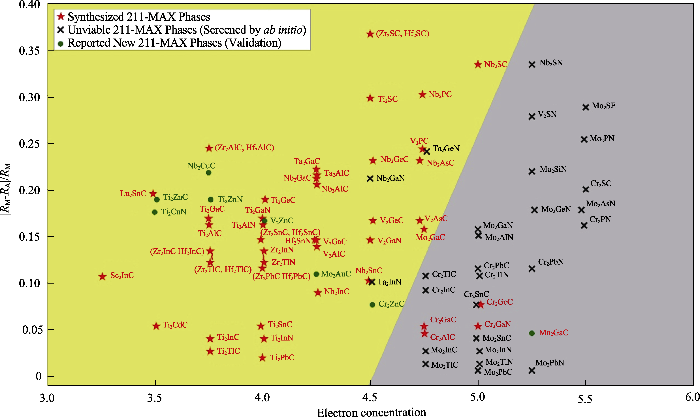
Structure mapping based on the selected characteristic quantities of electron concentration and atomic sizes<sup>[<xref ref-type="bibr" rid="b36">36</xref>]</sup>Fig. 16
Strukturuntersuchungen an carbosulfiden von titan und zirkon
1
1960
... In 1960, Ti2SC was synthesized[40]; From 1960 to 1966, a large number of ternary layered carbides/nitrides (H-phases) with an M2AX formula (211 type) were synthesized[41-42]; From 1967 to 1968, Ti3SiC2 (312 type) and a set of 312 and 211 types H-phases were produced[41,43-44]; In 1969, a typical ternary layered boride Fe2AlB2 was synthesized[7]; In 1994, Ti3AlC2 was discovered[45]; In 1996, the high purity Ti3SiC2 was produced and exhibited excellent properties, thus triggering the research upsurge to these materials[46]; In 2000, Barsoum[1] renamed H-phases as Mn+1AXn phases, short for MAX phases; In 2011, the first MXene Ti3C2Tx was discovered[28]; In 2013, the discovery of magnetocaloric effect of Fe2AlB2 raised research upsurge on ternary layered borides[9]. Also, Lu2SnC was synthesized and found to be superconducting[47]; In 2014, an o-MAX (Cr2/3Ti1/3)3AlC2 was synthesized[48]; In 2015, ternary layered borides were named as MAB phases. In addition, the first Zr-based MAX phase was discovered[10,49]; In 2017, an i-MAX (Mo2/3Sc1/3)2AlC and two noble-metal MAX phases Ti3AuC2 and Ti3IrC2 were synthesized[22,50]; In 2019, a series of MAX phases containing Cu and Zn, and a hexagonal MAB phase Ti2InB2, as well as Nb2SBxC1-x (x=0-1) were synthesized[24⇓-26,51,52]; In 2020, two i-MAB phases (Mo2/3Sc1/3)2AlB2 and (Mo2/3Y1/3)2AlB2, as well as a variety of MAX phases containing Fe, Co, Ni, and Mn were synthesized[16,19]; In 2021, MAX phases having Se atoms at the A-site were produced[53]; In 2022, o-MAX phase Ti4MoSiB2, the first MBene, and Zr2Se(B1-xSex) were synthesized[20,54-55]; In 2023, a chemical scissor-mediated structural editing strategy was proposed, which extremely expands the diversity of MAX phases and MXene[56] ...
Strukturchemie einiger verbindungen der übergangsmetalle mit den elementen C, Si, Ge, Sn
2
1971
... In 1960, Ti2SC was synthesized[40]; From 1960 to 1966, a large number of ternary layered carbides/nitrides (H-phases) with an M2AX formula (211 type) were synthesized[41-42]; From 1967 to 1968, Ti3SiC2 (312 type) and a set of 312 and 211 types H-phases were produced[41,43-44]; In 1969, a typical ternary layered boride Fe2AlB2 was synthesized[7]; In 1994, Ti3AlC2 was discovered[45]; In 1996, the high purity Ti3SiC2 was produced and exhibited excellent properties, thus triggering the research upsurge to these materials[46]; In 2000, Barsoum[1] renamed H-phases as Mn+1AXn phases, short for MAX phases; In 2011, the first MXene Ti3C2Tx was discovered[28]; In 2013, the discovery of magnetocaloric effect of Fe2AlB2 raised research upsurge on ternary layered borides[9]. Also, Lu2SnC was synthesized and found to be superconducting[47]; In 2014, an o-MAX (Cr2/3Ti1/3)3AlC2 was synthesized[48]; In 2015, ternary layered borides were named as MAB phases. In addition, the first Zr-based MAX phase was discovered[10,49]; In 2017, an i-MAX (Mo2/3Sc1/3)2AlC and two noble-metal MAX phases Ti3AuC2 and Ti3IrC2 were synthesized[22,50]; In 2019, a series of MAX phases containing Cu and Zn, and a hexagonal MAB phase Ti2InB2, as well as Nb2SBxC1-x (x=0-1) were synthesized[24⇓-26,51,52]; In 2020, two i-MAB phases (Mo2/3Sc1/3)2AlB2 and (Mo2/3Y1/3)2AlB2, as well as a variety of MAX phases containing Fe, Co, Ni, and Mn were synthesized[16,19]; In 2021, MAX phases having Se atoms at the A-site were produced[53]; In 2022, o-MAX phase Ti4MoSiB2, the first MBene, and Zr2Se(B1-xSex) were synthesized[20,54-55]; In 2023, a chemical scissor-mediated structural editing strategy was proposed, which extremely expands the diversity of MAX phases and MXene[56] ...
... [41,43-44]; In 1969, a typical ternary layered boride Fe2AlB2 was synthesized[7]; In 1994, Ti3AlC2 was discovered[45]; In 1996, the high purity Ti3SiC2 was produced and exhibited excellent properties, thus triggering the research upsurge to these materials[46]; In 2000, Barsoum[1] renamed H-phases as Mn+1AXn phases, short for MAX phases; In 2011, the first MXene Ti3C2Tx was discovered[28]; In 2013, the discovery of magnetocaloric effect of Fe2AlB2 raised research upsurge on ternary layered borides[9]. Also, Lu2SnC was synthesized and found to be superconducting[47]; In 2014, an o-MAX (Cr2/3Ti1/3)3AlC2 was synthesized[48]; In 2015, ternary layered borides were named as MAB phases. In addition, the first Zr-based MAX phase was discovered[10,49]; In 2017, an i-MAX (Mo2/3Sc1/3)2AlC and two noble-metal MAX phases Ti3AuC2 and Ti3IrC2 were synthesized[22,50]; In 2019, a series of MAX phases containing Cu and Zn, and a hexagonal MAB phase Ti2InB2, as well as Nb2SBxC1-x (x=0-1) were synthesized[24⇓-26,51,52]; In 2020, two i-MAB phases (Mo2/3Sc1/3)2AlB2 and (Mo2/3Y1/3)2AlB2, as well as a variety of MAX phases containing Fe, Co, Ni, and Mn were synthesized[16,19]; In 2021, MAX phases having Se atoms at the A-site were produced[53]; In 2022, o-MAX phase Ti4MoSiB2, the first MBene, and Zr2Se(B1-xSex) were synthesized[20,54-55]; In 2023, a chemical scissor-mediated structural editing strategy was proposed, which extremely expands the diversity of MAX phases and MXene[56] ...
Die h-phasen: Ti2CdC, Ti2GaC, Ti2GaN, Ti2InN, Zr2InN und Nb2GaC
1
1964
... In 1960, Ti2SC was synthesized[40]; From 1960 to 1966, a large number of ternary layered carbides/nitrides (H-phases) with an M2AX formula (211 type) were synthesized[41-42]; From 1967 to 1968, Ti3SiC2 (312 type) and a set of 312 and 211 types H-phases were produced[41,43-44]; In 1969, a typical ternary layered boride Fe2AlB2 was synthesized[7]; In 1994, Ti3AlC2 was discovered[45]; In 1996, the high purity Ti3SiC2 was produced and exhibited excellent properties, thus triggering the research upsurge to these materials[46]; In 2000, Barsoum[1] renamed H-phases as Mn+1AXn phases, short for MAX phases; In 2011, the first MXene Ti3C2Tx was discovered[28]; In 2013, the discovery of magnetocaloric effect of Fe2AlB2 raised research upsurge on ternary layered borides[9]. Also, Lu2SnC was synthesized and found to be superconducting[47]; In 2014, an o-MAX (Cr2/3Ti1/3)3AlC2 was synthesized[48]; In 2015, ternary layered borides were named as MAB phases. In addition, the first Zr-based MAX phase was discovered[10,49]; In 2017, an i-MAX (Mo2/3Sc1/3)2AlC and two noble-metal MAX phases Ti3AuC2 and Ti3IrC2 were synthesized[22,50]; In 2019, a series of MAX phases containing Cu and Zn, and a hexagonal MAB phase Ti2InB2, as well as Nb2SBxC1-x (x=0-1) were synthesized[24⇓-26,51,52]; In 2020, two i-MAB phases (Mo2/3Sc1/3)2AlB2 and (Mo2/3Y1/3)2AlB2, as well as a variety of MAX phases containing Fe, Co, Ni, and Mn were synthesized[16,19]; In 2021, MAX phases having Se atoms at the A-site were produced[53]; In 2022, o-MAX phase Ti4MoSiB2, the first MBene, and Zr2Se(B1-xSex) were synthesized[20,54-55]; In 2023, a chemical scissor-mediated structural editing strategy was proposed, which extremely expands the diversity of MAX phases and MXene[56] ...
Die kristallstruktur von Ti3SiC2- einneuerkom plexcarbid-typ
1
1967
... In 1960, Ti2SC was synthesized[40]; From 1960 to 1966, a large number of ternary layered carbides/nitrides (H-phases) with an M2AX formula (211 type) were synthesized[41-42]; From 1967 to 1968, Ti3SiC2 (312 type) and a set of 312 and 211 types H-phases were produced[41,43-44]; In 1969, a typical ternary layered boride Fe2AlB2 was synthesized[7]; In 1994, Ti3AlC2 was discovered[45]; In 1996, the high purity Ti3SiC2 was produced and exhibited excellent properties, thus triggering the research upsurge to these materials[46]; In 2000, Barsoum[1] renamed H-phases as Mn+1AXn phases, short for MAX phases; In 2011, the first MXene Ti3C2Tx was discovered[28]; In 2013, the discovery of magnetocaloric effect of Fe2AlB2 raised research upsurge on ternary layered borides[9]. Also, Lu2SnC was synthesized and found to be superconducting[47]; In 2014, an o-MAX (Cr2/3Ti1/3)3AlC2 was synthesized[48]; In 2015, ternary layered borides were named as MAB phases. In addition, the first Zr-based MAX phase was discovered[10,49]; In 2017, an i-MAX (Mo2/3Sc1/3)2AlC and two noble-metal MAX phases Ti3AuC2 and Ti3IrC2 were synthesized[22,50]; In 2019, a series of MAX phases containing Cu and Zn, and a hexagonal MAB phase Ti2InB2, as well as Nb2SBxC1-x (x=0-1) were synthesized[24⇓-26,51,52]; In 2020, two i-MAB phases (Mo2/3Sc1/3)2AlB2 and (Mo2/3Y1/3)2AlB2, as well as a variety of MAX phases containing Fe, Co, Ni, and Mn were synthesized[16,19]; In 2021, MAX phases having Se atoms at the A-site were produced[53]; In 2022, o-MAX phase Ti4MoSiB2, the first MBene, and Zr2Se(B1-xSex) were synthesized[20,54-55]; In 2023, a chemical scissor-mediated structural editing strategy was proposed, which extremely expands the diversity of MAX phases and MXene[56] ...
Die Kristallstruktur von Ti3GeC2: Kurze Mitteilung
1
1967
... In 1960, Ti2SC was synthesized[40]; From 1960 to 1966, a large number of ternary layered carbides/nitrides (H-phases) with an M2AX formula (211 type) were synthesized[41-42]; From 1967 to 1968, Ti3SiC2 (312 type) and a set of 312 and 211 types H-phases were produced[41,43-44]; In 1969, a typical ternary layered boride Fe2AlB2 was synthesized[7]; In 1994, Ti3AlC2 was discovered[45]; In 1996, the high purity Ti3SiC2 was produced and exhibited excellent properties, thus triggering the research upsurge to these materials[46]; In 2000, Barsoum[1] renamed H-phases as Mn+1AXn phases, short for MAX phases; In 2011, the first MXene Ti3C2Tx was discovered[28]; In 2013, the discovery of magnetocaloric effect of Fe2AlB2 raised research upsurge on ternary layered borides[9]. Also, Lu2SnC was synthesized and found to be superconducting[47]; In 2014, an o-MAX (Cr2/3Ti1/3)3AlC2 was synthesized[48]; In 2015, ternary layered borides were named as MAB phases. In addition, the first Zr-based MAX phase was discovered[10,49]; In 2017, an i-MAX (Mo2/3Sc1/3)2AlC and two noble-metal MAX phases Ti3AuC2 and Ti3IrC2 were synthesized[22,50]; In 2019, a series of MAX phases containing Cu and Zn, and a hexagonal MAB phase Ti2InB2, as well as Nb2SBxC1-x (x=0-1) were synthesized[24⇓-26,51,52]; In 2020, two i-MAB phases (Mo2/3Sc1/3)2AlB2 and (Mo2/3Y1/3)2AlB2, as well as a variety of MAX phases containing Fe, Co, Ni, and Mn were synthesized[16,19]; In 2021, MAX phases having Se atoms at the A-site were produced[53]; In 2022, o-MAX phase Ti4MoSiB2, the first MBene, and Zr2Se(B1-xSex) were synthesized[20,54-55]; In 2023, a chemical scissor-mediated structural editing strategy was proposed, which extremely expands the diversity of MAX phases and MXene[56] ...
Summary of constitutional data on the aluminum-carbon-titanium system
1
1994
... In 1960, Ti2SC was synthesized[40]; From 1960 to 1966, a large number of ternary layered carbides/nitrides (H-phases) with an M2AX formula (211 type) were synthesized[41-42]; From 1967 to 1968, Ti3SiC2 (312 type) and a set of 312 and 211 types H-phases were produced[41,43-44]; In 1969, a typical ternary layered boride Fe2AlB2 was synthesized[7]; In 1994, Ti3AlC2 was discovered[45]; In 1996, the high purity Ti3SiC2 was produced and exhibited excellent properties, thus triggering the research upsurge to these materials[46]; In 2000, Barsoum[1] renamed H-phases as Mn+1AXn phases, short for MAX phases; In 2011, the first MXene Ti3C2Tx was discovered[28]; In 2013, the discovery of magnetocaloric effect of Fe2AlB2 raised research upsurge on ternary layered borides[9]. Also, Lu2SnC was synthesized and found to be superconducting[47]; In 2014, an o-MAX (Cr2/3Ti1/3)3AlC2 was synthesized[48]; In 2015, ternary layered borides were named as MAB phases. In addition, the first Zr-based MAX phase was discovered[10,49]; In 2017, an i-MAX (Mo2/3Sc1/3)2AlC and two noble-metal MAX phases Ti3AuC2 and Ti3IrC2 were synthesized[22,50]; In 2019, a series of MAX phases containing Cu and Zn, and a hexagonal MAB phase Ti2InB2, as well as Nb2SBxC1-x (x=0-1) were synthesized[24⇓-26,51,52]; In 2020, two i-MAB phases (Mo2/3Sc1/3)2AlB2 and (Mo2/3Y1/3)2AlB2, as well as a variety of MAX phases containing Fe, Co, Ni, and Mn were synthesized[16,19]; In 2021, MAX phases having Se atoms at the A-site were produced[53]; In 2022, o-MAX phase Ti4MoSiB2, the first MBene, and Zr2Se(B1-xSex) were synthesized[20,54-55]; In 2023, a chemical scissor-mediated structural editing strategy was proposed, which extremely expands the diversity of MAX phases and MXene[56] ...
Synthesis and characterization of a remarkable ceramic: Ti3SiC2
1
1996
... In 1960, Ti2SC was synthesized[40]; From 1960 to 1966, a large number of ternary layered carbides/nitrides (H-phases) with an M2AX formula (211 type) were synthesized[41-42]; From 1967 to 1968, Ti3SiC2 (312 type) and a set of 312 and 211 types H-phases were produced[41,43-44]; In 1969, a typical ternary layered boride Fe2AlB2 was synthesized[7]; In 1994, Ti3AlC2 was discovered[45]; In 1996, the high purity Ti3SiC2 was produced and exhibited excellent properties, thus triggering the research upsurge to these materials[46]; In 2000, Barsoum[1] renamed H-phases as Mn+1AXn phases, short for MAX phases; In 2011, the first MXene Ti3C2Tx was discovered[28]; In 2013, the discovery of magnetocaloric effect of Fe2AlB2 raised research upsurge on ternary layered borides[9]. Also, Lu2SnC was synthesized and found to be superconducting[47]; In 2014, an o-MAX (Cr2/3Ti1/3)3AlC2 was synthesized[48]; In 2015, ternary layered borides were named as MAB phases. In addition, the first Zr-based MAX phase was discovered[10,49]; In 2017, an i-MAX (Mo2/3Sc1/3)2AlC and two noble-metal MAX phases Ti3AuC2 and Ti3IrC2 were synthesized[22,50]; In 2019, a series of MAX phases containing Cu and Zn, and a hexagonal MAB phase Ti2InB2, as well as Nb2SBxC1-x (x=0-1) were synthesized[24⇓-26,51,52]; In 2020, two i-MAB phases (Mo2/3Sc1/3)2AlB2 and (Mo2/3Y1/3)2AlB2, as well as a variety of MAX phases containing Fe, Co, Ni, and Mn were synthesized[16,19]; In 2021, MAX phases having Se atoms at the A-site were produced[53]; In 2022, o-MAX phase Ti4MoSiB2, the first MBene, and Zr2Se(B1-xSex) were synthesized[20,54-55]; In 2023, a chemical scissor-mediated structural editing strategy was proposed, which extremely expands the diversity of MAX phases and MXene[56] ...
Superconductivity in Lu2SnC
1
2013
... In 1960, Ti2SC was synthesized[40]; From 1960 to 1966, a large number of ternary layered carbides/nitrides (H-phases) with an M2AX formula (211 type) were synthesized[41-42]; From 1967 to 1968, Ti3SiC2 (312 type) and a set of 312 and 211 types H-phases were produced[41,43-44]; In 1969, a typical ternary layered boride Fe2AlB2 was synthesized[7]; In 1994, Ti3AlC2 was discovered[45]; In 1996, the high purity Ti3SiC2 was produced and exhibited excellent properties, thus triggering the research upsurge to these materials[46]; In 2000, Barsoum[1] renamed H-phases as Mn+1AXn phases, short for MAX phases; In 2011, the first MXene Ti3C2Tx was discovered[28]; In 2013, the discovery of magnetocaloric effect of Fe2AlB2 raised research upsurge on ternary layered borides[9]. Also, Lu2SnC was synthesized and found to be superconducting[47]; In 2014, an o-MAX (Cr2/3Ti1/3)3AlC2 was synthesized[48]; In 2015, ternary layered borides were named as MAB phases. In addition, the first Zr-based MAX phase was discovered[10,49]; In 2017, an i-MAX (Mo2/3Sc1/3)2AlC and two noble-metal MAX phases Ti3AuC2 and Ti3IrC2 were synthesized[22,50]; In 2019, a series of MAX phases containing Cu and Zn, and a hexagonal MAB phase Ti2InB2, as well as Nb2SBxC1-x (x=0-1) were synthesized[24⇓-26,51,52]; In 2020, two i-MAB phases (Mo2/3Sc1/3)2AlB2 and (Mo2/3Y1/3)2AlB2, as well as a variety of MAX phases containing Fe, Co, Ni, and Mn were synthesized[16,19]; In 2021, MAX phases having Se atoms at the A-site were produced[53]; In 2022, o-MAX phase Ti4MoSiB2, the first MBene, and Zr2Se(B1-xSex) were synthesized[20,54-55]; In 2023, a chemical scissor-mediated structural editing strategy was proposed, which extremely expands the diversity of MAX phases and MXene[56] ...
Crystal structure and formation mechanism of (Cr2/3Ti1/3)3AlC2 MAX phase
1
2014
... In 1960, Ti2SC was synthesized[40]; From 1960 to 1966, a large number of ternary layered carbides/nitrides (H-phases) with an M2AX formula (211 type) were synthesized[41-42]; From 1967 to 1968, Ti3SiC2 (312 type) and a set of 312 and 211 types H-phases were produced[41,43-44]; In 1969, a typical ternary layered boride Fe2AlB2 was synthesized[7]; In 1994, Ti3AlC2 was discovered[45]; In 1996, the high purity Ti3SiC2 was produced and exhibited excellent properties, thus triggering the research upsurge to these materials[46]; In 2000, Barsoum[1] renamed H-phases as Mn+1AXn phases, short for MAX phases; In 2011, the first MXene Ti3C2Tx was discovered[28]; In 2013, the discovery of magnetocaloric effect of Fe2AlB2 raised research upsurge on ternary layered borides[9]. Also, Lu2SnC was synthesized and found to be superconducting[47]; In 2014, an o-MAX (Cr2/3Ti1/3)3AlC2 was synthesized[48]; In 2015, ternary layered borides were named as MAB phases. In addition, the first Zr-based MAX phase was discovered[10,49]; In 2017, an i-MAX (Mo2/3Sc1/3)2AlC and two noble-metal MAX phases Ti3AuC2 and Ti3IrC2 were synthesized[22,50]; In 2019, a series of MAX phases containing Cu and Zn, and a hexagonal MAB phase Ti2InB2, as well as Nb2SBxC1-x (x=0-1) were synthesized[24⇓-26,51,52]; In 2020, two i-MAB phases (Mo2/3Sc1/3)2AlB2 and (Mo2/3Y1/3)2AlB2, as well as a variety of MAX phases containing Fe, Co, Ni, and Mn were synthesized[16,19]; In 2021, MAX phases having Se atoms at the A-site were produced[53]; In 2022, o-MAX phase Ti4MoSiB2, the first MBene, and Zr2Se(B1-xSex) were synthesized[20,54-55]; In 2023, a chemical scissor-mediated structural editing strategy was proposed, which extremely expands the diversity of MAX phases and MXene[56] ...
Synthesis of the novel Zr3AlC2 MAX phase
2
2016
... In 1960, Ti2SC was synthesized[40]; From 1960 to 1966, a large number of ternary layered carbides/nitrides (H-phases) with an M2AX formula (211 type) were synthesized[41-42]; From 1967 to 1968, Ti3SiC2 (312 type) and a set of 312 and 211 types H-phases were produced[41,43-44]; In 1969, a typical ternary layered boride Fe2AlB2 was synthesized[7]; In 1994, Ti3AlC2 was discovered[45]; In 1996, the high purity Ti3SiC2 was produced and exhibited excellent properties, thus triggering the research upsurge to these materials[46]; In 2000, Barsoum[1] renamed H-phases as Mn+1AXn phases, short for MAX phases; In 2011, the first MXene Ti3C2Tx was discovered[28]; In 2013, the discovery of magnetocaloric effect of Fe2AlB2 raised research upsurge on ternary layered borides[9]. Also, Lu2SnC was synthesized and found to be superconducting[47]; In 2014, an o-MAX (Cr2/3Ti1/3)3AlC2 was synthesized[48]; In 2015, ternary layered borides were named as MAB phases. In addition, the first Zr-based MAX phase was discovered[10,49]; In 2017, an i-MAX (Mo2/3Sc1/3)2AlC and two noble-metal MAX phases Ti3AuC2 and Ti3IrC2 were synthesized[22,50]; In 2019, a series of MAX phases containing Cu and Zn, and a hexagonal MAB phase Ti2InB2, as well as Nb2SBxC1-x (x=0-1) were synthesized[24⇓-26,51,52]; In 2020, two i-MAB phases (Mo2/3Sc1/3)2AlB2 and (Mo2/3Y1/3)2AlB2, as well as a variety of MAX phases containing Fe, Co, Ni, and Mn were synthesized[16,19]; In 2021, MAX phases having Se atoms at the A-site were produced[53]; In 2022, o-MAX phase Ti4MoSiB2, the first MBene, and Zr2Se(B1-xSex) were synthesized[20,54-55]; In 2023, a chemical scissor-mediated structural editing strategy was proposed, which extremely expands the diversity of MAX phases and MXene[56] ...
Two-dimensional Mo1.33C MXene with divacancy ordering prepared from parent 3D laminate with in-plane chemical ordering
5
2017
... In 1960, Ti2SC was synthesized[40]; From 1960 to 1966, a large number of ternary layered carbides/nitrides (H-phases) with an M2AX formula (211 type) were synthesized[41-42]; From 1967 to 1968, Ti3SiC2 (312 type) and a set of 312 and 211 types H-phases were produced[41,43-44]; In 1969, a typical ternary layered boride Fe2AlB2 was synthesized[7]; In 1994, Ti3AlC2 was discovered[45]; In 1996, the high purity Ti3SiC2 was produced and exhibited excellent properties, thus triggering the research upsurge to these materials[46]; In 2000, Barsoum[1] renamed H-phases as Mn+1AXn phases, short for MAX phases; In 2011, the first MXene Ti3C2Tx was discovered[28]; In 2013, the discovery of magnetocaloric effect of Fe2AlB2 raised research upsurge on ternary layered borides[9]. Also, Lu2SnC was synthesized and found to be superconducting[47]; In 2014, an o-MAX (Cr2/3Ti1/3)3AlC2 was synthesized[48]; In 2015, ternary layered borides were named as MAB phases. In addition, the first Zr-based MAX phase was discovered[10,49]; In 2017, an i-MAX (Mo2/3Sc1/3)2AlC and two noble-metal MAX phases Ti3AuC2 and Ti3IrC2 were synthesized[22,50]; In 2019, a series of MAX phases containing Cu and Zn, and a hexagonal MAB phase Ti2InB2, as well as Nb2SBxC1-x (x=0-1) were synthesized[24⇓-26,51,52]; In 2020, two i-MAB phases (Mo2/3Sc1/3)2AlB2 and (Mo2/3Y1/3)2AlB2, as well as a variety of MAX phases containing Fe, Co, Ni, and Mn were synthesized[16,19]; In 2021, MAX phases having Se atoms at the A-site were produced[53]; In 2022, o-MAX phase Ti4MoSiB2, the first MBene, and Zr2Se(B1-xSex) were synthesized[20,54-55]; In 2023, a chemical scissor-mediated structural editing strategy was proposed, which extremely expands the diversity of MAX phases and MXene[56] ...
<i>i-</i>MAX phases and its derived two<i>-</i>dimensional product of <i>i-</i>MXene<sup>[<xref ref-type="bibr" rid="b50">50</xref>]</sup>
(a-c) i-MAX with in-plane chemical order, viewed from [100], [010] and [110] zone axes, respectively; (d) Schematic of the conversion from i-MAX to i-MXene; (e) Low-magnification STEM image of single flake of Mo1.33C i-MXene; (f) Higher magnification STEM image with the FFT result of Mo1.33C i-MXene; (g) Atomically resolved STEM image of Mo1.33C i-MXene; (h) Atomic structure model corresponding to (g) ...
... [50]
(a-c) i-MAX with in-plane chemical order, viewed from [100], [010] and [110] zone axes, respectively; (d) Schematic of the conversion from i-MAX to i-MXene; (e) Low-magnification STEM image of single flake of Mo1.33C i-MXene; (f) Higher magnification STEM image with the FFT result of Mo1.33C i-MXene; (g) Atomically resolved STEM image of Mo1.33C i-MXene; (h) Atomic structure model corresponding to (g) ...
Syntheses and physical properties of the MAX phase boride Nb2SB and the solid solutions Nb2SBxC-x (x=0-1)
3
2019
... In 1960, Ti2SC was synthesized[40]; From 1960 to 1966, a large number of ternary layered carbides/nitrides (H-phases) with an M2AX formula (211 type) were synthesized[41-42]; From 1967 to 1968, Ti3SiC2 (312 type) and a set of 312 and 211 types H-phases were produced[41,43-44]; In 1969, a typical ternary layered boride Fe2AlB2 was synthesized[7]; In 1994, Ti3AlC2 was discovered[45]; In 1996, the high purity Ti3SiC2 was produced and exhibited excellent properties, thus triggering the research upsurge to these materials[46]; In 2000, Barsoum[1] renamed H-phases as Mn+1AXn phases, short for MAX phases; In 2011, the first MXene Ti3C2Tx was discovered[28]; In 2013, the discovery of magnetocaloric effect of Fe2AlB2 raised research upsurge on ternary layered borides[9]. Also, Lu2SnC was synthesized and found to be superconducting[47]; In 2014, an o-MAX (Cr2/3Ti1/3)3AlC2 was synthesized[48]; In 2015, ternary layered borides were named as MAB phases. In addition, the first Zr-based MAX phase was discovered[10,49]; In 2017, an i-MAX (Mo2/3Sc1/3)2AlC and two noble-metal MAX phases Ti3AuC2 and Ti3IrC2 were synthesized[22,50]; In 2019, a series of MAX phases containing Cu and Zn, and a hexagonal MAB phase Ti2InB2, as well as Nb2SBxC1-x (x=0-1) were synthesized[24⇓-26,51,52]; In 2020, two i-MAB phases (Mo2/3Sc1/3)2AlB2 and (Mo2/3Y1/3)2AlB2, as well as a variety of MAX phases containing Fe, Co, Ni, and Mn were synthesized[16,19]; In 2021, MAX phases having Se atoms at the A-site were produced[53]; In 2022, o-MAX phase Ti4MoSiB2, the first MBene, and Zr2Se(B1-xSex) were synthesized[20,54-55]; In 2023, a chemical scissor-mediated structural editing strategy was proposed, which extremely expands the diversity of MAX phases and MXene[56] ...
Discovery of hexagonal ternary phase Ti2InB2 and its evolution to layered boride TiB
12
2019
... In 1960, Ti2SC was synthesized[40]; From 1960 to 1966, a large number of ternary layered carbides/nitrides (H-phases) with an M2AX formula (211 type) were synthesized[41-42]; From 1967 to 1968, Ti3SiC2 (312 type) and a set of 312 and 211 types H-phases were produced[41,43-44]; In 1969, a typical ternary layered boride Fe2AlB2 was synthesized[7]; In 1994, Ti3AlC2 was discovered[45]; In 1996, the high purity Ti3SiC2 was produced and exhibited excellent properties, thus triggering the research upsurge to these materials[46]; In 2000, Barsoum[1] renamed H-phases as Mn+1AXn phases, short for MAX phases; In 2011, the first MXene Ti3C2Tx was discovered[28]; In 2013, the discovery of magnetocaloric effect of Fe2AlB2 raised research upsurge on ternary layered borides[9]. Also, Lu2SnC was synthesized and found to be superconducting[47]; In 2014, an o-MAX (Cr2/3Ti1/3)3AlC2 was synthesized[48]; In 2015, ternary layered borides were named as MAB phases. In addition, the first Zr-based MAX phase was discovered[10,49]; In 2017, an i-MAX (Mo2/3Sc1/3)2AlC and two noble-metal MAX phases Ti3AuC2 and Ti3IrC2 were synthesized[22,50]; In 2019, a series of MAX phases containing Cu and Zn, and a hexagonal MAB phase Ti2InB2, as well as Nb2SBxC1-x (x=0-1) were synthesized[24⇓-26,51,52]; In 2020, two i-MAB phases (Mo2/3Sc1/3)2AlB2 and (Mo2/3Y1/3)2AlB2, as well as a variety of MAX phases containing Fe, Co, Ni, and Mn were synthesized[16,19]; In 2021, MAX phases having Se atoms at the A-site were produced[53]; In 2022, o-MAX phase Ti4MoSiB2, the first MBene, and Zr2Se(B1-xSex) were synthesized[20,54-55]; In 2023, a chemical scissor-mediated structural editing strategy was proposed, which extremely expands the diversity of MAX phases and MXene[56] ...
... 虽然现在已经普遍采用“MAB相”来称呼这一类化合物, 但是目前对其尚无严格的定义.Ade等[10]命名时的MAB相主要包括一些具有正交晶体结构的含铝化合物, 并且可以采用一个通用的化学式(MB)2Alm(MB2)n (n = 0, 1, 2… m = 1, 2, 3…)来表示, 主要包括222相(Cmcm)、212相(Cmmm)、314相 (Pmmm)和416相(Cmmm).其中, 222相是目前为止唯一具有双层A族原子的MAB相结构.然而, 最近“MAB相”的概念得到了极大的拓展而不满足通式.例如, 张海明等[134]发现了一种新型MAB相化合物Cr4AlB4(Immm); 含Si/P的Fe5SiB2[135]、Mn5SiB2[136]和Fe5PB2[135](512相)近期也引起了人们的关注.此外, 王俊杰等[52]发现的六方MAB相(hexagonal MAB phases, 简称h-MAB)则是另一类值得注意的材料体系(图9(a~c)).不同于通常具有正交晶体结构的MAB相, h-MAB相具有类似于MAX相的密排六方结构, 进一步拓展了该类化合物的化学空间.而最近研究发现的M2AB(M = Zr, Nb, Hf; A = S, Se, Te)则完全与211型MAX相的晶体结构(P63/mmc)相同[93,137].虽然现在已经无法使用统一的化学式来表示这些化合物, 但是它们都具有共同的特征[138]: “原子尺度”上的层状结构[6,139]和这些纳米层片之间的弱结合[131,140].因此, 并不是所有的三元硼化物都可以称之为“MAB相”, 例如M5Si3B[141]. ...
... (a) SEM image of layered Ti2InB2; (b) STEM image of Ti2InB2 along the direction of [001] and corresponding FFT result in the inset image; (c) SEM image of 2D-TiB and its corresponding EDS semi-quantitative resultin inset table[52]; (d-f) STEM images of i-MAB phase (Mo2/3A1/3)2AlB2 and corresponding atomic model along the direction [0001], [$1\bar{1}00$] and [$11\bar{2}0$], respectively, and their corresponding FFT images[55]; (g-i) STEM images of o-MAB phase Ti4MoSiB2 and corresponding atomic model along the direction [100], [210] and [110], respectivly, and their corresponding FFT images[54] ...
... Stable MAB phases by theoretical predictionTable 2
MAB phase
M type
A type
Ref.
MAB phase
M type
A type
Ref.
Orthorhombic M2A2B2
Ti
Al
[160-161]
Orthorhombic M3AB4
Sc
Al
[160-161]
Hf
Ti
V
Zr
Nb
Hf
Ta
V
Tc
Nb
Cr
Ta
Mn
Mo
Orthorhombic M2AB2
Sc
Al
[160-161]
W
Ti
Mn
Zr
Fe
Hf
Orthorhombic M4AB6
Sc
Al
[160-161]
V
Ti
Nb
Zr
W
Hf
Tc
V
Rh
Nb
Ni
Ta
Co
Mo
Orthorhombic M3A2B2
Sc
Al
[160-161]
Hexagonal M2AB2
Ti
Sn
[52]
Ti
Hf
In
[162]
Zr
Sn
Hf
Zr
In
Cr
Pb
Mn
Tl
Tc
Hexagonal M3AB4
Hf
In
[162]
Fe
Sn
Ni
P
Zr
Cd
Pb
10.15541/jim20230123.F0012
MAB相的理论计算
Theoretical calculation of MAB phases
(a) Structures of orthorhombic and hexagonal MAB phases[163]; (b) Bonding energy of M2AlB2-type orthorhombic MAB and M2AlC-type MAX phases; (c) Simulated exfoliation process of orthorhombic M2AlB2 using HF, where the red, green, black, cyan, and pink balls represent Mo, B, Al, F, and H atoms, respectively[146] ...
... (a) Calculation-based approach to discovery of novel ternary phases Ti2InB2[52]; (b) High-throughput prediction of MAB phases[162]; (c) Crystal structures for the stable Nb2AB2 and Nb2AB (A: P or S)[183] ...
MAX phase Zr2SeC and its thermal conduction behavior
4
2021
... In 1960, Ti2SC was synthesized[40]; From 1960 to 1966, a large number of ternary layered carbides/nitrides (H-phases) with an M2AX formula (211 type) were synthesized[41-42]; From 1967 to 1968, Ti3SiC2 (312 type) and a set of 312 and 211 types H-phases were produced[41,43-44]; In 1969, a typical ternary layered boride Fe2AlB2 was synthesized[7]; In 1994, Ti3AlC2 was discovered[45]; In 1996, the high purity Ti3SiC2 was produced and exhibited excellent properties, thus triggering the research upsurge to these materials[46]; In 2000, Barsoum[1] renamed H-phases as Mn+1AXn phases, short for MAX phases; In 2011, the first MXene Ti3C2Tx was discovered[28]; In 2013, the discovery of magnetocaloric effect of Fe2AlB2 raised research upsurge on ternary layered borides[9]. Also, Lu2SnC was synthesized and found to be superconducting[47]; In 2014, an o-MAX (Cr2/3Ti1/3)3AlC2 was synthesized[48]; In 2015, ternary layered borides were named as MAB phases. In addition, the first Zr-based MAX phase was discovered[10,49]; In 2017, an i-MAX (Mo2/3Sc1/3)2AlC and two noble-metal MAX phases Ti3AuC2 and Ti3IrC2 were synthesized[22,50]; In 2019, a series of MAX phases containing Cu and Zn, and a hexagonal MAB phase Ti2InB2, as well as Nb2SBxC1-x (x=0-1) were synthesized[24⇓-26,51,52]; In 2020, two i-MAB phases (Mo2/3Sc1/3)2AlB2 and (Mo2/3Y1/3)2AlB2, as well as a variety of MAX phases containing Fe, Co, Ni, and Mn were synthesized[16,19]; In 2021, MAX phases having Se atoms at the A-site were produced[53]; In 2022, o-MAX phase Ti4MoSiB2, the first MBene, and Zr2Se(B1-xSex) were synthesized[20,54-55]; In 2023, a chemical scissor-mediated structural editing strategy was proposed, which extremely expands the diversity of MAX phases and MXene[56] ...
... (a-d) First synthesized Se-containing MAX phase, Zr2SeC[53]; (e, f) First synthesized Te-containing MAX phase, Hf2TeB[93]; (h-j) First synthesized MAX phase with chalcogen at X site, Zr2Se(B1-xSex) with x at 0 (h), 0.60 (i), and 0.97 (j), respectively[20] ...
Out-of-plane ordered laminate borides and their 2D Ti-based derivative from chemical exfoliation
4
2021
... In 1960, Ti2SC was synthesized[40]; From 1960 to 1966, a large number of ternary layered carbides/nitrides (H-phases) with an M2AX formula (211 type) were synthesized[41-42]; From 1967 to 1968, Ti3SiC2 (312 type) and a set of 312 and 211 types H-phases were produced[41,43-44]; In 1969, a typical ternary layered boride Fe2AlB2 was synthesized[7]; In 1994, Ti3AlC2 was discovered[45]; In 1996, the high purity Ti3SiC2 was produced and exhibited excellent properties, thus triggering the research upsurge to these materials[46]; In 2000, Barsoum[1] renamed H-phases as Mn+1AXn phases, short for MAX phases; In 2011, the first MXene Ti3C2Tx was discovered[28]; In 2013, the discovery of magnetocaloric effect of Fe2AlB2 raised research upsurge on ternary layered borides[9]. Also, Lu2SnC was synthesized and found to be superconducting[47]; In 2014, an o-MAX (Cr2/3Ti1/3)3AlC2 was synthesized[48]; In 2015, ternary layered borides were named as MAB phases. In addition, the first Zr-based MAX phase was discovered[10,49]; In 2017, an i-MAX (Mo2/3Sc1/3)2AlC and two noble-metal MAX phases Ti3AuC2 and Ti3IrC2 were synthesized[22,50]; In 2019, a series of MAX phases containing Cu and Zn, and a hexagonal MAB phase Ti2InB2, as well as Nb2SBxC1-x (x=0-1) were synthesized[24⇓-26,51,52]; In 2020, two i-MAB phases (Mo2/3Sc1/3)2AlB2 and (Mo2/3Y1/3)2AlB2, as well as a variety of MAX phases containing Fe, Co, Ni, and Mn were synthesized[16,19]; In 2021, MAX phases having Se atoms at the A-site were produced[53]; In 2022, o-MAX phase Ti4MoSiB2, the first MBene, and Zr2Se(B1-xSex) were synthesized[20,54-55]; In 2023, a chemical scissor-mediated structural editing strategy was proposed, which extremely expands the diversity of MAX phases and MXene[56] ...
... (a) SEM image of layered Ti2InB2; (b) STEM image of Ti2InB2 along the direction of [001] and corresponding FFT result in the inset image; (c) SEM image of 2D-TiB and its corresponding EDS semi-quantitative resultin inset table[52]; (d-f) STEM images of i-MAB phase (Mo2/3A1/3)2AlB2 and corresponding atomic model along the direction [0001], [$1\bar{1}00$] and [$11\bar{2}0$], respectively, and their corresponding FFT images[55]; (g-i) STEM images of o-MAB phase Ti4MoSiB2 and corresponding atomic model along the direction [100], [210] and [110], respectivly, and their corresponding FFT images[54] ...
... 一系列新型MAB相固溶体则是该领域另一值得注意的进展.该固溶体包括面内有序的i-MAB相(in-plane ordered MAB phases)和面外有序o-MAB相(out-of-plane ordered MAB phases), 进一步丰富和扩展了MAB相化合物的数量, 展现出MAB相材料优异的结构和性能可调控性.这些固溶体可分为在M位、A位的无序固溶, 如(Mo1/2W1/2)AlB[142]、(Fe1/2Mn1/2)2AlB2[143]、(Mn1/3Cr2/3)3AlB4[144]、(Fe4/5Mn1/5)5SiB2[135]和MoAl0.97Si0.03B[145]等.i-MAB相的两种M位原子均占据同一平面并有序固溶, o-MAB相的两种M位原子则分别占据不同平面.Rosen等[55]合成了i-MAB相(Mo2/3A1/3)2AlB2 (A = Y, Sc)(图9(d~f))和o-MAB相Ti4MoSiB2(图9(g~i)), 并利用高分辨扫描透射电镜技术确认其原子结构[54].以(Mo2/3A1/3)2AlB2 (A = Y, Sc)为前驱体成功刻蚀出了对应的二维材料Mo4/3B(图10), 通过实验证实存在二维MBenes[55,146].总的来说, MAB相及其固溶体在化学成分和结构上的多样性为下一步的性能调节和实际应用提供了广阔的选择空间. ...
... (a) Schematic of chemical etching i-MAB phase to prepare two-dimensional derivative[55]; (b) XRD patterns of prestine i-MAX (Mo2/3Y1/3)2AlB2, etched product Mo4/3B2-xTz, TBAOH intercalation product, and delamination film with SEM image (inset) showing the cross-sectional morphology of Mo4/3B2-xTz film [55]; (c) STEM image of monolayer Mo4/3B2-xTz and its FFT image (inset) [55]; (d) XRD patterns of o-MAX Ti4MoSiB2, product etched by ZnCl2 and two-dimensional TiOxCly after delamination and filtering with SEM image (inset) of cross-sectional morphology of a TiOxCly film[54] ...
Boridene: two-dimensional Mo4/3B2-x with ordered metal vacancies obtained by chemical exfoliation
8
2021
... In 1960, Ti2SC was synthesized[40]; From 1960 to 1966, a large number of ternary layered carbides/nitrides (H-phases) with an M2AX formula (211 type) were synthesized[41-42]; From 1967 to 1968, Ti3SiC2 (312 type) and a set of 312 and 211 types H-phases were produced[41,43-44]; In 1969, a typical ternary layered boride Fe2AlB2 was synthesized[7]; In 1994, Ti3AlC2 was discovered[45]; In 1996, the high purity Ti3SiC2 was produced and exhibited excellent properties, thus triggering the research upsurge to these materials[46]; In 2000, Barsoum[1] renamed H-phases as Mn+1AXn phases, short for MAX phases; In 2011, the first MXene Ti3C2Tx was discovered[28]; In 2013, the discovery of magnetocaloric effect of Fe2AlB2 raised research upsurge on ternary layered borides[9]. Also, Lu2SnC was synthesized and found to be superconducting[47]; In 2014, an o-MAX (Cr2/3Ti1/3)3AlC2 was synthesized[48]; In 2015, ternary layered borides were named as MAB phases. In addition, the first Zr-based MAX phase was discovered[10,49]; In 2017, an i-MAX (Mo2/3Sc1/3)2AlC and two noble-metal MAX phases Ti3AuC2 and Ti3IrC2 were synthesized[22,50]; In 2019, a series of MAX phases containing Cu and Zn, and a hexagonal MAB phase Ti2InB2, as well as Nb2SBxC1-x (x=0-1) were synthesized[24⇓-26,51,52]; In 2020, two i-MAB phases (Mo2/3Sc1/3)2AlB2 and (Mo2/3Y1/3)2AlB2, as well as a variety of MAX phases containing Fe, Co, Ni, and Mn were synthesized[16,19]; In 2021, MAX phases having Se atoms at the A-site were produced[53]; In 2022, o-MAX phase Ti4MoSiB2, the first MBene, and Zr2Se(B1-xSex) were synthesized[20,54-55]; In 2023, a chemical scissor-mediated structural editing strategy was proposed, which extremely expands the diversity of MAX phases and MXene[56] ...
... (a) SEM image of layered Ti2InB2; (b) STEM image of Ti2InB2 along the direction of [001] and corresponding FFT result in the inset image; (c) SEM image of 2D-TiB and its corresponding EDS semi-quantitative resultin inset table[52]; (d-f) STEM images of i-MAB phase (Mo2/3A1/3)2AlB2 and corresponding atomic model along the direction [0001], [$1\bar{1}00$] and [$11\bar{2}0$], respectively, and their corresponding FFT images[55]; (g-i) STEM images of o-MAB phase Ti4MoSiB2 and corresponding atomic model along the direction [100], [210] and [110], respectivly, and their corresponding FFT images[54] ...
... 一系列新型MAB相固溶体则是该领域另一值得注意的进展.该固溶体包括面内有序的i-MAB相(in-plane ordered MAB phases)和面外有序o-MAB相(out-of-plane ordered MAB phases), 进一步丰富和扩展了MAB相化合物的数量, 展现出MAB相材料优异的结构和性能可调控性.这些固溶体可分为在M位、A位的无序固溶, 如(Mo1/2W1/2)AlB[142]、(Fe1/2Mn1/2)2AlB2[143]、(Mn1/3Cr2/3)3AlB4[144]、(Fe4/5Mn1/5)5SiB2[135]和MoAl0.97Si0.03B[145]等.i-MAB相的两种M位原子均占据同一平面并有序固溶, o-MAB相的两种M位原子则分别占据不同平面.Rosen等[55]合成了i-MAB相(Mo2/3A1/3)2AlB2 (A = Y, Sc)(图9(d~f))和o-MAB相Ti4MoSiB2(图9(g~i)), 并利用高分辨扫描透射电镜技术确认其原子结构[54].以(Mo2/3A1/3)2AlB2 (A = Y, Sc)为前驱体成功刻蚀出了对应的二维材料Mo4/3B(图10), 通过实验证实存在二维MBenes[55,146].总的来说, MAB相及其固溶体在化学成分和结构上的多样性为下一步的性能调节和实际应用提供了广阔的选择空间. ...
... (a) Schematic of chemical etching i-MAB phase to prepare two-dimensional derivative[55]; (b) XRD patterns of prestine i-MAX (Mo2/3Y1/3)2AlB2, etched product Mo4/3B2-xTz, TBAOH intercalation product, and delamination film with SEM image (inset) showing the cross-sectional morphology of Mo4/3B2-xTz film [55]; (c) STEM image of monolayer Mo4/3B2-xTz and its FFT image (inset) [55]; (d) XRD patterns of o-MAX Ti4MoSiB2, product etched by ZnCl2 and two-dimensional TiOxCly after delamination and filtering with SEM image (inset) of cross-sectional morphology of a TiOxCly film[54] ...
... [55]; (c) STEM image of monolayer Mo4/3B2-xTz and its FFT image (inset) [55]; (d) XRD patterns of o-MAX Ti4MoSiB2, product etched by ZnCl2 and two-dimensional TiOxCly after delamination and filtering with SEM image (inset) of cross-sectional morphology of a TiOxCly film[54] ...
... [55]; (d) XRD patterns of o-MAX Ti4MoSiB2, product etched by ZnCl2 and two-dimensional TiOxCly after delamination and filtering with SEM image (inset) of cross-sectional morphology of a TiOxCly film[54] ...
Chemical scissor-mediated structural editing of layered transition metal carbides
4
2023
... In 1960, Ti2SC was synthesized[40]; From 1960 to 1966, a large number of ternary layered carbides/nitrides (H-phases) with an M2AX formula (211 type) were synthesized[41-42]; From 1967 to 1968, Ti3SiC2 (312 type) and a set of 312 and 211 types H-phases were produced[41,43-44]; In 1969, a typical ternary layered boride Fe2AlB2 was synthesized[7]; In 1994, Ti3AlC2 was discovered[45]; In 1996, the high purity Ti3SiC2 was produced and exhibited excellent properties, thus triggering the research upsurge to these materials[46]; In 2000, Barsoum[1] renamed H-phases as Mn+1AXn phases, short for MAX phases; In 2011, the first MXene Ti3C2Tx was discovered[28]; In 2013, the discovery of magnetocaloric effect of Fe2AlB2 raised research upsurge on ternary layered borides[9]. Also, Lu2SnC was synthesized and found to be superconducting[47]; In 2014, an o-MAX (Cr2/3Ti1/3)3AlC2 was synthesized[48]; In 2015, ternary layered borides were named as MAB phases. In addition, the first Zr-based MAX phase was discovered[10,49]; In 2017, an i-MAX (Mo2/3Sc1/3)2AlC and two noble-metal MAX phases Ti3AuC2 and Ti3IrC2 were synthesized[22,50]; In 2019, a series of MAX phases containing Cu and Zn, and a hexagonal MAB phase Ti2InB2, as well as Nb2SBxC1-x (x=0-1) were synthesized[24⇓-26,51,52]; In 2020, two i-MAB phases (Mo2/3Sc1/3)2AlB2 and (Mo2/3Y1/3)2AlB2, as well as a variety of MAX phases containing Fe, Co, Ni, and Mn were synthesized[16,19]; In 2021, MAX phases having Se atoms at the A-site were produced[53]; In 2022, o-MAX phase Ti4MoSiB2, the first MBene, and Zr2Se(B1-xSex) were synthesized[20,54-55]; In 2023, a chemical scissor-mediated structural editing strategy was proposed, which extremely expands the diversity of MAX phases and MXene[56] ...
... (a) Schematic illustration of chemical intercalation strategy aided by chemical scissors[56]; (b) Periodic table showing elements involved in the formation of MAX phases and MXenes. Light blue: M elements; Brown: A elements; Black: X elements; Green: ligand (T) elements; Circled: elements studied in the present work[56] ...
... [56] ...
Conversion of non-van der Waals solids to 2D transition-metal chalcogenides
3
2020
... (a) Schematic illustration of Ti3SiC2 film covered by Au film on the SiC substrate[22]; (b) STEM image of Ti3SiC2 and its corresponding atomic model[22]; (c) Schematic illustration of preparing novel MAX phases and MXene based on a Lewis-acidic-molten-salt route[24]; (d) STEM image of Ti3ZnC2 and its corresponding atomic model[24]; (e) STEM image of Ti3C2Cl2 and its corresponding atomic model[24]; (f) Schematic illustration of the conversion from non-van der Waals solids to 2D transition-metal chalcogenides[57] ...
Nanolaminated ternary transition metal carbide (MAX phase)-derived core-shell structure electrocatalysts for hydrogen evolution and oxygen evolution reactions in alkaline electrolytes
Organic-base-driven intercalation and delamination for the production of functionalized titanium carbide nanosheets with superior photothermal therapeutic performance
One-pot green process to synthesize MXene with controllable surface terminations using molten salts
2
2021
... (a) Schematic illustration of preparing MXene using HF solution as etchant[28]; (b) SEM image of Ti3C2Tx prepared by HF solution, showing the typical accordion-like morpholorgy of MXene particle[28]; (c) STEM image of Ti3C2Cl2 prepared by Lewis-acidic-molten-salt route, and its corresponding atomic model[24]; (d) Schematic illustration of preparing Ti3C2Tx MXene via a reaction between Ti3SiC2 and CuCl2; (e) Redox potential/Gibbs free energy between Lewis acid cations and A-site atoms in molten salts[30]; (f) Schematic illustration of the electrochemistry etching strategy for the preparation of MXene in molten salt[72] ...
A comparative study the structural, mechanical, and electronic properties of medium- entropy MAX phase (TiZrHf)2SC with Ti2SC, Zr2SC, Hf2SC via first-principles
Thermal explosion synthesis of first Te-containing layered ternary Hf2TeB MAX phase
3
2023
... (a-d) First synthesized Se-containing MAX phase, Zr2SeC[53]; (e, f) First synthesized Te-containing MAX phase, Hf2TeB[93]; (h-j) First synthesized MAX phase with chalcogen at X site, Zr2Se(B1-xSex) with x at 0 (h), 0.60 (i), and 0.97 (j), respectively[20] ...
... (a) SEM image of layered Ti2InB2; (b) STEM image of Ti2InB2 along the direction of [001] and corresponding FFT result in the inset image; (c) SEM image of 2D-TiB and its corresponding EDS semi-quantitative resultin inset table[52]; (d-f) STEM images of i-MAB phase (Mo2/3A1/3)2AlB2 and corresponding atomic model along the direction [0001], [$1\bar{1}00$] and [$11\bar{2}0$], respectively, and their corresponding FFT images[55]; (g-i) STEM images of o-MAB phase Ti4MoSiB2 and corresponding atomic model along the direction [100], [210] and [110], respectivly, and their corresponding FFT images[54] ...
Low temperature thermal expansion, high temperature electrical conductivity, and mechanical properties of Nb4AlC3 ceramic synthesized by spark plasma sintering
... (a) Crystal structure of V4AlC3-x[106]; (b) SEM image of single MAX phase V4AlC3-x[106]; (c) Schematic of the experimental set-up used for high temperature solution growth[107]; (d) Photograph of part of the crucible cut after growth and dipping into dilute HCl, the Cr2AlC platelets are coalescing due to an unusually long growth time[107] ...
... [106]; (c) Schematic of the experimental set-up used for high temperature solution growth[107]; (d) Photograph of part of the crucible cut after growth and dipping into dilute HCl, the Cr2AlC platelets are coalescing due to an unusually long growth time[107] ...
High temperature solution growth and characterization of Cr2AlC single crystals
3
2013
... (a) Crystal structure of V4AlC3-x[106]; (b) SEM image of single MAX phase V4AlC3-x[106]; (c) Schematic of the experimental set-up used for high temperature solution growth[107]; (d) Photograph of part of the crucible cut after growth and dipping into dilute HCl, the Cr2AlC platelets are coalescing due to an unusually long growth time[107] ...
... [110]Heat capacity and anisotropic thermal conductivity in Cr<sub>2</sub>AlC single crystals at high temperatures<sup>[<xref ref-type="bibr" rid="b110">110</xref>]</sup>
(a) Atomic structure model of Cr2AlC; (b) Schematic of the in-plane resistivity measurements in Cr2AlC using a four-probe configuration with equidistant and parallel pads; (c) Temperature-dependence measurements of the in-plane resistivity for Cr2AlC single crystals (black line); (d) Predicted out-of-plane resistivity (orange line); (e) Heat capacity measurements of Cr2AlC single crystals measured experimentally (blue dots); (f) Measured in-plane (κ∥) and out-of-plane (κ⊥) thermal conductivities using various techniques ...
... [110]
(a) Atomic structure model of Cr2AlC; (b) Schematic of the in-plane resistivity measurements in Cr2AlC using a four-probe configuration with equidistant and parallel pads; (c) Temperature-dependence measurements of the in-plane resistivity for Cr2AlC single crystals (black line); (d) Predicted out-of-plane resistivity (orange line); (e) Heat capacity measurements of Cr2AlC single crystals measured experimentally (blue dots); (f) Measured in-plane (κ∥) and out-of-plane (κ⊥) thermal conductivities using various techniques ...
... (a) SEM image of layered Ti2InB2; (b) STEM image of Ti2InB2 along the direction of [001] and corresponding FFT result in the inset image; (c) SEM image of 2D-TiB and its corresponding EDS semi-quantitative resultin inset table[52]; (d-f) STEM images of i-MAB phase (Mo2/3A1/3)2AlB2 and corresponding atomic model along the direction [0001], [$1\bar{1}00$] and [$11\bar{2}0$], respectively, and their corresponding FFT images[55]; (g-i) STEM images of o-MAB phase Ti4MoSiB2 and corresponding atomic model along the direction [100], [210] and [110], respectivly, and their corresponding FFT images[54] ...
Conversion of MAX phase single crystals in highly porous carbides by high temperature chlorination
... [120]STEM micrographs of (Mo<sub>2/3</sub>RE<sub>1/3</sub>)<sub>2</sub>GaC <i>i-</i>MAX phase along (a) [100] and (b) [010] zone axis<sup>[<xref ref-type="bibr" rid="b120">120</xref>]</sup>Fig. 254 展望
Magnetic and structural properties of ferromagnetic Fe5PB2 and Fe5SiB2 and effects of Co and Mn substitutions
3
2015
... 虽然现在已经普遍采用“MAB相”来称呼这一类化合物, 但是目前对其尚无严格的定义.Ade等[10]命名时的MAB相主要包括一些具有正交晶体结构的含铝化合物, 并且可以采用一个通用的化学式(MB)2Alm(MB2)n (n = 0, 1, 2… m = 1, 2, 3…)来表示, 主要包括222相(Cmcm)、212相(Cmmm)、314相 (Pmmm)和416相(Cmmm).其中, 222相是目前为止唯一具有双层A族原子的MAB相结构.然而, 最近“MAB相”的概念得到了极大的拓展而不满足通式.例如, 张海明等[134]发现了一种新型MAB相化合物Cr4AlB4(Immm); 含Si/P的Fe5SiB2[135]、Mn5SiB2[136]和Fe5PB2[135](512相)近期也引起了人们的关注.此外, 王俊杰等[52]发现的六方MAB相(hexagonal MAB phases, 简称h-MAB)则是另一类值得注意的材料体系(图9(a~c)).不同于通常具有正交晶体结构的MAB相, h-MAB相具有类似于MAX相的密排六方结构, 进一步拓展了该类化合物的化学空间.而最近研究发现的M2AB(M = Zr, Nb, Hf; A = S, Se, Te)则完全与211型MAX相的晶体结构(P63/mmc)相同[93,137].虽然现在已经无法使用统一的化学式来表示这些化合物, 但是它们都具有共同的特征[138]: “原子尺度”上的层状结构[6,139]和这些纳米层片之间的弱结合[131,140].因此, 并不是所有的三元硼化物都可以称之为“MAB相”, 例如M5Si3B[141]. ...
... [135](512相)近期也引起了人们的关注.此外, 王俊杰等[52]发现的六方MAB相(hexagonal MAB phases, 简称h-MAB)则是另一类值得注意的材料体系(图9(a~c)).不同于通常具有正交晶体结构的MAB相, h-MAB相具有类似于MAX相的密排六方结构, 进一步拓展了该类化合物的化学空间.而最近研究发现的M2AB(M = Zr, Nb, Hf; A = S, Se, Te)则完全与211型MAX相的晶体结构(P63/mmc)相同[93,137].虽然现在已经无法使用统一的化学式来表示这些化合物, 但是它们都具有共同的特征[138]: “原子尺度”上的层状结构[6,139]和这些纳米层片之间的弱结合[131,140].因此, 并不是所有的三元硼化物都可以称之为“MAB相”, 例如M5Si3B[141]. ...
... 一系列新型MAB相固溶体则是该领域另一值得注意的进展.该固溶体包括面内有序的i-MAB相(in-plane ordered MAB phases)和面外有序o-MAB相(out-of-plane ordered MAB phases), 进一步丰富和扩展了MAB相化合物的数量, 展现出MAB相材料优异的结构和性能可调控性.这些固溶体可分为在M位、A位的无序固溶, 如(Mo1/2W1/2)AlB[142]、(Fe1/2Mn1/2)2AlB2[143]、(Mn1/3Cr2/3)3AlB4[144]、(Fe4/5Mn1/5)5SiB2[135]和MoAl0.97Si0.03B[145]等.i-MAB相的两种M位原子均占据同一平面并有序固溶, o-MAB相的两种M位原子则分别占据不同平面.Rosen等[55]合成了i-MAB相(Mo2/3A1/3)2AlB2 (A = Y, Sc)(图9(d~f))和o-MAB相Ti4MoSiB2(图9(g~i)), 并利用高分辨扫描透射电镜技术确认其原子结构[54].以(Mo2/3A1/3)2AlB2 (A = Y, Sc)为前驱体成功刻蚀出了对应的二维材料Mo4/3B(图10), 通过实验证实存在二维MBenes[55,146].总的来说, MAB相及其固溶体在化学成分和结构上的多样性为下一步的性能调节和实际应用提供了广阔的选择空间. ...
Synthesis, characterization, properties, first principles calculations, and X-ray photoelectron spectroscopy of bulk Mn5SiB2 and Fe5SiB2 ternary borides
1
2021
... 虽然现在已经普遍采用“MAB相”来称呼这一类化合物, 但是目前对其尚无严格的定义.Ade等[10]命名时的MAB相主要包括一些具有正交晶体结构的含铝化合物, 并且可以采用一个通用的化学式(MB)2Alm(MB2)n (n = 0, 1, 2… m = 1, 2, 3…)来表示, 主要包括222相(Cmcm)、212相(Cmmm)、314相 (Pmmm)和416相(Cmmm).其中, 222相是目前为止唯一具有双层A族原子的MAB相结构.然而, 最近“MAB相”的概念得到了极大的拓展而不满足通式.例如, 张海明等[134]发现了一种新型MAB相化合物Cr4AlB4(Immm); 含Si/P的Fe5SiB2[135]、Mn5SiB2[136]和Fe5PB2[135](512相)近期也引起了人们的关注.此外, 王俊杰等[52]发现的六方MAB相(hexagonal MAB phases, 简称h-MAB)则是另一类值得注意的材料体系(图9(a~c)).不同于通常具有正交晶体结构的MAB相, h-MAB相具有类似于MAX相的密排六方结构, 进一步拓展了该类化合物的化学空间.而最近研究发现的M2AB(M = Zr, Nb, Hf; A = S, Se, Te)则完全与211型MAX相的晶体结构(P63/mmc)相同[93,137].虽然现在已经无法使用统一的化学式来表示这些化合物, 但是它们都具有共同的特征[138]: “原子尺度”上的层状结构[6,139]和这些纳米层片之间的弱结合[131,140].因此, 并不是所有的三元硼化物都可以称之为“MAB相”, 例如M5Si3B[141]. ...
Zr2SeB and Hf2SeB: two new MAB phase compounds with the Cr2AlC-type MAX phase (211 phase) crystal structures
1
2022
... 虽然现在已经普遍采用“MAB相”来称呼这一类化合物, 但是目前对其尚无严格的定义.Ade等[10]命名时的MAB相主要包括一些具有正交晶体结构的含铝化合物, 并且可以采用一个通用的化学式(MB)2Alm(MB2)n (n = 0, 1, 2… m = 1, 2, 3…)来表示, 主要包括222相(Cmcm)、212相(Cmmm)、314相 (Pmmm)和416相(Cmmm).其中, 222相是目前为止唯一具有双层A族原子的MAB相结构.然而, 最近“MAB相”的概念得到了极大的拓展而不满足通式.例如, 张海明等[134]发现了一种新型MAB相化合物Cr4AlB4(Immm); 含Si/P的Fe5SiB2[135]、Mn5SiB2[136]和Fe5PB2[135](512相)近期也引起了人们的关注.此外, 王俊杰等[52]发现的六方MAB相(hexagonal MAB phases, 简称h-MAB)则是另一类值得注意的材料体系(图9(a~c)).不同于通常具有正交晶体结构的MAB相, h-MAB相具有类似于MAX相的密排六方结构, 进一步拓展了该类化合物的化学空间.而最近研究发现的M2AB(M = Zr, Nb, Hf; A = S, Se, Te)则完全与211型MAX相的晶体结构(P63/mmc)相同[93,137].虽然现在已经无法使用统一的化学式来表示这些化合物, 但是它们都具有共同的特征[138]: “原子尺度”上的层状结构[6,139]和这些纳米层片之间的弱结合[131,140].因此, 并不是所有的三元硼化物都可以称之为“MAB相”, 例如M5Si3B[141]. ...
Stability trend, weak bonding, and magnetic properties of the Al-and Si-containing ternary-layered borides MAB phases
5
2022
... 虽然现在已经普遍采用“MAB相”来称呼这一类化合物, 但是目前对其尚无严格的定义.Ade等[10]命名时的MAB相主要包括一些具有正交晶体结构的含铝化合物, 并且可以采用一个通用的化学式(MB)2Alm(MB2)n (n = 0, 1, 2… m = 1, 2, 3…)来表示, 主要包括222相(Cmcm)、212相(Cmmm)、314相 (Pmmm)和416相(Cmmm).其中, 222相是目前为止唯一具有双层A族原子的MAB相结构.然而, 最近“MAB相”的概念得到了极大的拓展而不满足通式.例如, 张海明等[134]发现了一种新型MAB相化合物Cr4AlB4(Immm); 含Si/P的Fe5SiB2[135]、Mn5SiB2[136]和Fe5PB2[135](512相)近期也引起了人们的关注.此外, 王俊杰等[52]发现的六方MAB相(hexagonal MAB phases, 简称h-MAB)则是另一类值得注意的材料体系(图9(a~c)).不同于通常具有正交晶体结构的MAB相, h-MAB相具有类似于MAX相的密排六方结构, 进一步拓展了该类化合物的化学空间.而最近研究发现的M2AB(M = Zr, Nb, Hf; A = S, Se, Te)则完全与211型MAX相的晶体结构(P63/mmc)相同[93,137].虽然现在已经无法使用统一的化学式来表示这些化合物, 但是它们都具有共同的特征[138]: “原子尺度”上的层状结构[6,139]和这些纳米层片之间的弱结合[131,140].因此, 并不是所有的三元硼化物都可以称之为“MAB相”, 例如M5Si3B[141]. ...
... [138]Experimentally measured unilateral notched beam fracture toughness as a function of the weakest to strongest chemical bond stiffness ratio <i>k</i><sub>min</sub>/<i>k</i><sub>max</sub> for some typical ternary layered compounds (MAX and MAB phases)<sup>[<xref ref-type="bibr" rid="b138">138</xref>]</sup>Fig. 112 MAX/MAB相的结构计算及其新材料挖掘2.1 材料智能设计研发平台及材料挖掘
Atomic structure and lattice defects in nanolaminated ternary transition metal borides
1
2017
... 虽然现在已经普遍采用“MAB相”来称呼这一类化合物, 但是目前对其尚无严格的定义.Ade等[10]命名时的MAB相主要包括一些具有正交晶体结构的含铝化合物, 并且可以采用一个通用的化学式(MB)2Alm(MB2)n (n = 0, 1, 2… m = 1, 2, 3…)来表示, 主要包括222相(Cmcm)、212相(Cmmm)、314相 (Pmmm)和416相(Cmmm).其中, 222相是目前为止唯一具有双层A族原子的MAB相结构.然而, 最近“MAB相”的概念得到了极大的拓展而不满足通式.例如, 张海明等[134]发现了一种新型MAB相化合物Cr4AlB4(Immm); 含Si/P的Fe5SiB2[135]、Mn5SiB2[136]和Fe5PB2[135](512相)近期也引起了人们的关注.此外, 王俊杰等[52]发现的六方MAB相(hexagonal MAB phases, 简称h-MAB)则是另一类值得注意的材料体系(图9(a~c)).不同于通常具有正交晶体结构的MAB相, h-MAB相具有类似于MAX相的密排六方结构, 进一步拓展了该类化合物的化学空间.而最近研究发现的M2AB(M = Zr, Nb, Hf; A = S, Se, Te)则完全与211型MAX相的晶体结构(P63/mmc)相同[93,137].虽然现在已经无法使用统一的化学式来表示这些化合物, 但是它们都具有共同的特征[138]: “原子尺度”上的层状结构[6,139]和这些纳米层片之间的弱结合[131,140].因此, 并不是所有的三元硼化物都可以称之为“MAB相”, 例如M5Si3B[141]. ...
Defect behavior and radiation tolerance of MAB phases (MoAlB and Fe2AlB2) with comparison to MAX phases
1
2020
... 虽然现在已经普遍采用“MAB相”来称呼这一类化合物, 但是目前对其尚无严格的定义.Ade等[10]命名时的MAB相主要包括一些具有正交晶体结构的含铝化合物, 并且可以采用一个通用的化学式(MB)2Alm(MB2)n (n = 0, 1, 2… m = 1, 2, 3…)来表示, 主要包括222相(Cmcm)、212相(Cmmm)、314相 (Pmmm)和416相(Cmmm).其中, 222相是目前为止唯一具有双层A族原子的MAB相结构.然而, 最近“MAB相”的概念得到了极大的拓展而不满足通式.例如, 张海明等[134]发现了一种新型MAB相化合物Cr4AlB4(Immm); 含Si/P的Fe5SiB2[135]、Mn5SiB2[136]和Fe5PB2[135](512相)近期也引起了人们的关注.此外, 王俊杰等[52]发现的六方MAB相(hexagonal MAB phases, 简称h-MAB)则是另一类值得注意的材料体系(图9(a~c)).不同于通常具有正交晶体结构的MAB相, h-MAB相具有类似于MAX相的密排六方结构, 进一步拓展了该类化合物的化学空间.而最近研究发现的M2AB(M = Zr, Nb, Hf; A = S, Se, Te)则完全与211型MAX相的晶体结构(P63/mmc)相同[93,137].虽然现在已经无法使用统一的化学式来表示这些化合物, 但是它们都具有共同的特征[138]: “原子尺度”上的层状结构[6,139]和这些纳米层片之间的弱结合[131,140].因此, 并不是所有的三元硼化物都可以称之为“MAB相”, 例如M5Si3B[141]. ...
Electronic, elastic, and thermal properties, fracture toughness, and damage tolerance of TM5Si3B (TM=V and Nb) MAB phases
1
2022
... 虽然现在已经普遍采用“MAB相”来称呼这一类化合物, 但是目前对其尚无严格的定义.Ade等[10]命名时的MAB相主要包括一些具有正交晶体结构的含铝化合物, 并且可以采用一个通用的化学式(MB)2Alm(MB2)n (n = 0, 1, 2… m = 1, 2, 3…)来表示, 主要包括222相(Cmcm)、212相(Cmmm)、314相 (Pmmm)和416相(Cmmm).其中, 222相是目前为止唯一具有双层A族原子的MAB相结构.然而, 最近“MAB相”的概念得到了极大的拓展而不满足通式.例如, 张海明等[134]发现了一种新型MAB相化合物Cr4AlB4(Immm); 含Si/P的Fe5SiB2[135]、Mn5SiB2[136]和Fe5PB2[135](512相)近期也引起了人们的关注.此外, 王俊杰等[52]发现的六方MAB相(hexagonal MAB phases, 简称h-MAB)则是另一类值得注意的材料体系(图9(a~c)).不同于通常具有正交晶体结构的MAB相, h-MAB相具有类似于MAX相的密排六方结构, 进一步拓展了该类化合物的化学空间.而最近研究发现的M2AB(M = Zr, Nb, Hf; A = S, Se, Te)则完全与211型MAX相的晶体结构(P63/mmc)相同[93,137].虽然现在已经无法使用统一的化学式来表示这些化合物, 但是它们都具有共同的特征[138]: “原子尺度”上的层状结构[6,139]和这些纳米层片之间的弱结合[131,140].因此, 并不是所有的三元硼化物都可以称之为“MAB相”, 例如M5Si3B[141]. ...
Single crystal growth of (MoxCr1-x)AlB and (MoxW1-x)AlB by metal Al solutions and properties of the crystals
1
1997
... 一系列新型MAB相固溶体则是该领域另一值得注意的进展.该固溶体包括面内有序的i-MAB相(in-plane ordered MAB phases)和面外有序o-MAB相(out-of-plane ordered MAB phases), 进一步丰富和扩展了MAB相化合物的数量, 展现出MAB相材料优异的结构和性能可调控性.这些固溶体可分为在M位、A位的无序固溶, 如(Mo1/2W1/2)AlB[142]、(Fe1/2Mn1/2)2AlB2[143]、(Mn1/3Cr2/3)3AlB4[144]、(Fe4/5Mn1/5)5SiB2[135]和MoAl0.97Si0.03B[145]等.i-MAB相的两种M位原子均占据同一平面并有序固溶, o-MAB相的两种M位原子则分别占据不同平面.Rosen等[55]合成了i-MAB相(Mo2/3A1/3)2AlB2 (A = Y, Sc)(图9(d~f))和o-MAB相Ti4MoSiB2(图9(g~i)), 并利用高分辨扫描透射电镜技术确认其原子结构[54].以(Mo2/3A1/3)2AlB2 (A = Y, Sc)为前驱体成功刻蚀出了对应的二维材料Mo4/3B(图10), 通过实验证实存在二维MBenes[55,146].总的来说, MAB相及其固溶体在化学成分和结构上的多样性为下一步的性能调节和实际应用提供了广阔的选择空间. ...
Magnetic properties of (Fe1-xMnx)2AlB2 and the impact of substitution on the magnetocaloric effect
1
2020
... 一系列新型MAB相固溶体则是该领域另一值得注意的进展.该固溶体包括面内有序的i-MAB相(in-plane ordered MAB phases)和面外有序o-MAB相(out-of-plane ordered MAB phases), 进一步丰富和扩展了MAB相化合物的数量, 展现出MAB相材料优异的结构和性能可调控性.这些固溶体可分为在M位、A位的无序固溶, 如(Mo1/2W1/2)AlB[142]、(Fe1/2Mn1/2)2AlB2[143]、(Mn1/3Cr2/3)3AlB4[144]、(Fe4/5Mn1/5)5SiB2[135]和MoAl0.97Si0.03B[145]等.i-MAB相的两种M位原子均占据同一平面并有序固溶, o-MAB相的两种M位原子则分别占据不同平面.Rosen等[55]合成了i-MAB相(Mo2/3A1/3)2AlB2 (A = Y, Sc)(图9(d~f))和o-MAB相Ti4MoSiB2(图9(g~i)), 并利用高分辨扫描透射电镜技术确认其原子结构[54].以(Mo2/3A1/3)2AlB2 (A = Y, Sc)为前驱体成功刻蚀出了对应的二维材料Mo4/3B(图10), 通过实验证实存在二维MBenes[55,146].总的来说, MAB相及其固溶体在化学成分和结构上的多样性为下一步的性能调节和实际应用提供了广阔的选择空间. ...
Synthesis, characterization and first principle modelling of the MAB phase solid solutions: (Mn1-xCrx)2AlB2 and (Mn1-xCrx)3AlB4
1
2021
... 一系列新型MAB相固溶体则是该领域另一值得注意的进展.该固溶体包括面内有序的i-MAB相(in-plane ordered MAB phases)和面外有序o-MAB相(out-of-plane ordered MAB phases), 进一步丰富和扩展了MAB相化合物的数量, 展现出MAB相材料优异的结构和性能可调控性.这些固溶体可分为在M位、A位的无序固溶, 如(Mo1/2W1/2)AlB[142]、(Fe1/2Mn1/2)2AlB2[143]、(Mn1/3Cr2/3)3AlB4[144]、(Fe4/5Mn1/5)5SiB2[135]和MoAl0.97Si0.03B[145]等.i-MAB相的两种M位原子均占据同一平面并有序固溶, o-MAB相的两种M位原子则分别占据不同平面.Rosen等[55]合成了i-MAB相(Mo2/3A1/3)2AlB2 (A = Y, Sc)(图9(d~f))和o-MAB相Ti4MoSiB2(图9(g~i)), 并利用高分辨扫描透射电镜技术确认其原子结构[54].以(Mo2/3A1/3)2AlB2 (A = Y, Sc)为前驱体成功刻蚀出了对应的二维材料Mo4/3B(图10), 通过实验证实存在二维MBenes[55,146].总的来说, MAB相及其固溶体在化学成分和结构上的多样性为下一步的性能调节和实际应用提供了广阔的选择空间. ...
Oxidation behavior of MoAl0.97Si0.03B solid solution at 1200-1400 ℃
1
2020
... 一系列新型MAB相固溶体则是该领域另一值得注意的进展.该固溶体包括面内有序的i-MAB相(in-plane ordered MAB phases)和面外有序o-MAB相(out-of-plane ordered MAB phases), 进一步丰富和扩展了MAB相化合物的数量, 展现出MAB相材料优异的结构和性能可调控性.这些固溶体可分为在M位、A位的无序固溶, 如(Mo1/2W1/2)AlB[142]、(Fe1/2Mn1/2)2AlB2[143]、(Mn1/3Cr2/3)3AlB4[144]、(Fe4/5Mn1/5)5SiB2[135]和MoAl0.97Si0.03B[145]等.i-MAB相的两种M位原子均占据同一平面并有序固溶, o-MAB相的两种M位原子则分别占据不同平面.Rosen等[55]合成了i-MAB相(Mo2/3A1/3)2AlB2 (A = Y, Sc)(图9(d~f))和o-MAB相Ti4MoSiB2(图9(g~i)), 并利用高分辨扫描透射电镜技术确认其原子结构[54].以(Mo2/3A1/3)2AlB2 (A = Y, Sc)为前驱体成功刻蚀出了对应的二维材料Mo4/3B(图10), 通过实验证实存在二维MBenes[55,146].总的来说, MAB相及其固溶体在化学成分和结构上的多样性为下一步的性能调节和实际应用提供了广阔的选择空间. ...
New two-dimensional transition metal borides for Li ion batteries and electrocatalysis
4
2017
... 一系列新型MAB相固溶体则是该领域另一值得注意的进展.该固溶体包括面内有序的i-MAB相(in-plane ordered MAB phases)和面外有序o-MAB相(out-of-plane ordered MAB phases), 进一步丰富和扩展了MAB相化合物的数量, 展现出MAB相材料优异的结构和性能可调控性.这些固溶体可分为在M位、A位的无序固溶, 如(Mo1/2W1/2)AlB[142]、(Fe1/2Mn1/2)2AlB2[143]、(Mn1/3Cr2/3)3AlB4[144]、(Fe4/5Mn1/5)5SiB2[135]和MoAl0.97Si0.03B[145]等.i-MAB相的两种M位原子均占据同一平面并有序固溶, o-MAB相的两种M位原子则分别占据不同平面.Rosen等[55]合成了i-MAB相(Mo2/3A1/3)2AlB2 (A = Y, Sc)(图9(d~f))和o-MAB相Ti4MoSiB2(图9(g~i)), 并利用高分辨扫描透射电镜技术确认其原子结构[54].以(Mo2/3A1/3)2AlB2 (A = Y, Sc)为前驱体成功刻蚀出了对应的二维材料Mo4/3B(图10), 通过实验证实存在二维MBenes[55,146].总的来说, MAB相及其固溶体在化学成分和结构上的多样性为下一步的性能调节和实际应用提供了广阔的选择空间. ...
... (a) Structures of orthorhombic and hexagonal MAB phases[163]; (b) Bonding energy of M2AlB2-type orthorhombic MAB and M2AlC-type MAX phases; (c) Simulated exfoliation process of orthorhombic M2AlB2 using HF, where the red, green, black, cyan, and pink balls represent Mo, B, Al, F, and H atoms, respectively[146] ...
... Stable MAB phases by theoretical predictionTable 2
MAB phase
M type
A type
Ref.
MAB phase
M type
A type
Ref.
Orthorhombic M2A2B2
Ti
Al
[160-161]
Orthorhombic M3AB4
Sc
Al
[160-161]
Hf
Ti
V
Zr
Nb
Hf
Ta
V
Tc
Nb
Cr
Ta
Mn
Mo
Orthorhombic M2AB2
Sc
Al
[160-161]
W
Ti
Mn
Zr
Fe
Hf
Orthorhombic M4AB6
Sc
Al
[160-161]
V
Ti
Nb
Zr
W
Hf
Tc
V
Rh
Nb
Ni
Ta
Co
Mo
Orthorhombic M3A2B2
Sc
Al
[160-161]
Hexagonal M2AB2
Ti
Sn
[52]
Ti
Hf
In
[162]
Zr
Sn
Hf
Zr
In
Cr
Pb
Mn
Tl
Tc
Hexagonal M3AB4
Hf
In
[162]
Fe
Sn
Ni
P
Zr
Cd
Pb
10.15541/jim20230123.F0012
MAB相的理论计算
Theoretical calculation of MAB phases
(a) Structures of orthorhombic and hexagonal MAB phases[163]; (b) Bonding energy of M2AlB2-type orthorhombic MAB and M2AlC-type MAX phases; (c) Simulated exfoliation process of orthorhombic M2AlB2 using HF, where the red, green, black, cyan, and pink balls represent Mo, B, Al, F, and H atoms, respectively[146] ...
... [160-161]
Hf
Ti
V
Zr
Nb
Hf
Ta
V
Tc
Nb
Cr
Ta
Mn
Mo
Orthorhombic M2AB2
Sc
Al
[160-161]
W
Ti
Mn
Zr
Fe
Hf
Orthorhombic M4AB6
Sc
Al
[160-161]
V
Ti
Nb
Zr
W
Hf
Tc
V
Rh
Nb
Ni
Ta
Co
Mo
Orthorhombic M3A2B2
Sc
Al
[160-161]
Hexagonal M2AB2
Ti
Sn
[52]
Ti
Hf
In
[162]
Zr
Sn
Hf
Zr
In
Cr
Pb
Mn
Tl
Tc
Hexagonal M3AB4
Hf
In
[162]
Fe
Sn
Ni
P
Zr
Cd
Pb
10.15541/jim20230123.F0012
MAB相的理论计算
Theoretical calculation of MAB phases
(a) Structures of orthorhombic and hexagonal MAB phases[163]; (b) Bonding energy of M2AlB2-type orthorhombic MAB and M2AlC-type MAX phases; (c) Simulated exfoliation process of orthorhombic M2AlB2 using HF, where the red, green, black, cyan, and pink balls represent Mo, B, Al, F, and H atoms, respectively[146] ...
... [160-161]
W
Ti
Mn
Zr
Fe
Hf
Orthorhombic M4AB6
Sc
Al
[160-161]
V
Ti
Nb
Zr
W
Hf
Tc
V
Rh
Nb
Ni
Ta
Co
Mo
Orthorhombic M3A2B2
Sc
Al
[160-161]
Hexagonal M2AB2
Ti
Sn
[52]
Ti
Hf
In
[162]
Zr
Sn
Hf
Zr
In
Cr
Pb
Mn
Tl
Tc
Hexagonal M3AB4
Hf
In
[162]
Fe
Sn
Ni
P
Zr
Cd
Pb
10.15541/jim20230123.F0012
MAB相的理论计算
Theoretical calculation of MAB phases
(a) Structures of orthorhombic and hexagonal MAB phases[163]; (b) Bonding energy of M2AlB2-type orthorhombic MAB and M2AlC-type MAX phases; (c) Simulated exfoliation process of orthorhombic M2AlB2 using HF, where the red, green, black, cyan, and pink balls represent Mo, B, Al, F, and H atoms, respectively[146] ...
... [160-161]
V
Ti
Nb
Zr
W
Hf
Tc
V
Rh
Nb
Ni
Ta
Co
Mo
Orthorhombic M3A2B2
Sc
Al
[160-161]
Hexagonal M2AB2
Ti
Sn
[52]
Ti
Hf
In
[162]
Zr
Sn
Hf
Zr
In
Cr
Pb
Mn
Tl
Tc
Hexagonal M3AB4
Hf
In
[162]
Fe
Sn
Ni
P
Zr
Cd
Pb
10.15541/jim20230123.F0012
MAB相的理论计算
Theoretical calculation of MAB phases
(a) Structures of orthorhombic and hexagonal MAB phases[163]; (b) Bonding energy of M2AlB2-type orthorhombic MAB and M2AlC-type MAX phases; (c) Simulated exfoliation process of orthorhombic M2AlB2 using HF, where the red, green, black, cyan, and pink balls represent Mo, B, Al, F, and H atoms, respectively[146] ...
... [160-161]
Hexagonal M2AB2
Ti
Sn
[52]
Ti
Hf
In
[162]
Zr
Sn
Hf
Zr
In
Cr
Pb
Mn
Tl
Tc
Hexagonal M3AB4
Hf
In
[162]
Fe
Sn
Ni
P
Zr
Cd
Pb
10.15541/jim20230123.F0012
MAB相的理论计算
Theoretical calculation of MAB phases
(a) Structures of orthorhombic and hexagonal MAB phases[163]; (b) Bonding energy of M2AlB2-type orthorhombic MAB and M2AlC-type MAX phases; (c) Simulated exfoliation process of orthorhombic M2AlB2 using HF, where the red, green, black, cyan, and pink balls represent Mo, B, Al, F, and H atoms, respectively[146] ...
... Theoretical mechanical properties of several MAB-phases, including bulk modulus (B), shear modulus (G), Young’s modulus (E), and Poisson ratio (ν)Table 3
... Stable MAB phases by theoretical predictionTable 2
MAB phase
M type
A type
Ref.
MAB phase
M type
A type
Ref.
Orthorhombic M2A2B2
Ti
Al
[160-161]
Orthorhombic M3AB4
Sc
Al
[160-161]
Hf
Ti
V
Zr
Nb
Hf
Ta
V
Tc
Nb
Cr
Ta
Mn
Mo
Orthorhombic M2AB2
Sc
Al
[160-161]
W
Ti
Mn
Zr
Fe
Hf
Orthorhombic M4AB6
Sc
Al
[160-161]
V
Ti
Nb
Zr
W
Hf
Tc
V
Rh
Nb
Ni
Ta
Co
Mo
Orthorhombic M3A2B2
Sc
Al
[160-161]
Hexagonal M2AB2
Ti
Sn
[52]
Ti
Hf
In
[162]
Zr
Sn
Hf
Zr
In
Cr
Pb
Mn
Tl
Tc
Hexagonal M3AB4
Hf
In
[162]
Fe
Sn
Ni
P
Zr
Cd
Pb
10.15541/jim20230123.F0012
MAB相的理论计算
Theoretical calculation of MAB phases
(a) Structures of orthorhombic and hexagonal MAB phases[163]; (b) Bonding energy of M2AlB2-type orthorhombic MAB and M2AlC-type MAX phases; (c) Simulated exfoliation process of orthorhombic M2AlB2 using HF, where the red, green, black, cyan, and pink balls represent Mo, B, Al, F, and H atoms, respectively[146] ...
... -161]
Hf
Ti
V
Zr
Nb
Hf
Ta
V
Tc
Nb
Cr
Ta
Mn
Mo
Orthorhombic M2AB2
Sc
Al
[160-161]
W
Ti
Mn
Zr
Fe
Hf
Orthorhombic M4AB6
Sc
Al
[160-161]
V
Ti
Nb
Zr
W
Hf
Tc
V
Rh
Nb
Ni
Ta
Co
Mo
Orthorhombic M3A2B2
Sc
Al
[160-161]
Hexagonal M2AB2
Ti
Sn
[52]
Ti
Hf
In
[162]
Zr
Sn
Hf
Zr
In
Cr
Pb
Mn
Tl
Tc
Hexagonal M3AB4
Hf
In
[162]
Fe
Sn
Ni
P
Zr
Cd
Pb
10.15541/jim20230123.F0012
MAB相的理论计算
Theoretical calculation of MAB phases
(a) Structures of orthorhombic and hexagonal MAB phases[163]; (b) Bonding energy of M2AlB2-type orthorhombic MAB and M2AlC-type MAX phases; (c) Simulated exfoliation process of orthorhombic M2AlB2 using HF, where the red, green, black, cyan, and pink balls represent Mo, B, Al, F, and H atoms, respectively[146] ...
... -161]
W
Ti
Mn
Zr
Fe
Hf
Orthorhombic M4AB6
Sc
Al
[160-161]
V
Ti
Nb
Zr
W
Hf
Tc
V
Rh
Nb
Ni
Ta
Co
Mo
Orthorhombic M3A2B2
Sc
Al
[160-161]
Hexagonal M2AB2
Ti
Sn
[52]
Ti
Hf
In
[162]
Zr
Sn
Hf
Zr
In
Cr
Pb
Mn
Tl
Tc
Hexagonal M3AB4
Hf
In
[162]
Fe
Sn
Ni
P
Zr
Cd
Pb
10.15541/jim20230123.F0012
MAB相的理论计算
Theoretical calculation of MAB phases
(a) Structures of orthorhombic and hexagonal MAB phases[163]; (b) Bonding energy of M2AlB2-type orthorhombic MAB and M2AlC-type MAX phases; (c) Simulated exfoliation process of orthorhombic M2AlB2 using HF, where the red, green, black, cyan, and pink balls represent Mo, B, Al, F, and H atoms, respectively[146] ...
... -161]
V
Ti
Nb
Zr
W
Hf
Tc
V
Rh
Nb
Ni
Ta
Co
Mo
Orthorhombic M3A2B2
Sc
Al
[160-161]
Hexagonal M2AB2
Ti
Sn
[52]
Ti
Hf
In
[162]
Zr
Sn
Hf
Zr
In
Cr
Pb
Mn
Tl
Tc
Hexagonal M3AB4
Hf
In
[162]
Fe
Sn
Ni
P
Zr
Cd
Pb
10.15541/jim20230123.F0012
MAB相的理论计算
Theoretical calculation of MAB phases
(a) Structures of orthorhombic and hexagonal MAB phases[163]; (b) Bonding energy of M2AlB2-type orthorhombic MAB and M2AlC-type MAX phases; (c) Simulated exfoliation process of orthorhombic M2AlB2 using HF, where the red, green, black, cyan, and pink balls represent Mo, B, Al, F, and H atoms, respectively[146] ...
... -161]
Hexagonal M2AB2
Ti
Sn
[52]
Ti
Hf
In
[162]
Zr
Sn
Hf
Zr
In
Cr
Pb
Mn
Tl
Tc
Hexagonal M3AB4
Hf
In
[162]
Fe
Sn
Ni
P
Zr
Cd
Pb
10.15541/jim20230123.F0012
MAB相的理论计算
Theoretical calculation of MAB phases
(a) Structures of orthorhombic and hexagonal MAB phases[163]; (b) Bonding energy of M2AlB2-type orthorhombic MAB and M2AlC-type MAX phases; (c) Simulated exfoliation process of orthorhombic M2AlB2 using HF, where the red, green, black, cyan, and pink balls represent Mo, B, Al, F, and H atoms, respectively[146] ...
... Stable MAB phases by theoretical predictionTable 2
MAB phase
M type
A type
Ref.
MAB phase
M type
A type
Ref.
Orthorhombic M2A2B2
Ti
Al
[160-161]
Orthorhombic M3AB4
Sc
Al
[160-161]
Hf
Ti
V
Zr
Nb
Hf
Ta
V
Tc
Nb
Cr
Ta
Mn
Mo
Orthorhombic M2AB2
Sc
Al
[160-161]
W
Ti
Mn
Zr
Fe
Hf
Orthorhombic M4AB6
Sc
Al
[160-161]
V
Ti
Nb
Zr
W
Hf
Tc
V
Rh
Nb
Ni
Ta
Co
Mo
Orthorhombic M3A2B2
Sc
Al
[160-161]
Hexagonal M2AB2
Ti
Sn
[52]
Ti
Hf
In
[162]
Zr
Sn
Hf
Zr
In
Cr
Pb
Mn
Tl
Tc
Hexagonal M3AB4
Hf
In
[162]
Fe
Sn
Ni
P
Zr
Cd
Pb
10.15541/jim20230123.F0012
MAB相的理论计算
Theoretical calculation of MAB phases
(a) Structures of orthorhombic and hexagonal MAB phases[163]; (b) Bonding energy of M2AlB2-type orthorhombic MAB and M2AlC-type MAX phases; (c) Simulated exfoliation process of orthorhombic M2AlB2 using HF, where the red, green, black, cyan, and pink balls represent Mo, B, Al, F, and H atoms, respectively[146] ...
... [162]
Fe
Sn
Ni
P
Zr
Cd
Pb
10.15541/jim20230123.F0012
MAB相的理论计算
Theoretical calculation of MAB phases
(a) Structures of orthorhombic and hexagonal MAB phases[163]; (b) Bonding energy of M2AlB2-type orthorhombic MAB and M2AlC-type MAX phases; (c) Simulated exfoliation process of orthorhombic M2AlB2 using HF, where the red, green, black, cyan, and pink balls represent Mo, B, Al, F, and H atoms, respectively[146] ...
... (a) Calculation-based approach to discovery of novel ternary phases Ti2InB2[52]; (b) High-throughput prediction of MAB phases[162]; (c) Crystal structures for the stable Nb2AB2 and Nb2AB (A: P or S)[183] ...
... (a) Structures of orthorhombic and hexagonal MAB phases[163]; (b) Bonding energy of M2AlB2-type orthorhombic MAB and M2AlC-type MAX phases; (c) Simulated exfoliation process of orthorhombic M2AlB2 using HF, where the red, green, black, cyan, and pink balls represent Mo, B, Al, F, and H atoms, respectively[146] ...
... Theoretical mechanical properties of several MAB-phases, including bulk modulus (B), shear modulus (G), Young’s modulus (E), and Poisson ratio (ν)Table 3
The investigation of electronic, anisotropic elastic and lattice dynamical properties of MAB phase nanolaminated ternary borides: M2AlB2 (M=Mn, Fe and Co) under spin effects
... Theoretical mechanical properties of several MAB-phases, including bulk modulus (B), shear modulus (G), Young’s modulus (E), and Poisson ratio (ν)Table 3
... Theoretical mechanical properties of several MAB-phases, including bulk modulus (B), shear modulus (G), Young’s modulus (E), and Poisson ratio (ν)Table 3
... Theoretical mechanical properties of several MAB-phases, including bulk modulus (B), shear modulus (G), Young’s modulus (E), and Poisson ratio (ν)Table 3
... Theoretical mechanical properties of several MAB-phases, including bulk modulus (B), shear modulus (G), Young’s modulus (E), and Poisson ratio (ν)Table 3
First-principle calculations on the structure, electronic property and catalytic activity for hydrogen evolution reaction of 2D transition-metal borides
... (a) Calculation-based approach to discovery of novel ternary phases Ti2InB2[52]; (b) High-throughput prediction of MAB phases[162]; (c) Crystal structures for the stable Nb2AB2 and Nb2AB (A: P or S)[183] ...
Hexagonal MBene (Hf2BO2): a promising platform for the electrocatalysis of hydrogen evolution reaction
... (a) Crystal structure of Cr3AlB4, ordered M2M'AlB4, and disordered M2M'AlB4[186]; (b) Prediction and synthesis of i-MAB phases Mo4/3Sc2/3AlB2 and Mo4/3Y2/3AlB2[16]; (c) Elemental mapping involved in this computational work; (d) Schematic illustration of the evolution of structure and electronic structure of h-MAB during the introduction of the fourth element M″[187] ...
Theoretical exploration of quaternary hexagonal MAB phases and two-dimensional derivatives
... (a) Crystal structure of Cr3AlB4, ordered M2M'AlB4, and disordered M2M'AlB4[186]; (b) Prediction and synthesis of i-MAB phases Mo4/3Sc2/3AlB2 and Mo4/3Y2/3AlB2[16]; (c) Elemental mapping involved in this computational work; (d) Schematic illustration of the evolution of structure and electronic structure of h-MAB during the introduction of the fourth element M″[187] ...
Fully reversible, dislocation-based compressive deformation of Ti3SiC2 to 1 GPa
2
2003
... (a) SEM image of layered Ti2InB2; (b) STEM image of Ti2InB2 along the direction of [001] and corresponding FFT result in the inset image; (c) SEM image of 2D-TiB and its corresponding EDS semi-quantitative resultin inset table[52]; (d-f) STEM images of i-MAB phase (Mo2/3A1/3)2AlB2 and corresponding atomic model along the direction [0001], [$1\bar{1}00$] and [$11\bar{2}0$], respectively, and their corresponding FFT images[55]; (g-i) STEM images of o-MAB phase Ti4MoSiB2 and corresponding atomic model along the direction [100], [210] and [110], respectivly, and their corresponding FFT images[54] ...
... (a-b) Fracture morphology of MAX in Mg matrix composites undergoing microplastic deformation[213]; (c) MAX/Cu matrix composite MCC pantograph slide plate[215]; (d, e) Transformation of MAX to TiCx and Cr3C2 in Ni matrix composites and morphology of in situ authentic γ'[224]; (f) Morphology of the MAX transformation to TiCx and Ti5Si3 in Ti matrix composites[225] ...
On the tribology of the MAX phases and their composites during dry sliding: a review
... (a-b) Fracture morphology of MAX in Mg matrix composites undergoing microplastic deformation[213]; (c) MAX/Cu matrix composite MCC pantograph slide plate[215]; (d, e) Transformation of MAX to TiCx and Cr3C2 in Ni matrix composites and morphology of in situ authentic γ'[224]; (f) Morphology of the MAX transformation to TiCx and Ti5Si3 in Ti matrix composites[225] ...
Investigation of the preparation and tribological behavior of a frictional interface covered with sinusoidal microchannels containing SnAgCu and Ti3SiC2
In-situ TiC and γ′-Ni3(Al,Ti) triggered microstructural modification and strengthening of Ni matrix composite by reactive hot-press sintering pure Ni and Ti2AlC precursor
2
2018
... (a-b) Fracture morphology of MAX in Mg matrix composites undergoing microplastic deformation[213]; (c) MAX/Cu matrix composite MCC pantograph slide plate[215]; (d, e) Transformation of MAX to TiCx and Cr3C2 in Ni matrix composites and morphology of in situ authentic γ'[224]; (f) Morphology of the MAX transformation to TiCx and Ti5Si3 in Ti matrix composites[225] ...
Microstructure, mechanical properties and strengthening mechanisms of in-situ prepared (Ti5Si3+TiC0.67)/TC4 composites
2
2019
... (a-b) Fracture morphology of MAX in Mg matrix composites undergoing microplastic deformation[213]; (c) MAX/Cu matrix composite MCC pantograph slide plate[215]; (d, e) Transformation of MAX to TiCx and Cr3C2 in Ni matrix composites and morphology of in situ authentic γ'[224]; (f) Morphology of the MAX transformation to TiCx and Ti5Si3 in Ti matrix composites[225] ...
... [243]SEM images of fractured Zr<sub>2</sub>InC surface and an In whisker<sup>[<xref ref-type="bibr" rid="b243">243</xref>]</sup>
(a) Fractured Zr2InC surface showing In at grain boundaries (this surface being covered with thin In film); (b) An In whisker whose cross-sectional shape is determined by grain boundary geometry at the In/Zr2InC interface ...
... [243]
(a) Fractured Zr2InC surface showing In at grain boundaries (this surface being covered with thin In film); (b) An In whisker whose cross-sectional shape is determined by grain boundary geometry at the In/Zr2InC interface ...
Controllable growth of Ga wires from Cr2GaC-Ga and its mechanism
Low-temperature instability of Ti2SnC: a combined transmission electron microscopy, differential scanning calorimetry, and X-ray diffraction investigations
... [259]SEM images of a Sn whisker alternately cultivated in air and vacuum<sup>[<xref ref-type="bibr" rid="b259">259</xref>]</sup>
(a-e) For once, twice, 3 times, 4 times, and 5 times, respectively with faceted segments formed in vacuum being pointed by white arrows; (f-h) High magnification SEM images of the faceted segments indicated by arrow A in (b), arrow C in (c), and arrow C in (d), respectively ...
... [259]
(a-e) For once, twice, 3 times, 4 times, and 5 times, respectively with faceted segments formed in vacuum being pointed by white arrows; (f-h) High magnification SEM images of the faceted segments indicated by arrow A in (b), arrow C in (c), and arrow C in (d), respectively ...
... [282](a) Electrical conductivity of different MXene films and (b) conductivity-dependent electromagnetic interference shielding effectiveness of different MXenes<sup>[<xref ref-type="bibr" rid="b282">282</xref>]</sup>Fig. 21
... (a) STEM HAADF (high-angle annular dark-field) image along [11¯20] of Ti3AlC2 irradiated with 1 MeV Au ions, showing direct evidence of cation antisite defects. The white arrows indicate the initial Al layers, whose image contrast is altered when compared with the initial hexagonal structure[295]; (b, c) Contrast profiles along line 1 and line 2 in (a), respectively, which directly show the variation of contrast arising from the formation of TiAl-AlTi antisite defects produced by ion irradiation[295]; (d) TEM image of Ti3(Si,Al)C2 being irradiated at 0.2 dpa indicating a cluster of point defects (black dots)[296]; (e-g) Phase transformation (hcp to γ to fcc solid solution) processes with chemical disorder induced by ion irradiation in a typical MAX phase, Ti3AlC2 (hcp: hexagonal close packing; fcc: face-centered cubic)[295] ...
... [295]; (d) TEM image of Ti3(Si,Al)C2 being irradiated at 0.2 dpa indicating a cluster of point defects (black dots)[296]; (e-g) Phase transformation (hcp to γ to fcc solid solution) processes with chemical disorder induced by ion irradiation in a typical MAX phase, Ti3AlC2 (hcp: hexagonal close packing; fcc: face-centered cubic)[295] ...
... [295] ...
Irradiation damage in Ti3(Si,Al)C2: a TEM investigation
... (a) STEM HAADF (high-angle annular dark-field) image along [11¯20] of Ti3AlC2 irradiated with 1 MeV Au ions, showing direct evidence of cation antisite defects. The white arrows indicate the initial Al layers, whose image contrast is altered when compared with the initial hexagonal structure[295]; (b, c) Contrast profiles along line 1 and line 2 in (a), respectively, which directly show the variation of contrast arising from the formation of TiAl-AlTi antisite defects produced by ion irradiation[295]; (d) TEM image of Ti3(Si,Al)C2 being irradiated at 0.2 dpa indicating a cluster of point defects (black dots)[296]; (e-g) Phase transformation (hcp to γ to fcc solid solution) processes with chemical disorder induced by ion irradiation in a typical MAX phase, Ti3AlC2 (hcp: hexagonal close packing; fcc: face-centered cubic)[295] ...
The structural transitions of Ti3AlC2 induced by ion irradiation
Ti3AlC2, a candidate structural material for innovative nuclear energy system: the microstructure phase transformation and defect evolution induced by energetic heavy-ion irradiation
... [302]Phase transformation and amorphization caused by irradiation of MAX phases<sup>[<xref ref-type="bibr" rid="b302">302</xref>]</sup>
(a) Schematic of atomic structure models of Ti2SnC and (TiVNbZrHf)2SnC; (b) In-situ selective area electron diffraction (SAED) micrographs of Ti2SnC and five-component (TiVNbZrHf)2SnC recorded during 800 keV Kr2+ irradiation, showing different phase transformation process and amorphization resistance; (c) M-Sn antisite defect formation energies calculated via DFT in the corresponding single-component M2SnC and the five-component (TiVNbZrHf)2SnC supercell ...
... [302]
(a) Schematic of atomic structure models of Ti2SnC and (TiVNbZrHf)2SnC; (b) In-situ selective area electron diffraction (SAED) micrographs of Ti2SnC and five-component (TiVNbZrHf)2SnC recorded during 800 keV Kr2+ irradiation, showing different phase transformation process and amorphization resistance; (c) M-Sn antisite defect formation energies calculated via DFT in the corresponding single-component M2SnC and the five-component (TiVNbZrHf)2SnC supercell ...
... (a) Ti3AlC2 is completely recovered to initial phase (a dose of 2×1016 cm-2) or partially recovered to initial phase and γ-Ti3AlC2 phase (a dose of 4×1016 cm-2) after irradiation with 1 MeV Au ions and then annealed at 800 ℃ for 1 h[303]; (b) Cr2AlC films showing completely amorphous after irradiation with 320 keV Xe ions up to 3.3 dpa at 300 K, but not completely amorphized after irradiation up to 90 dpa at 623 K[306] ...
Thermal effects in ion irradiated Ti2AlC and Ti3SiC2
... (a) Ti3AlC2 is completely recovered to initial phase (a dose of 2×1016 cm-2) or partially recovered to initial phase and γ-Ti3AlC2 phase (a dose of 4×1016 cm-2) after irradiation with 1 MeV Au ions and then annealed at 800 ℃ for 1 h[303]; (b) Cr2AlC films showing completely amorphous after irradiation with 320 keV Xe ions up to 3.3 dpa at 300 K, but not completely amorphized after irradiation up to 90 dpa at 623 K[306] ...