丁浩明 1,2,3(  ), 李勉 1,3, 李友兵 1,3, 陈科 1,3, 肖昱琨 1,3, 周洁 4, 陶泉争 4, 尹航 5, 柏跃磊 5, 张毕堃 6, 孙志梅 6, 王俊杰 7, 张一鸣 1,3, 黄振莺 8, 张培根 9, 孙正明 9, 韩美康 10, 赵双 11, 王晨旭 11, 黄庆 1,3( )
|
DING Haoming 1,2,3( ), LI Mian 1,3, LI Youbing 1,3, CHEN Ke 1,3, XIAO Yukun 1,3, ZHOU Jie 4, TAO Quanzheng 4, Johanna Rosen 4, YIN Hang 5, BAI Yuelei 5, ZHANG Bikun 6, SUN Zhimei 6, WANG Junjie 7, ZHANG Yiming 1,3, HUANG Zhenying 8, ZHANG Peigen 9, SUN Zhengming 9, HAN Meikang 10, ZHAO Shuang 11, WANG Chenxu 11, HUANG Qing 1,3( )
|
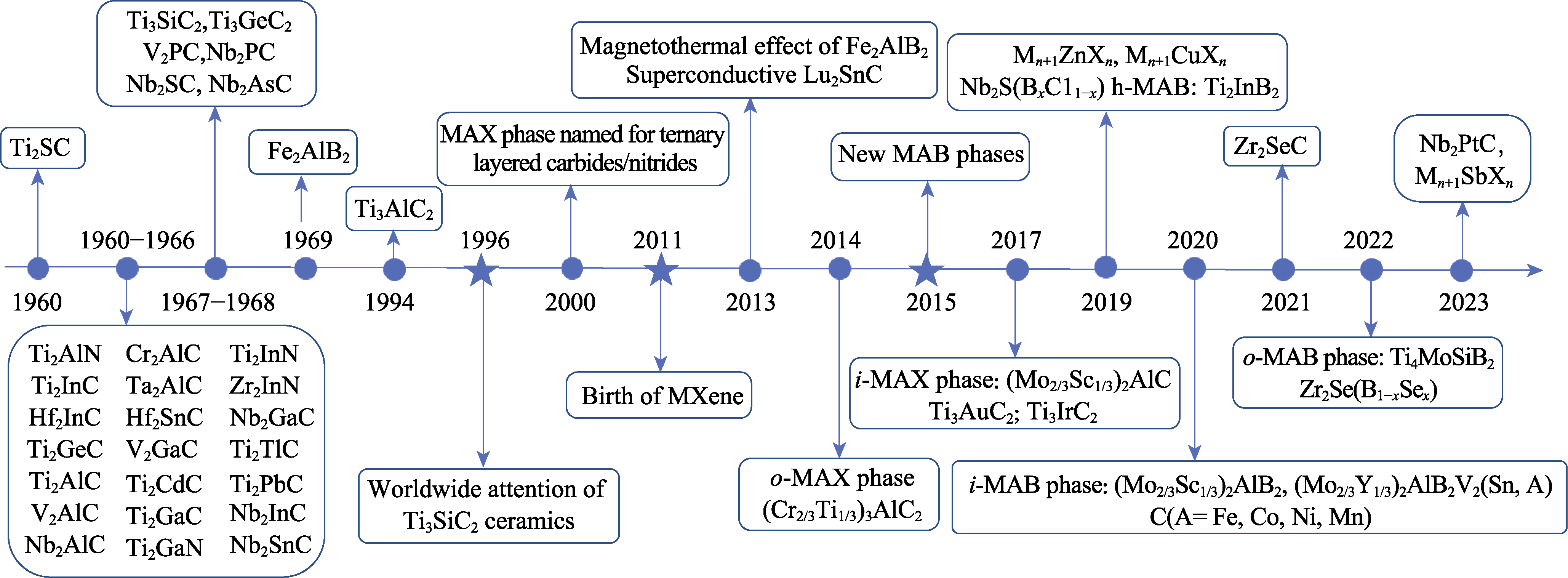
Fig. 1. Non-exhaustive chronicle of ternary layered materials
In 1960, Ti2SC was synthesized[40]; From 1960 to 1966, a large number of ternary layered carbides/nitrides (H-phases) with an M2AX formula (211 type) were synthesized[41-42]; From 1967 to 1968, Ti3SiC2 (312 type) and a set of 312 and 211 types H-phases were produced[41,43-44]; In 1969, a typical ternary layered boride Fe2AlB2 was synthesized[7]; In 1994, Ti3AlC2 was discovered[45]; In 1996, the high purity Ti3SiC2 was produced and exhibited excellent properties, thus triggering the research upsurge to these materials[46]; In 2000, Barsoum[1] renamed H-phases as Mn+1AXn phases, short for MAX phases; In 2011, the first MXene Ti3C2Tx was discovered[28]; In 2013, the discovery of magnetocaloric effect of Fe2AlB2 raised research upsurge on ternary layered borides[9]. Also, Lu2SnC was synthesized and found to be superconducting[47]; In 2014, an o-MAX (Cr2/3Ti1/3)3AlC2 was synthesized[48]; In 2015, ternary layered borides were named as MAB phases. In addition, the first Zr-based MAX phase was discovered[10,49]; In 2017, an i-MAX (Mo2/3Sc1/3)2AlC and two noble-metal MAX phases Ti3AuC2 and Ti3IrC2 were synthesized[22,50]; In 2019, a series of MAX phases containing Cu and Zn, and a hexagonal MAB phase Ti2InB2, as well as Nb2SBxC1-x (x=0-1) were synthesized[24⇓-26,51,52]; In 2020, two i-MAB phases (Mo2/3Sc1/3)2AlB2 and (Mo2/3Y1/3)2AlB2, as well as a variety of MAX phases containing Fe, Co, Ni, and Mn were synthesized[16,19]; In 2021, MAX phases having Se atoms at the A-site were produced[53]; In 2022, o-MAX phase Ti4MoSiB2, the first MBene, and Zr2Se(B1-xSex) were synthesized[20,54-55]; In 2023, a chemical scissor-mediated structural editing strategy was proposed, which extremely expands the diversity of MAX phases and MXene[56]
|