无机材料学报 ›› 2026, Vol. 41 ›› Issue (7): 1001-1010.DOI: 10.15541/jim20260017 CSTR: 32189.14.10.15541/jim20260017
左致平1,2( ), 郭春1,2, 周志勇1()
收稿日期:2026-01-12
修回日期:2026-02-27
出版日期:2026-07-20
网络出版日期:2026-03-02
通讯作者:
周志勇, 研究员. E-mail: zyzhou@mail.sic.ac.cn作者简介:左致平(2001-), 男, 博士研究生. E-mail: zuozhiping23@mails.ucas.ac.cn
ZUO Zhiping1,2(), GUO Chun1,2, ZHOU Zhiyong1()
Received:2026-01-12
Revised:2026-02-27
Published:2026-07-20
Online:2026-03-02
Contact:
ZHOU Zhiyong, professor. E-mail: zyzhou@mail.sic.ac.cnAbout author:ZUO Zhiping (2001-), male, PhD candidate. E-mail: zuozhiping23@mails.ucas.ac.cn
Supported by:摘要:
BiScO3-PbTiO3 (BSPT)基压电陶瓷因其高居里温度(TC)以及高压电系数(d33), 成为350 ℃以上高温压电应用领域的重要候选材料。然而, 传统试错法难以在广泛的成分空间范围内实现高温压电陶瓷的快速设计。本研究基于小样本数据集构建了机器学习模型, 并结合实验先验知识, 加速了兼具高d33和高TC的BSPT基压电陶瓷的设计。利用该模型, 设计并制备了Ga-W离子对共掺杂的0.36BiScO3-0.64PbTi1-x(Ga2/3W2/3)xO3 (BSPTGW1000x)压电陶瓷。结果表明, 该掺杂策略明显调控了BSPT基压电陶瓷的晶格畸变和畴结构, 从而提升了压电性能。其中, BSPTGW10 (x=0.010)陶瓷表现出最好的综合性能(d33=525 pC/N, TC=423 ℃), 与模型预测性能接近; 且在365 ℃以下, d33变化率保持在±15%以内, 表现出优异的热稳定性。本研究不仅为快速发现同时具备高压电性能和高居里温度的BSPT基压电陶瓷提供了有效途径, 而且获得了一种适用于高温应用有前景的压电陶瓷材料。本文数据集可通过
中图分类号:
左致平, 郭春, 周志勇. 基于机器学习的高温BSPT基压电陶瓷双重性能协同增强[J]. 无机材料学报, 2026, 41(7): 1001-1010.
ZUO Zhiping, GUO Chun, ZHOU Zhiyong. Machine Learning-assisted Design of High-temperature BSPT-based Piezoelectric Ceramics with Enhanced Dual Properties[J]. Journal of Inorganic Materials, 2026, 41(7): 1001-1010.
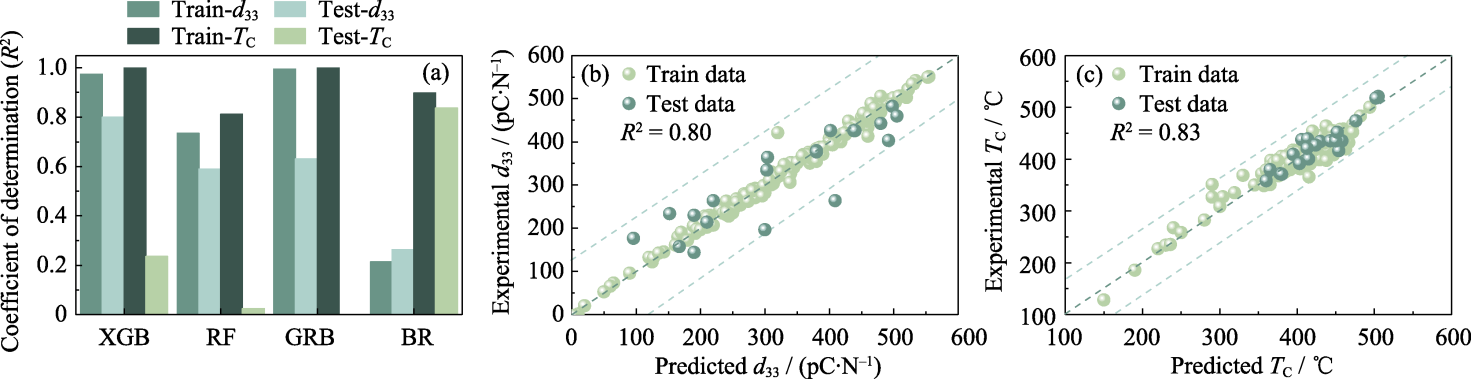
Fig. 1 (a) Results of model evaluations; (b) Performance of the XGB model on the d33 dataset; (c) Performance of the BR model on the TC dataset Colorful figures are available on website
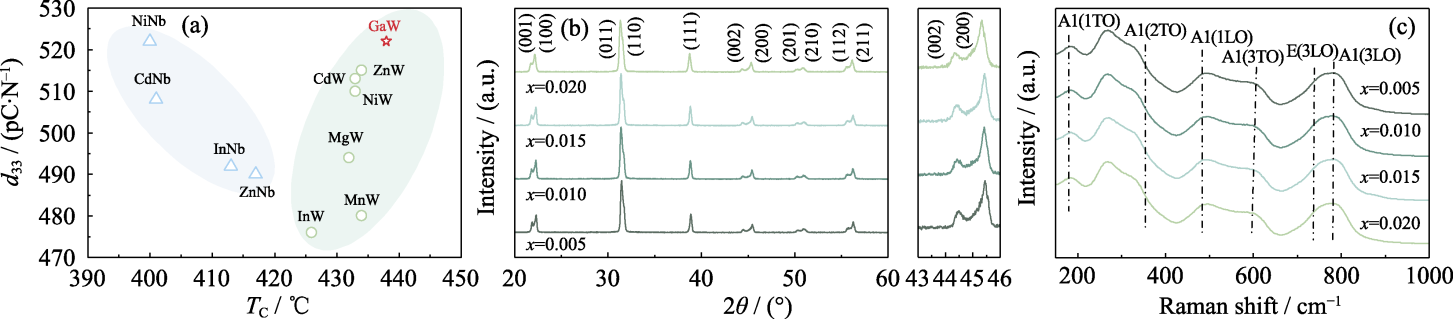
Fig. 2 (a) Predicted results of the machine learning model; (b) XRD patterns of the BSPTGW1000x ceramics and enlarged patterns in the 2θ range of 43°-46°; (c) Room temperature Raman spectra of the BSPTGW1000x ceramics
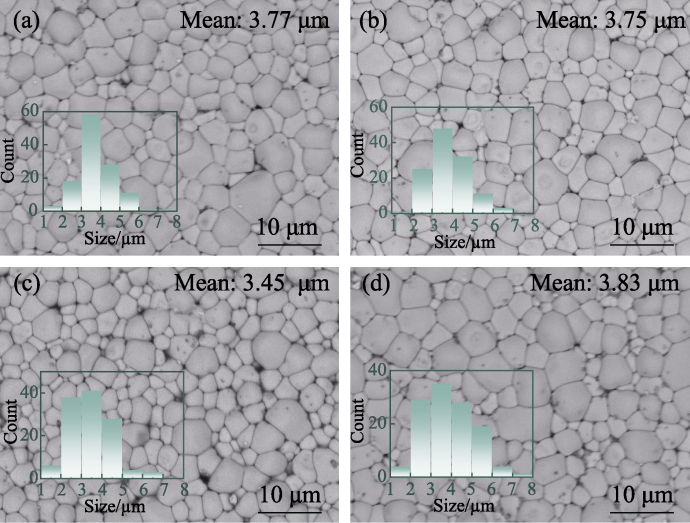
Fig. 3 SEM images of (a) BSPTGW05, (b) BSPTGW10, (c) BSPTGW15, and (d) BSPTGW20
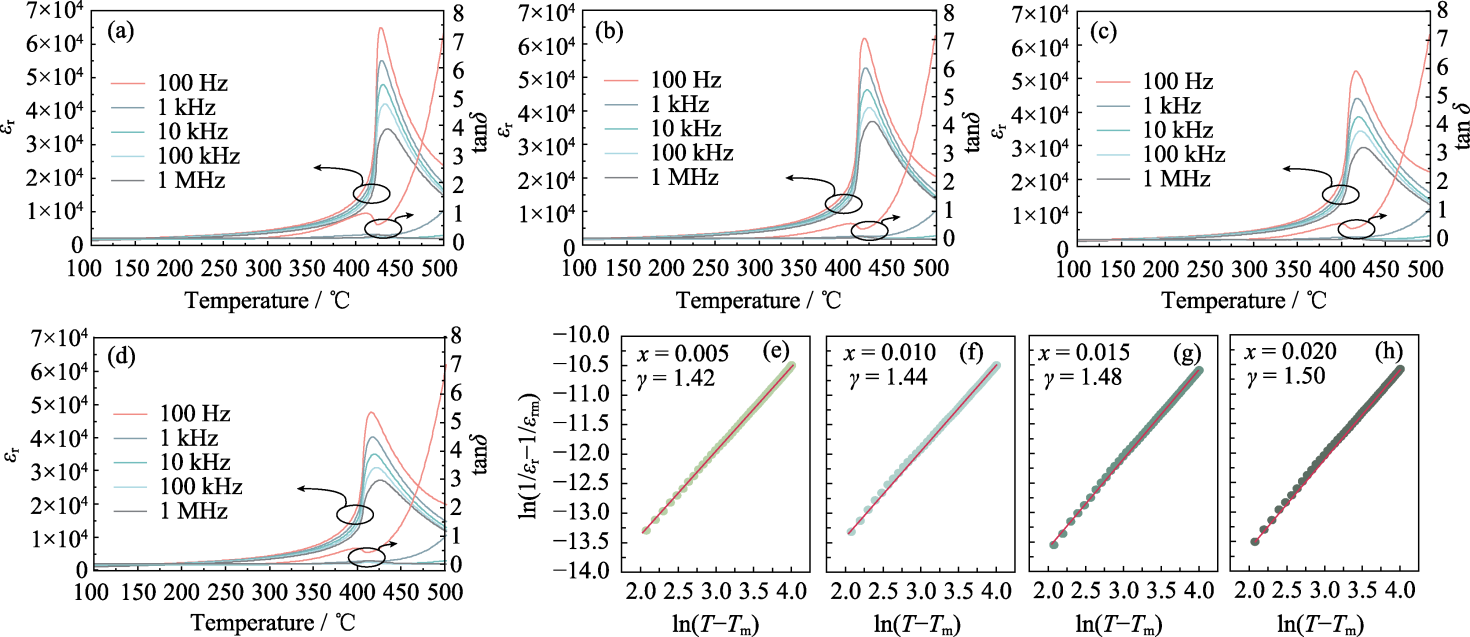
Fig. 4 (a-d) Temperature dependence of the dielectric constant for (a) BSPTGW05, (b) BSPTGW10, (c) BSPTGW15, and (d) BSPTGW20; (e-h) Line fitted by the Curie-Weiss relationship of BSPTGW1000x ceramics Colorful figures are available on website
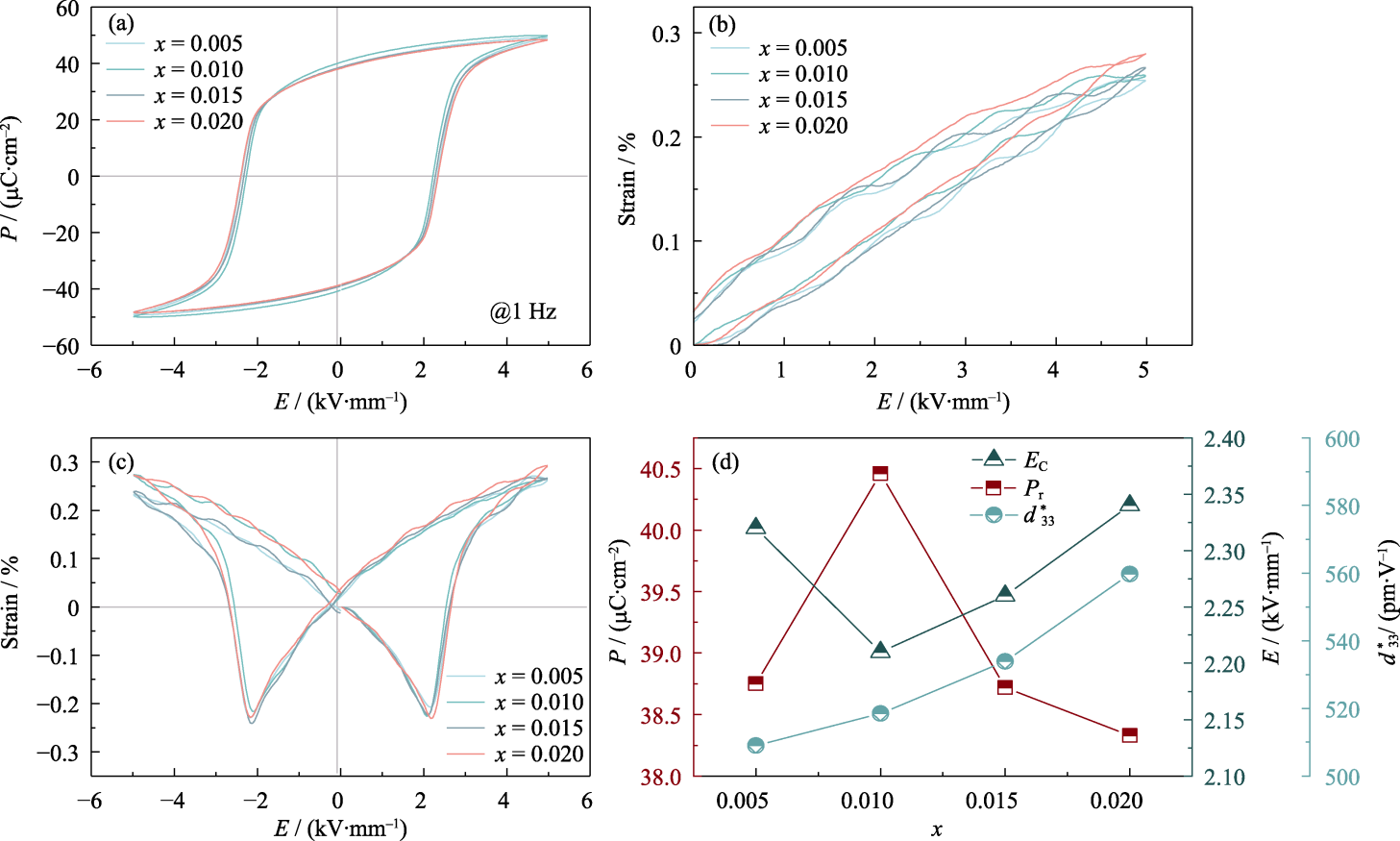
Fig. 5 (a) Hysteresis loops, (b) unipolar strain curves, (c) bipolar strain curves, and (d) the Pr, EC, and d33* for BSPTGW1000x ceramics Colorful figures are available on website
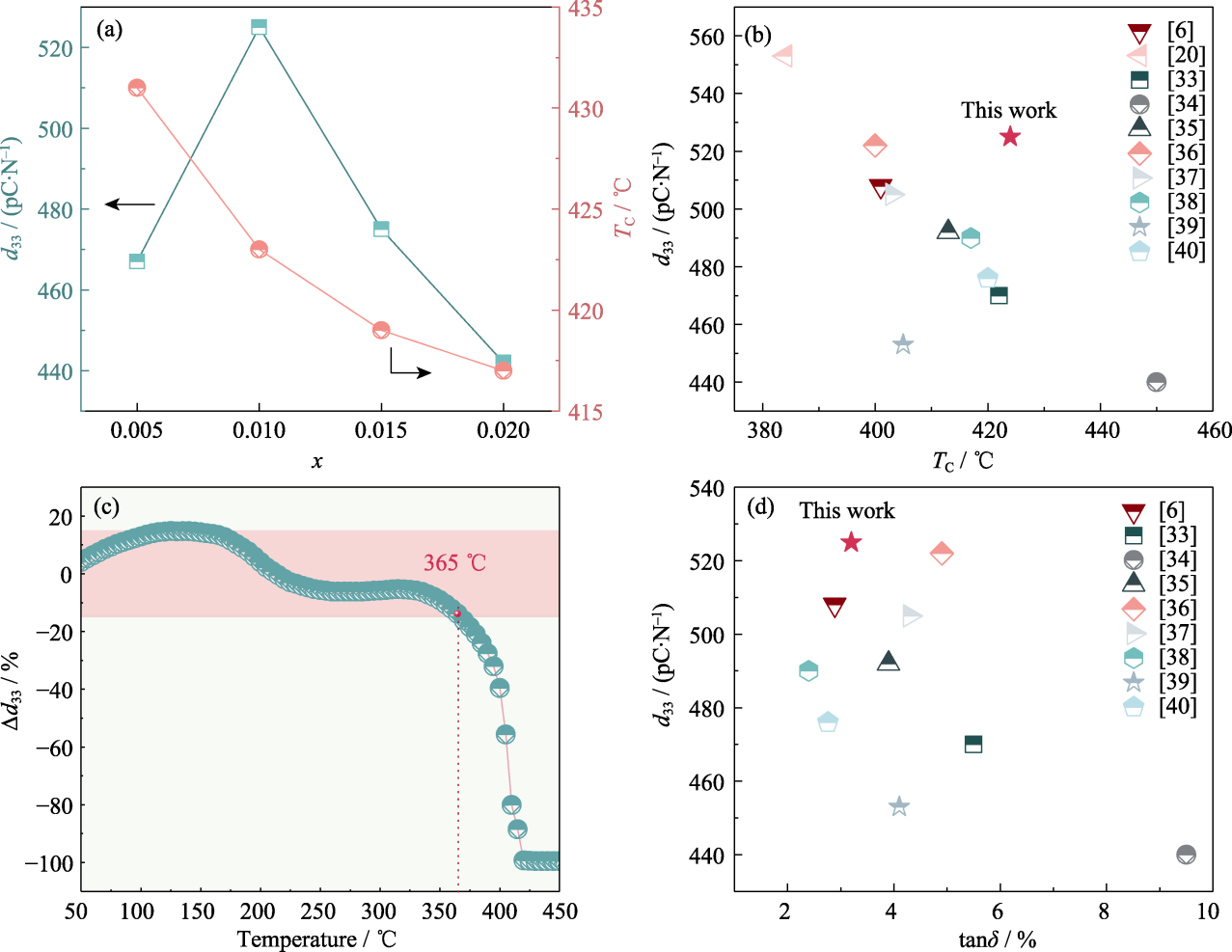
Fig. 6 (a) d33 and TC of BSPTGW1000x ceramics; (b) Comparison of d33 and TC between BSPTGW10 ceramic and previously reported piezoelectric ceramics; (c) Rate of change of in-situ d33 of BSPTGW10 ceramic; (d) Comparison of d33 and tanδ between BSPTGW10 ceramic and previously reported piezoelectric ceramics
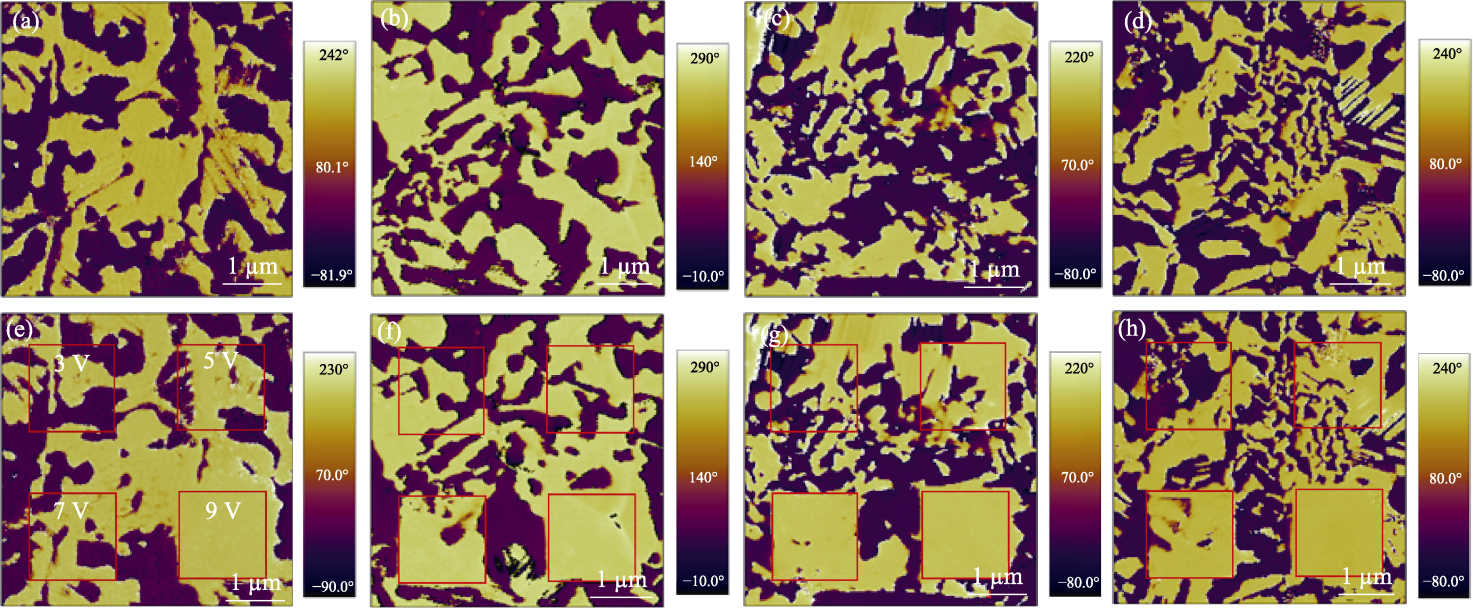
Fig. 7 (a-d) PFM images of BSPTGW1000x ceramics; (e-h) “Domain writing” of BSPTGW1000x ceramics (a, e) x=0.005; (b, f) x=0.010; (c, g) x=0.015; (d, h) x=0.020. Applied voltages for the four parts in Figs. (e-h) were 3, 5, 7, and 9 V, respectively. Colorful figures are available on website
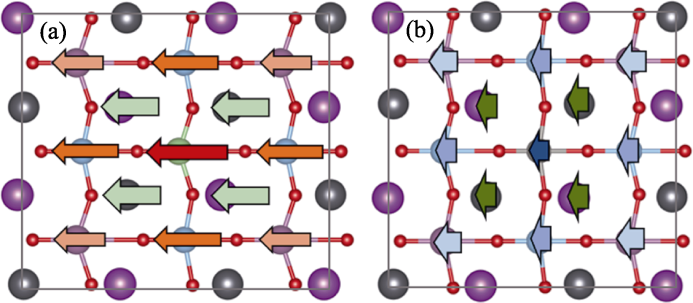
Fig. 8 Schematic diagram illustrating the influence of (a) Ga and (b) W element doping on lattice distortion
| Feature | Description |
|---|---|
| RCS12_A | Shannon's (1976) ionic radii 12 of A-site element |
| RC_A | Covalent radii of A-site element |
| RP_A | Pseudopotential core radii of A-site element |
| Rdce_A | Core electron distance of A-site element |
| Rdve_A | Valence electron distance of A-site element |
| Ven_A | Valence electron number of A-site element |
| Ne/IR_A | Ratio of electron number to ionic radii (A-site) |
| CNE_C/IR_A | Ratio of charge nuclear effective (Clementi) to ionic radii (A-site) |
| CNE_S/IR_A | Ratio of nuclear charge effective (Slater) to ionic radii (A-site) |
| VEC/Z_A | Ratio of valence electron number to nuclear charge (A-site) |
| Val/IR_A | Ratio of oxidation state to ionic radii (A-site) |
| CNE_C_A | Charge nuclear effective (Clementi) of A-site element |
| CNE_S_A | Nuclear charge effective (Slater) of A-site element |
| Valence_A | Oxidation state of A-site element |
| AN_A | Atomic number of A-site element |
| AW_A | Atomic weight of A-site element |
| AV_A | Atomic volume of A-site element |
| AR_A | Atomic radius of A-site element |
| IP_A | Ionic polarizability of A-site element |
| Electrons_A | Electron number of A-site element |
| ENA_A | Electronegativity (Alfred-Rochow) of A-site element |
| ENMB_A | Electronegativity (Martynov & Batsanov) of A-site element |
| ENP_A | Electronegativity (Pauling) of A-site element |
| EA_A | Electron affinity of A-site element |
| RVdw_A | Van der Waals radius of A-site element |
| I1_A | First ionization energy of A-site element |
| I2_A | Second ionization energy of A-site element |
| I3_A | Third ionization energy of A-site element |
| OF_A | Octahedral factor calculated by Shannon's ionic radii (A-site) |
| RCS6_B | Shannon's (1976) ionic radii 6 of B-site element |
| RC_B | Covalent radii of B-site element |
| RP_B | Pseudopotential core radii of B-site element |
| Rdce_B | Core electron distance of B-site element |
| Rdve_B | Valence electron distance of B-site element |
| Ven_B | Valence electron number of B-site element |
| Ne/IR_B | Ratio of electron number to ionic radii (B-site) |
| CNE_C/IR_B | Ratio of charge nuclear effective (Clementi) to ionic radii (B-site) |
| CNE_S/IR_B | Ratio of nuclear charge effective (Slater) to ionic radii (B-site) |
| VEC/Z_B | Ratio of valence electron number to nuclear charge (B-site) |
| Val/IR_B | Ratio of oxidation state to ionic radii (B-site) |
| CNE_C_B | Charge nuclear effective (Clementi) of B-site element |
| CNE_S_B | Nuclear charge effective (Slater) of B-site element |
| Valence_B | Oxidation state of B-site element |
| AN_B | Atomic number of B-site element |
| AW_B | Atomic weight of B-site element |
| AV_B | Atomic volume of B-site element |
| AR_B | Atomic radius of B-site element |
| IP_B | Ionic polarizability of B-site element |
| Electrons_B | Electron number of B-site element |
| ENA_B | Electronegativity (Alfred-Rochow) of B-site element |
| ENMB_B | Electronegativity (Martynov & Batsanov) of B-site element |
| ENP_B | Electronegativity (Pauling) of B-site element |
| EA_B | Electron affinity of B-site element |
| RVdw_B | Van der Waals radius of B-site element |
| I1_B | First ionization energy of B-site element |
| I2_B | Second ionization energy of B-site element |
| I3_B | Third ionization energy of B-site element |
| OF_B | Octahedral factor calculated by Shannon's ionic radii (B-site) |
| t | Tolerance_factor |
Table S1 Abbreviations and detailed meanings of all features
| Feature | Description |
|---|---|
| RCS12_A | Shannon's (1976) ionic radii 12 of A-site element |
| RC_A | Covalent radii of A-site element |
| RP_A | Pseudopotential core radii of A-site element |
| Rdce_A | Core electron distance of A-site element |
| Rdve_A | Valence electron distance of A-site element |
| Ven_A | Valence electron number of A-site element |
| Ne/IR_A | Ratio of electron number to ionic radii (A-site) |
| CNE_C/IR_A | Ratio of charge nuclear effective (Clementi) to ionic radii (A-site) |
| CNE_S/IR_A | Ratio of nuclear charge effective (Slater) to ionic radii (A-site) |
| VEC/Z_A | Ratio of valence electron number to nuclear charge (A-site) |
| Val/IR_A | Ratio of oxidation state to ionic radii (A-site) |
| CNE_C_A | Charge nuclear effective (Clementi) of A-site element |
| CNE_S_A | Nuclear charge effective (Slater) of A-site element |
| Valence_A | Oxidation state of A-site element |
| AN_A | Atomic number of A-site element |
| AW_A | Atomic weight of A-site element |
| AV_A | Atomic volume of A-site element |
| AR_A | Atomic radius of A-site element |
| IP_A | Ionic polarizability of A-site element |
| Electrons_A | Electron number of A-site element |
| ENA_A | Electronegativity (Alfred-Rochow) of A-site element |
| ENMB_A | Electronegativity (Martynov & Batsanov) of A-site element |
| ENP_A | Electronegativity (Pauling) of A-site element |
| EA_A | Electron affinity of A-site element |
| RVdw_A | Van der Waals radius of A-site element |
| I1_A | First ionization energy of A-site element |
| I2_A | Second ionization energy of A-site element |
| I3_A | Third ionization energy of A-site element |
| OF_A | Octahedral factor calculated by Shannon's ionic radii (A-site) |
| RCS6_B | Shannon's (1976) ionic radii 6 of B-site element |
| RC_B | Covalent radii of B-site element |
| RP_B | Pseudopotential core radii of B-site element |
| Rdce_B | Core electron distance of B-site element |
| Rdve_B | Valence electron distance of B-site element |
| Ven_B | Valence electron number of B-site element |
| Ne/IR_B | Ratio of electron number to ionic radii (B-site) |
| CNE_C/IR_B | Ratio of charge nuclear effective (Clementi) to ionic radii (B-site) |
| CNE_S/IR_B | Ratio of nuclear charge effective (Slater) to ionic radii (B-site) |
| VEC/Z_B | Ratio of valence electron number to nuclear charge (B-site) |
| Val/IR_B | Ratio of oxidation state to ionic radii (B-site) |
| CNE_C_B | Charge nuclear effective (Clementi) of B-site element |
| CNE_S_B | Nuclear charge effective (Slater) of B-site element |
| Valence_B | Oxidation state of B-site element |
| AN_B | Atomic number of B-site element |
| AW_B | Atomic weight of B-site element |
| AV_B | Atomic volume of B-site element |
| AR_B | Atomic radius of B-site element |
| IP_B | Ionic polarizability of B-site element |
| Electrons_B | Electron number of B-site element |
| ENA_B | Electronegativity (Alfred-Rochow) of B-site element |
| ENMB_B | Electronegativity (Martynov & Batsanov) of B-site element |
| ENP_B | Electronegativity (Pauling) of B-site element |
| EA_B | Electron affinity of B-site element |
| RVdw_B | Van der Waals radius of B-site element |
| I1_B | First ionization energy of B-site element |
| I2_B | Second ionization energy of B-site element |
| I3_B | Third ionization energy of B-site element |
| OF_B | Octahedral factor calculated by Shannon's ionic radii (B-site) |
| t | Tolerance_factor |
| Ionic size & geometric descriptors | Ionic size & geometric descriptors | ||
|---|---|---|---|
| RCS12_A | RCS12_B | Valence_A | Valence_B |
| RC_A | RC_B | CNE_C_A | CNE_C_B |
| RP_A | RP_B | CNE_S_A | CNE_S_B |
| AR_A | AR_B | Rdce_A | Rdce_B |
| RVdw_A | RVdw_B | Rdve_A | Rdve_B |
| Electronic & bonding descriptors | Derived ratios & perovskite structural factors | ||
| Ven_A | Ven_B | Ne/IR_A | |
| Electrons_A | Electrons_B | CNE_C/IR_A | |
| IP_A | IP_B | CNE_S/IR_A | |
| ENA_A | ENA_B | VEC/Z_A | |
| ENMB_A | ENMB_B | Val/IR_A | |
| ENP_A | ENP_B | Ne/IR_B | |
| EA_A | EA_B | CNE_C/IR_B | |
| I1_A | I1_B | CNE_S/IR_B | |
| I2_A | I2_B | VEC/Z_B | |
| I3_A | I3_B | Val/IR_B | |
| AN_A | AN_B | OF_A | |
| AW_A | AW_B | OF_B | |
| AV_A | AV_B | t | |
Table S2 Classification of input descriptors used in the machine learning model
| Ionic size & geometric descriptors | Ionic size & geometric descriptors | ||
|---|---|---|---|
| RCS12_A | RCS12_B | Valence_A | Valence_B |
| RC_A | RC_B | CNE_C_A | CNE_C_B |
| RP_A | RP_B | CNE_S_A | CNE_S_B |
| AR_A | AR_B | Rdce_A | Rdce_B |
| RVdw_A | RVdw_B | Rdve_A | Rdve_B |
| Electronic & bonding descriptors | Derived ratios & perovskite structural factors | ||
| Ven_A | Ven_B | Ne/IR_A | |
| Electrons_A | Electrons_B | CNE_C/IR_A | |
| IP_A | IP_B | CNE_S/IR_A | |
| ENA_A | ENA_B | VEC/Z_A | |
| ENMB_A | ENMB_B | Val/IR_A | |
| ENP_A | ENP_B | Ne/IR_B | |
| EA_A | EA_B | CNE_C/IR_B | |
| I1_A | I1_B | CNE_S/IR_B | |
| I2_A | I2_B | VEC/Z_B | |
| I3_A | I3_B | Val/IR_B | |
| AN_A | AN_B | OF_A | |
| AW_A | AW_B | OF_B | |
| AV_A | AV_B | t | |
| Material | Pr/(μC·cm-2) | S/% @5kV/mm | εr | SεrPr |
|---|---|---|---|---|
| BSPTGW05 | 38.75 | 0.255 | 1344 | 13280.40 |
| BSPTGW10 | 40.46 | 0.259 | 1386 | 14524.09 |
| BSPTGW15 | 38.72 | 0.268 | 1332 | 13822.11 |
| BSPTGW20 | 38.33 | 0.278 | 1290 | 13795.35 |
Table S3 Correlation between polarization, electrostrain and dielectric response
| Material | Pr/(μC·cm-2) | S/% @5kV/mm | εr | SεrPr |
|---|---|---|---|---|
| BSPTGW05 | 38.75 | 0.255 | 1344 | 13280.40 |
| BSPTGW10 | 40.46 | 0.259 | 1386 | 14524.09 |
| BSPTGW15 | 38.72 | 0.268 | 1332 | 13822.11 |
| BSPTGW20 | 38.33 | 0.278 | 1290 | 13795.35 |
| Material | Manufacturer | d33/(pC·N-1) | TC/℃ | tanδ/% |
|---|---|---|---|---|
| C-64 | Fuji Ceramics Corporation | 435 | 345 | 1.5 |
| C-602 | Fuji Ceramics Corporation | 310 | 360 | 1.3 |
| C-82 | Fuji Ceramics Corporation | 600 | 195 | 1.9 |
| K-350 | Piezo Technologies | 390 | 360 | 2 |
| K-500 | Piezo Technologies | 580 | 240 | 2 |
| K-600 | Piezo Technologies | 650 | 220 | 2 |
| BSPTGW10 | SICCAS | 525 | 423 | 3.2 |
Table S4 Comparison of BSPTGW10 ceramics with representative commercial piezoelectric material (data for commercial materials are taken from manufacturer datasheets)
| Material | Manufacturer | d33/(pC·N-1) | TC/℃ | tanδ/% |
|---|---|---|---|---|
| C-64 | Fuji Ceramics Corporation | 435 | 345 | 1.5 |
| C-602 | Fuji Ceramics Corporation | 310 | 360 | 1.3 |
| C-82 | Fuji Ceramics Corporation | 600 | 195 | 1.9 |
| K-350 | Piezo Technologies | 390 | 360 | 2 |
| K-500 | Piezo Technologies | 580 | 240 | 2 |
| K-600 | Piezo Technologies | 650 | 220 | 2 |
| BSPTGW10 | SICCAS | 525 | 423 | 3.2 |
| Model | Central atom | 〈λ〉 | σ2/(°)2 |
|---|---|---|---|
| Host | Sc | 1.0596 | 157.75 |
| Ti | 1.0235 | 72.34 | |
| Ga@Sc | Sc | 1.1030 | 659.40 |
| Ti | 1.0335 | 94.96 | |
| Ga | 1.1061 | 661.66 | |
| Ga@Ti | Sc | 1.1146 | 655.33 |
| Ti | 1.0446 | 121.69 | |
| Ga | 1.0849 | 672.50 | |
| W@Sc | Sc | 1.0291 | 89.55 |
| Ti | 1.0223 | 65.38 | |
| W | 1.0212 | 62.90 | |
| W@Ti | Sc | 1.0290 | 85.88 |
| Ti | 1.0172 | 55.95 | |
| W | 1.0183 | 58.70 |
Table S5 Quantitative octahedral distortion metrics for different substitution models
| Model | Central atom | 〈λ〉 | σ2/(°)2 |
|---|---|---|---|
| Host | Sc | 1.0596 | 157.75 |
| Ti | 1.0235 | 72.34 | |
| Ga@Sc | Sc | 1.1030 | 659.40 |
| Ti | 1.0335 | 94.96 | |
| Ga | 1.1061 | 661.66 | |
| Ga@Ti | Sc | 1.1146 | 655.33 |
| Ti | 1.0446 | 121.69 | |
| Ga | 1.0849 | 672.50 | |
| W@Sc | Sc | 1.0291 | 89.55 |
| Ti | 1.0223 | 65.38 | |
| W | 1.0212 | 62.90 | |
| W@Ti | Sc | 1.0290 | 85.88 |
| Ti | 1.0172 | 55.95 | |
| W | 1.0183 | 58.70 |
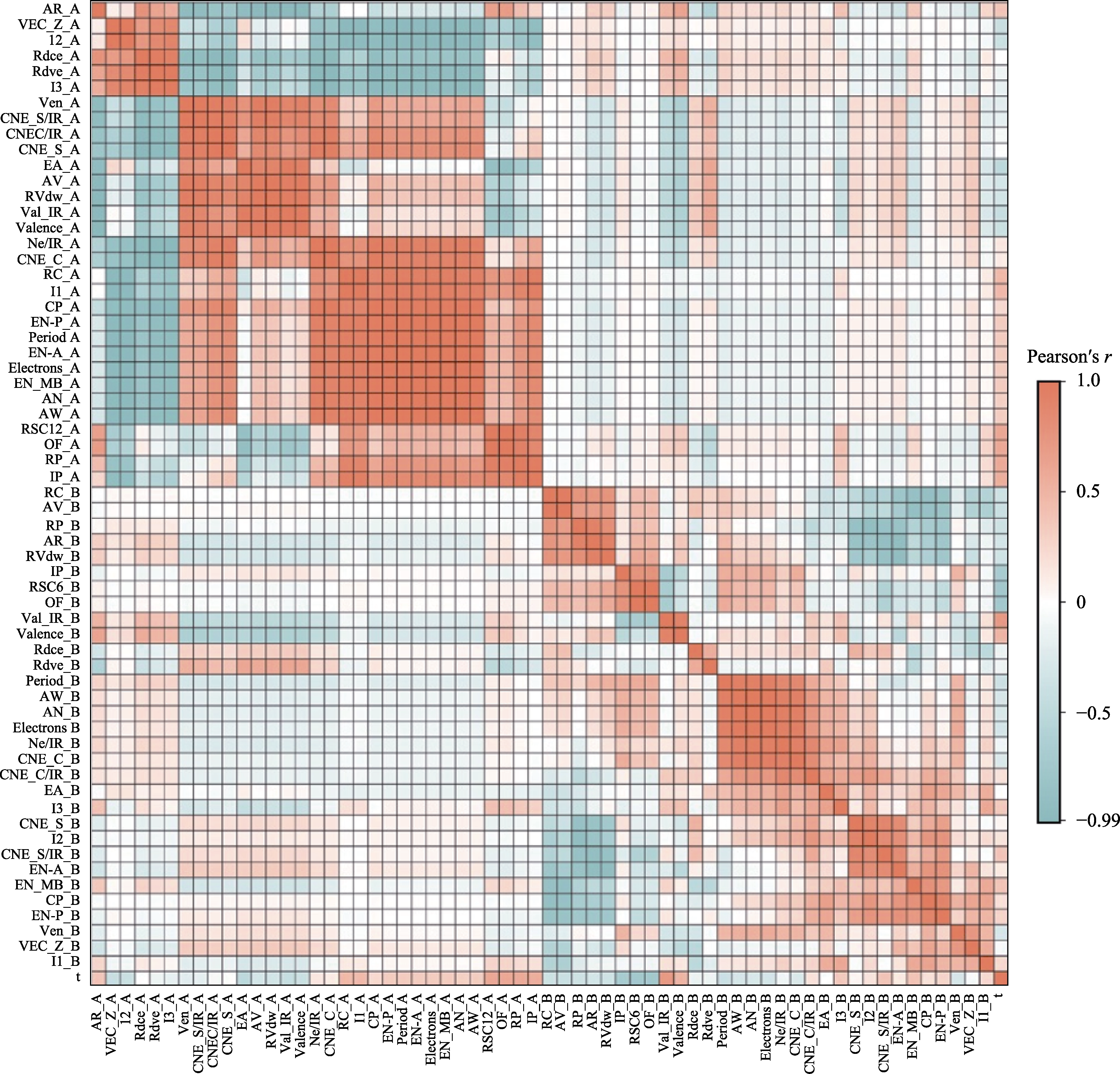
Fig. S1 Pearson correlation calculation results of all features
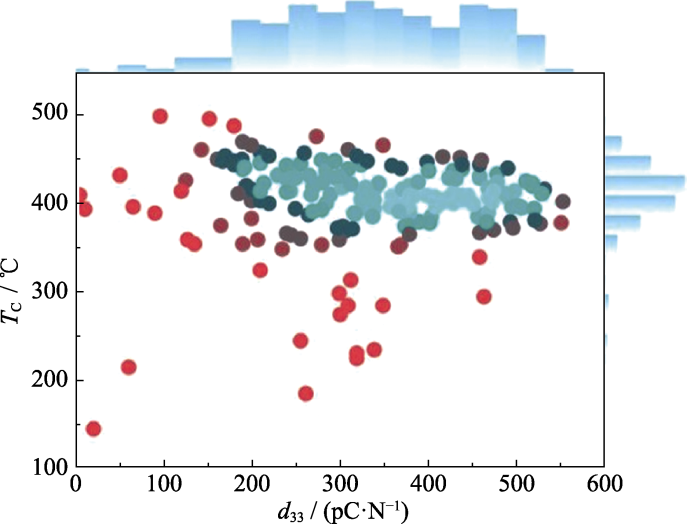
Fig. S2 Distribution of target properties (d33 and TC) in the training dataset
| [1] |
GAO X, YANG J, WU J, et al. Piezoelectric actuators and motors: materials, designs, and applications. Advanced Materials Technologies, 2020, 5(1): 1900716.
DOI URL |
| [2] |
PALATNIKOV M N, SANDLER V A, SIDOROV N V, et al. Conditions of application of LiNbO3 based piezoelectric resonators at high temperatures. Physics Letters A, 2020, 384(14): 126289.
DOI URL |
| [3] |
EITEL R E, RANDALL C A, SHROUT T R, et al. New high temperature morphotropic phase boundary piezoelectrics based on Bi(Me)O3-PbTiO3 ceramics. Japanese Journal of Applied Physics, 2001, 40(10R): 5999.
DOI |
| [4] |
LEE H J, ZHANG S, BAR-COHEN Y, et al. High temperature, high power piezoelectric composite transducers. Sensors, 2014, 14(8): 14526.
DOI PMID |
| [5] | LI Q, SHI W, JIANG Y, et al. Effect of Y-doping on the piezoelectric properties of (1-x)BiScO3-xPbTiO3 high-temperature piezoelectric ceramics. 2009 18th IEEE International Symposium on the Applications of Ferroelectrics, IEEE, 2009: 1-4. |
| [6] |
LAN Z, CHEN K, HE X, et al. Phase evolution and thermal stability of high Curie temperature BiScO3-PbTiO3-Pb(Cd1/3Nb2/3)O3 ceramics near MPB. Journal of Applied Physics, 2019, 126(23): 234103.
DOI URL |
| [7] | YANG C, XU X, ALI W, et al. Piezoelectricity in excess of 800 pC/N over 400 ℃ in BiScO3-PbTiO3-CaTiO3 ceramics. ACS Applied Materials & Interfaces, 2021, 13(28): 33253. |
| [8] |
WANG H, ZHU Y, LI J, et al. Machine learning-accelerated exploration on element doping-triggering material performance improvement for energy conversion and storage applications. Journal of Materials Chemistry A, 2025, 13(23): 17197.
DOI URL |
| [9] |
LING C. A review of the recent progress in battery informatics. npj Computational Materials, 2022, 8: 33.
DOI |
| [10] |
VALIZADEH A, SAHARA R, SOUISSI M. Alloys innovation through machine learning: a statistical literature review. Science and Technology of Advanced Materials: Methods, 2024, 4(1): 2326305.
DOI URL |
| [11] |
MANNODI-KANAKKITHODI A, CHAN M K Y. Computational data-driven materials discovery. Trends in Chemistry, 2021, 3(2): 79.
DOI URL |
| [12] |
LIU Y, WU J, WANG Z, et al. Predicting creep rupture life of Ni- based single crystal superalloys using divide-and-conquer approach based machine learning. Acta Materialia, 2020, 195: 454.
DOI URL |
| [13] | LIU Y, YANG Z, ZOU X, et al. Data quantity governance for machine learning in materials science. National Science Review, 2023, 10(7): nwad125. |
| [14] |
SAPKAL S, KANDASUBRAMANIAN B, DIXIT P, et al. Machine learning aided accelerated prediction and experimental validation of functional properties of K1-xNaxNbO3-based piezoelectric ceramics. Materials Today Energy, 2023, 37: 101402.
DOI URL |
| [15] |
HE J, YU C, HOU Y, et al. Accelerated discovery of high- performance piezocatalyst in BaTiO3-based ceramics via machine learning. Nano Energy, 2022, 97: 107218.
DOI URL |
| [16] |
LIU Y, GUO B, ZOU X, et al. Machine learning assisted materials design and discovery for rechargeable batterie. Energy Storage Materials, 2020, 31: 434.
DOI URL |
| [17] |
PANG D, LONG X, TAILOR H. A lead-reduced ferrolectric solid solution with high curie temperature: BiScO3-Pb(Zn1/3Nb2/3)O3- PbTiO3. Ceramics International, 2014, 40(8): 12953.
DOI URL |
| [18] |
BUSH A A, KAMENTSEV K E, LAVRENT’EV A M, et al. Dielectric and piezoelectric properties of (1-2x)BiScO3·xPbTiO3·xPbMg1/3Nb2/3O3 (0.30≤x≤0.46) solid solutions. Inorganic Materials, 2011, 47(7): 779.
DOI URL |
| [19] |
WANG D, JIANG Z, YANG B, et al. Enhanced electrical properties of novel Pb(Ni1/3Nb2/3)O3-BiScO3-PbTiO3 ternary system near morphotropic phase boundary. Japanese Journal of Applied Physics, 2013, 52(10R): 101101.
DOI |
| [20] |
ZHANG S, YU Y, WU J, et al. Enhanced piezoelectric performance of BiScO3-PbTiO3 ceramics modified by 0.03Pb(Sb1/2Nb1/2)O3. Journal of Alloys and Compounds, 2018, 731: 1140.
DOI URL |
| [21] |
RYU J, PRIYA S, SAKAKI C, et al. High power piezoelectric characteristics of BiScO3-PbTiO3-Pb(Mn1/3Nb2/3)O3. Japanese Journal of Applied Physics, 2002, 41(10R): 6040.
DOI URL |
| [22] |
ZHANG S, WANG X, LI L. Raman spectra and phase transition in (1-x)BiScO3-xPbTiO3 nanopowders. Ferroelectrics, 2013, 450(1): 28.
DOI URL |
| [23] |
DONG Y, ZHAO K, ZHOU Z, et al. High piezoelectricity with broad temperature insensitivity in BiScO3-PbTiO3-based piezoceramics. Journal of the American Ceramic Society, 2022, 105(11): 6898.
DOI URL |
| [24] |
WU N N, HOU Y D, WANG C, et al. Effect of sintering temperature on dielectric relaxation and Raman scattering of 0.65Pb(Mg1/3Nb2/3)O3-0.35PbTiO3 system. Journal of Applied Physics, 2009, 105(8): 084107.
DOI URL |
| [25] |
MARTIRENA H T, BURFOOT J C. Grain-size and pressure effects on the dielectric and piezoelectric properties of hot-pressed PZT-5. Ferroelectrics, 1974, 7(1): 151.
DOI URL |
| [26] |
YU T, ZHAO H, DUAN X, et al. Phase transition and relaxor nature of BaTiO3 ceramics induced by Li/Ga co-doping. Materials Chemistry and Physics, 2022, 290: 126566.
DOI URL |
| [27] | KRÖLL E, DEVECIOGLU L, SALAK A N, et al. Weakly-coupled barium titanate stannate-based relaxors as energy storage materials. Journal of the American Ceramic Society, 2025, 108(6): e20413. |
| [28] |
MALA D, SINGH C B, SINGH A K. Doping-induced relaxor ferroelectricity and site engineering in Ba1-xPr2x/3Ti1-y(Mo1/2Nb1/2)yO3 ceramics for enhanced permittivity and energy storage performance. ACS Omega, 2025, 10(38): 43779.
DOI URL |
| [29] |
QIN Y, LIU W, DING Y, et al. Enhanced electromechanical response in Dy3+-doped PNN-PZT relaxor ferroelectrics. Nanoscale, 2025, 17(17): 10685.
DOI URL |
| [30] |
XIAO A, XIE X, HE L, et al. Enhanced piezoelectric properties in a single-phase region of Sm-modified lead-free (Ba,Ca)(Zr,Ti)O3 ceramics. Materials, 2022, 15(21): 7839.
DOI URL |
| [31] |
JO W, DITTMER R, ACOSTA M, et al. Giant electric-field- induced strains in lead-free ceramics for actuator applications- status and perspective. Journal of Electroceramics, 2012, 29(1): 71.
DOI URL |
| [32] |
LEE D S, JEONG S J, KIM M S, et al. Electric field induced polarization and strain of Bi-based ceramic composites. Journal of Applied Physics, 2012, 112(12): 124109.
DOI URL |
| [33] |
ZHAO T L, FEI C, PU K, et al. Structure evolution and enhanced electrical performance for BiScO3-Bi(Ni1/2Zr1/2)O3-PbTiO3 solid solutions near the morphotropic phase boundary. Journal of Alloys and Compounds, 2021, 873: 159844.
DOI URL |
| [34] |
BERGANZA E, PASCUAL-GONZÁLEZ C, AMORÍN H, et al. Point defect engineering of high temperature piezoelectric BiScO3-PbTiO3 for high power operation. Journal of the European Ceramic Society, 2016, 36(16): 4039.
DOI URL |
| [35] |
ZHAO H, HOU Y, YU X, et al. Ultra-broad temperature insensitive ceramics with large piezoelectricity by morphotropic phase boundary design. Acta Materialia, 2019, 181: 238.
DOI URL |
| [36] |
ZHAO T L, FEI C, DAI X, et al. Structure and enhanced piezoelectric performance of BiScO3-PbTiO3-Pb(Ni1/3Nb2/3)O3 ternary high temperature piezoelectric ceramics. Journal of Alloys and Compounds, 2019, 806: 11.
DOI URL |
| [37] |
ZHAO T L, CHEN J, WANG C M, et al. Ferroelectric, piezoelectric, and dielectric properties of BiScO3-PbTiO3-Pb(Cd1/3Nb2/3)O3 ternary high temperature piezoelectric ceramics. Journal of Applied Physics, 2013, 114(2): 027014.
DOI URL |
| [38] |
YAO Z, LIU H, HAO H, et al. Structure, electrical properties, and depoling mechanism of BiScO3-PbTiO3-Pb(Zn1/3Nb2/3)O3 high- temperature piezoelectric ceramics. Journal of Applied Physics, 2011, 109(1): 014105.
DOI URL |
| [39] |
YAO Z, LIU H, LIU Y, et al. Morphotropic phase boundary in Pb(Sc1/2Nb1/2)O3-BiScO3-PbTiO3 high temperature piezoelectrics. Materials Letters, 2008, 62(29): 4449.
DOI URL |
| [40] |
DAI Z, LIU W, LIN D, et al. Electrical properties of zirconium- modified BiScO3-PbTiO3 piezoelectric ceramics at re-designed phase boundary. Materials Letters, 2018, 215: 46.
DOI URL |
| [41] |
PARK S E, SHROUT T R. Characteristics of relaxor-based piezoelectric single crystals for ultrasonic transducer. IEEE Transactions on Ultrasonics, Ferroelectrics, and Frequency Control, 1997, 44(5): 1140.
DOI URL |
| [42] | LIU W, ZHENG T, ZHANG F, et al. Achieving high piezoelectricity and excellent temperature stability in Pb(Zr,Ti)O3-based ceramics via low-temperature sintering. ACS Applied Materials & Interfaces, 2022, 14(45): 51113. |
| [43] |
XING J, MO M, CHENG Y, et al. Decoding the piezo- contributions of potassium sodium niobate ceramics. Journal of Physical Chemistry C, 2024, 128(1): 658.
DOI URL |
| [44] |
DAMJANOVIC D. Contributions to the piezoelectric effect in ferroelectric single crystals and ceramics. Journal of the American Ceramic Society, 2005, 88(10): 2663.
DOI URL |
| [45] |
TAN P, HUANG X, WANG Y, et al. Deciphering the atomistic mechanism underlying highly tunable piezoelectric properties in perovskite ferroelectrics via transition metal doping. Nature Communications, 2024, 15: 10619.
DOI |
| [46] |
WANG X, HUAN Y, JI S, et al. Ultra-high piezoelectric performance by rational tuning of heterovalent-ion doping in lead- free piezoelectric ceramics. Nano Energy, 2022, 101: 107580.
DOI URL |
| [47] |
SMÅBRÅTEN D R. Domain wall mobility and roughening in doped ferroelectric hexagonal manganites. Physical Review Research, 2020, 2(3): 033159.
DOI URL |
| [48] |
KUAMR R, ASOKAN K, PATNAIK S, et al. Evolution of microstructure and relaxor ferroelectric properties in (LazBa1-z)(Ti0.80Sn0.20)O3. Journal of Alloys and Compounds, 2016, 687: 197.
DOI URL |
| [49] |
LV X, ZHU J, XIAO D, et al. Emerging new phase boundary in potassium sodium-niobate based ceramics. Chemical Society Reviews, 2020, 49(3): 671.
DOI PMID |
| [50] |
FU Y, JIANG X, Li X, et al. Cation engineering in two- dimensional Ruddlesden-Popper lead iodide perovskites with mixed large A-site cations in the cage. Journal of the American Chemical Society, 2020, 142(8): 4008.
DOI URL |
| [51] |
ZOU J, WEI T, SONG M, et al. Unveiling the origin of ultrahigh piezoelectricity in Sb doped KNN based piezoceramics. Advanced Functional Materials, 2025, 35(28): 2425080.
DOI URL |
| [52] |
ZOU J, SONG M, ZHOU X, et al. Enhancing piezoelectric coefficient and thermal stability in lead-free piezoceramics: insights at the atomic-scale. Nature Communications, 2024, 15: 8591.
DOI PMID |
| [1] | 胡扬, 谢敏, 张筱怡, 李想, 郭新伟, 姜南, 周文瀚, 张胜利, 曾海波. 计算与数据驱动环保型发光材料的研究进展[J]. 无机材料学报, 2026, 41(6): 704-722. |
| [2] | 宋坤洁, 解荣军. 机器学习驱动新型发光材料的研究进展[J]. 无机材料学报, 2026, 41(6): 689-703. |
| [3] | 解陈一, 缪花明, 张蔚然, 刘荣军, 王衍飞, 李端. 理论计算在高熵陶瓷领域的研究进展[J]. 无机材料学报, 2026, 41(5): 545-560. |
| [4] | 周阳阳, 张艳艳, 于子怡, 傅正钱, 许钫钫, 梁瑞虹, 周志勇. 通过Bi3+自掺杂增强CaBi4Ti4O15基陶瓷压电性能[J]. 无机材料学报, 2025, 40(6): 719-728. |
| [5] | 黄建锋, 梁瑞虹, 周志勇. W/Cr共掺杂对CaBi2Nb2O9陶瓷晶体结构及电学性能的影响[J]. 无机材料学报, 2024, 39(8): 887-894. |
| [6] | 邹凯, 张文斌, 关胜, 孙海轶, 彭凯伦, 邹家杰, 李学红, 王成, 冷雨欣, 梁瑞虹, 周志勇. 压电式高温液滴喷射元件研制[J]. 无机材料学报, 2023, 38(8): 987-988. |
| [7] | 焦志翔, 贾帆豪, 王永晨, 陈建国, 任伟, 程晋荣. 基于机器学习的BiFeO3-PbTiO3-BaTiO3固溶体居里温度预测[J]. 无机材料学报, 2022, 37(12): 1321-1328. |
| [8] | 施思齐, 孙拾雨, 马舒畅, 邹欣欣, 钱权, 刘悦. 融合材料领域知识的数据准确性检测方法[J]. 无机材料学报, 2022, 37(12): 1311-1320. |
| [9] | 张瑞鸿, 魏鑫, 卢占会, 艾玥洁. 基于机器学习训练金属离子吸附能预测模型的研究[J]. 无机材料学报, 2021, 36(11): 1178-1184. |
| [10] | 孟嫣然, 王星尔, 杨健, 徐涵, 岳峰. 基于机器学习算法的夹层玻璃冲击破坏预测模型研究[J]. 无机材料学报, 2021, 36(1): 61-68. |
| [11] | 周志勇, 陈涛, 董显林. 超高居里温度钙钛矿层状结构压电陶瓷研究进展[J]. 无机材料学报, 2018, 33(3): 251-258. |
| [12] | 李启寿, 肖定全, 朱建国. 钇掺杂对 BSPT 高温压电陶瓷铁电性能的影响[J]. 无机材料学报, 2011, 26(2): 185-190. |
| [13] | 侯育冬,崔 磊,王 赛,王 超,朱满康,严 辉. BiAlO3基高温无铅压电陶瓷的研究进展[J]. 无机材料学报, 2010, 25(3): 225-229. |
| [14] | 黄宣威,李承恩. Ca-(Na,Ce)-Bi-Ti系列高温压电陶瓷材料及其压电性能的研究[J]. 无机材料学报, 1998, 13(1): 59-64. |
| 阅读次数 | ||||||
|
全文 |
|
|||||
|
摘要 |
|
|||||