
Journal of Inorganic Materials ›› 2026, Vol. 41 ›› Issue (5): 595-603.DOI: 10.15541/jim20250349
• RESEARCH ARTICLE • Previous Articles Next Articles
QIAN Xinyu1( ), WANG Wudi1, GUO Junyao1, REN Yongchun1, DONG Jianshu1, WANG Qingguo1(), TANG Huili1, ZHANG Chenbo1, XU Xiaodong2, DONG Yongjun3, HUA Wei4, XU Jun1()
Received:2025-09-02
Revised:2025-10-08
Published:2026-05-20
Online:2025-11-26
Contact:
XU Jun, professor. E-mail: 15503@tongji.edu.cn;About author:QIAN Xinyu (1998-), male, PhD candidate. E-mail: 894742295@qq.com
Supported by:CLC Number:
QIAN Xinyu, WANG Wudi, GUO Junyao, REN Yongchun, DONG Jianshu, WANG Qingguo, TANG Huili, ZHANG Chenbo, XU Xiaodong, DONG Yongjun, HUA Wei, XU Jun. Spectroscopic Analysis of Ho:BaF2 Crystals in the NIR to MIR Spectral Region[J]. Journal of Inorganic Materials, 2026, 41(5): 595-603.
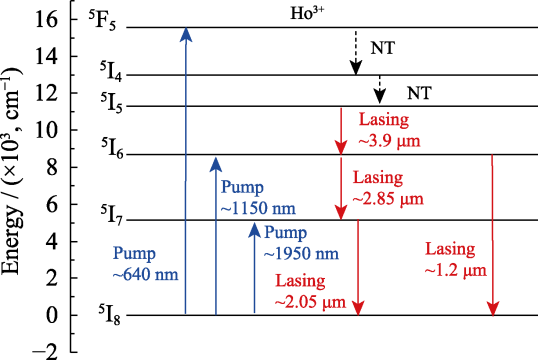
Fig. 1 Energy level diagram of Ho3+ ions for luminescence in the red spectral region
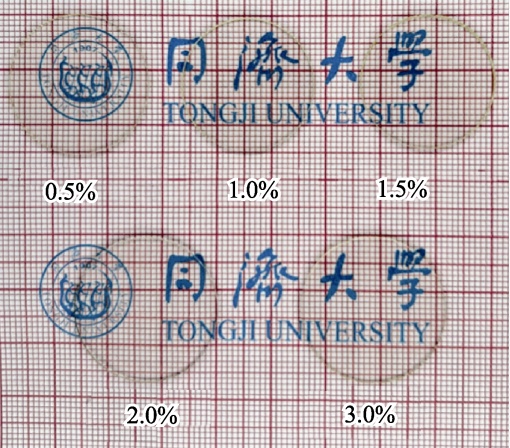
Fig. 2 Ho:BaF2 single crystals grown by porous-crucible TGT
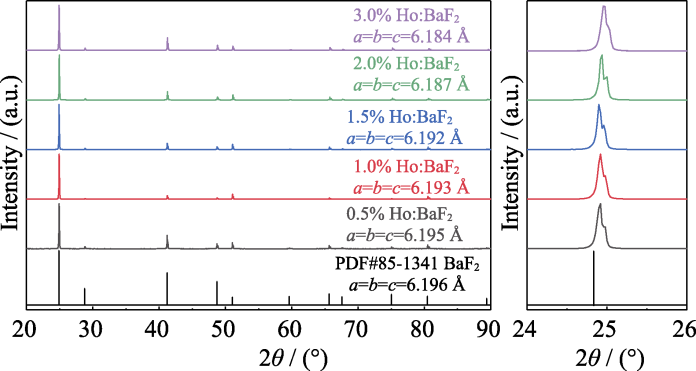
Fig. 3 XRD patterns of Ho:BaF2 single crystals and BaF2 reference sample
| Sample | Initial concentration/% (in atom) | Actual concentration/% (in atom) | Doping segregation ratio |
|---|---|---|---|
| 1 | 0.5 | 0.52 | 1.04 |
| 2 | 1.0 | 0.91 | 0.91 |
| 3 | 1.5 | 1.37 | 0.91 |
| 4 | 2.0 | 1.87 | 0.94 |
| 5 | 3.0 | 2.73 | 0.91 |
Table 1 Actual concentration and doping segregation ratio of Ho3+ ions in BaF2 crystals
| Sample | Initial concentration/% (in atom) | Actual concentration/% (in atom) | Doping segregation ratio |
|---|---|---|---|
| 1 | 0.5 | 0.52 | 1.04 |
| 2 | 1.0 | 0.91 | 0.91 |
| 3 | 1.5 | 1.37 | 0.91 |
| 4 | 2.0 | 1.87 | 0.94 |
| 5 | 3.0 | 2.73 | 0.91 |
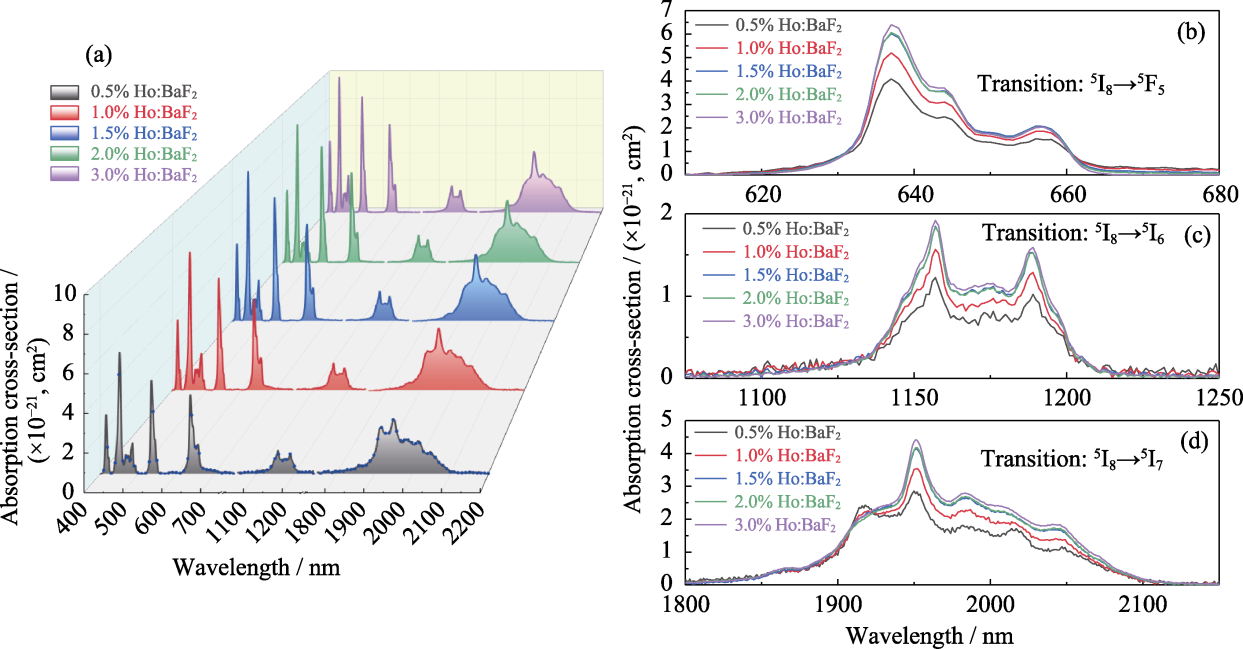
Fig. 4 Absorption spectra of the Ho:BaF2 crystals (a) 400-2200 nm range; (b) 5I8→5F5 transition; (c) 5I8→5I6 transition; (d) 5I8→5I7 transition. Colorful figures are available on website
| Gain medium | Concentration/% (in atom) | 637 nm (5I8→5F5) | 1157nm (5I8→5I6) | 1950 nm (5I8→5I7) | |||
|---|---|---|---|---|---|---|---|
| σabs/(×10-21, cm2) | FWHM/nm | σabs/(×10-21, cm2) | FWHM/nm | σabs/(×10-21, cm2) | FWHM/nm | ||
| BaF2 | 0.5 | 4.022 | 12 | 1.212 | 50 | 2.865 | 117 |
| 1.0 | 5.150 | 12 | 1.572 | 49 | 3.570 | 112 | |
| 1.5 | 5.986 | 12 | 1.851 | 48 | 4.140 | 102 | |
| 2.0 | 6.041 | 11 | 1.835 | 48 | 4.181 | 97 | |
| 3.0 | 6.457 | 11 | 1.923 | 49 | 4.423 | 95 | |
Table 2 Absorption cross-sections (σabs) and full width at half maximum (FWHM) of Ho:BaF2 crystals at 637 nm (5I8 → 5F5 transition), 1157 nm (5I8 → 5I6 transition), and 1950 nm (5I8 → 5I7 transition)
| Gain medium | Concentration/% (in atom) | 637 nm (5I8→5F5) | 1157nm (5I8→5I6) | 1950 nm (5I8→5I7) | |||
|---|---|---|---|---|---|---|---|
| σabs/(×10-21, cm2) | FWHM/nm | σabs/(×10-21, cm2) | FWHM/nm | σabs/(×10-21, cm2) | FWHM/nm | ||
| BaF2 | 0.5 | 4.022 | 12 | 1.212 | 50 | 2.865 | 117 |
| 1.0 | 5.150 | 12 | 1.572 | 49 | 3.570 | 112 | |
| 1.5 | 5.986 | 12 | 1.851 | 48 | 4.140 | 102 | |
| 2.0 | 6.041 | 11 | 1.835 | 48 | 4.181 | 97 | |
| 3.0 | 6.457 | 11 | 1.923 | 49 | 4.423 | 95 | |
| Concentration/% (in atom) | Ω2/(×10-20, cm2) | Ω4/(×10-20, cm2) | Ω6/(×10-20, cm2) | Ω4/Ω6 | RMSΔS/(×10-21, cm2) |
|---|---|---|---|---|---|
| 0.5 | 0.482 | 1.792 | 0.904 | 1.983 | 0.469 |
| 1.0 | 0.459 | 2.178 | 1.088 | 2.001 | 0.476 |
| 1.5 | 0.533 | 2.493 | 1.251 | 1.993 | 0.457 |
| 2.0 | 0.506 | 2.554 | 1.303 | 1.961 | 0.430 |
| 3.0 | 0.559 | 2.697 | 1.391 | 1.938 | 0.427 |
Table 3 J-O intensity parameters Ωt (t=2, 4, 6) and root mean square deviation (RMSΔS) for experimental and theoretical oscillator strengths in Ho:BaF2 crystals
| Concentration/% (in atom) | Ω2/(×10-20, cm2) | Ω4/(×10-20, cm2) | Ω6/(×10-20, cm2) | Ω4/Ω6 | RMSΔS/(×10-21, cm2) |
|---|---|---|---|---|---|
| 0.5 | 0.482 | 1.792 | 0.904 | 1.983 | 0.469 |
| 1.0 | 0.459 | 2.178 | 1.088 | 2.001 | 0.476 |
| 1.5 | 0.533 | 2.493 | 1.251 | 1.993 | 0.457 |
| 2.0 | 0.506 | 2.554 | 1.303 | 1.961 | 0.430 |
| 3.0 | 0.559 | 2.697 | 1.391 | 1.938 | 0.427 |
| Transition | Concentration/% (in atom) | FWHM/nm | β/% | τrad/ms | σem/(×10-21, cm2) | τ/ms | Q/(×10-21, cm2·ms) |
|---|---|---|---|---|---|---|---|
| ~1.2 μm (5I6→5I8) | 0.5 | 23.00 | 80.43 | 12.01 | 2.47 | 8.71 | 21.51 |
| 1.0 | 22.90 | 81.95 | 10.16 | 3.01 | 8.05 | 24.23 | |
| 1.5 | 31.63 | 82.94 | 8.95 | 2.83 | 7.49 | 21.20 | |
| 2.0 | 24.69 | 83.21 | 8.64 | 3.36 | 7.23 | 24.29 | |
| 3.0 | 26.03 | 83.64 | 8.14 | 3.64 | 6.39 | 23.26 | |
| ~2.05 μm (5I7→5I8) | 0.5 | 151.26 | - | 22.83 | 2.69 | 15.49 | 41.67 |
| 1.0 | 147.85 | - | 20.21 | 3.11 | 16.27 | 50.60 | |
| 1.5 | 144.99 | - | 18.36 | 3.49 | 17.22 | 60.10 | |
| 2.0 | 144.45 | - | 17.88 | 3.60 | 18.76 | 67.53 | |
| 3.0 | 144.23 | - | 17.07 | 3.81 | 15.68 | 59.74 | |
| ~2.85 μm (5I6→5I7) | 0.5 | 116.70 | 19.57 | 12.01 | 4.77 | 8.71 | 41.55 |
| 1.0 | 115.09 | 18.05 | 10.16 | 5.53 | 8.05 | 44.52 | |
| 1.5 | 114.01 | 17.06 | 8.95 | 5.81 | 7.49 | 43.52 | |
| 2.0 | 115.53 | 16.79 | 8.64 | 5.61 | 7.23 | 40.56 | |
| 3.0 | 115.04 | 16.36 | 8.14 | 6.09 | 6.39 | 38.91 |
Table 4 Infrared emission transition parameters of Ho:BaF2 crystals, including full width at half maximum (FWHM), fluorescence branching ratio (β), radiative lifetime of energy levels (τrad), emission cross section (σem), fluorescence lifetime (τ), and spectroscopic quality factor (Q)
| Transition | Concentration/% (in atom) | FWHM/nm | β/% | τrad/ms | σem/(×10-21, cm2) | τ/ms | Q/(×10-21, cm2·ms) |
|---|---|---|---|---|---|---|---|
| ~1.2 μm (5I6→5I8) | 0.5 | 23.00 | 80.43 | 12.01 | 2.47 | 8.71 | 21.51 |
| 1.0 | 22.90 | 81.95 | 10.16 | 3.01 | 8.05 | 24.23 | |
| 1.5 | 31.63 | 82.94 | 8.95 | 2.83 | 7.49 | 21.20 | |
| 2.0 | 24.69 | 83.21 | 8.64 | 3.36 | 7.23 | 24.29 | |
| 3.0 | 26.03 | 83.64 | 8.14 | 3.64 | 6.39 | 23.26 | |
| ~2.05 μm (5I7→5I8) | 0.5 | 151.26 | - | 22.83 | 2.69 | 15.49 | 41.67 |
| 1.0 | 147.85 | - | 20.21 | 3.11 | 16.27 | 50.60 | |
| 1.5 | 144.99 | - | 18.36 | 3.49 | 17.22 | 60.10 | |
| 2.0 | 144.45 | - | 17.88 | 3.60 | 18.76 | 67.53 | |
| 3.0 | 144.23 | - | 17.07 | 3.81 | 15.68 | 59.74 | |
| ~2.85 μm (5I6→5I7) | 0.5 | 116.70 | 19.57 | 12.01 | 4.77 | 8.71 | 41.55 |
| 1.0 | 115.09 | 18.05 | 10.16 | 5.53 | 8.05 | 44.52 | |
| 1.5 | 114.01 | 17.06 | 8.95 | 5.81 | 7.49 | 43.52 | |
| 2.0 | 115.53 | 16.79 | 8.64 | 5.61 | 7.23 | 40.56 | |
| 3.0 | 115.04 | 16.36 | 8.14 | 6.09 | 6.39 | 38.91 |
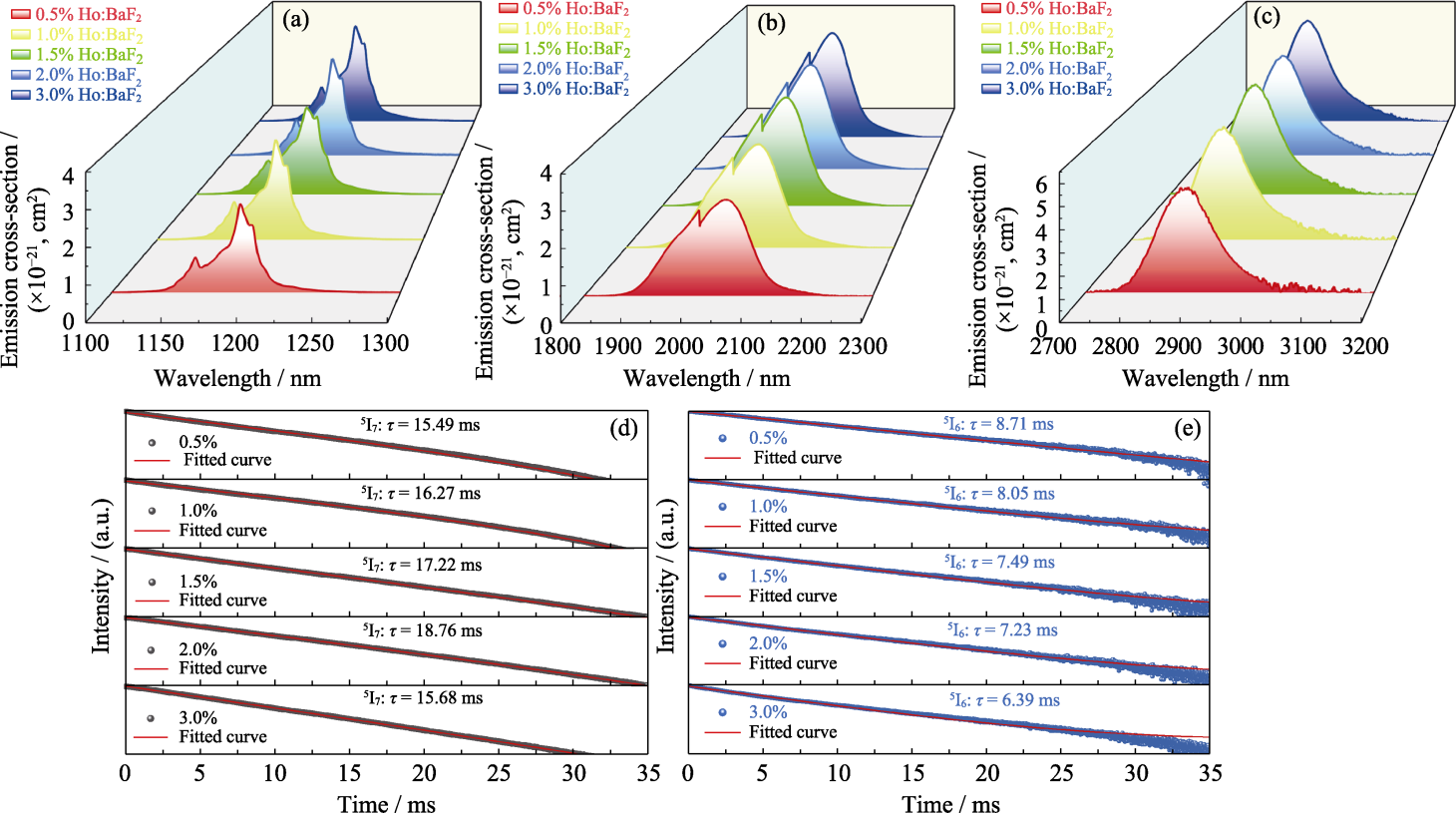
Fig. 5 Fluorescence spectra in the infrared region and fluorescence lifetimes of the Ho:BaF2 crystals (a) 5I6→5I8 emission transition; (b) 5I7→5I8 emission transition; (c) 5I6→5I7 emission transition; (d) Lifetime of the 5I7 level; (e) Lifetime of the 5I6 level. Colorful figures are available on website
| Waveband | Gain medium | τ/ms | Q/(×10-21, cm2·ms) | Ref. |
|---|---|---|---|---|
| ~1.2 μm | 2.0% Ho:BaF2 | 7.23 | 24.29 | This work |
| YSGG | 0.643 | 6.43 | [ | |
| Nano glass | 7.8 | 21.06 | [ | |
| BaF2 Nano crystals | 2.87 | 17.22 | [ | |
| ~2.05 μm | 2.0% Ho:BaF2 | 17.76 | 67.53 | This work |
| YAG | 7.8 | 62.4 | [ | |
| CaF2 | 11.52 | 46.81 | [ | |
| CNGG | 6.41 | 40.38 | [ | |
| GdScO3 | 6.13 | 30.04 | [ | |
| ~2.85 μm | 1.0% Ho:BaF2 | 8.05 | 44.52 | This work |
| LuAG | 0.13 | 20.15 | [ | |
| LLF | 1.83 | 30.61 | [ | |
| PbF2 | 5.40 | 77.76 | [ |
Table 5 Comparative analysis of infrared spectral characteristics in Ho:BaF2 versus alternative gain medium
| Waveband | Gain medium | τ/ms | Q/(×10-21, cm2·ms) | Ref. |
|---|---|---|---|---|
| ~1.2 μm | 2.0% Ho:BaF2 | 7.23 | 24.29 | This work |
| YSGG | 0.643 | 6.43 | [ | |
| Nano glass | 7.8 | 21.06 | [ | |
| BaF2 Nano crystals | 2.87 | 17.22 | [ | |
| ~2.05 μm | 2.0% Ho:BaF2 | 17.76 | 67.53 | This work |
| YAG | 7.8 | 62.4 | [ | |
| CaF2 | 11.52 | 46.81 | [ | |
| CNGG | 6.41 | 40.38 | [ | |
| GdScO3 | 6.13 | 30.04 | [ | |
| ~2.85 μm | 1.0% Ho:BaF2 | 8.05 | 44.52 | This work |
| LuAG | 0.13 | 20.15 | [ | |
| LLF | 1.83 | 30.61 | [ | |
| PbF2 | 5.40 | 77.76 | [ |
| [1] |
ARSLANOV D D, SPUNEI M, MANDON J, et al. Continuous- wave optical parametric oscillator based infrared spectroscopy for sensitive molecular gas sensing. Laser & Photonics Reviews, 2013, 7(2): 188.
DOI URL |
| [2] |
GODARD A. Infrared (2-12 μm) solid-state laser sources: a review. Comptes Rendus Physique, 2007, 8(10): 1100.
DOI URL |
| [3] |
SCHIFF H I, MACKAY G I, BECHARA J. The use of tunable diode laser absorption spectroscopy for atmospheric measurements. Research on Chemical Intermediates, 1994, 20(3): 525.
DOI URL |
| [4] | YUAN W, FANG R, XU H, et al. Red light pumped Ho3+: YLF laser at 1195.8 nm. Optics & Laser Technology, 2023, 167: 109784. |
| [5] | WANG J, ZHU X, MA Y, et al. Compact CNT mode-locked Ho3+- doped fluoride fiber laser at 1.2 μm. IEEE Journal of Selected Topics in Quantum Electronics, 2018, 24(3): 1101205. |
| [6] |
HEMMER M, SÁNCHEZ D, JELÍNEK M, et al. 2-μm wavelength, high-energy Ho:YLF chirped-pulse amplifier for mid-infrared OPCPA. Optics letters, 2015, 40(4): 451.
DOI PMID |
| [7] |
WANG S, ZHANG J, XU N, et al.2.9 µm lasing from a Ho3+/Pr3+ co-doped AlF3-based glass fiber pumped by a 1150 nm laser. Optics Letters, 2020, 45(5): 1216.
DOI URL |
| [8] |
REN Y, DONG J, WANG W, et al. Crystal growth and spectroscopic analysis of Ho, Pr: BaF2 crystal for 3 μm mid-infrared emission. Journal of Luminescence, 2024, 275: 120743.
DOI URL |
| [9] |
SCHNEIDE J, CARBONNIER C, UNRAU U B. Characterization of a Ho3+-doped fluoride fiber laser with a 3.9-μm emission wavelength. Applied Optics, 1997, 36(33): 8595.
DOI URL |
| [10] | XUE G, ZHANG B, YIN K, et al. All-fiber wavelength-tunable Tm/Ho-codoped laser between 1727 nm and 2030 nm, International Symposium on High-Power Laser Systems and Applications, Chengdu. |
| [11] |
STONEMAN R C, ESTEROWITZ L. Intracavity-pumped 2.09-μm Ho: YAG laser. Optics Letters, 1992, 17(10): 736.
DOI URL |
| [12] |
NEWBURGH G A, WORD-DANIELS A, MICHAEL A, et al. Resonantly diode-pumped Ho3+: Y2O3 ceramic 2.1 µm laser. Optics Express, 2011, 19(4): 3604.
DOI URL |
| [13] |
CLERICI M, PECCIANTI M, SCHMIDT B E, et al. Wavelength scaling of Terahertz generation by gas ionization. Physical Review Letters, 2013, 110(25): 253901.
DOI URL |
| [14] |
PETROV V. Frequency down-conversion of solid-state laser sources to the mid-infrared spectral range using non-oxide nonlinear crystals. Progress in Quantum Electronics, 2015, 42: 1.
DOI URL |
| [15] |
SMOLSKI V O, YANG H, GORELOV S D, et al. Coherence properties of a 2.6-7.5 μm frequency comb produced as a subharmonic of a Tm-fiber laser. Optics Letters, 2016, 41(7): 1388.
DOI URL |
| [16] |
PAYNE S A, CAIRD J A, CHASE L L, et al. Spectroscopy and gain measurements of Nd3+ in SrF2 and other fluorite-structure hosts. Journal of the Optical Society of America B, 1991, 8(4): 726.
DOI URL |
| [17] |
CHEN X, WU Y. High concentration Ce3+ doped BaF2 transparent ceramics. Journal of Alloys and Compounds, 2020, 817: 153075.
DOI URL |
| [18] |
NICOARA I, STEF M. Charge compensating defects study of YbF3-doped BaF2 crystals using dielectric loss. Physica Status Solidi B, 2016, 253(2): 397.
DOI URL |
| [19] |
KENBAYEV D, SOROKIN M V, EL-SAID A S, et al. Creation and stability of color centers in BaF2 single crystals irradiated with swift 132Xe ions. Crystals, 2025, 15(9): 785.
DOI URL |
| [20] | ZHANG Q L, YIN S T, SUN D L, et al. Segregation during crystal growth from melt and absorption cross section determination by optical absorption method. Science in China Series G: Physics, Mechanics and Astronomy, 2008, 51(5): 481. |
| [21] |
VESELSKÝ K, LOIKO P, EREMEEV K, et al. Broadly tunable continuous-wave Tm, Ho: SrF2 and Tm, Ho: BaF2 lasers. Optics Letters, 2024, 49(19): 5631.
DOI URL |
| [22] |
QIAN X, ZHANG N, WANG W, et al. Spectroscopic characterization and efficient tunable lasers of Ho: BaF2 single crystals. Chinese Optics Letters, 2025, 23(7): 071403.
DOI URL |
| [23] |
CAO R, LU Y, TIAN Y, et al. 2 μm emission properties and nonresonant energy transfer of Er3+ and Ho3+ codoped silicate glasses. Scientific Reports, 2016, 6: 37873.
DOI |
| [24] |
ORLOVSKII Y V, BASIEV T T, PUKHOV K K, et al. Low- phonon BaF2: Ho3+, Tm3+ doped crystals for 3.5-4 μm lasing. Optical Materials, 2010, 32(5): 599.
DOI URL |
| [25] | 王无敌. 镨离子掺杂碱土/稀土氟化物晶体生长、局域结构与发光性能研究. 上海: 同济大学博士学位论文, 2024. |
| [26] |
HAYES W, LAMBOURN K F. Production of F and F-aggregate centres in CaF2 and SrF2 by irradiation. Physica Status Solidi B, 1973, 57(2): 693.
DOI URL |
| [27] |
MA F K, ZHANG Z, JIANG D P, et al. Neodymium cluster evolution in fluorite laser crystal: a combined DFT and synchrotron X-ray absorption fine structure study. Crystal Growth & Design, 2022, 22(7): 4480.
DOI URL |
| [28] |
JUDD B R. Optical absorption intensities of rare-earth ions. Physical Review, 1962, 127(3): 750.
DOI URL |
| [29] |
OFELT G S. Intensities of crystal spectra of rare-earth ions. The Journal of Chemical Physics, 1962, 37(3): 511.
DOI URL |
| [30] |
YANG C, LIU J, WANG Z, et al. Enhanced 2.8 μm emission of Ho, Pr: CaYAlO4 crystal. Optical Materials, 2024, 152: 115407.
DOI URL |
| [31] | ŠULC J, NĚMEC M, VYHLÍDAL D, et al. Holmium doping concentration influence on Ho: YAG crystal spectroscopic properties. Solid State Lasers XXX: Technology and Devices. SPIE, 2021, 11664: 105. |
| [32] | ŠULC J, NĚMEC M, JELÍNEK M, et al. Anisotropy of spectroscopic and laser properties of Ho: YAP crystal. Solid State Lasers: Technology and Devices. SPIE, 2022, 11980: 74. |
| [33] |
WALSH B M, BARNES N P, DI BARTOLO B. Branching ratios, cross sections, and radiative lifetimes of rare earth ions in solids: application to Tm3+ and Ho3+ ions in LiYF4. Journal of Applied Physics, 1998, 83(5): 2772.
DOI URL |
| [34] |
WALSH B M, GREW G W, BARNES N P. Energy levels and intensity parameters of Ho3+ ions in GdLiF4, YLiF4 and LuLiF4. Journal of Physics: Condensed Matter, 2005, 17(48): 7643.
DOI URL |
| [35] |
YANG F, TU C, WANG H, et al. Growth and spectroscopy of ZnWO4: Ho3+ crystal. Journal of Alloys and Compounds, 2008, 455(1/2): 269.
DOI URL |
| [36] |
IKONNIKOV D A, MALAKHOVSKII A V, SUKHACHEV A L, et al. Spectroscopic properties of HoAl3(BO3)4 single crystal. Optical Materials, 2014, 37: 257.
DOI URL |
| [37] |
EREMEEV K, LOIKO P, ZHAO C, et al. Growth, spectroscopy and laser operation of Tm, Ho: GdScO3 perovskite crystal. Optics Express, 2024, 32(8): 13527.
DOI URL |
| [38] |
KOLOBKOVA E, ALKHLEF A, DINH B M, et al. Spectral properties of Nd3+ ions in the new fluoride glasses with small additives of the phosphates. Journal of Luminescence, 2019, 206: 523.
DOI URL |
| [39] |
OSIAC E, SOKÓLSKA I, KÜCK S. Evaluation of the upconversion mechanisms in Ho3+-doped crystals: experiment and theoretical modeling. Physical Review B, 2002, 65(23): 235119.
DOI URL |
| [40] |
CAPOBIANCO J A, BOYER J C, VETRONE F, et al. Optical spectroscopy and upconversion studies of Ho3+-doped bulk and nanocrystalline Y2O3. Chemistry of Materials, 2002, 14(7): 2915.
DOI URL |
| [41] | 董建树. Ho3+离子掺杂激光晶体的生长与光谱性能研究, 上海: 同济大学博士学位论文, 2022. |
| [42] |
CHEN M, SHIRAKAWA A, OLAUSSON C B, et al. 87 W, narrow-linewidth, linearly-polarized 1178 nm photonic bandgap fiber amplifier. Optics Express, 2015, 23(3): 3134.
DOI PMID |
| [43] |
SONG Q, ZHANG N, LIU J, et al. Efficient continuous wave and broad tunable lasers with the Tm:GdScO3 crystal. Optics Letters, 2023, 48(3): 640.
DOI URL |
| [44] |
DIENING A, KÜCK S. Spectroscopy and diode-pumped laser oscillation of Yb3+, Ho 3+-doped yttrium scandium gallium garnet. Journal of Applied Physics, 2000, 87(9): 4063.
DOI URL |
| [45] |
DRIESEN K, TIKHOMIROV V K, GÖRLLER-WALRAND C, et al. Transparent Ho3+-doped nano-glass-ceramics for efficient infrared emission. Applied Physics Letters, 2006, 88(7): 073111.
DOI URL |
| [46] |
ZHAO Z, LIU C, XIA M, et al. Intense ∼1.2 μm emission from Ho3+/Y3+ ions co-doped oxyfluoride glass-ceramics containing BaF2 nanocrystals. Journal of Alloys and Compounds, 2017, 701: 392.
DOI URL |
| [47] |
PAYNE S A, CHASE L L, SMITH L K, et al. Infrared cross- section measurements for crystals doped with Er3+, Tm3+, and Ho3+. IEEE Journal of Quantum Electronics, 1992, 28(11): 2619.
DOI URL |
| [48] |
ZHOU Y, CHEN J, DONG L, et al. Growth and spectroscopic properties of Yb-Ho co-doped CNGG crystal. Optical Materials, 2021, 114: 110998.
DOI URL |
| [49] |
HU D, DONG J, TIAN J, et al. Crystal growth, spectral properties and Judd-Ofelt analysis of Ho:GdScO3 crystal. Journal of Luminescence, 2021, 238: 118243.
DOI URL |
| [50] |
WANG Y H, LI Z, YIN H, et al. Enhanced -3 μm mid-infrared emissions of Ho3+ via Yb3+ sensitization and Pr3+ deactivation in Lu3Al5O12 crystal. Optical Materials Express, 2018, 8(7): 1882.
DOI URL |
| [51] |
ZHAO C C, HANG Y, ZHANG L H, et al. Polarized spectroscopic properties of Ho3+-doped LuLiF4 single crystal for 2 μm and 2.9 μm lasers. Optical Materials, 2011, 33(11): 1610.
DOI URL |
| [52] |
ZHANG P X, YIN J G, ZHANG B T, et al. Intense 2.8 μm emission of Ho3+ doped PbF2 single crystal. Optics Letters, 2014, 39(13): 3942.
DOI URL |
| [53] |
MISHRA A, FRECHERO M A, CARON A, et al. Recent progress and future directions in nanoglass materials: a deep insight into synthesis, characterization, and application. Nanotechnology and Precision Engineering, 2025, 8: 015002.
DOI URL |
| [54] |
VEBER A, LU Z, VERMILLAC M, et al. Nano-structured optical fibers made of glass-ceramics, and phase separated and metallic particle-containing glasses. Fibers, 2019, 7(12): 105.
DOI URL |
| [55] |
POPOV P A, SIDOROV А А, KUL’CHENKOV Е А, et al. Thermal conductivity and expansion of PbF2 single crystals. Ionics, 2017, 23(1): 233.
DOI URL |
| [1] | TAM YU Puy Mang, XU Yu, GAO Quanhao, ZHOU Haiqiong, ZHANG Zhen, YIN Hao, LI Zhen, LÜ Qitao, CHEN Zhenqiang, MA Fengkai, SU Liangbi. Spectroscopic Properties and Optical Clusters in Erbium-doped CaF2, SrF2 and PbF2 Crystals [J]. Journal of Inorganic Materials, 2024, 39(3): 330-336. |
| Viewed | ||||||
|
Full text |
|
|||||
|
Abstract |
|
|||||
