无机材料学报 ›› 2026, Vol. 41 ›› Issue (6): 805-813.DOI: 10.15541/jim20250354 CSTR: 32189.14.10.15541/jim20250354
刘雷敏1( ), 罗红心2, 何玉梅2, 金利民2, 李永杰1, 刘静雯2, 魏玉全1, 孙安乐1, 陈忠明1, 刘学建1, 殷杰1(), 黄政仁1,2()
收稿日期:2025-09-08
出版日期:2026-06-20
网络出版日期:2025-11-12
通讯作者:
殷 杰, 研究员. E-mail: jieyin@mail.sic.ac.cn;作者简介:刘雷敏(1987-), 男, 高级工程师. E-mail: leiminliu@mail.sic.ac.cn*本文投稿正逢黄政仁研究员60岁生日之际, 衷心祝愿黄老师身体健康, 学术长青!
基金资助:
LIU Leimin1(), LUO Hongxin2, HE Yumei2, JIN Limin2, LI Yongjie1, LIU Jingwen2, WEI Yuquan1, SUN Anle1, CHEN Zhongming1, LIU Xuejian1, YIN Jie1(), HUANG Zhengren1,2()
Received:2025-09-08
Published:2026-06-20
Online:2025-11-12
Contact:
YIN Jie, professor. E-mail: jieyin@mail.sic.ac.cn;About author:LIU Leimin (1987-), male, senior engineer. E-mail: leiminliu@mail.sic.ac.cn
Supported by:摘要:
随着同步辐射、X射线自由电子激光等先进光源技术的快速发展, 高能、高亮度X射线装置面临的挑战日益突出。高能光束照射到反射镜表面时, 高能量吸收会导致反射镜出现辐射损伤和热变形等现象, 这已成为限制光束线性能提升的关键因素之一。本研究从反射镜的结构设计、材料优选、性能模拟、样件制备、光学加工及性能检测等方面进行了深入探讨, 采用固相烧结结合精密光学加工技术, 研制了具备优异光学性能的碳化硅平面反射镜, 分析了不同材料对反射镜面热变形的影响, 以及反射镜面形精度和光洁度控制对光学表面质量的影响。研究表明: 在吸收功率为200 W工况下, 改性碳化硅反射镜与通用单晶硅反射镜相比, 镜面子午方向上的法向变形降低约25%; 经光学加工后, 其镜面峰谷值(PV)为24.294 nm、均方根值(RMS)为1.680 nm, 表面粗糙度RMS为0.168 nm, 释气率为2.40×10⁻⁷ Pa∙L/(s∙cm2)。这些性能满足先进光源装置对超光滑反射镜的使用要求, 有望推动高性能碳化硅陶瓷成为继单晶硅之后新一代先进光源装置反射镜的理想材料。
中图分类号:
刘雷敏, 罗红心, 何玉梅, 金利民, 李永杰, 刘静雯, 魏玉全, 孙安乐, 陈忠明, 刘学建, 殷杰, 黄政仁. 先进光源装置用碳化硅反射镜性能研究[J]. 无机材料学报, 2026, 41(6): 805-813.
LIU Leimin, LUO Hongxin, HE Yumei, JIN Limin, LI Yongjie, LIU Jingwen, WEI Yuquan, SUN Anle, CHEN Zhongming, LIU Xuejian, YIN Jie, HUANG Zhengren. Performance of Silicon Carbide Mirrors for Advanced Light Source Devices[J]. Journal of Inorganic Materials, 2026, 41(6): 805-813.
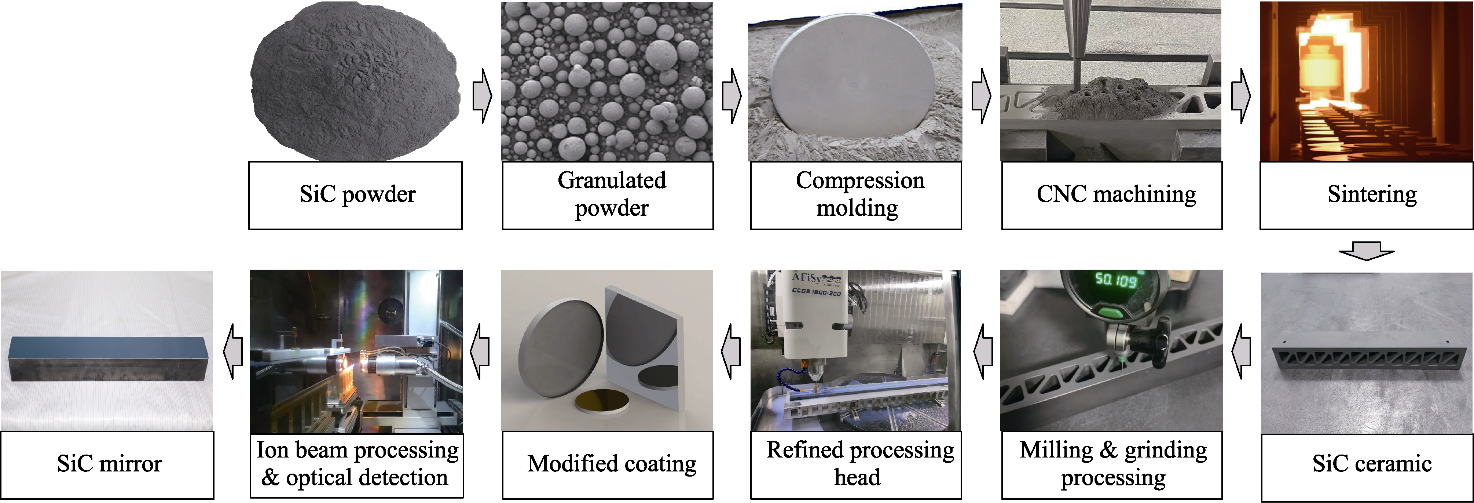
图1 碳化硅反射镜制备工艺流程
Fig. 1 Preparation process of silicon carbide mirror
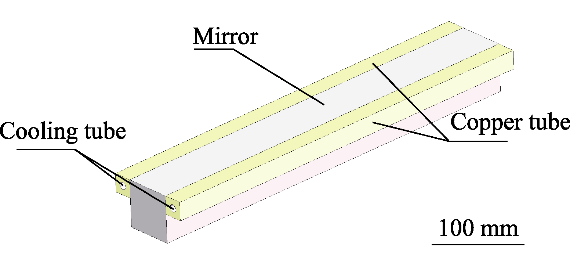
图2 反射镜冷却系统模型图
Fig. 2 Model diagram of mirror cooling system
| Physical parameter | SiC | Si | Cu |
|---|---|---|---|
| Elastic modulus/GPa | 440 | 112 | 115 |
| Poisson’s ratio | 0.18 | 0.28 | 0.32 |
| Bulk density/(g·cm-3) | 3.12 | 2.33 | 8.94 |
| Thermal conductivity/(W·m-1·K-1) | 180 | 100 | 320 |
| Coefficient of thermal expansion/(×10-6, K-1) | 2.20 | 4.00 | 16.5 |
表1 材料的物理参数
Table 1 Physical parameters of materials
| Physical parameter | SiC | Si | Cu |
|---|---|---|---|
| Elastic modulus/GPa | 440 | 112 | 115 |
| Poisson’s ratio | 0.18 | 0.28 | 0.32 |
| Bulk density/(g·cm-3) | 3.12 | 2.33 | 8.94 |
| Thermal conductivity/(W·m-1·K-1) | 180 | 100 | 320 |
| Coefficient of thermal expansion/(×10-6, K-1) | 2.20 | 4.00 | 16.5 |
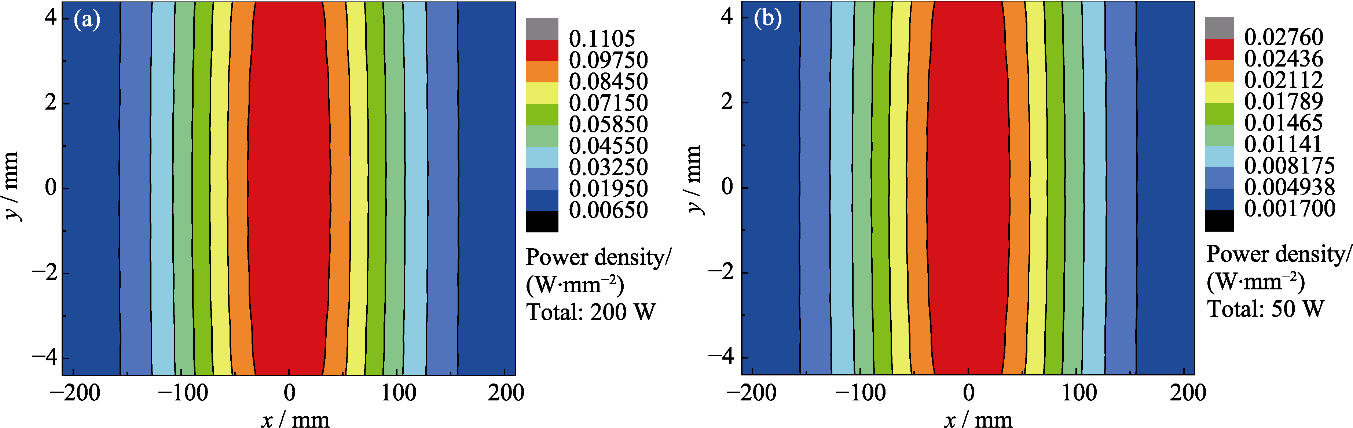
图3 反射镜吸收的热功率密度分布
Fig. 3 Distribution of heat power absorbed on the mirror surface (a) 200 W; (b) 50 W. Colorful figures are available on website
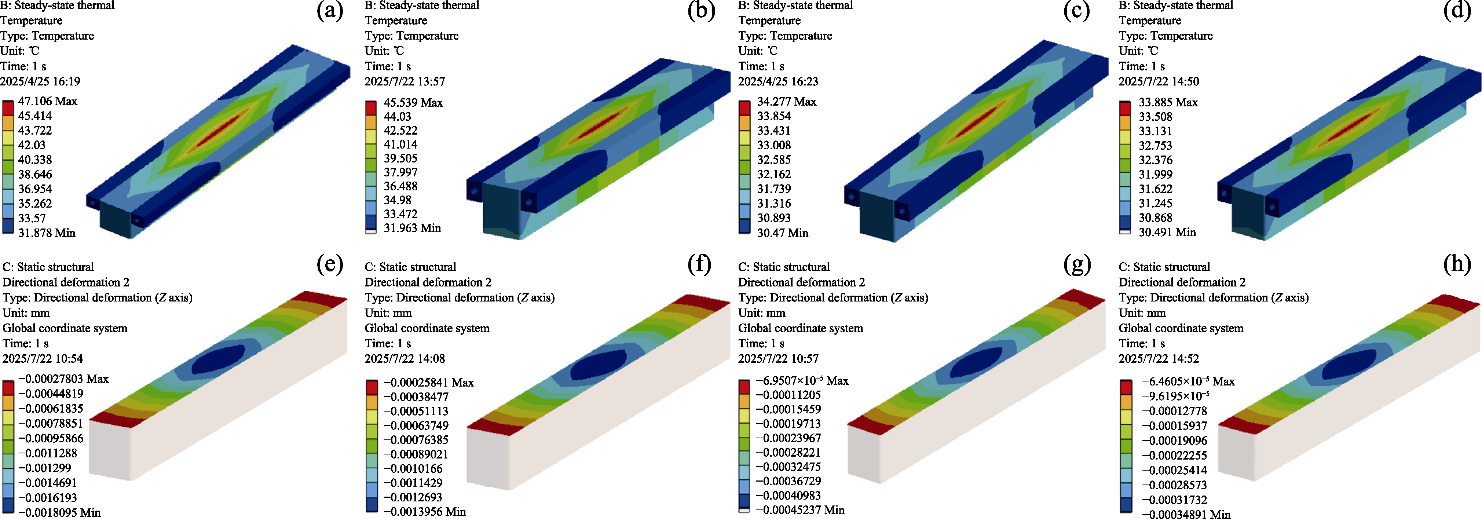
图4 两种材质反射镜的热-结构数值模拟结果
Fig. 4 Thermal-structure numerical simulation results of two types of material mirrors Temperature distribution: (a) Si-200 W, (b) SiC-200 W, (c) Si-50 W, (d) SiC-50 W; Thermal deformation distribution: (e) Si-200 W, (f) SiC-200 W, (g) Si-50 W, (h) SiC-50 W. Colorful figures are available on website
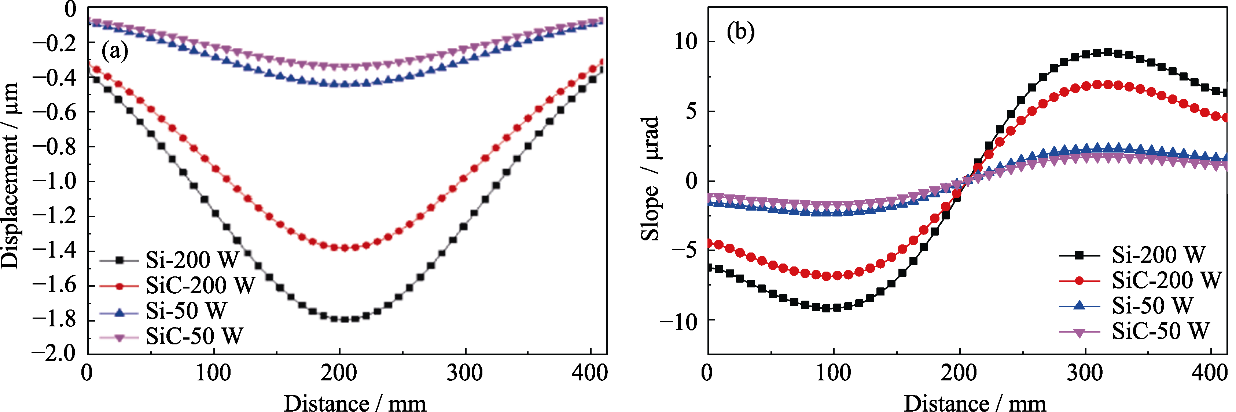
图5 热载荷冲击下反射镜子午方向面形
Fig. 5 Meridian surface shape of mirror under thermal load impact (a) Normal deformation curves of center line of the spot region; (b) Slope curves
| Thermal power/W | Material | Maximum temperature/ ℃ | Meridian slope/ μrad | Residual meridian slope after deducting the fitted circle/μrad | Fitting the radius of the circle/ km |
|---|---|---|---|---|---|
| 200 | Si | 47.1 | 7.3 | 4.8 | 8.7 |
| SiC | 45.5 | 5.5 | 2.8 | 18.2 | |
| 50 | Si | 34.3 | 1.8 | 1.2 | 34.7 |
| SiC | 33.9 | 1.4 | 0.7 | 72.6 |
表2 反射镜热-结构仿真分析结果
Table 2 Thermal-structure simulation and analysis results of mirror
| Thermal power/W | Material | Maximum temperature/ ℃ | Meridian slope/ μrad | Residual meridian slope after deducting the fitted circle/μrad | Fitting the radius of the circle/ km |
|---|---|---|---|---|---|
| 200 | Si | 47.1 | 7.3 | 4.8 | 8.7 |
| SiC | 45.5 | 5.5 | 2.8 | 18.2 | |
| 50 | Si | 34.3 | 1.8 | 1.2 | 34.7 |
| SiC | 33.9 | 1.4 | 0.7 | 72.6 |
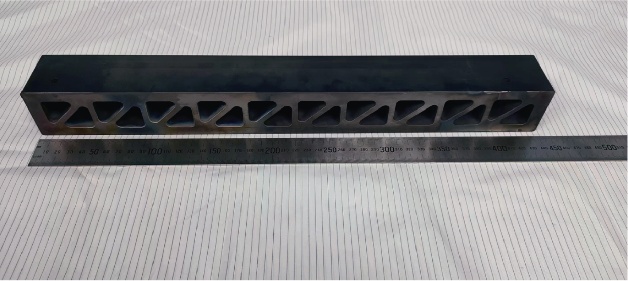
图6 碳化硅反射镜镜坯
Fig. 6 Silicon carbide mirror blank
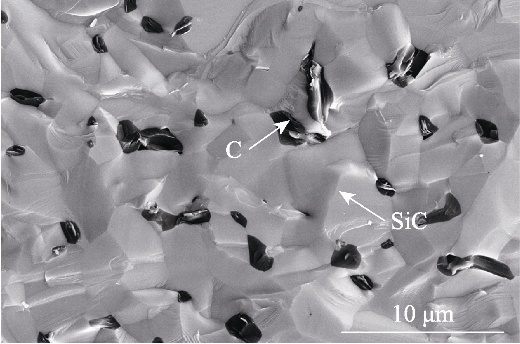
图7 碳化硅陶瓷的断口形貌
Fig. 7 Fracture morphology of silicon carbide ceramics
| Physical property | Result |
|---|---|
| Bulk density/(g·cm-3) | 3.12±0.01 |
| Flexural strength/MPa | 491±56 |
| Elastic modulus/GPa | 439±3 |
| Thermal conductivity/(W·m-1·K-1) | 180.0±7.5 |
| Coefficient of thermal expansion/(×10-6, K-1) | 2.22±0.02 |
表3 碳化硅陶瓷的物理性能
Table 3 Physical properties of silicon carbide ceramics
| Physical property | Result |
|---|---|
| Bulk density/(g·cm-3) | 3.12±0.01 |
| Flexural strength/MPa | 491±56 |
| Elastic modulus/GPa | 439±3 |
| Thermal conductivity/(W·m-1·K-1) | 180.0±7.5 |
| Coefficient of thermal expansion/(×10-6, K-1) | 2.22±0.02 |
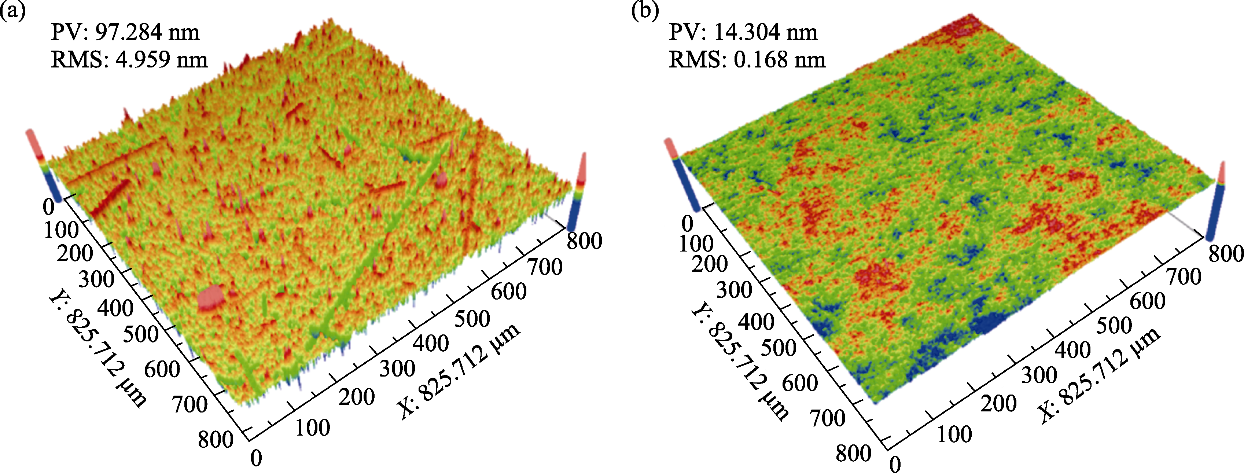
图8 碳化硅反射镜表面粗糙度
Fig. 8 Surface roughness of silicon carbide mirror (a) Polished SiC; (b) Polished Si film. Colorful figures are available on website
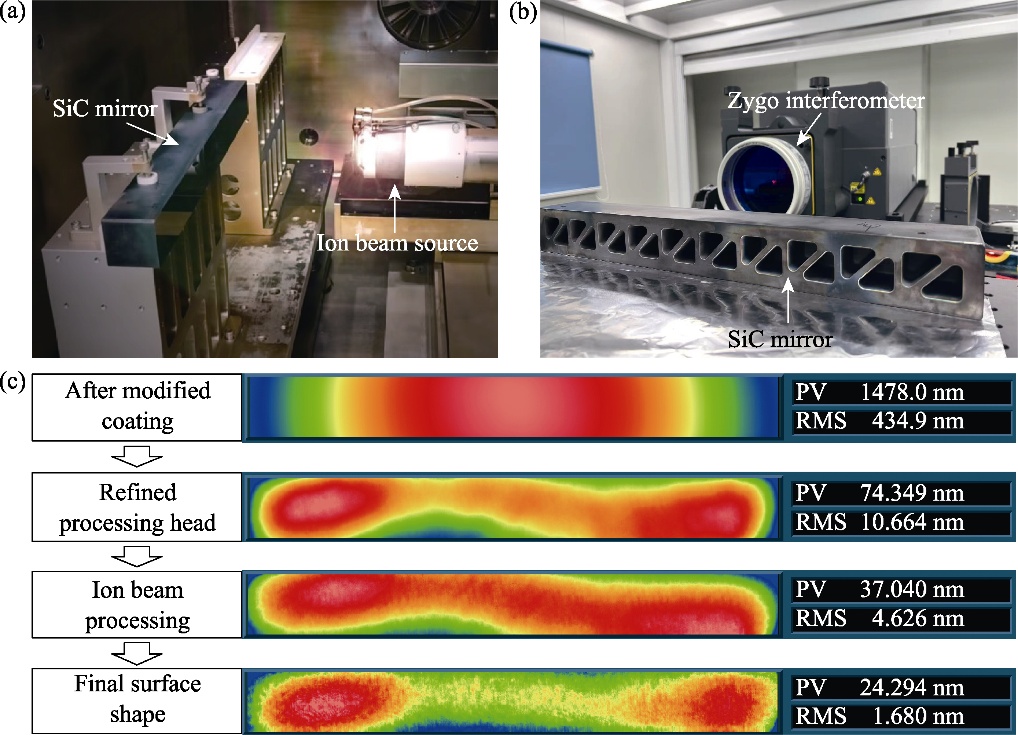
图9 碳化硅反射镜光学加工与面形检测
Fig. 9 Optical processing and surface shape detection of silicon carbide mirror (a) Ion beam fine polishing; (b) Surface shape detection; (c) Convergence process of silicon carbide mirror shape error. Colorful figures are available on website
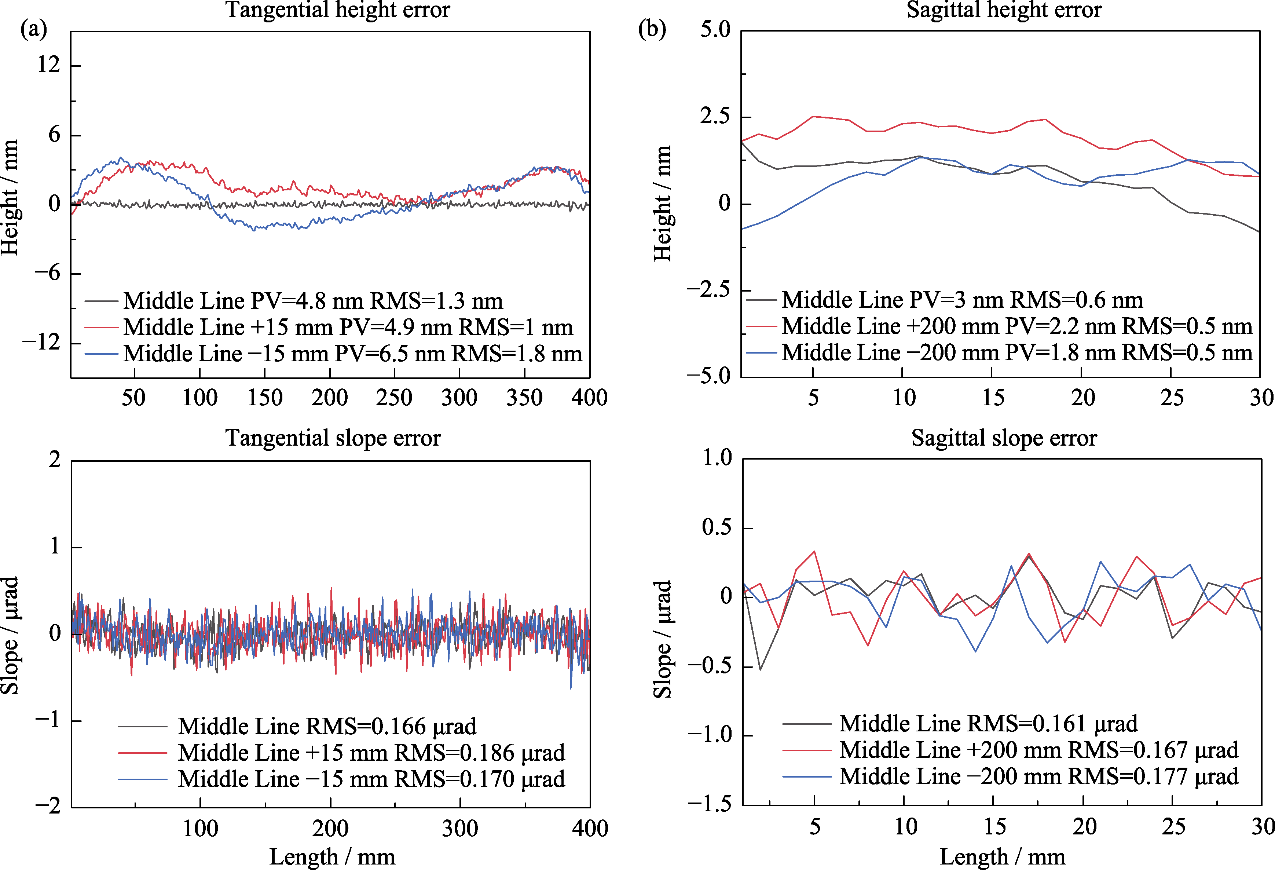
图10 碳化硅反射镜最终面形
Fig. 10 Final surface shape of silicon carbide mirror (a) Meridian direction; (b) Arc vector direction. Colorful figures are available on website
| Country | Year | Device | Material | Size/(mm×mm×mm) | Surface shape accuracy | Roughness/nm |
|---|---|---|---|---|---|---|
| France[ | 2018 | ESRF BM08/LISA | Si | 900×35 | Slope error: 0.5 μrad RMS | 0.2 |
| Germany[ | 2014 | PETRA III | Si | 100×50×15 | Height error: <0.1 nm Slope error: 0.041 μrad RMS | 0.2 |
| Japan[ | 2025 | SPring-8 | Si | 400×50×50 | Height error: 1 nm | 0.15 |
| China[ | 2020 | HEPS/SSRF | Si | 200×50×50 | Slope error: 0.26 μrad RMS | 0.3 |
| China | 2025 | This work | SiC | 440×50×50 | Height error: 1.3 nm Slope error: 0.166 μrad RMS | 0.13 |
表4 本研究与国际研制反射镜的光学面形对比
Table 4 Comparison of optical surface shape of this study with internationally developed mirrors
| Country | Year | Device | Material | Size/(mm×mm×mm) | Surface shape accuracy | Roughness/nm |
|---|---|---|---|---|---|---|
| France[ | 2018 | ESRF BM08/LISA | Si | 900×35 | Slope error: 0.5 μrad RMS | 0.2 |
| Germany[ | 2014 | PETRA III | Si | 100×50×15 | Height error: <0.1 nm Slope error: 0.041 μrad RMS | 0.2 |
| Japan[ | 2025 | SPring-8 | Si | 400×50×50 | Height error: 1 nm | 0.15 |
| China[ | 2020 | HEPS/SSRF | Si | 200×50×50 | Slope error: 0.26 μrad RMS | 0.3 |
| China | 2025 | This work | SiC | 440×50×50 | Height error: 1.3 nm Slope error: 0.166 μrad RMS | 0.13 |
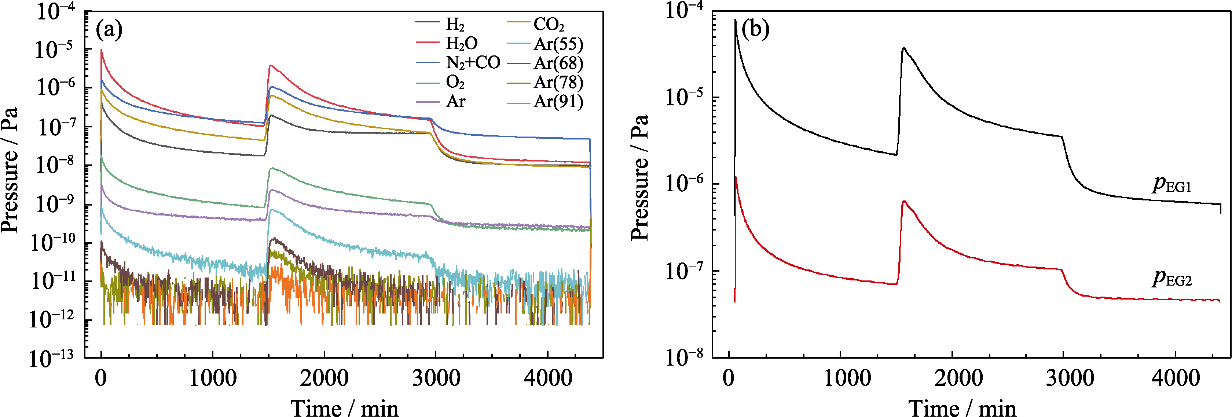
图11 碳化硅反射镜释气压力检测
Fig. 11 Detection results of outgassing rate of SiC mirror (a) Outgassing spectrum; (b) Extractor gauges. Colorful figures are available on website
| Material | Elastic modulus/ GPa | Density/ (g·cm-3) | Thermal conductivity/ (W·m-1·K-1) | Coefficient of thermal expansion/ (×10-6, K-1) | Ratio stiffness/ (MPa·m3·kg-1) | Thermal stability/ (×106, W·m-1) | Maximum weight loss rate***/% |
|---|---|---|---|---|---|---|---|
| Diamond | 880 | 3.50 | 2000 | 1.50 | 251 | 1333 | 0 |
| SSiC* | 440 | 3.12 | 180 | 2.20 | 138 | 81 | 90 |
| RB-SiC** | 360 | 3.03 | 130 | 2.50 | 119 | 52 | 90 |
| ULE | 67 | 2.20 | 1.30 | 0.03 | 30 | 43 | 75 |
| Si | 112 | 2.33 | 100 | 4.00 | 48 | 25 | - |
| Be | 303 | 1.84 | 216 | 11.50 | 165 | 19 | 60 |
表S1 反射镜材料的关键性能比较[4]
Table S1 Comparison of the key performance stability of mirror materials[4]
| Material | Elastic modulus/ GPa | Density/ (g·cm-3) | Thermal conductivity/ (W·m-1·K-1) | Coefficient of thermal expansion/ (×10-6, K-1) | Ratio stiffness/ (MPa·m3·kg-1) | Thermal stability/ (×106, W·m-1) | Maximum weight loss rate***/% |
|---|---|---|---|---|---|---|---|
| Diamond | 880 | 3.50 | 2000 | 1.50 | 251 | 1333 | 0 |
| SSiC* | 440 | 3.12 | 180 | 2.20 | 138 | 81 | 90 |
| RB-SiC** | 360 | 3.03 | 130 | 2.50 | 119 | 52 | 90 |
| ULE | 67 | 2.20 | 1.30 | 0.03 | 30 | 43 | 75 |
| Si | 112 | 2.33 | 100 | 4.00 | 48 | 25 | - |
| Be | 303 | 1.84 | 216 | 11.50 | 165 | 19 | 60 |
| [1] | CLAUDIO P, AGOSTINO M, SVEN R. The physics of X-ray free electron lasers. Reviews of Modern Physics, 2016, 88: 015006. |
| [2] | TSCHENTSCHER T, BRESSLER C, GRÜNERT J, et al. Photon beam transport and scientific instruments at the European XFEL. Applied Sciences, 2017, 7(6): 592. |
| [3] | DANIELE C, MOURAD I, DANIEL M, et al. Advances in X-ray optics: from metrology characterization to wavefront sensing- based optimization of active optics. Nuclear Instruments and Methods in Physics Research Section A: Accelerators, Spectrometers, Detectors and Associated Equipment, 2018, 907: 105. |
| [4] | LIU Y, ZHANG H, LIU L M, et al. Preparation and environmental simulation tests of large-size silicon carbide brazed reflection mirrors. Opto-Electronic Engineering, 2020, 47(8): 200088. |
| [5] | DONALD H B, ANDREAS K F, GORDON S K, et al. The historical development of cryogenically cooled monochromators for third-generation synchrotron radiation sources. Journal of Synchrotron Radiation, 2000, 7: 53. |
| [6] | KELLY M M, WEST J B. Fabrication and use of silicon carbide mirrors for synchrotron radiation. Proceedings of SPIE, 1982, 315: 135. |
| [7] | GARDNER J D. The James Webb space telescope: extending the science. Proceedings of SPIE, 2012, 8842: 884228. |
| [8] | GREENHOUSE M A. The JWST science instrument payload:mission context and status. Proceedings of SPIE, 2016, 9143: 914307. |
| [9] | TAKACZ P Z, HURSMAN T L, WILLIAMS J T. Application of silicon carbide to synchrotron radiation mirrors. Nuclear Instruments and Methods in Physics Research, 1984, 222(1/2): 133. |
| [10] | PILBRATT G L. Herschel space observatory mission overview. Proceedings of SPIE, 2003, 4850: 586. |
| [11] | DENY P, BOUGOIN M. Silicon carbide components for optics: present and near future capabilities. Proceedings of SPIE, 2005, 5868: 58680G. |
| [12] | LIU Y, MA Z. CHEN J, et al. Environmental simulation evaluation of SSiC brazed optical mirrors. Proceedings of SPIE, 2014, 9280: 928009. |
| [13] | DONG B C, ZHANG G. Fabrication and properties of ultra- lightweight SiC mirror. Optics and Precision Engineering. 2018, 23(8): 2185. |
| [14] | ZHANG G, ZHAO R C, ZHAO W X, et al. Manufacture of Φ1.2m reaction bonded silicon carbide mirror blank CFID. Proceedings of SPIE, 2010, 7654: 76541B. |
| [15] | 刘海林, 霍艳丽, 胡传奇, 等. 光刻机用精密碳化硅陶瓷部件制备技术. 现代技术陶瓷, 2016, 37(3): 168. |
| [16] | 袁振侠, 陆有军, 吴澜尔, 等. 硅粉与碳黑微波合成碳化硅微粉. 现代技术陶瓷, 2016, 37(3): 190. |
| [17] | YAO X M, LIANG H Q, LIU X J, et al. Effect of carbon source and adding ratio on the microstructure and properties of solid-state sintering silicon carbide. Journal of Inorganic Materials, 2013, 28(9): 1009. |
| [18] | YANG X, LIU X J, HUANG Z R, et al. Surface cracks of solid- phase-sintered silicon carbide ceramics and their influences on material strength. Journal of Inorganic Materials, 2014, 29(4): 438. |
| [19] | GAO J Q, CHEN J, LIU G L, et al. Role of microstructure on surface and subsurface damage of sintered silicon carbide during grinding and polishing. Wear, 2010, 270: 88. |
| [20] | YANG Y, ZHANG J W, FU C L, et al. Deposition of thick Si coating with low residual stress on SiC ceramics by fabricating multilayer with compressive/tensile stress layer-pairs. Materials and Design, 2016, 107: 1. |
| [21] | FU C L, YANG Y, MA Y F, et al. Effect of ion source bias on the properties of HfO2 laser films prepared by the PIA-EB-Hf method. Journal of Inorganic Materials, 2017, 1: 69. |
| [22] | LI T, JIN L M, ZHU W Q, et al. A reliable FEA-based calculation approach of convective heat transfer coefficient for steady-state thermal analysis of X-ray water-cooled mirrors. Nuclear Instruments and Methods in Physics Research Section A: Accelerators, Spectrometers, Detectors and Associated Equipment, 2022, 1040: 167288. |
| [23] | JIN LM, ZHU W Q, WANG Y, et al. A numerical comparison between internal cooling and side cooling of the reflection mirror for spatial and spin (S2) beam-line at SSRF. Nuclear Instruments and Methods in Physics Research Section A: Accelerators, Spectrometers, Detectors and Associated Equipment, 2018, 902: 190. |
| [24] | JIN L M, WANG N X, ZHU W Q, et al. FEA-based structural optimization design of a side cooling collimating mirror at SSRF. Nuclear Science and Technology, 2017, 28(11): 159. |
| [25] | 廖文林, 戴一帆, 周林, 等. 离子束抛光加工矩形离轴非球面镜. 国防科技大学学报, 2011, 23(1): 100. |
| [26] | D'ACAPITO F, LEPORE G O, PURI A, et al. The LISA beamline at ESRF. Journal of Synchrotron Radiation, 2019, 26(Pt 2): 551. |
| [27] | SIEWERT F, BUCHHEIM J, ZESCHKE T, et al. On the characterization of ultra-precise X-ray optical components: advances and challenges in ex situ metrology. Synchrotron Radiation, 2014, 21(5): 968. |
| [28] | YUMOTO H, KOYAMA T, YAMAZAKI H, et al. An X-ray beamline for utilizing intense, high-energy undulator radiation. Synchrotron Radiation, 2025, 32(5): 1201. |
| [29] | LI M, WU J L, WU Y Q, et al. A review on the fabrication technology of X-ray reflector. Opto-Electronic Engineering, 2020, 47(8): 200205. |
| [1] | 刘今霄, 刘镇汉, 陈星宇, 周钲洋, 仇鹏飞, 张家伟, 史迅. 制备工艺对塑性热电材料Ag2S0.4Te0.6结构与性能的影响[J]. 无机材料学报, 2026, 41(7): 939-946. |
| [2] | 李乔磊, 顾玥, 于雪华, 张朝威, 邹明科, 梁静静, 李金国. 烧结温度对3D打印硅基陶瓷型芯表面形貌及粗糙度的影响[J]. 无机材料学报, 2022, 37(3): 325-332. |
| [3] | 刘云鹏, 盛伟繁, 吴忠华. 同步辐射及其在无机材料中的应用进展[J]. 无机材料学报, 2021, 36(9): 901-918. |
| [4] | 周煜筑, 张友魁, 宋礼. 贵金属磷化物催化剂及其同步辐射X射线吸收谱[J]. 无机材料学报, 2021, 36(3): 225-244. |
| [5] | 魏世强, 王昌达, 张鹏军, 朱可夫, 陈双明, 宋礼. Mn 2+插层V2C MXene应用于钠离子电池的研究[J]. 无机材料学报, 2020, 35(1): 139-144. |
| [6] | 何永周, 周巧根. 磁性材料在同步辐射及自由电子激光中的应用[J]. 无机材料学报, 2016, 31(10): 1031-1038. |
| [7] | 张小锋, 周克崧, 张吉阜, 韩 滔, 宋进兵, 刘 敏. 粗糙度对热障涂层冲蚀失效的影响及模型建立[J]. 无机材料学报, 2014, 29(3): 294-300. |
| [8] | 侯维敏, 于 云, 胡学兵, 于 洋, 米 乐, 宋力昕. Al2O3微滤膜的超疏水改性研究[J]. 无机材料学报, 2013, 28(8): 864-868. |
| [9] | 鄢晓晖, 王胜男, 杜 博, 王小祥. 淡水三角帆蚌贝壳珍珠质的同步辐射XRD研究[J]. 无机材料学报, 2012, 27(5): 524-528. |
| [10] | 许 峰,胡小方,卢 斌,赵建华,伍小平,袁清习. 碳化硼固相烧结微观结构演化的同步辐射CT观测[J]. 无机材料学报, 2009, 24(1): 175-181. |
| [11] | 刘翠霞,杨延清,黄斌,张荣军,罗贤,任晓霞. 化学气相沉积SiC膜{111}取向生长的原子尺度模拟[J]. 无机材料学报, 2008, 23(5): 933-937. |
| [12] | 张磊磊,李贺军,李克智,李新涛,翟言强,张雨雷. 碳/碳复合材料表面粗糙度对成骨细胞生长行为的影响[J]. 无机材料学报, 2008, 23(2): 341-345. |
| [13] | 李红军,苏良碧,徐军,袁清习,朱佩平. Ce:YAP晶体中的孪晶缺陷[J]. 无机材料学报, 2007, 22(4): 663-666. |
| [14] | 孙柏,邹崇文,刘忠良,徐彭寿,张国斌. 衬底温度对PLD方法生长的ZnO薄膜结构和发光特性的影响[J]. 无机材料学报, 2006, 21(4): 1005-1010. |
| [15] | 苏青峰,夏义本,王林军,史伟民. 复合抛光对 CVD金刚石薄膜表面光洁度的改进研究[J]. 无机材料学报, 2006, 21(2): 499-502. |
| 阅读次数 | ||||||
|
全文 |
|
|||||
|
摘要 |
|
|||||