
Journal of Inorganic Materials ›› 2026, Vol. 41 ›› Issue (10): 1470-1480.DOI: 10.15541/jim20260113
• RESEARCH ARTICLE • Previous Articles Next Articles
SHI Jinzhao1( ), ZHU Meiling1, ZHENG Qi1,2(), WANG Lianjun1,2(), JIANG Wan1
Received:2026-03-13
Revised:2026-04-12
Published:2026-10-20
Online:2026-05-08
Contact:
ZHENG Qi, professor. E-mail: qi.zheng@dhu.edu.cn;About author:SHI Jinzhao (1999-), male, Master candidate. E-mail: 2230364@mail.dhu.edu.cn
Supported by:CLC Number:
SHI Jinzhao, ZHU Meiling, ZHENG Qi, WANG Lianjun, JIANG Wan. Boric Acid-assisted Construction of Polyoxometalate/Lactose-derived Defective Porous Carbon for Highly Efficient Microwave Absorption[J]. Journal of Inorganic Materials, 2026, 41(10): 1470-1480.
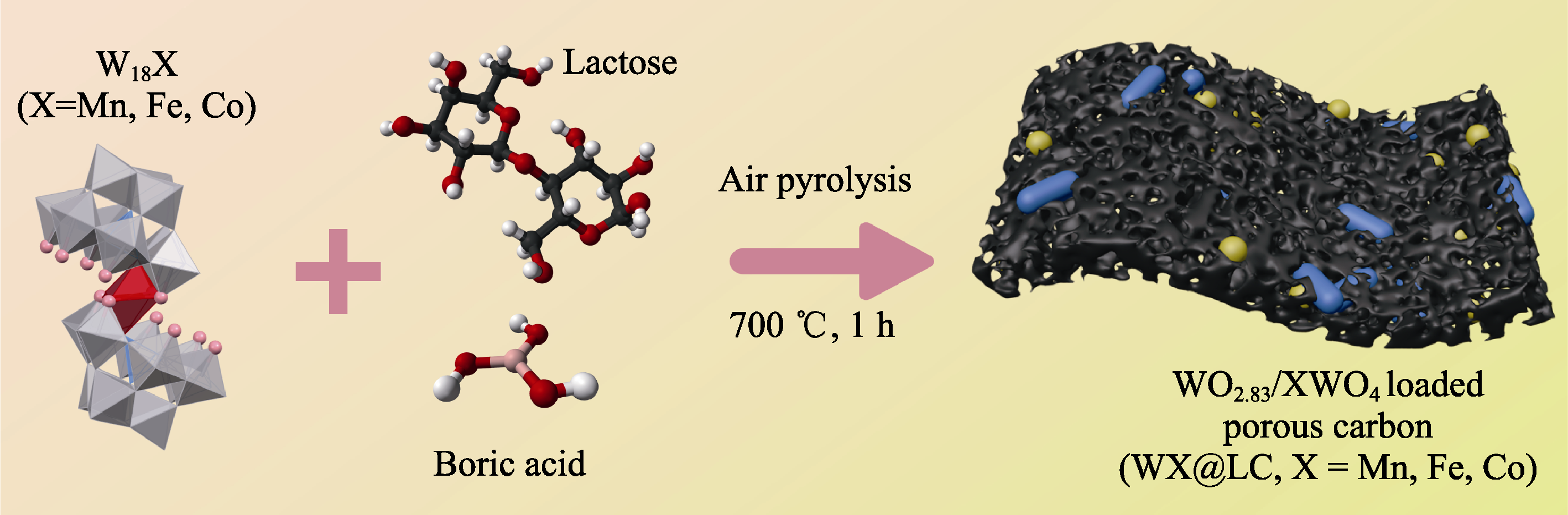
Fig. 1 Schematic diagram of the experimental procedure for preparing WX@LC composites by boric acid template-assisted pyrolysis
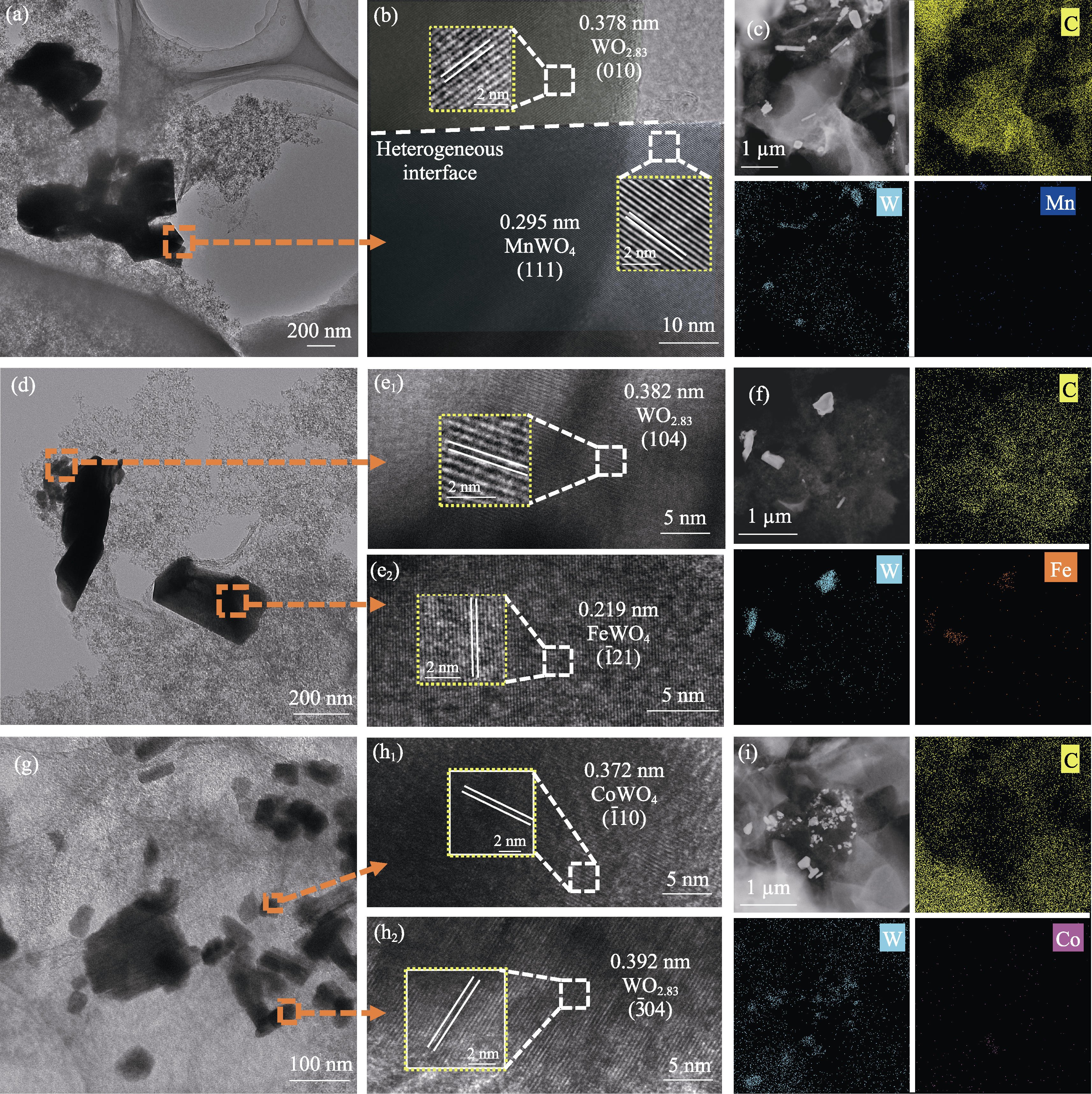
Fig. 2 TEM images and corresponding elemental distributions of WX@LC composites (a, d, g) TEM images; (b, e1, e2, h1, h2) HRTEM images; (c, f, i) STEM images and corresponding EDS elemental mappings; (a-c) WM@LC; (d, e1, e2, f) WF@LC; (g, h1, h2, i) WC@LC
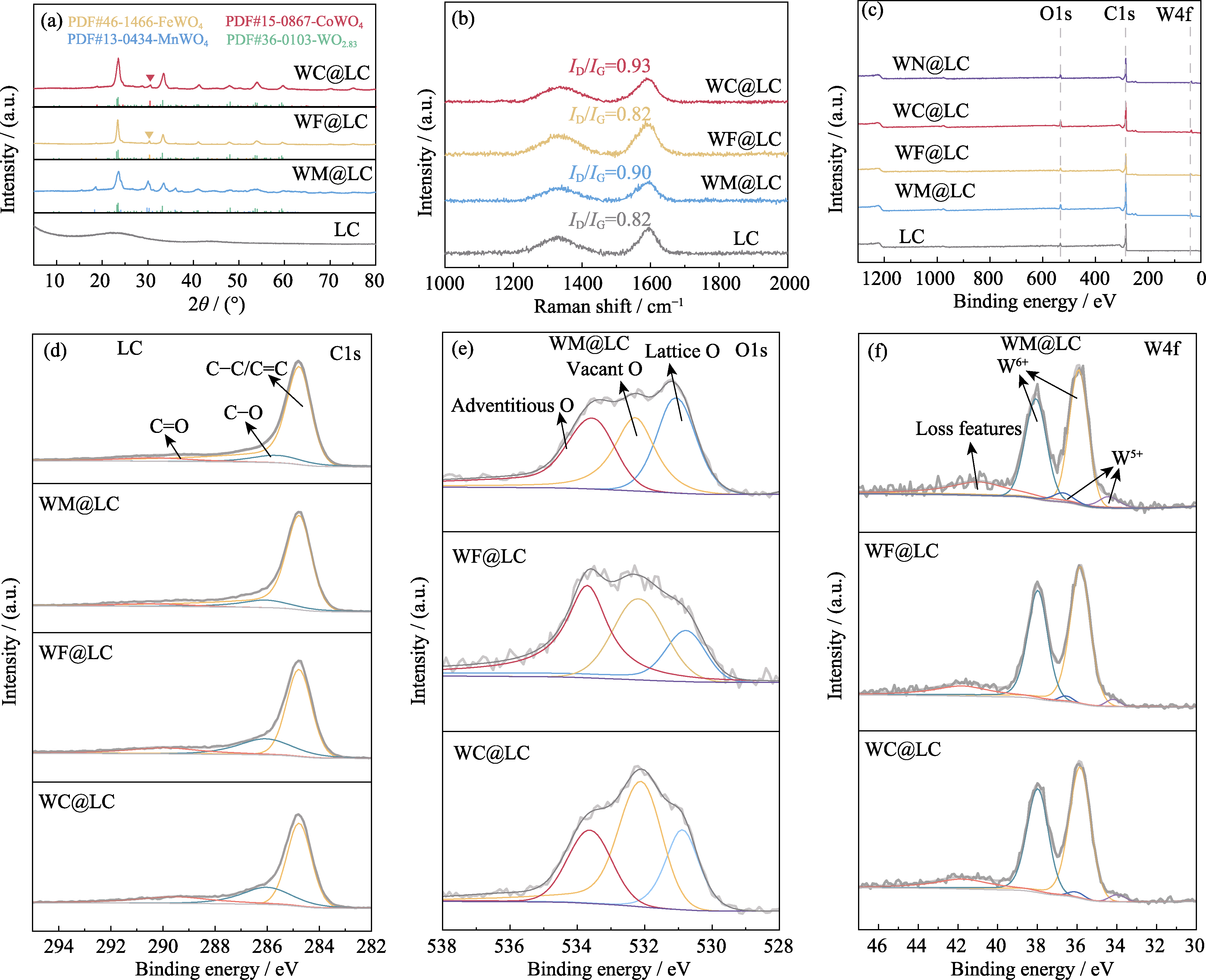
Fig. 3 Characterization of phase structure and surface chemical composition of the samples (a) XRD patterns; (b) Raman spectra; (c) XPS full spectra; (d-f) High-resolution XPS spectra of (d) C1s, (e) O1s and (f) W4f, which reveal the coexistence of oxygen vacancies and multiple valence states of tungsten. Colorful figures are available on website
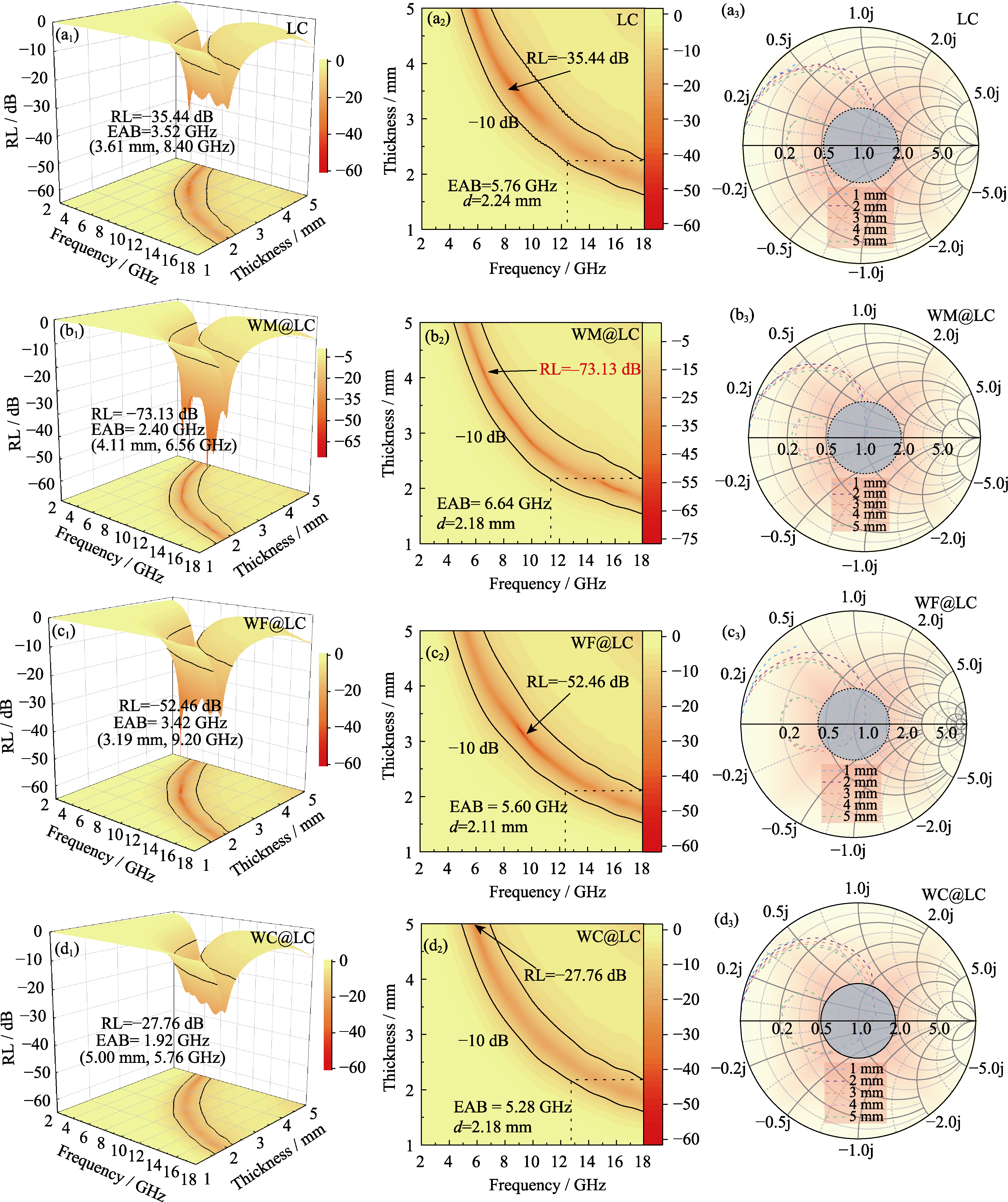
Fig. 4 Microwave absorption performance characterization of the samples (a1-d1) Three-dimensional reflection loss plots; (a2-d2) Corresponding two-dimensional RL contour plots; (a3-d3) Impedance matching Smith chart. Colorful figures are available on website
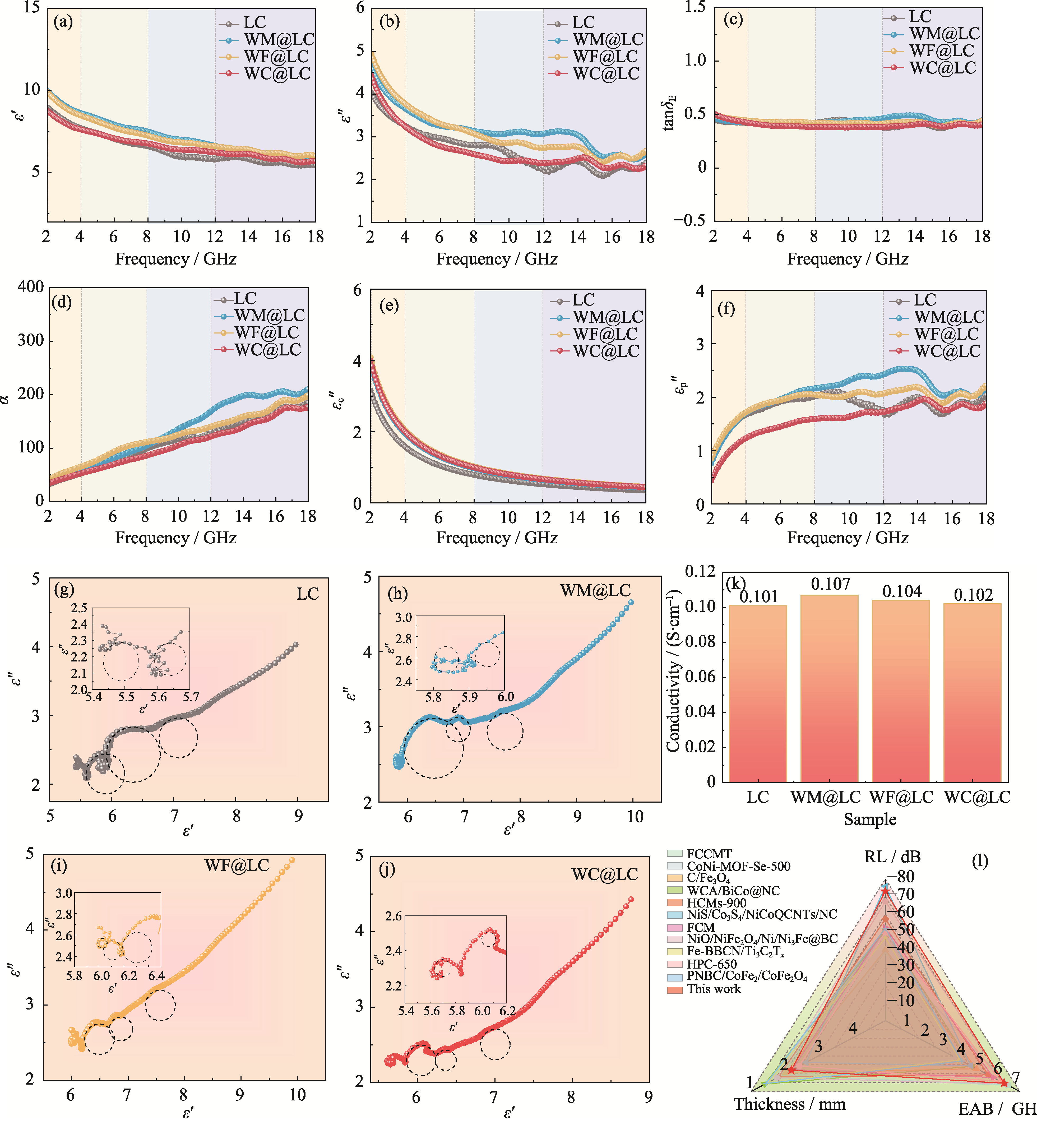
Fig. 5 Comparison of electromagnetic parameters, dielectric loss mechanisms, and microwave absorption performance of the samples (a) Real part of complex permittivity (ε'); (b) Imaginary part of complex permittivity (ε''); (c) Dielectric loss tangent (tanδE); (d) Attenuation constant (α); (e) Conduction loss (εc''); (f) Polarization relaxation (εp''); (g-j) Cole-Cole curves; (k) Conductivity histogram; (l) Comparison of microwave absorption performance. Colorful figures are available on website
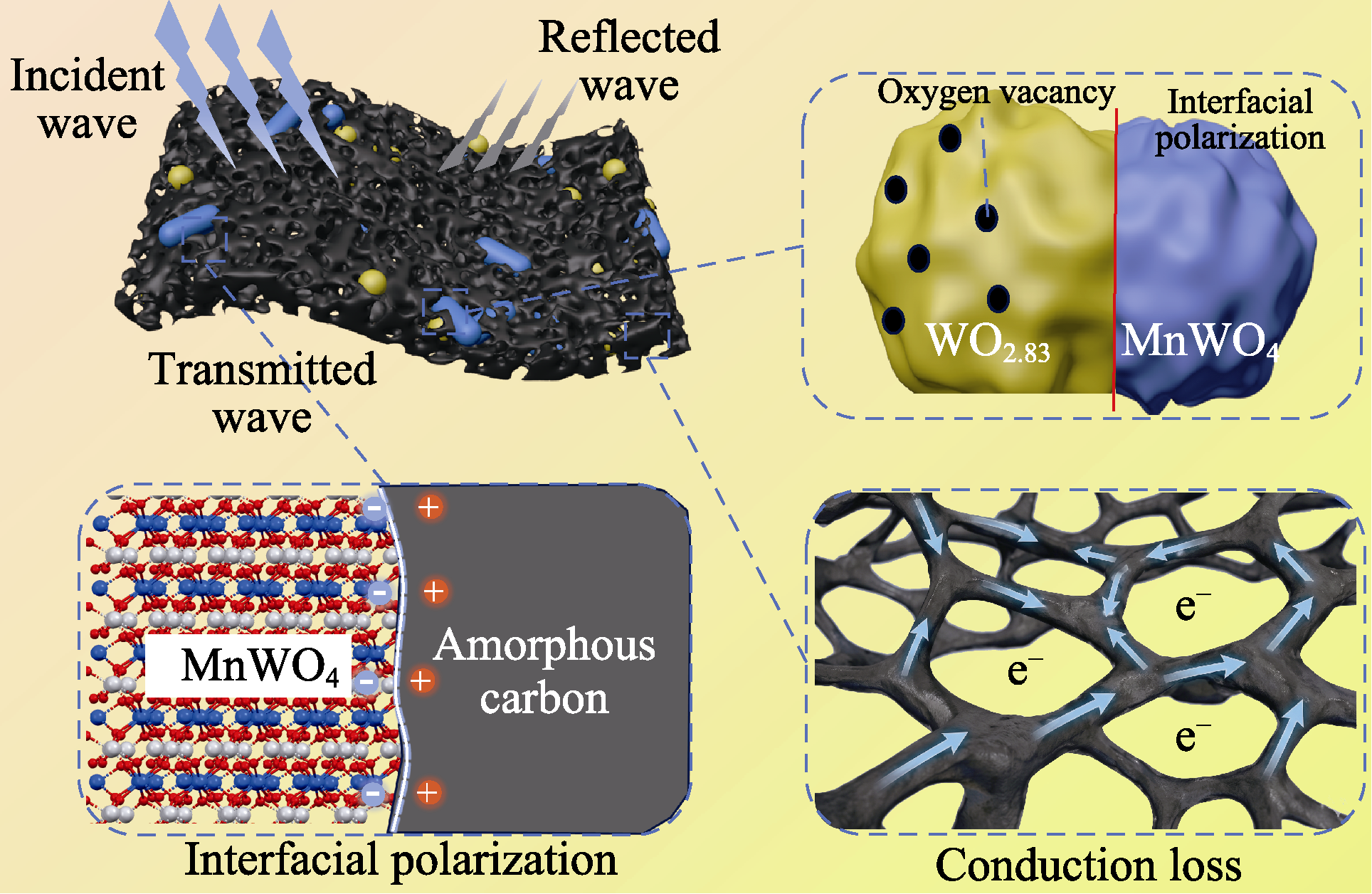
Fig. 6 Microwave mechanism of WM@LC
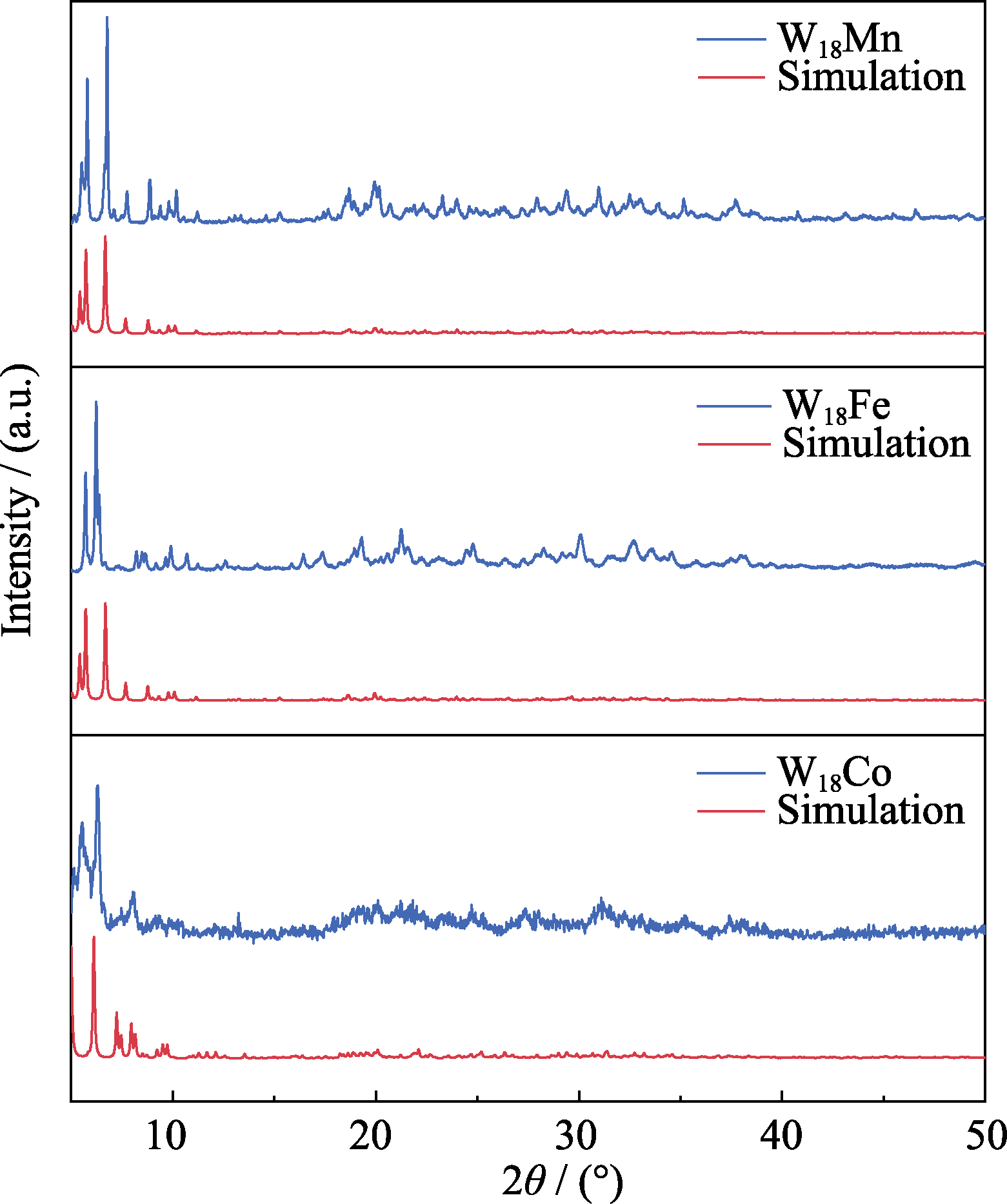
Fig. S1 Comparison of experimental and simulated XRD patterns for W18Mn, W18Fe, and W18Co samples
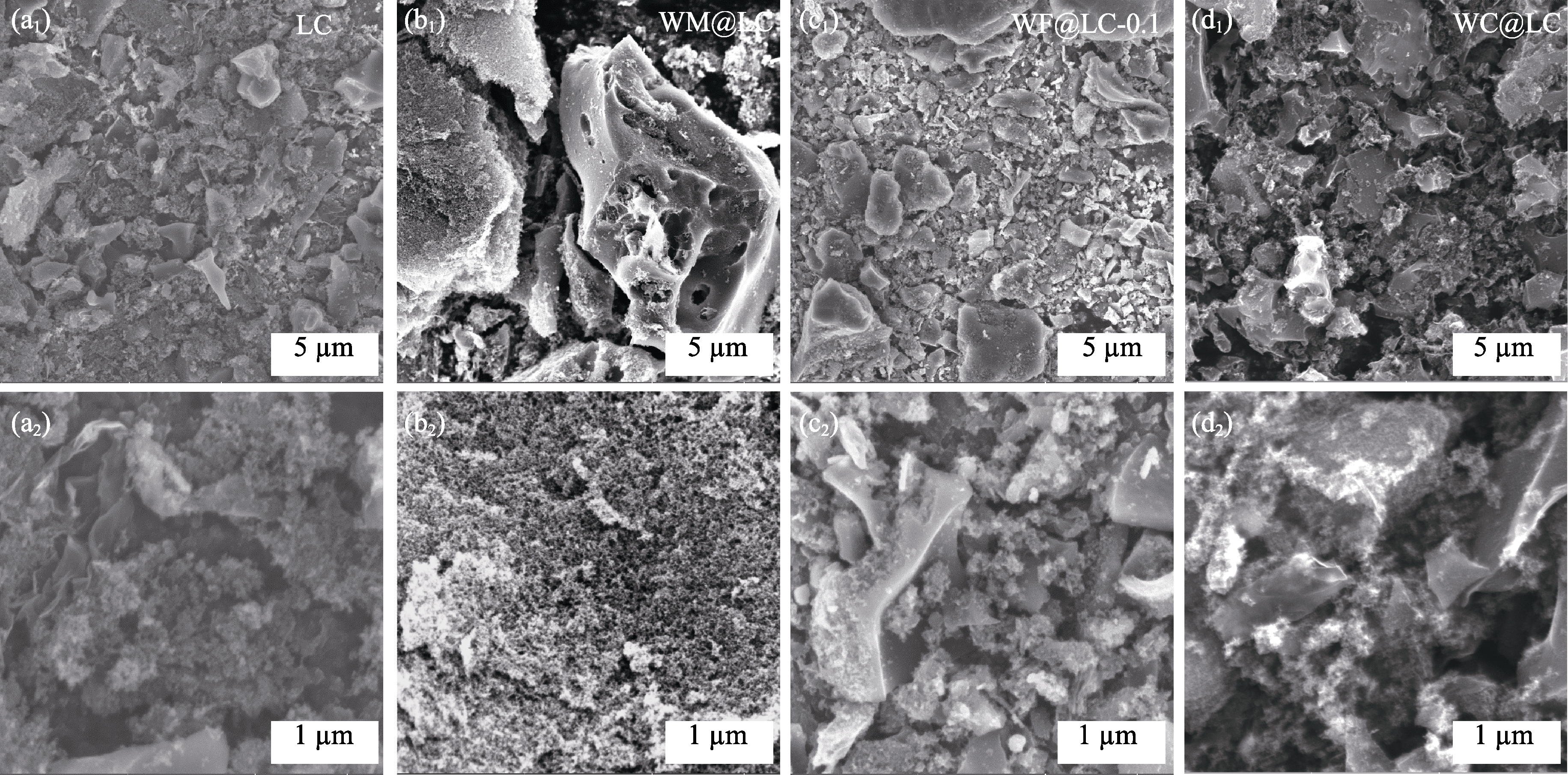
Fig. S2 SEM images of the samples (a1-d1) Low-magnification SEM images of LC, WM@LC, WF@LC and WC@LC; (a2-d2) High-magnification SEM images of the corresponding samples
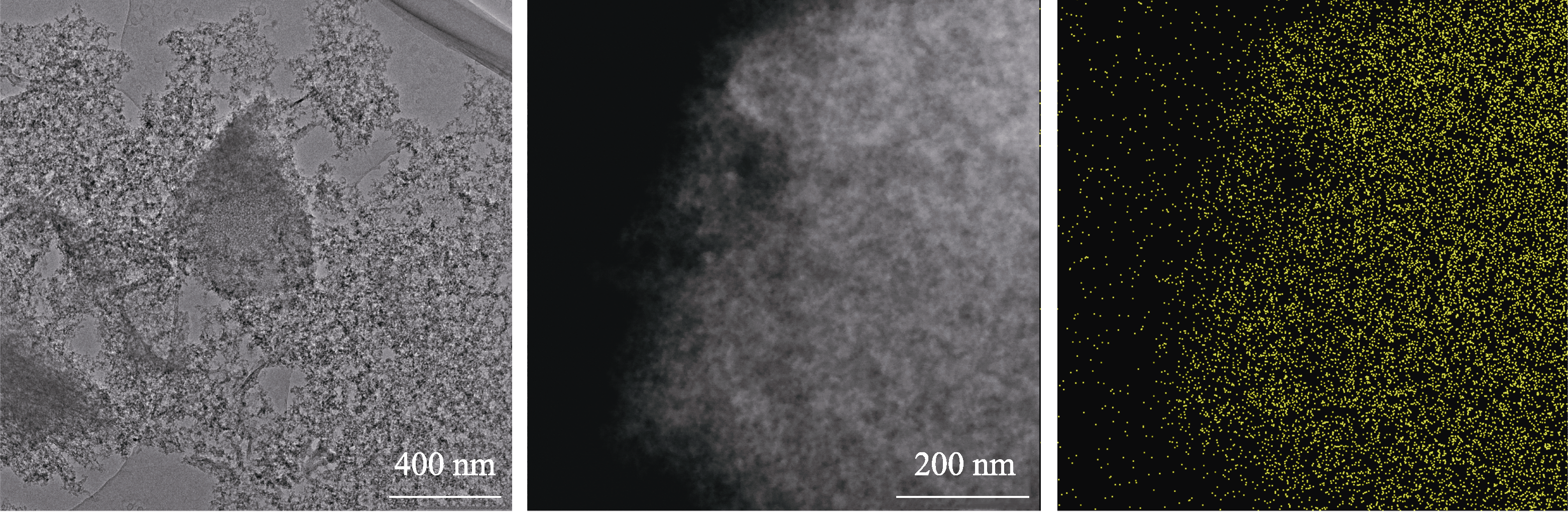
Fig. S3 TEM image and C elemental distribution of LC
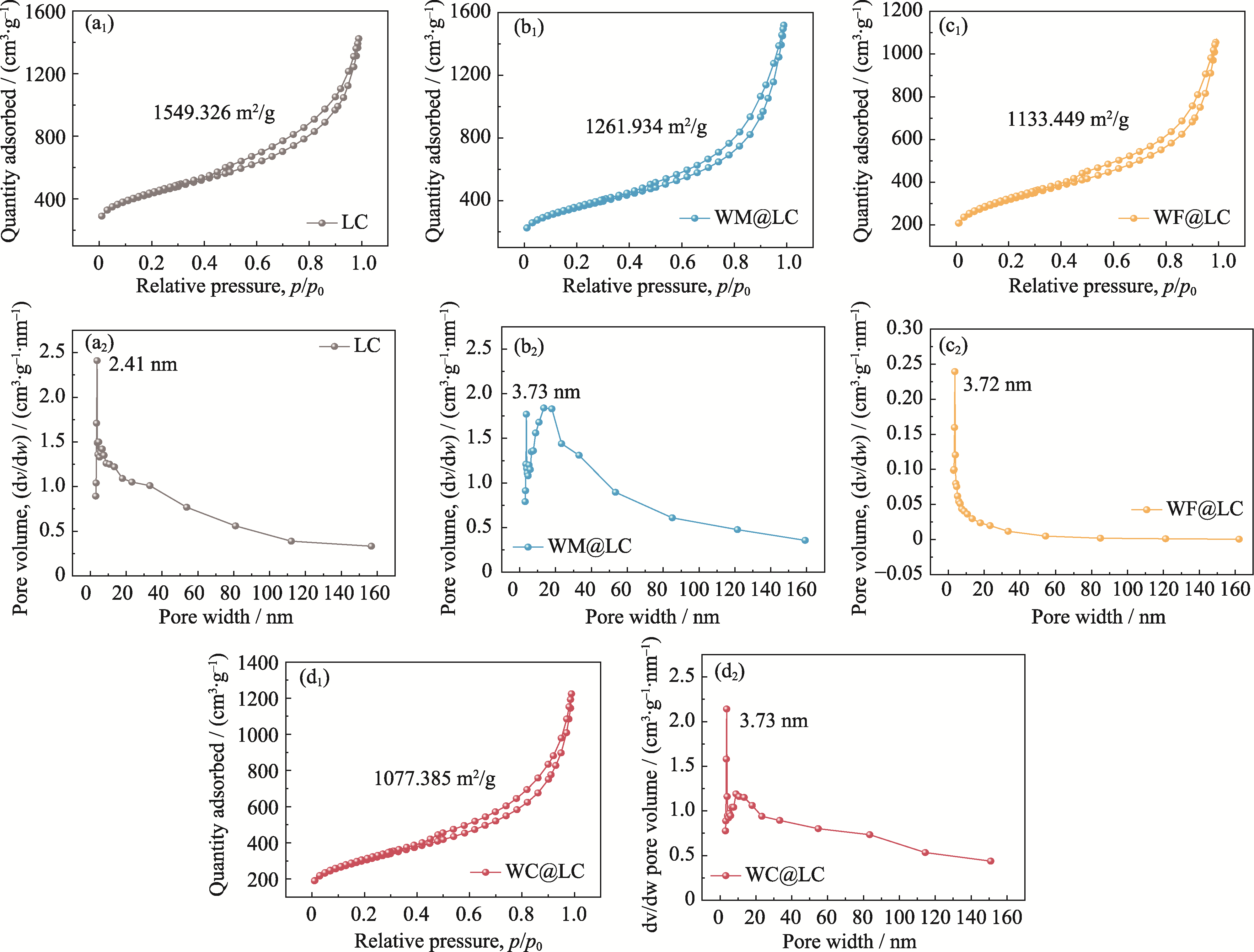
Fig. S4 Pore structure characterization of the samples (a1-d1) Nitrogen adsorption-desorption isotherms; (a2-d2) Pore size distribution curves
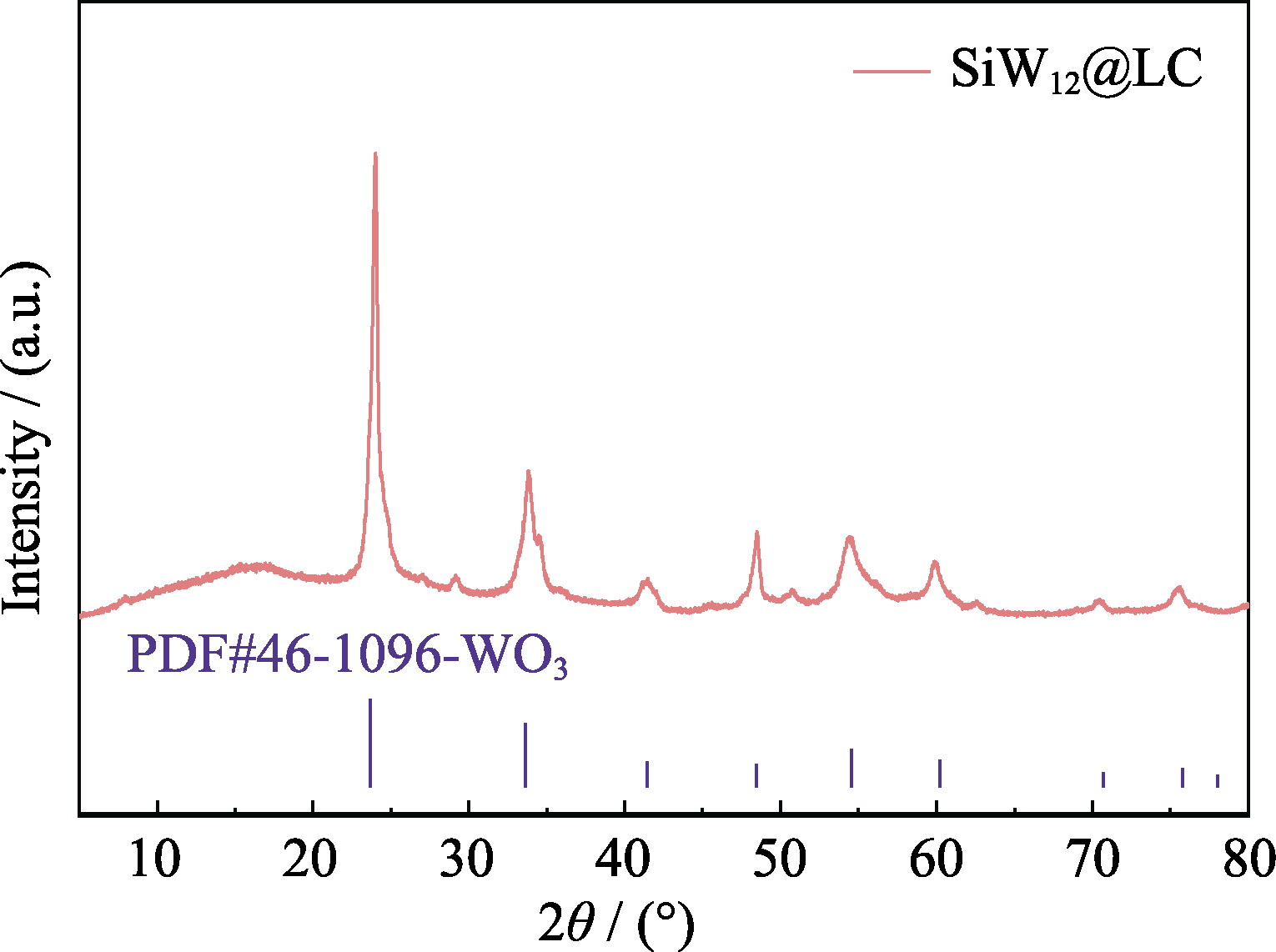
Fig. S5 XRD pattern of SiW12@LC sample
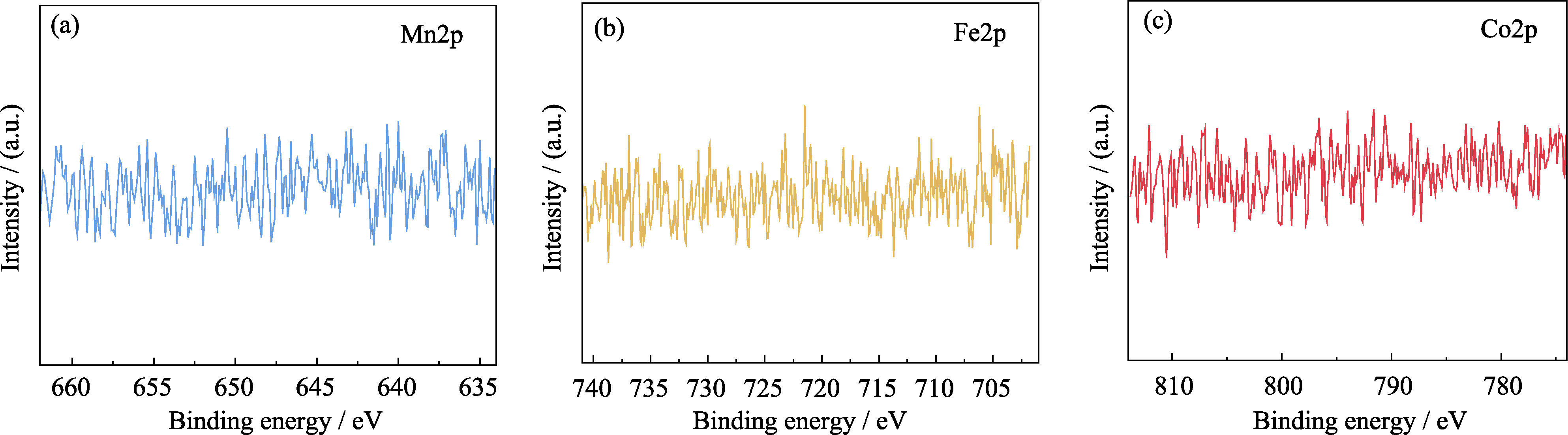
Fig. S6 High-resolution XPS spectra of the samples (a) Mn2p; (b) Fe2p; (c) Co2p
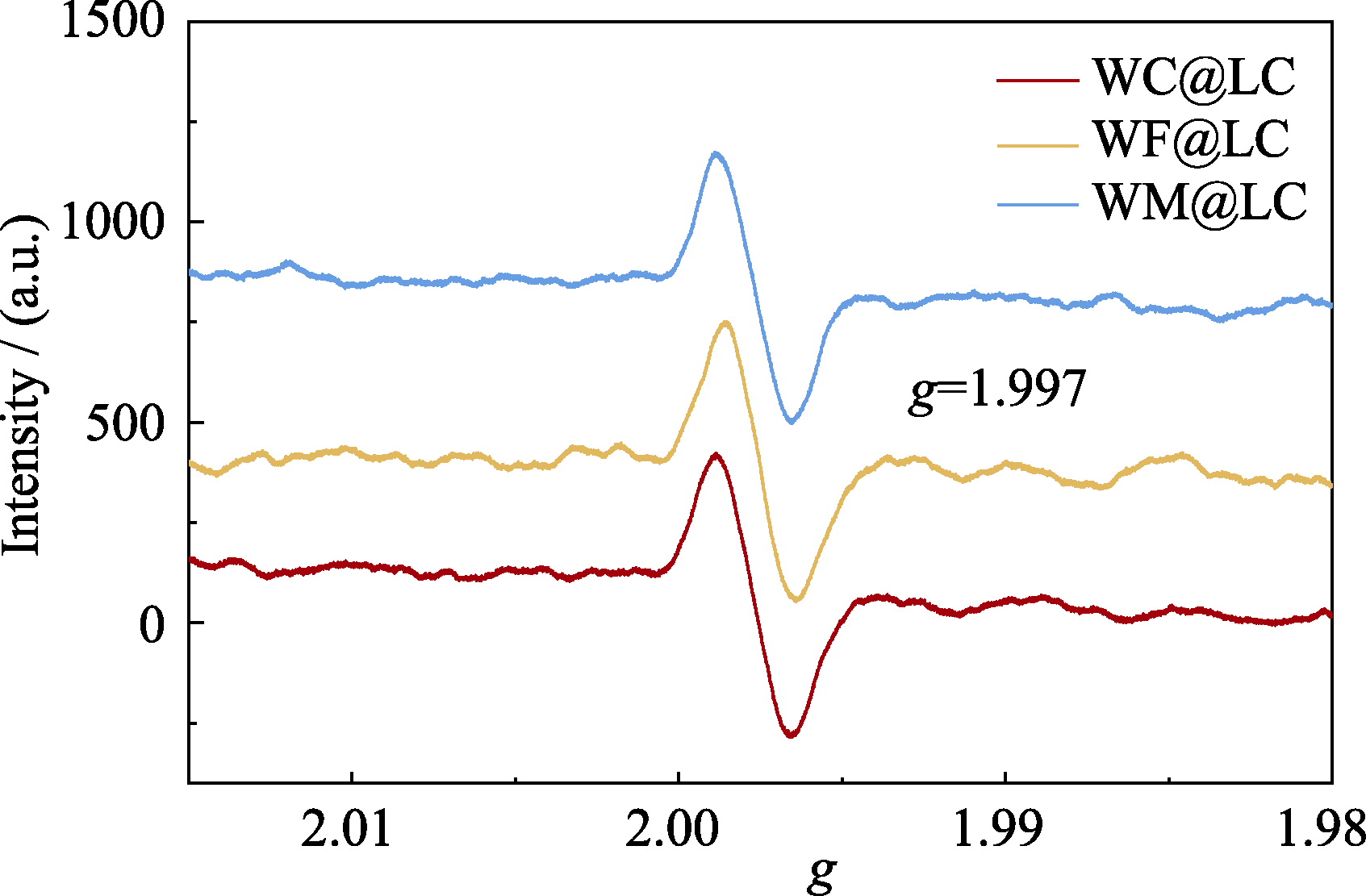
Fig. S7 EPR spectra of WX@LC
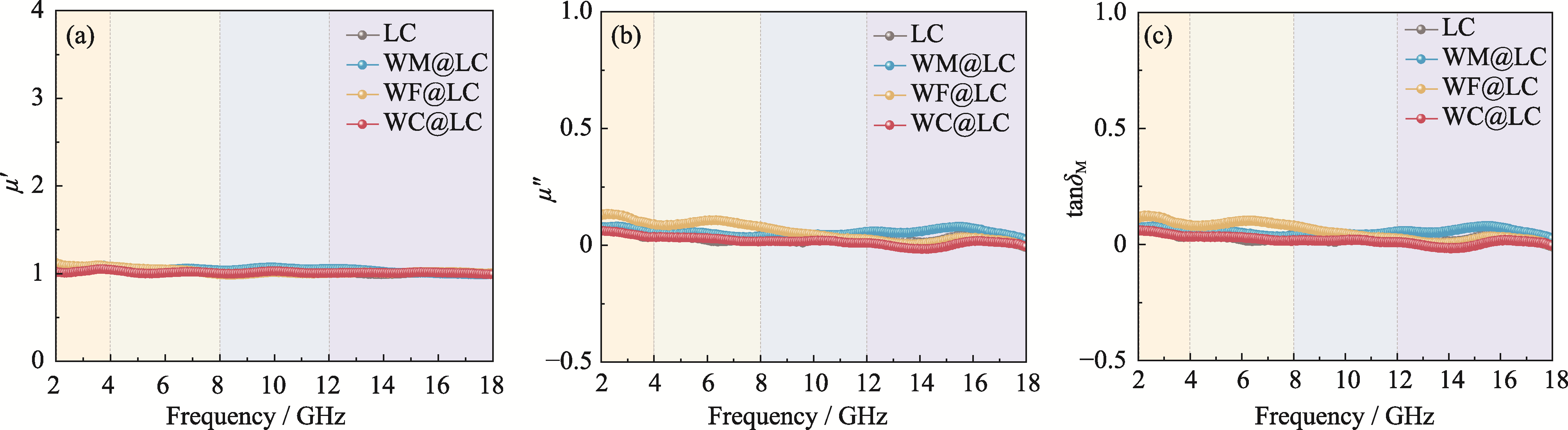
Fig. S8 Complex permeability and magnetic loss characteristics for samples (a) Real part of complex permeability (μ'), (b) Imaginary part of complex permeability (μ''), (c) Magnetic loss tangent (tanδM)
| Sample | RLmin/dB | Thickness/mm | EABmax/GHz | Thickness/mm | Loading/% (in mass) | Ref. |
|---|---|---|---|---|---|---|
| FCCMT | -39.08 | 1.9 | 6.85 | 1.9 | 30 | [ |
| CoNi-MOF-Se-500 | -51.1 | 1.8 | 4 | 1.8 | 25 | [ |
| C/Fe3O4 | -40.1 | 2 | 5.12 | 2 | 50 | [ |
| WCA/BiCo@NC | -50.92 | 1.4 | 4.88 | 1.4 | 40 | [ |
| HCMs-900 | -57.5 | 2.5 | 5.76 | 1.8 | 15 | [ |
| NiS/Co3S4/NiCoQCNTs/NC | -75.9 | 2.6 | 4.8 | 2.6 | 30 | [ |
| FCM | -52.59 | 1.92 | 6.04 | 2.2 | 30 | [ |
| NiO/NiFe2O4/Ni/Ni3Fe@BC | -67.44 | 2.773 | 6.7 | 1.754 | 25 | [ |
| Fe-BBCN/Ti3C2Tx | -46.8 | 2 | 4.2 | 1.5 | 30 | [ |
| HPC-650 | -49.96 | 1.5 | 6.46 | 2.4 | 30 | [ |
| PNBC/CoFe2/CoFe2O4 | -52.21 | 1.44 | 4.32 | 1.44 | 30 | [ |
| WM@LC | -73.13 | 4.11 | 6.64 | 2.18 | 15 | This work |
Table S1 Comparison of the overall performance of WM@LC with recent bio-derived carbon/advanced carbon-based microwave absorbing materials
| Sample | RLmin/dB | Thickness/mm | EABmax/GHz | Thickness/mm | Loading/% (in mass) | Ref. |
|---|---|---|---|---|---|---|
| FCCMT | -39.08 | 1.9 | 6.85 | 1.9 | 30 | [ |
| CoNi-MOF-Se-500 | -51.1 | 1.8 | 4 | 1.8 | 25 | [ |
| C/Fe3O4 | -40.1 | 2 | 5.12 | 2 | 50 | [ |
| WCA/BiCo@NC | -50.92 | 1.4 | 4.88 | 1.4 | 40 | [ |
| HCMs-900 | -57.5 | 2.5 | 5.76 | 1.8 | 15 | [ |
| NiS/Co3S4/NiCoQCNTs/NC | -75.9 | 2.6 | 4.8 | 2.6 | 30 | [ |
| FCM | -52.59 | 1.92 | 6.04 | 2.2 | 30 | [ |
| NiO/NiFe2O4/Ni/Ni3Fe@BC | -67.44 | 2.773 | 6.7 | 1.754 | 25 | [ |
| Fe-BBCN/Ti3C2Tx | -46.8 | 2 | 4.2 | 1.5 | 30 | [ |
| HPC-650 | -49.96 | 1.5 | 6.46 | 2.4 | 30 | [ |
| PNBC/CoFe2/CoFe2O4 | -52.21 | 1.44 | 4.32 | 1.44 | 30 | [ |
| WM@LC | -73.13 | 4.11 | 6.64 | 2.18 | 15 | This work |
| [1] |
QU N, SUN H, SUN Y, et al. 2D/2D coupled MOF/Fe composite metamaterials enable robust ultra-broadband microwave absorption. Nat Commun., 2024, 15: 5642.
DOI PMID |
| [2] | QUAN B, CHEN Y, LI L, et al. Artificially magnetically programmed metamaterial films for enhanced ultra-wideband electromagnetic response. Adv. Mater., 2026, 38(12): e20176. |
| [3] | QI J, LIANG C, RUAN K, et al. Cactus-like architecture for synergistic microwave absorption and thermal management. Natl. Sci. Rev., 2025, 12(11): nwaf394. |
| [4] | YI C, HU J, WANG J, et al. Dual magnetic resonances from site-selective doping of hexaferrite yielding ultrabroadband microwave absorption. Adv. Mater., 2025, 38(10): e16331. |
| [5] | CUI G, PENG Z, LIU Z, et al. Flexible graphene@silica fabric metasurface for electromagnetic wave absorption on high-speed aircraft. Adv. Mater., 2026, 38(4): e16254. |
| [6] |
YU D, SHI G M, GAO Q, et al. A novel heterogeneous Mo/Mo2C embedded N, P co-doped carbon nanofiber for C-band broadband and strong microwave absorption. Chem. Eng. J., 2025, 525: 170001.
DOI URL |
| [7] |
LIAO Y, YAN T, FEI D, et al. Defect-engineered charge redistribution in CoNi/CNT/carbon foam heterostructures: synergistic polarization and conductivity modulation for effective microwave absorption. Chem. Eng. J., 2026, 531: 173684.
DOI URL |
| [8] |
LI Z Y, ZHANG F, ZONG Z, et al. Flexible aramid fiber-based film with hollow microsphere structure for efficient microwave absorption. J. Mater. Sci. Technol., 2026, 253: 289.
DOI |
| [9] |
SUN C, YUAN T, ZHANG H, et al. Integration of helical carbon microcoils on toilet paper substrates for low-cost and broadband microwave absorption. Carbon, 2025, 238: 120266.
DOI URL |
| [10] | XIA Y, GAO W, GAO C. A review on graphene-based electromagnetic functional materials: electromagnetic wave shielding and absorption. Adv. Fun. Mater., 2022, 32(42): 2204591. |
| [11] |
AI Y, XING R, REN N, et al. Biomass-derived hierarchical carbon frameworks enable robust microwave absorption. Matter, 2025, 8(9): 102289.
DOI URL |
| [12] |
SHI J, ZHANG X, HE W, et al. Biomass-derived porous carbon materials for tunable microwave absorption with excellent low- frequency performance. ACS Appl. Mater. Interf., 2025, 17(27): 39440.
DOI URL |
| [13] |
LIU J T, ZHENG Y C, JIANG C Y, et al. Cobalt-cobalt oxide doped lignin-based carbon materials for microwave absorption via microwave carbonization. Nano Res., 2025, 18(9): 94907640.
DOI URL |
| [14] | BAI J, ZHANG H, YUE S, et al. Magnetic pinning and multi-scale polarization enhance microwave absorption of vacancy-rich CoFe2O4/ lignin-derived carbon nanofiber composites. Adv. Fiber Mater., 2026, 8: 15951 |
| [15] |
GONG Y, WEI Z, WANG J, et al. Design and fabrication of hierarchically porous carbon with a template-free method. Sci. Rep., 2014, 4: 6349.
DOI PMID |
| [16] |
YANG H, YE S, ZHOU J, et al. Biomass-derived porous carbon materials for supercapacitor. Front Chem., 2019, 7: 274.
DOI PMID |
| [17] |
YAN Y, SUN W, WEI Y, et al. Review of biomass-derived carbon nanomaterials-from 0D to 3D-for supercapacitor applications. Nanomaterials, 2025, 15(4): 315.
DOI URL |
| [18] |
DING R, ZHOU Y P, ZHANG Y C, et al. Air-pyrolysis precision synthesis of functional porous carbon materials. Adv. Funct. Mater., 2025, 35(6): 2415006.
DOI URL |
| [19] |
LIU M, CHEN G, LIANG G, et al. Asymmetric atomic diffusion-engineered magnetic nano-interfaces for enhanced low- frequency electromagnetic wave attenuation. Adv. Funct. Mater., 2025, 35(43): 2508174.
DOI URL |
| [20] | ZUO X, QI J, WEN N, et al. Construction of carbon foam with micro-meso-macropores and in-plane multi-components for microwave absorption. Adv. Funct. Mater., 2026, 36(39): e74687. |
| [21] | WANG D, LIAO Y, HUANG X, et al. Intrinsic diatom resonators enable enhanced microwave absorption via engineered hierarchical porosity. Adv. Powder Mater., 2026, 5(5): 100411. |
| [22] |
LIU P, HE Z, LI X, et al. Multifunctional hollow carbon microspheres enable superior electromagnetic wave response and corrosion barrier. Adv. Mater., 2025, 37(35): 2500646.
DOI URL |
| [23] |
LONG D L, BURKHOLDER E, CRONIN L. Polyoxometalate clusters, nanostructures and materials: from self assembly to designer materials and devices. Chem. Soc. Rev., 2006, 36(1): 105.
DOI URL |
| [24] |
HORN M R, SINGH A, ALOMARI S, et al. Polyoxometalates (POMs): from electroactive clusters to energy materials. Energy Environ. Sci., 2021, 14(4): 1652.
DOI URL |
| [25] |
LONG D L, TSUNASHIMA R, CRONIN L. Polyoxometalates: building blocks for functional nanoscale systems. Angew. Chem. Int. Ed., 2010, 49(10): 1736.
DOI URL |
| [26] |
GUMEROVA N I, ROMPEL A. Synthesis, structures and applications of electron-rich polyoxometalates. Nat. Rev. Chem., 2018, 2(2): 0112.
DOI URL |
| [27] |
ZHOU W, HUANG Y, CAI H, et al. A strongly coupled cluster heterostructure with Pt-N-Mo bonding for durable and efficient H2 evolution in anion-exchange membrane water electrolyzers. Nano- Micro Lett., 2025, 17(1): 296.
DOI |
| [28] |
CAI H Q, YANG Q H, CHEN L L, et al. Polyoxometalates-derived Pt-Mo2C cluster heterostructure for co-catalytic alkaline hydrogen evolution reaction. Rare Met., 2025, 44(7): 4701.
DOI URL |
| [29] |
LI Z, RAO Y, WANG Z, et al. Universal synthesis of core-shell- structured ordered mesoporous transition metal dichalcogenides/metal oxides heterostructures with active edge sites. Small Struct., 2025, 6(1): 2400376.
DOI URL |
| [30] |
HE P, MA R, LI C, et al. Molybdenum blue preassembly strategy to design bimetallic Fe0.54Mo0.73/Mo2C@C for tuneable and low- frequency electromagnetic wave absorption. Inorg. Chem. Front., 2022, 9(9): 1931.
DOI URL |
| [31] |
WU C, CHEN Z, WANG M, et al. Confining tiny MoO2 clusters into reduced graphene oxide for highly efficient low frequency microwave absorption. Small, 2020, 16(30): 2001686.
DOI URL |
| [32] |
MINATO T, SUZUKI K, OHATA Y, et al. A modular synthesis approach to multinuclear heterometallic oxo clusters in polyoxometalates. Chem Commun., 2017, 53(54): 7533.
DOI URL |
| [33] |
MINATO T, SALLEY D, MIZUNO N, et al. Robotic stepwise synthesis of hetero-multinuclear metal oxo clusters as single- molecule magnets. J. Am. Chem. Soc., 2021, 143(32): 12809.
DOI URL |
| [34] |
HUANG Y, SUN Y, ZHENG X, et al. Atomically engineering activation sites onto metallic 1T-MoS2 catalysts for enhanced electrochemical hydrogen evolution. Nat. Commun., 2019, 10: 982.
DOI |
| [35] |
HE P, RAN L, LI C, et al. Drawing inspiration from nature: trinitarian strategies for designing polyoxometalates and metal- organic framework-based biomimetic microhoneycomb electromagnetic wave-absorbing materials. Inorg. Chem., 2024, 63(3): 1613.
DOI URL |
| [36] |
LI X, HAN Y, WANG C, et al. Atomic-Level heterometallic engineering in single-crystalline polyoxometalate-based MOF for efficient solar photo-thermo-electric conversion. J. Am. Chem. Soc., 2026, 148(7): 7460.
DOI URL |
| [37] |
WANG X, ZHENG Q, WANG L, et al. Phase engineering of MoS2 via Anderson-type polyoxometalate precursor for efficient electromagnetic wave absorption. Adv. Funct. Mater., 2025, 35(33): 2501720.
DOI URL |
| [38] |
HAO M, XIONG X G, LI Z, et al. Adsorption-catalysis synergy boosting the conversion of polysulfide over mesoporous carbon confined molecular catalysts. Adv. Energy Mater., 2025, 15(31): 2501226.
DOI URL |
| [39] | QI C, BAO W, XU J, et al. Integrated two-in-one strategy for efficient neutral hydrogen peroxide electrosynthesis via phosphorous doping in 2D mesoporous carbon carriers. Angew Chem. Int. Ed., 2025, 64(15): e202500177. |
| [40] | ZHANG X R, WANG B J, SUN H W, et al. Pre-polymerization and pre-etching dominated by carbon dots to fabricate the sub- nanometer microporous carbon for supercapacitors. Angew. Chem. Int. Ed., 2025, 64(50): e202519704. |
| [41] |
HAO Z, SHI S, WANG B, et al. Constructing oxygen-rich vacancies for efficient microwave absorption in Co3O4/C/N-doped carbon nanonets. J. Alloys Compd., 2025, 1024: 180206.
DOI URL |
| [42] |
WANG J, QU H, YE X, et al. Electronic structure and absorption mechanism of Fe-doped Y0.9Sr0.1CoO3 perovskite microwave absorbers. J. Adv. Ceram., 2025, 14(12): 9221191.
DOI URL |
| [43] | LI M, ZHAO K, FAN B, et al. Rational A-site entropy engineering in perovskites: dual-exchange enhanced magnetoelectric coupling for ultra-efficient microwave absorption. Adv. Sci., 2026, 13(1): e16938. |
| [44] |
LUO Y K, ZHANG Y, ZHANG K, et al. Tunable microwave absorption in nickel-doped perovskite Barium Titanate via selecting doping sites and amount. Nano Res., 2025, 18(11): 94907843.
DOI URL |
| [45] |
SHU R, LI Y, HUANG R, et al. Mountain laurel-like FeCo alloy decorated nitrogen-doped reduced graphene oxide composites for broadband and high-efficiency microwave absorption. Chem. Eng. J., 2026, 530: 173444.
DOI URL |
| [46] | ZHAO P Y, PENG H L, CAI B, et al. Mechanism decoupling of impedance matching and attenuation enhancement via spatial distribution of loading components. Adv. Funct. Mater., 2025, 36(10): e18479. |
| [47] |
HU F, ZHANG F, WANG X, et al. Ultrabroad band microwave absorption from hierarchical MoO3/TiO2/Mo2TiC2Tx hybrids via annealing treatment. J. Adv. Ceram., 2022, 11(9): 1466.
DOI |
| [48] |
TONG S, WU F, NIU X, et al. N-doped carbon nanofibers coupled with in situ-grown small Co3Fe7 nanoparticles and short carbon nanotubes for radar-infrared compatible stealth. Carbon, 2026, 248: 121144.
DOI URL |
| [49] |
ZHANG K, LIU Y, LI X, et al. All-dielectric ultra-broadband microwave absorbing aerogel with optimized dielectric dispersion via dielectric relaxation time regulation. Adv. Mater., 2025, 37(35): 2506386.
DOI URL |
| [50] | CUI K B, HE C L, WU J H, et al. Multispectrum electromagnetic response in FeNiHO/C heterodimensional structure for microwave absorption and multimode photodetection. Adv. Mater., 2025, 37(44): e10507. |
| [51] | BAO Y, LIU Y, WANG W, et al. Thermal-driven structure-phase cooperative evolution of magnetic micro-flower on biomass-derived carbon for exceptional microwave absorption and radar-infrared stealth. Small, 2026, 22(8): e12704. |
| [52] |
WANG Y, QIN J, DAI R, et al. Amplified heterogeneous interface for modulating high-frequency polarization response in confined space. Adv. Funct. Mater., 2025, 35(41): 2506831.
DOI URL |
| [53] | ZENG X, PENG X, LIU Q, et al. BiM@NC (M = Fe, Co, Ni; NC = N-doped carbon) nanoplates confined in wood-derived carbon with excellent electromagnetic wave absorption performance. Adv. Funct. Mater., 2026, 36(12): e16772. |
| [54] | HE Q, KOU X, HUANG H, et al. Combustion-driven lattice reconstruction activates electron spin and densifies electronic states for synergistic broadband microwave absorption. Adv. Funct. Mater., 2026, 36(30): e28574. |
| [55] | LI L Y, BAI J X, MA Z, et al. Multiphase high-entropy carbon sphere: defect engineering and multispectral electromagnetic response. Adv. Funct. Mater., 2026, 36(13): e19905. |
| [56] |
CHEN Y, WANG X, CUI W G, et al. Multiple Schottky contacts motivated via defects to tune the response ability of electromagnetic waves. Adv. Funct. Mater., 2025, 35(11): 2417215.
DOI URL |
| [57] | XU C, LUO K, DU Y, et al. Nano-heterointerface coupling engineering induced electromagnetic response by tailored spindle arrays for microwave absorption. Adv. Funct. Mater., 2025, 35(52): e12806. |
| [58] |
FAN Q, SONG C, SUN Y, et al. Giant enhancement in microwave absorption efficiency of bamboo-based Fe-linked two-phase heterogeneous interface structure (C&Ti3C2) synthesized under magnetic environments: expanded bandwidth and reduced thickness. J. Cleaner Product., 2025, 507: 145538.
DOI URL |
| [59] | GONG X, LI M, GE Y, et al. Enhanced low-frequency microwave absorption of N-doped biomass derived carbon. Mater. Today Commun., 2023, 37: 107093. |
| [60] | JI X, DENG Y, XU Z, et al. Facile synthesis of pine needle-derived carbon/CoFe2/CoFe2O4 composites with precisely tunable microwave attenuation efficiency. Mater. Today Nano, 2025, 32: 100707. |
| [1] | QU Boxuan, TAN Ji, CHEN Shuhan, LIU Xuanyong. Enhanced ROS Scavenging Property of Polyoxometalates by Manganese Doping for Cytoprotection [J]. Journal of Inorganic Materials, 2026, 41(6): 839-846. |
| [2] | ZHU Zhengwang,FENG Rui,LIU Yang,ZHANG Yang,XIE Wenhan,DONG Lijie. Preparation and Property of CoFe2O4 Nanofibers with Fishbone-like Structure [J]. Journal of Inorganic Materials, 2020, 35(9): 1011-1016. |
| [3] | WANG Bin, ZHENG Jin-Hui, WANG Xiao-Hong, ZHAO Bo, XU Liang, LIU Zong-Rui. Preparation and Chemically Responsive Luminescent Switching of the Flexible Self-supporting TbW10-Agarose Green Emission Thin Films [J]. Journal of Inorganic Materials, 2019, 34(8): 844-850. |
| [4] | ZHANG Xue-Ke, XIANG Jun, WU Zhi-Peng, LIU Min, SHEN Xiang-Qian. Co Content on Absorption Property of C/Co Nanofibers as a Lightweight Microwave Absorber [J]. Journal of Inorganic Materials, 2017, 32(12): 1299-1307. |
| [5] | LIU Ke, WANG Ji-Tong, LONG Dong-Hui, LING Li-Cheng. Scalable Preparation and Microwave Absorption of Lightweight Fe3O4/Mesoporous Carbon Microsphere Composites [J]. Journal of Inorganic Materials, 2017, 32(10): 1023-1028. |
| [6] | ZHANG Yi, ZHANG Xiao-Feng, He Xiao-Lei, HUANG Huo-Di, LE Li-Juan, LIN Shen. Preparation and Electrocatalytic Property of Pt/{GN/CuPW11}n Composite Films toward Methanol Oxidation [J]. Journal of Inorganic Materials, 2017, 32(10): 1075-1082. |
| [7] | LI Jia-Le, XIANG Jun, YE Qin, LIU Min, SHEN Xiang-Qian. Microwave Absorption Properties of Double-layer Absorbing Coatings Based on Ni0.4Co0.2Zn0.4Fe2O4 and BaTiO3 Nanofibers [J]. Journal of Inorganic Materials, 2015, 30(5): 479-486. |
| [8] | HUA Cheng-Jiang, WANG Ming-Hui, LUAN Guo-You, LIU Yan, WU Hua. Rapid in situ Crystallization and Catalytic Performance of Cu3(BTC)2-based Film on Copper Mesh [J]. Journal of Inorganic Materials, 2015, 30(5): 529-534. |
| [9] | WU Xiao-Yu, LI Song-Mei,LIU Jian-Hua, YU Mei, WANG Bo. Preparation and Microwave Absorption Properties of CoFe2O4-graphene Nanocomposites [J]. Journal of Inorganic Materials, 2014, 29(8): 845-850. |
| [10] | HUANG Xiao-Ling, LIN Zhou, LIAN Xing-Yi, ZHANG Xiao-Feng, LIN Shen. Preparation and Electrocatalytic Properties of Pd/PMo12-GN Composite towards Formic Acid Oxidation [J]. Journal of Inorganic Materials, 2014, 29(7): 722-728. |
| [11] | LI Jia, LIU Hong-Bo, YANG Li. Research on Microwave Absorption Properties of FeCo/Graphite Nanocomposite [J]. Journal of Inorganic Materials, 2014, 29(5): 470-474. |
| [12] | ZHOU Wei, XIAO Peng, LI Yang, LUO Heng, HONG Wen. Microwave Absorbing Properties of Carbon Fibers Modified with BN/SiC Composite Coatings [J]. Journal of Inorganic Materials, 2014, 29(10): 1093-1098. |
| [13] | ZHOU Wei, XIAO Peng, LI Yang, LUO Heng, ZHOU Liang. Synthesis and Microwave Absorbing Properties of PyC/BN Composite Powders [J]. Journal of Inorganic Materials, 2013, 28(5): 479-484. |
| [14] | FANG Jian-Jun, LI Su-Fang, ZHA Wen-Ke, CONG Hong-Yun, CHEN Jun-Fang, CHEN Zong-Zhang. Microwave Absorbing Properties of Nickel-coated Graphene [J]. Journal of Inorganic Materials, 2011, 26(5): 467-471. |
| [15] | ZHANG Yan-Qing,ZHANG Xiong. Microwave Absorbing Property and Modification of Ferrite-encapsulated Cenosphere Powders [J]. Journal of Inorganic Materials, 2009, 24(4): 732-736. |
| Viewed | ||||||
|
Full text |
|
|||||
|
Abstract |
|
|||||
