
Journal of Inorganic Materials ›› 2026, Vol. 41 ›› Issue (6): 787-794.DOI: 10.15541/jim20250426
• RESEARCH ARTICLE • Previous Articles Next Articles
HONG Enliu1( ), TU Xinchen1, LI Ziqing2(), FANG Xiaosheng1()
Received:2025-10-28
Revised:2025-12-23
Published:2026-06-20
Online:2026-01-22
Contact:
LI Ziqing, associate professor. E-mail: lzq@fudan.edu.cn;About author:HONG Enliu (2000-), male, PhD candidate. E-mail: 21110300005@m.fudan.edu.cn
Supported by:CLC Number:
HONG Enliu, TU Xinchen, LI Ziqing, FANG Xiaosheng. Two-dimensional Perovskite Single Crystal Nanosheets: Floating Growth and Optoelectronic Performance[J]. Journal of Inorganic Materials, 2026, 41(6): 787-794.

Fig. 1 Experimental procedures of preparing single crystal nanosheets by liquid-air interface floating growth method
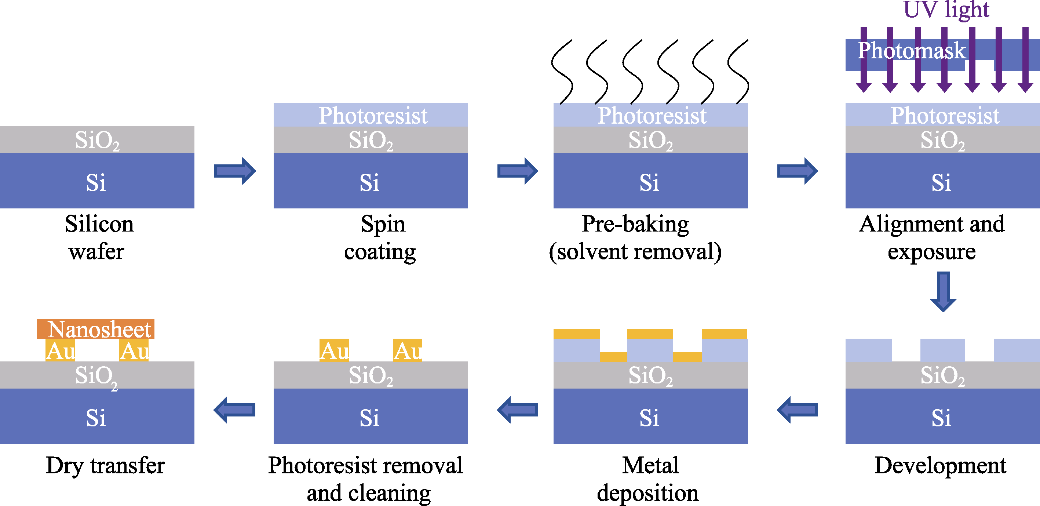
Fig. 2 Flowchart of constructing MSM-structure photodetectors using micro-nano processing technology and dry transfer technique
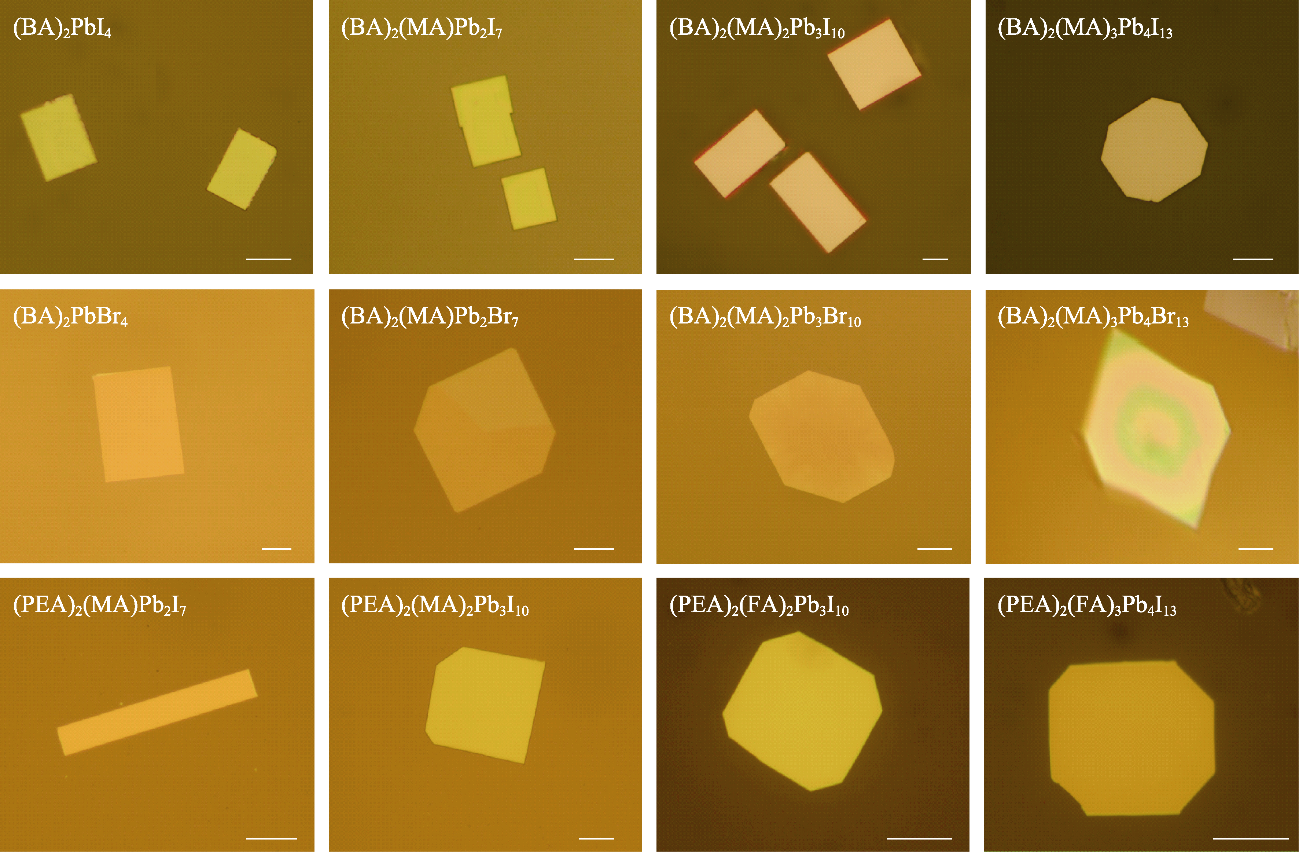
Fig. 3 Optical microscopic images of various compositions of two-dimensional perovskite nanosheets grown by the liquid-air interfacial floating method Scale bar: 30 μm
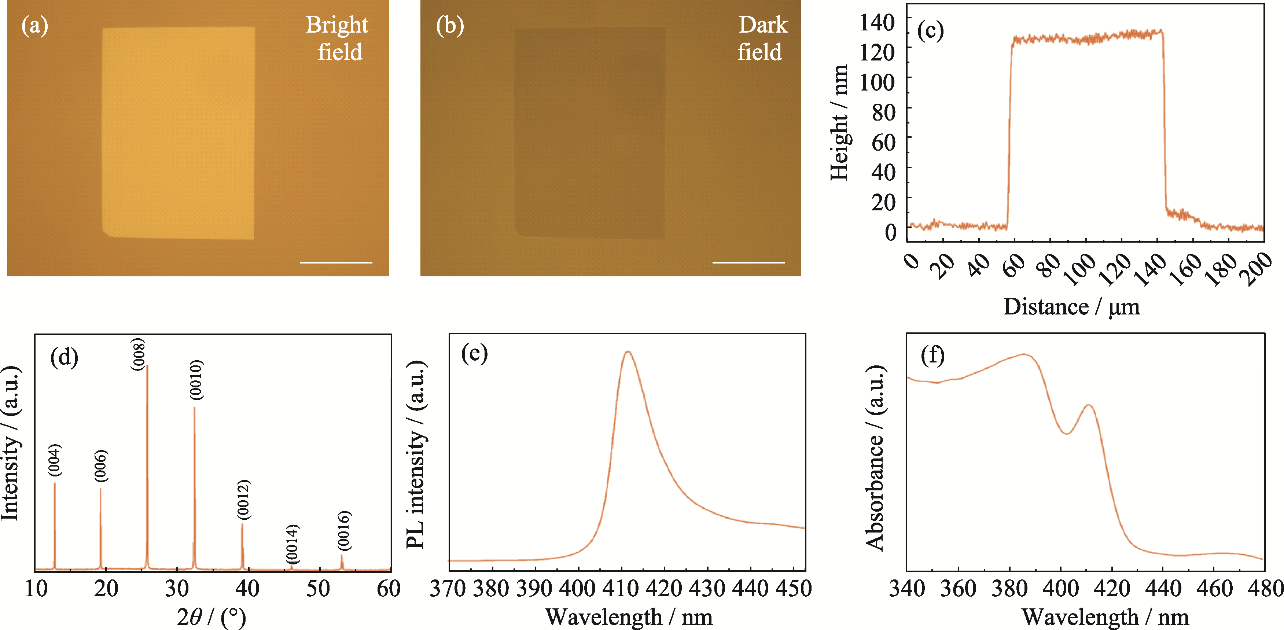
Fig. 4 Analysis of the composition and optical properties of (BA)2PbBr4 nanosheets (a, b) Optical microscope magnification images in (a) bright field and (b) dark field (scale bar: 30 μm); (c) Thickness profile; (d) XRD pattern; (e) Photoluminescence spectrum; (f) UV-visible absorption spectrum
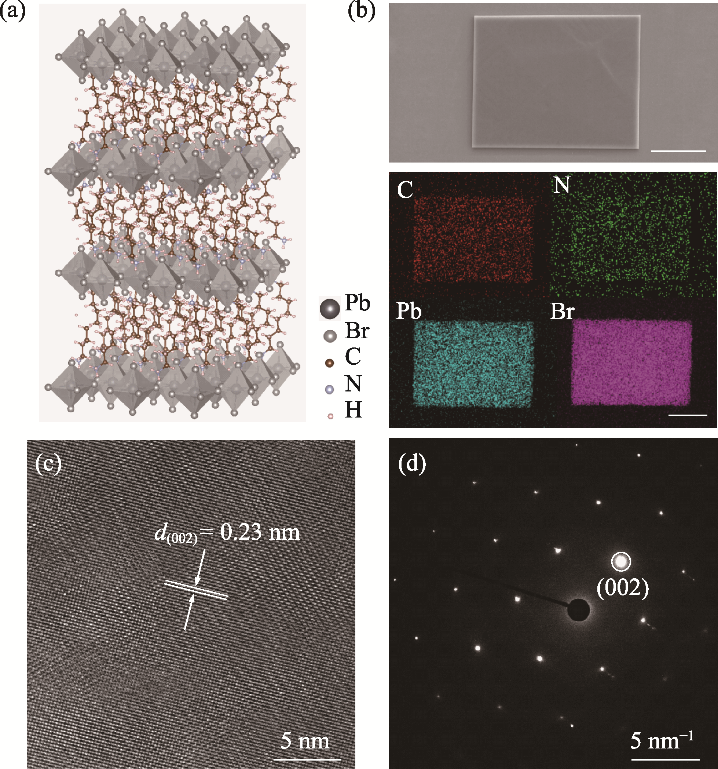
Fig. 5 (a) Crystal structure depiction, (b) SEM image (upper) and corresponding elemental distribution mappings (lower) (scale bar: 30 μm), (c) high-resolution TEM image and (d) selected area electron diffraction pattern of (BA)2PbBr4 nanosheets
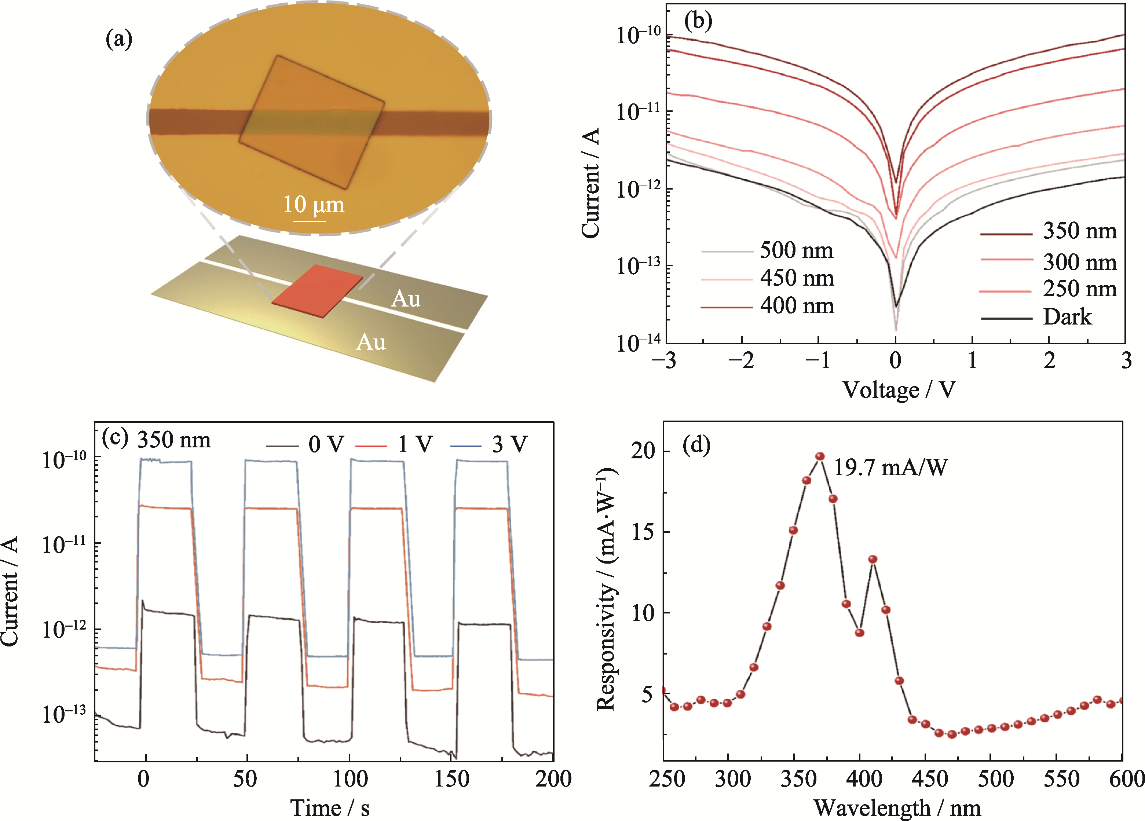
Fig. 6 Analysis of the optoelectronic properties of (BA)2PbBr4 nanosheets (a) Structural diagram of the device and the corresponding optical microscope image; (b) I-V curves of the device under light of different wavelengths; (c) I-t curves of the device at the optimal response wavelength with different bias voltages; (d) Responsivity curve of the device as a function of wavelength at 3 V bias voltage. Colorful figures are available on website
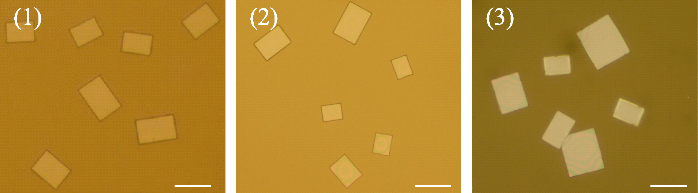
Fig. S1 Verification of process reliability of multiple batches by floating method Taking the (BA)2PbBr4 component as an example; Scale bar: 100 μm
| Material | Type | Testing condition | Responsivity/ (mA·W-1) | Specific detectivity/ Jones | Ion/off | Ref. |
|---|---|---|---|---|---|---|
| MoS2/CsPbBr3 | Film | 10 V, 385 nm | 0.4 | 3.5×10⁹ | - | [S1] |
| (OA)2FAn-1PbnBr3n+1 | Film | 3 V, 442 nm | 3.2×10⁴ | - | - | [S2] |
| (BA)2Pb(Cl0.1Br0.9)4 | Single crystal | 10 V, 340 nm | 3.19 | 3.87×10¹¹ | ~10 | [S3] |
| MAPbI3/(BA)2(MA)3Pb4I13 | Film | 3 V, 405 nm | 9.4 | 3.1×10⁸ | 8.91×10³ | [S4] |
| (BA)2(MA)2Pb3I10 | Film | 30 V, - | 12.78 | - | 1.6×10³ | [S5] |
| MAPbI3 | Film | 10 V, 650 nm | 1×10² | 1.02×10¹² | 3×10² | [S6] |
| MoS2/CsPbBr3 | Single crystal | 10 V, 442 nm | 4.4×10³ | 2.5×10¹⁰ | 1.67×10⁴ | [S7] |
| (PEA)2(MA)Pb2I7 | Single crystal | 9.5 V, 600 nm | 3.87 | 2.92×10¹⁰ | ~103 | [S8] |
| (BA)2(MA)3Pb4I13 | Single crystal | 3 V, 532 nm | 71.9 | 1.1×10¹² | ~105 | [S9] |
| Si/CsPbBr3 | Film | −1 V, 532 nm | 24.85 | 1.01×10¹¹ | ~9×10² | [S10] |
| (BA)2PbBr4 | Single crystal | 3 V, 370 nm | 19.7 | 1.14×10¹¹ | 2.3×10² | This work |
Table S1 Performance comparison of this working device with other similar devices
| Material | Type | Testing condition | Responsivity/ (mA·W-1) | Specific detectivity/ Jones | Ion/off | Ref. |
|---|---|---|---|---|---|---|
| MoS2/CsPbBr3 | Film | 10 V, 385 nm | 0.4 | 3.5×10⁹ | - | [S1] |
| (OA)2FAn-1PbnBr3n+1 | Film | 3 V, 442 nm | 3.2×10⁴ | - | - | [S2] |
| (BA)2Pb(Cl0.1Br0.9)4 | Single crystal | 10 V, 340 nm | 3.19 | 3.87×10¹¹ | ~10 | [S3] |
| MAPbI3/(BA)2(MA)3Pb4I13 | Film | 3 V, 405 nm | 9.4 | 3.1×10⁸ | 8.91×10³ | [S4] |
| (BA)2(MA)2Pb3I10 | Film | 30 V, - | 12.78 | - | 1.6×10³ | [S5] |
| MAPbI3 | Film | 10 V, 650 nm | 1×10² | 1.02×10¹² | 3×10² | [S6] |
| MoS2/CsPbBr3 | Single crystal | 10 V, 442 nm | 4.4×10³ | 2.5×10¹⁰ | 1.67×10⁴ | [S7] |
| (PEA)2(MA)Pb2I7 | Single crystal | 9.5 V, 600 nm | 3.87 | 2.92×10¹⁰ | ~103 | [S8] |
| (BA)2(MA)3Pb4I13 | Single crystal | 3 V, 532 nm | 71.9 | 1.1×10¹² | ~105 | [S9] |
| Si/CsPbBr3 | Film | −1 V, 532 nm | 24.85 | 1.01×10¹¹ | ~9×10² | [S10] |
| (BA)2PbBr4 | Single crystal | 3 V, 370 nm | 19.7 | 1.14×10¹¹ | 2.3×10² | This work |
| [1] | LI L, YAO J, ZHU J, et al. Colloid driven low supersaturation crystallization for atomically thin Bismuth halide perovskite. Nature Communications, 2023, 14: 3764. |
| [2] | LIN K B, YAN C Z, SABATINI R P, et al. Dual-phase regulation for high-efficiency perovskite light-emitting diodes. Advanced Functional Materials, 2022, 32(24): 2200350. |
| [3] | HONG E L, LI Z Q, ZHANG X Y, et al. Deterministic fabrication and quantum-well modulation of phase-pure 2D perovskite heterostructures for encrypted light communication. Advanced Materials, 2024, 36(29): 202400365. |
| [4] | LIANG C, SALIM K M M, LI P W, et al. Controlling the film structure by regulating 2D Ruddlesden-Popper perovskite formation enthalpy for efficient and stable tri-cation perovskite solar cells. Journal of Materials Chemistry A, 2020, 8(12): 5874. |
| [5] | LI J W, YU Q, HE Y H, et al. Cs2PbI2Cl2, all-inorganic two- dimensional Ruddlesden-Popper mixed halide perovskite with optoelectronic response. Journal of the American Chemical Society, 2018, 140(35): 11085. |
| [6] | CAI K, JIN Z W. Photodetector based on two-dimensional perovskite (PEA)2PbI4. Journal of Inorganic Materials, 2023, 38(9): 1069. |
| [7] | HU Y, LI Z Q, FANG X S. Solution-prepared AgBi2I7 thin films and their photodetecting properties. Journal of Inorganic Materials, 2023, 38(9): 1055. |
| [8] | TIAN X X, ZHANG Y Z, ZHENG R K, et al. Two-dimensional organic-inorganic hybrid Ruddlesden-Popper perovskite materials: preparation, enhanced stability, and applications in photodetection. Sustainable Energy & Fuels, 2020, 4(5): 2087. |
| [9] | LIANG J, ZHANG Z, XUE Q, et al. A finely regulated quantum well structure in quasi-2D Ruddlesden-Popper perovskite solar cells with efficiency exceeding 20%. Energy & Environmental Science, 2022, 15(1): 296. |
| [10] | YAN L, MA J, LI P, et al. Charge-carrier transport in quasi-2D Ruddlesden-Popper perovskite solar cells. Advanced Materials, 2022, 34(7): 2106822. |
| [11] | CHEN K, ZHANG Q P, LIANG Y, et al. Quasi-two dimensional Ruddlesden-Popper halide perovskites for laser applications. Frontiers of Physics, 2024, 19(2): 23502. |
| [12] | GAO X, ZHANG X, YIN W, et al. Ruddlesden-Popper perovskites: synthesis and optical properties for optoelectronic applications. Advanced Science, 2019, 6(22): 1900941. |
| [13] | WU L F, CAO Q W, LI H Y, et al. A 2D perovskite photodetector for NIR range and weak-Light imaging applications via thermal regulation. Advanced Functional Materials, 2025, 35(48): 2505180. |
| [14] | LI Z J, GU H, LIU X L, et al. Uniform phase permutation of efficient Ruddlesden-Popper perovskite solar cells via binary spacers and single srystal coordination. Advanced Materials, 2024, 36(48): 2410408. |
| [15] | TEALE S, DEGANI M, CHEN B, et al. Molecular cation and low-dimensional perovskite surface passivation in perovskite solar cells. Nature Energy, 2024, 9(10): 779. |
| [16] | LI S H, WU Y, ZHONG J, et al. Toward efficient and stable Ruddlesden-Popper perovskite: unraveling the selection rule of binary spacer cations. Advanced Functional Materials, 2025, 35(19): 2420854. |
| [17] | WAN J X, YUAN H, XIAO Z X, et al. 2D Ruddlesden-Popper polycrystalline perovskite pyro-phototronic photodetectors. Small, 2023, 19(38): 202207185. |
| [18] | WANG R, DONG X Y, LING Q, et al. Nucleation and crystallization in 2D-Ruddlesden-Popper perovskites using formamidinium-based organic semiconductor spacers for efficient solar cells. Angewandte Chemie-International Edition, 2023, 62(50): 202314690. |
| [19] | LI J, HUANG J, MA F, et al. Unveiling microscopic carrier loss mechanisms in 12% efficient Cu2ZnSnSe4 solar cells. Nature Energy, 2022, 7(8): 754. |
| [20] | WEI L J, LIU Y, MA Y, et al. Centimeter-level double perovskite single crystals with strong interlaminar hydrogen bonds for high-performance X-ray detection. Journal of Materials Chemistry C, 2025, 13(4): 1675. |
| [21] | CAO F, LIU Y, ZHANG X L, et al. Lead-free single crystal metal halide perovskite detectors. Materials Science & Engineering R-Reports, 2025, 164(10): 100991. |
| [22] | DI J Y, CHANG J J, LIU S Z. Recent progress of two-dimensional lead halide perovskite single crystals: crystal growth, physical properties, and device applications. Ecological Materials, 2020, 2(3): 12036. |
| [23] | ZHANG Y R, HAN E Q, ZHANG B W, et al. 2D and quasi-2D hybrid halide perovskite single crystals: from fundamentals to functionalized photodetectors. Nano Energy, 2024, 132(17): 110368. |
| [24] | LEE Y H, PARK J Y, NIU P R, et al. One-step solution patterning for two-dimensional perovskite nanoplate arrays. ACS Nano, 2023, 17(14): 13840. |
| [25] | YAN J K, LI H J, ALDAMASY M H, et al. Advances in the synthesis of halide perovskite single crystals for optoelectronic applications. Chemistry of Materials, 2023, 35(7): 2683. |
| [26] | GAO W, WEI Q, WANG T, et al. Two-photon lasing from two-dimensional homologous Ruddlesden-Popper perovskite with giant nonlinear absorption and natural microcavities. American Chemical Society Nano, 2022, 16(8): 13082. |
| [27] | LUO J, LIU B, YANG J L, et al. Regulation of luminescence properties of the ultrathin two-dimensional halide perovskite Cs2PbIxCl4-x (x=0, 1, 2, 3, 4) with Ruddlesden-Popper structure. Physical Review Applied, 2023, 20(2): 024047. |
| [28] | DING Y F, ZHAO Q Q, YU Z L, et al. Strong thickness-dependent quantum confinement in all-inorganic perovskite Cs2PbI4 with a Ruddlesden-Popper structure. Journal of Materials Chemistry C, 2019, 7(24): 7433. |
| [29] | WANG Z, LIU X D, REN H, et al. Insight into the enhanced charge transport in quasi-2D perovskite via fluorination of ammonium cations for photovoltaic applications. ACS Applied Materials & Interfaces, 2022, 14(6): 7917. |
| [30] | CAO J G, DUAN C H, LI Z H, et al. Theoretical selection of 2D perovskite for constructing efficient heterojunction solar cells. ACS Materials Letters, 2023, 5(4): 970. |
| [31] | DU J Y, ZHANG M Q, TIAN J J. Controlled crystal orientation of two-dimensional Ruddlesden-Popper halide perovskite films for solar cells. International Journal of Minerals Metallurgy and Materials, 2022, 29(1): 49. |
| [32] | YANG B, GUO P, HAO D D, et al. Self-powered photodetectors based on CsPbBr quantum dots/organic semiconductors/SnO heterojunction for weak light detection. Science China-Materials, 2023, 66(2): 716. |
| [33] | GUAN X Y, CHEN Y, MA Y H, et al. New paradigms of 2D layered material self-driven photodetectors. Nanoscale, 2024, 16(45): 20811. |
| [34] | HAN S G, LIU X T, LIU Y, et al. High-temperature antiferroelectric of lead iodide hybrid perovskites. Journal of the American Chemical Society, 2019, 141(32): 12470. |
| [35] | LIU X T, WANG S S, LONG P Q, et al. Polarization-driven self-powered photodetection in a single-phase biaxial hybrid perovskite ferroelectric. Angewandte Chemie International Edition, 2019, 58(41): 14504. |
| [1] | LI Zexi, LU Wenjie, WANG Chao, ZHANG Lu, LI Shuti, GAO Fangliang. Two-dimensional GaN: Preparation Based on Liquid Metal Gallium and Photoelectric Properties [J]. Journal of Inorganic Materials, 2026, 41(3): 377-384. |
| [2] | YANG Jialin, WANG Liangjun, RUAN Siyuan, JIANG Xiulin, YANG Chang. Highly Weak-light Sensitive and Dual-band Switchable Photodetector Based on CuI/Si Unilateral Heterojunction [J]. Journal of Inorganic Materials, 2024, 39(9): 1063-1069. |
| [3] | LI La, SHEN Guozhen. 2D MXenes Based Flexible Photodetectors: Progress and Prospects [J]. Journal of Inorganic Materials, 2024, 39(2): 186-194. |
| [4] | CAI Kai, JIN Zhiwen. Photodetector Based on Two-dimensional Perovskite (PEA)2PbI4 [J]. Journal of Inorganic Materials, 2023, 38(9): 1069-1075. |
| [5] | TAO You-Rong,CHEN Jin-Qiang,WU Xing-Cai. Phototransistor Based on Single TaON Nanobelt and Its Photoresponse from Ultraviolet to Near-infrared [J]. Journal of Inorganic Materials, 2019, 34(9): 1004-1010. |
| [6] | Chao-Xiang SUN, Liang CHEN, Yu CHANG, Wei TIAN, Liang LI. A Self-powered UV-visible Photodetector Based on p-Se/Al2O3/n-ZnO Nanorod Array Heterojunction [J]. Journal of Inorganic Materials, 2019, 34(5): 560-566. |
| [7] | RUI Run-Sheng, LIU Zhi-Yong, BAI Chuang-Yi, GUO Yan-Quen, JIN Xiao-Yan, CAI Chuan-Bing. Influence of Thickness on Performances of YBa2Cu3O7-δ Films Prepared by Metal Organic Solution Deposition [J]. Journal of Inorganic Materials, 2014, 29(11): 1167-1172. |
| Viewed | ||||||
|
Full text |
|
|||||
|
Abstract |
|
|||||
