无机材料学报 ›› 2026, Vol. 41 ›› Issue (8): 1095-1102.DOI: 10.15541/jim20250406
纪若男1( ), 魏大庆1(), 王庆宇1, 李永昶1, 张田1, 杜青2
收稿日期:2025-10-16
修回日期:2025-12-19
出版日期:2026-08-20
网络出版日期:2025-12-19
通讯作者:
魏大庆, 教授. E-mail: daqingwei@hrbeu.edu.cn作者简介:纪若男(1994-), 女, 讲师. E-mail: 1327952321@qq.com
基金资助:
JI Ruonan1(), WEI Daqing1(), WANG Qingyu1, LI Yongchang1, ZHANG Tian1, DU Qing2
Received:2025-10-16
Revised:2025-12-19
Published:2026-08-20
Online:2025-12-19
Contact:
WEI Daqing, professor. E-mail: daqingwei@hrbeu.edu.cnAbout author:JI Ruonan (1994-), female, lecturer. E-mail: 1327952321@qq.com
Supported by:摘要:
核用锆合金在反应堆失水事故工况下易发生剧烈的锆水反应, 而传统微弧氧化(MAO)涂层因孔隙率高, 难以提供足够保护。本研究在MAO过程中创新性地引入氮气, 利用氮气氛围抑制电弧集中, 实现涂层结构优化与氮元素掺杂。实验结果表明, 该方法成功制备出致密氧化锆涂层, 其孔隙率显著降至4.96%(降幅62%), 表面粗糙度降低, 且与基体结合紧密、无明显裂纹; 同步实现氮元素晶格固溶, 并形成特征性Zr-O-N键合结构。得益于此微观结构与化学组成的协同优化, 致密涂层在0.1 mol/L LiOH溶液中的腐蚀电流密度低至1.61×10⁻⁸ A·cm-2, 较常规MAO涂层降低一个数量级。本研究证实, 氮气氛围可同步实现结构调控与化学改性, 为开发高性能事故容错锆合金包壳涂层提供了新途径。
中图分类号:
纪若男, 魏大庆, 王庆宇, 李永昶, 张田, 杜青. 氮气调控微弧氧化: 锆合金涂层的致密化与耐蚀性[J]. 无机材料学报, 2026, 41(8): 1095-1102.
JI Ruonan, WEI Daqing, WANG Qingyu, LI Yongchang, ZHANG Tian, DU Qing. Nitrogen Modulation of Micro-arc Oxidation: Densification and Corrosion Resistance of Zirconium Alloy Coatings[J]. Journal of Inorganic Materials, 2026, 41(8): 1095-1102.
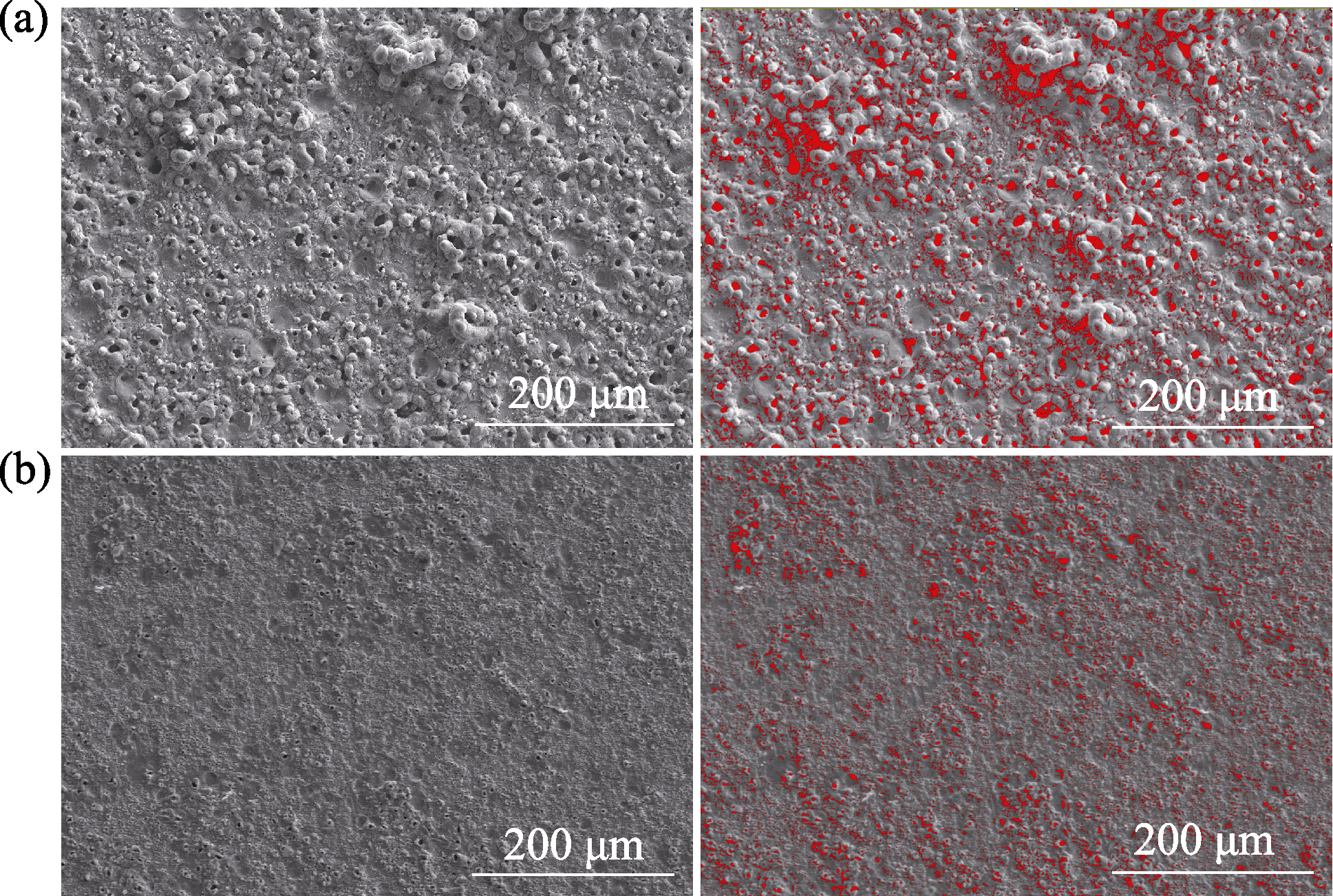
图1 (a) MAO和(b) MAO-N2涂层的微观形貌以及ImageJ二值化处理图
Fig. 1 Micro-morphologies and ImageJ binarization processed images of (a) MAO and (b) MAO-N2 coatings
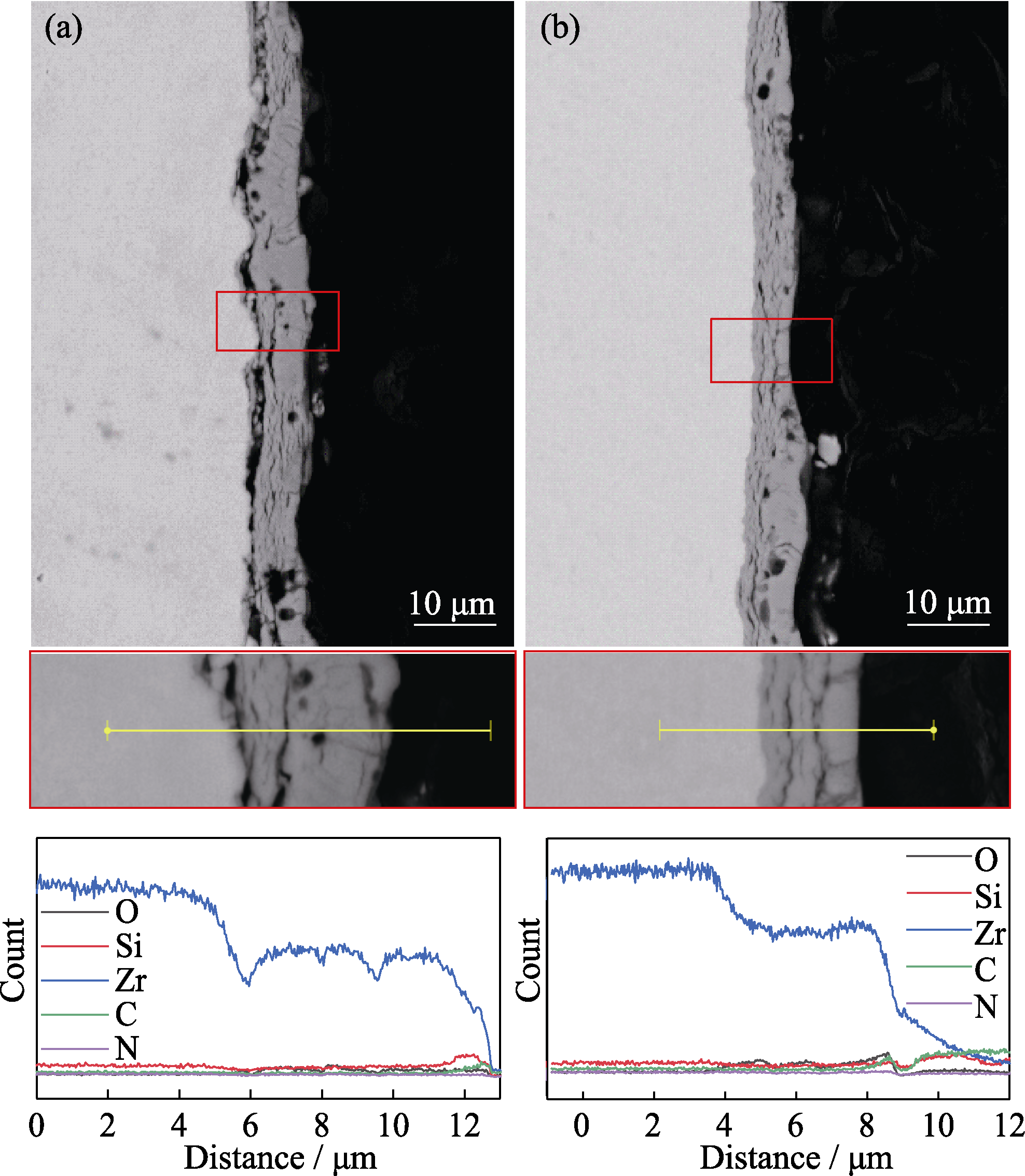
图2 (a) MAO和(b) MAO-N2涂层的截面形貌及元素能谱分析
Fig. 2 Cross-sectional morphologies and corresponding element distributions of (a) MAO and (b) MAO-N2 coatings Colorful figures are available on website
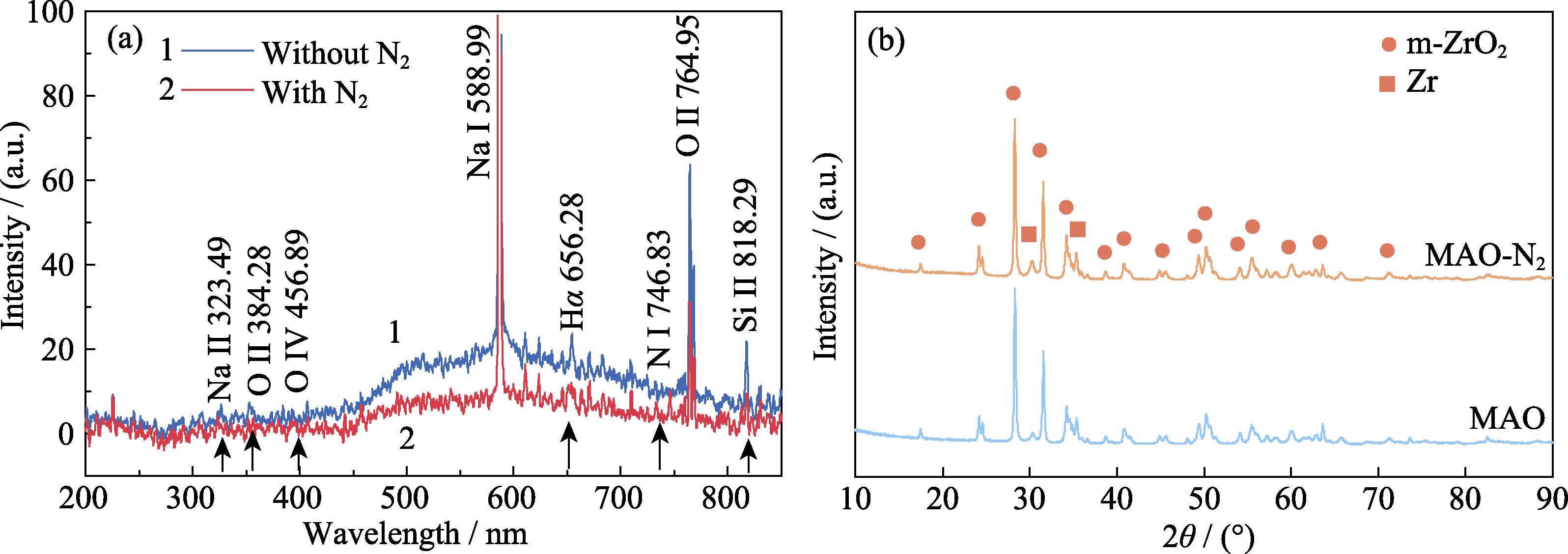
图3 (a) OES总谱图和(b)涂层的XRD谱图
Fig. 3 (a) OES full spectra and (b) XRD patterns of coatings
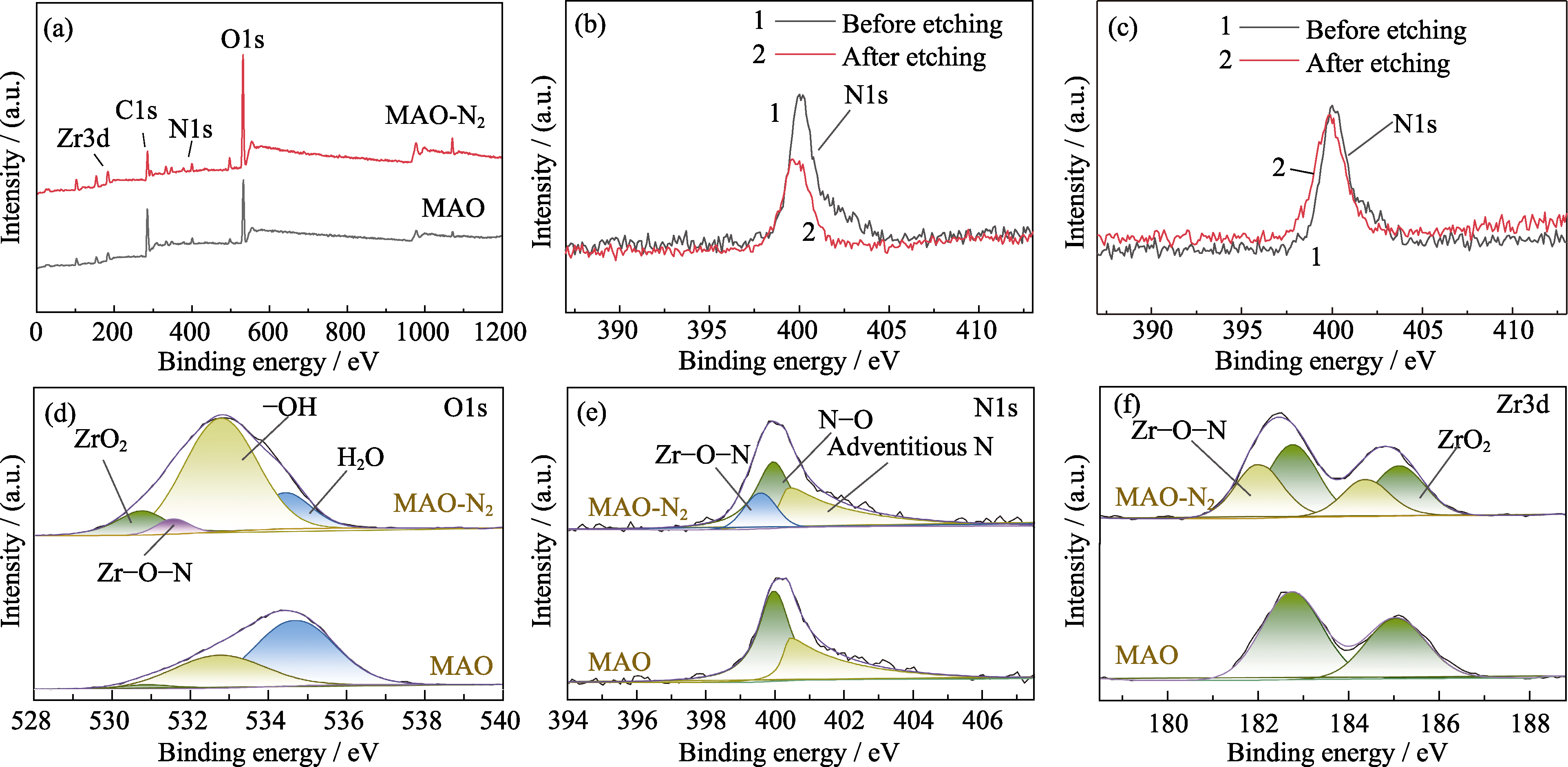
图4 MAO和MAO-N2涂层的XPS谱图
Fig. 4 XPS spectra of MAO and MAO-N2 coatings (a) XPS full spectra; (b, c) N1s XPS spectra of (b) MAO and (c) MAO-N2 coatings before and after etching; (d) O1s, (e) N1s and (f) Zr3d XPS spectra of MAO and MAO-N2 coatings
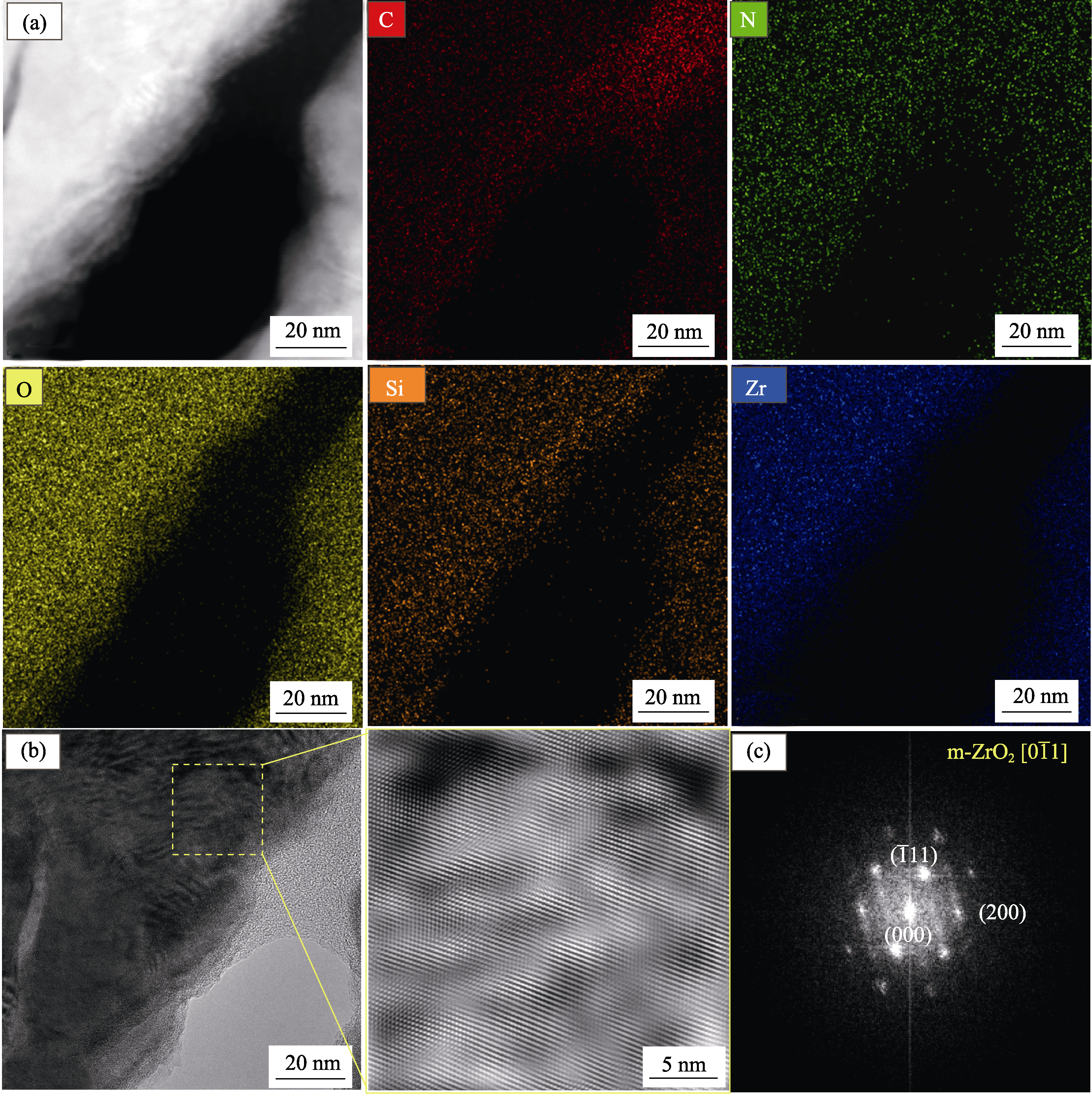
图5 MAO-N2涂层的TEM结果
Fig. 5 TEM results of MAO-N2 coating (a) TEM image and EDS mappings; (b) HRTEM images; (c) FFT pattern
| Element | C | N | O | Si | Zr |
|---|---|---|---|---|---|
| Chemical composition/ % (in atom) | 14.05 | 3.70 | 45.35 | 1.58 | 35.32 |
表1 图5(a)所示区域的元素组成
Table 1 Chemical composition of the area presented in Fig. 5(a)
| Element | C | N | O | Si | Zr |
|---|---|---|---|---|---|
| Chemical composition/ % (in atom) | 14.05 | 3.70 | 45.35 | 1.58 | 35.32 |
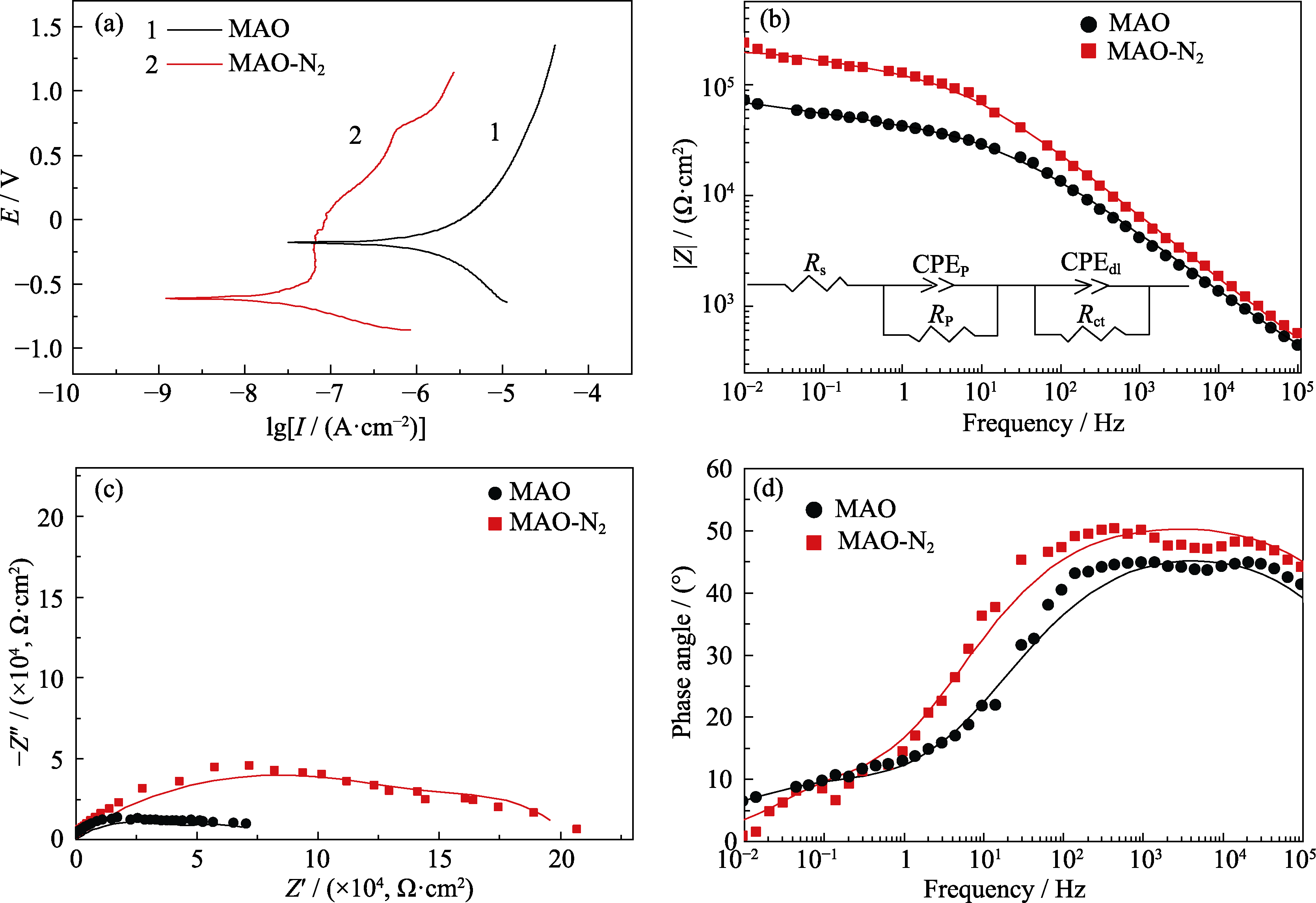
图6 极化曲线和EIS测试结果
Fig. 6 Results of polarization curves and EIS tests (a) Potentiodynamic polarization curves; (b) Bode plots of |Z| vs. frequency and the equivalent circuit model; (c) Nyquist plots; (d) Bode plots of phase angle vs. frequency
| Coating | Ecorr/V | Icorr/(A·cm−2) | ba/V | bc/V | Rp/(Ω·cm2) |
|---|---|---|---|---|---|
| MAO | -0.175 | 5.51×10⁻⁷ | 0.1944 | -0.2004 | 5.116×10⁶ |
| MAO-N2 | -0.605 | 1.61×10⁻⁸ | 0.2287 | -0.1576 | 1.371×10⁷ |
表2 极化曲线分析结果
Table 2 Polarization analysis
| Coating | Ecorr/V | Icorr/(A·cm−2) | ba/V | bc/V | Rp/(Ω·cm2) |
|---|---|---|---|---|---|
| MAO | -0.175 | 5.51×10⁻⁷ | 0.1944 | -0.2004 | 5.116×10⁶ |
| MAO-N2 | -0.605 | 1.61×10⁻⁸ | 0.2287 | -0.1576 | 1.371×10⁷ |
| Coating | Rs/(Ω·cm2) | Rp/(Ω·cm2) | Qp/(F·cm−2) | np | Rct/(Ω·cm2) | Qdl/(F·cm−2) | ndl |
|---|---|---|---|---|---|---|---|
| MAO | 82 | 4.26×10⁴ | 1.83×10⁻⁶ | 0.55 | 3.92×10⁴ | 2.91×10³ | 0.50 |
| MAO-N2 | 82 | 1.54×10⁵ | 9.20×10⁻⁷ | 0.58 | 5.05×10⁴ | 3.75×10⁻⁵ | 0.75 |
表3 EIS数据拟合结果
Table 3 Fitting results of EIS data
| Coating | Rs/(Ω·cm2) | Rp/(Ω·cm2) | Qp/(F·cm−2) | np | Rct/(Ω·cm2) | Qdl/(F·cm−2) | ndl |
|---|---|---|---|---|---|---|---|
| MAO | 82 | 4.26×10⁴ | 1.83×10⁻⁶ | 0.55 | 3.92×10⁴ | 2.91×10³ | 0.50 |
| MAO-N2 | 82 | 1.54×10⁵ | 9.20×10⁻⁷ | 0.58 | 5.05×10⁴ | 3.75×10⁻⁵ | 0.75 |
| [1] |
BAIR J, ZAEEM M A, TONKS M. A review on hydride precipitation in zirconium alloys. Journal of Nuclear Materials, 2015, 466: 12.
DOI URL |
| [2] |
HONG X, MA F, ZHANG J, et al. Effect of hydride orientation on tensile properties and crack formation in zirconium alloy cladding tubes. Journal of Nuclear Materials, 2024, 596: 155120.
DOI URL |
| [3] | KIM H G, KIM I H, CHOI B K, et al. A study of the breakaway oxidation behavior of zirconium cladding materials. Journal of Nuclear Materials, 2011, 418(1): 186. |
| [4] | JIA Y J, HAN W Z. Mechanisms of hydride nucleation, growth, reorientation, and embrittlement in zirconium: a review. Materials, 2023, 16(6): 2419. |
| [5] | CHEN S L, HE X J, YUAN C X. Recent studies on potential accident-tolerant fuel-cladding systems in light water reactors. Nuclear Science and Techniques, 2020, 31(3): 32. |
| [6] | KURATA M. Research and development methodology for practical use of accident tolerant fuel in light water reactors. Nuclear Engineering and Technology, 2016, 48(1): 26. |
| [7] |
TERRANI K A. Accident tolerant fuel cladding development: promise, status, and challenges. Journal of Nuclear Materials, 2018, 501: 13.
DOI URL |
| [8] | WANG W, LV K, DU Z, et al. Effect of discharge energy on micro-arc oxidation coating of zirconium alloy. Materials, 2024, 17(13): 3166. |
| [9] |
JI R, WANG S, ZHAO X, et al. TiO2-BN/CNTs coating with radiative cooling and reduced friction. Chemical Engineering Journal, 2024, 493: 152802.
DOI URL |
| [10] |
JI R, WANG S, ZOU Y, et al. Enhanced tribological performance of TiO2-hBN/CNT double-layer coating by CNT-assisted plasma electrolytic oxidation with nanoparticles addition. Tribology International, 2024, 198: 109885.
DOI URL |
| [11] |
LI G, MA F, LIU P, et al. Review of micro-arc oxidation of titanium alloys: mechanism, properties and applications. Journal of Alloys and Compounds, 2023, 948: 169773.
DOI URL |
| [12] | WANG D, MA C, LIU J, et al. Corrosion resistance and anti-soiling performance of micro-arc oxidation/graphene oxide/ stearic acid superhydrophobic composite coating on magnesium alloys. International Journal of Minerals, Metallurgy and Materials, 2023, 30(6): 1128. |
| [13] |
ZHANG J, DAI W, WANG X, et al. Micro-arc oxidation of Al alloys: mechanism, microstructure, surface properties, and fatigue damage behavior. Journal of Materials Research and Technology, 2023, 23: 4307.
DOI URL |
| [14] | YAO W, WU L, WANG J, et al. Micro-arc oxidation of magnesium alloys: a review. Journal of Materials Science & Technology, 2022, 118: 158. |
| [15] | WANG M, LV K, DU Z, et al. Study on growth mechanism and characteristics of zirconium alloy micro-arc oxidation film. Metals, 2023, 13(5): 935. |
| [16] |
LI Z Y, CAI Z B, CUI X J, et al. Influence of nanoparticle additions on structure and fretting corrosion behavior of micro-arc oxidation coatings on zirconium alloy. Surface and Coatings Technology, 2021, 410: 126949.
DOI URL |
| [17] |
LI Z Y, CAI Z B, DING Y, et al. Characterization of graphene oxide/ZrO2 composite coatings deposited on zirconium alloy by micro-arc oxidation. Applied Surface Science, 2020, 506: 144928.
DOI URL |
| [18] | WANG Z G, CHEN W D, YAN S F, et al. Optimization of electrical parameters for micro-arc oxidation of zirconium hydride alloy. Rare Metals, 2022, 41(7): 2324. |
| [19] | WANG Z G, CHEN W D, YAN S F, et al. Characterization of ZrO2 ceramic coatings on ZrH1.8 prepared in different electrolytes by micro-arc oxidation. Rare Metals, 2022, 41(3): 1043. |
| [20] | SHOAEI-RAD V, BAYATI M R, ZARGAR H R, et al. In situ growth of ZrO2-Al2O3 nano-crystalline ceramic coatings via micro arc oxidation of aluminum substrates. Materials Research Bulletin, 2012, 47(6): 1494. |
| [21] | MIRENGHI L, RIZZO A. An accurate quantitative X-ray photoelectron spectroscopy study of pure and homogeneous ZrN thin films deposited using BPDMS. Applied Sciences, 2023, 13(3): 1271. |
| [22] |
CHEN X W, LI M L, ZHANG D F, et al. Corrosion resistance of MoS2-modified titanium alloy micro-arc oxidation coating. Surface and Coatings Technology, 2022, 433: 128127.
DOI URL |
| [23] |
HUANG S Y, CHU Y R, YANG S H, et al. Effect of pause time on microstructure and corrosion resistance in AZ 31 magnesium alloy’s micro-arc oxidation coating. Surface and Coatings Technology, 2023, 475: 130164.
DOI URL |
| [24] | LI J X, CHEN J X, SIDDIQUI M A, et al. Enhancing corrosion resistance and antibacterial properties of ZK60 magnesium alloy using micro-arc oxidation coating containing nano-zinc oxide. Acta Metallurgica Sinica (English Letters), 2025, 38(1): 45. |
| [25] | LUO Q, YANG S, WANG P, et al. Influences of Sr(OH)2 on the structure and corrosion resistance of micro-arc oxidation coatings formed on TC 4 titanium alloy. Materials and Corrosion, 2025, 76(3): 424. |
| [26] |
ZHANG X, ZHANG T, LV Y, et al. Enhanced uniformity, corrosion resistance and biological performance of Cu-incorporated TiO2 coating produced by ultrasound-auxiliary micro-arc oxidation. Applied Surface Science, 2021, 569: 150932.
DOI URL |
| [27] | WANG Z H, ZHANG J M, LI Y, et al. Enhanced corrosion resistance of micro-arc oxidation coated magnesium alloy by superhydrophobic Mg-Al layered double hydroxide coating. Transactions of Nonferrous Metals Society of China, 2019, 29(10): 2066. |
| [28] | LIU B. Electrochemical corrosion behaviour of microarc oxidized film on 2A 12 aluminium alloy. Failure Analysis and Prevention, 2020, 15(5): 305. |
| [1] | 汪加辉, 刘晶晶, 邱毅, 王永霞, 崔香枝. 原子级铁锚定氮掺杂石墨烯的双功能氧电催化性能[J]. 无机材料学报, 2026, 41(6): 814-822. |
| [2] | 王新玲, 周娜, 田亚文, 周明冉, 韩静茹, 申远升, 胡执一, 李昱. SnS2/ZIF-8衍生二维多孔氮掺杂碳纳米片复合材料的锂硫电池性能研究[J]. 无机材料学报, 2023, 38(8): 938-946. |
| [3] | 杜佳恒, 范鑫丽, 肖东琴, 尹一然, 李忠, 贺葵, 段可. 电泳沉积制备微弧氧化钛表面氧化镁涂层及其生物学性能[J]. 无机材料学报, 2023, 38(12): 1441-1448. |
| [4] | 安琳, 吴淏, 韩鑫, 李耀刚, 王宏志, 张青红. 非贵金属Co5.47N/N-rGO助催化剂增强TiO2光催化制氢性能[J]. 无机材料学报, 2022, 37(5): 534-540. |
| [5] | 刘自若, 刘炜, 郝策, 胡金文, 史彦涛. 蜂窝状碳负载铁基单原子催化剂的制备及ORR催化性能研究[J]. 无机材料学报, 2021, 36(9): 943-949. |
| [6] | 郑燕宁, 季军荣, 梁雪玲, 赖正杰, 陈启帆, 廖丹葵. 氮掺杂中空碳球氧化物模拟酶性能研究[J]. 无机材料学报, 2021, 36(5): 527-534. |
| [7] | 王志虎,张菊梅,白力静,张国君. AZ31镁合金微弧氧化陶瓷层表面Mg(OH)2膜层的制备及耐蚀性[J]. 无机材料学报, 2020, 35(6): 709-716. |
| [8] | 杨少辉, 闫淑芳, 李世江, 陈伟东, 杜培, 马文. 阶段占空比对ZrH1.8表面微弧氧化陶瓷层性能的影响[J]. 无机材料学报, 2020, 35(10): 1112-1116. |
| [9] | 罗世强, 郑春满, 孙巍巍, 谢威, 柯剑煌, 刘双科, 洪晓斌, 李宇杰, 许静. ZIF-67衍生Co-NC多孔碳材料的可控制备及其在锂-硫二次电池中的应用研究[J]. 无机材料学报, 2019, 34(5): 502-508. |
| [10] | 杜培, 闫淑芳, 陈伟东, 李世江, 马文. 石墨烯浓度对ZrH1.8表面微弧氧化陶瓷层的影响[J]. 无机材料学报, 2019, 34(11): 1175-1180. |
| [11] | 何王涛, 马汝广, 朱钰方, 杨明杰, 王家成. 氢氧化钾活化制备可再生多孔碳及其电催化氧还原性能研究[J]. 无机材料学报, 2019, 34(10): 1115-1122. |
| [12] | 刘小元, 刘宝丹, 姜亚南, 王柯, 周洋, 杨兵, 张兴来, 姜辛. 形貌可控及光学吸收性能可调的钙钛矿型SrTiO3纳米结构的原位生长[J]. 无机材料学报, 2019, 34(1): 65-71. |
| [13] | 张鹏飞, 闫淑芳, 陈伟东, 李世江, 耿艳花, 王宏兴. 正向电压对氢化锆微弧氧化阻氢膜层性能的影响[J]. 无机材料学报, 2018, 33(7): 793-797. |
| [14] | 赵宁, 刘春俊, 王波, 彭同华. 4H-SiC晶体中的层错研究[J]. 无机材料学报, 2018, 33(5): 540-544. |
| [15] | 张鹏飞, 闫淑芳, 陈伟东, 李世江, 赵丽, 王宏兴. 铝酸盐体系下反应时间对ZrH1.8表面阻氢膜层制备的影响[J]. 无机材料学报, 2018, 33(3): 284-288. |
| 阅读次数 | ||||||
|
全文 |
|
|||||
|
摘要 |
|
|||||