A novel electrophotographic system
1
1969
... 自1969年Deb研制出第一个基于WO3 的电致变色器件以来[1 ] , 提高电致变色器件性能的研究就一直是人们关注的重点.目前大多数的电致变色器件仍存在颜色或透过率调制范围小、响应速度慢、循环稳定性差、装配工艺不完善和难以大规模制备等种种问题, 而发挥阴极和阳极电致变色材料协同补色作用的互补型器件在提高光学对比度和循环寿命等方面的作用已得到普遍认可, 并大规模运用在智能窗的商业化生产中.阴极电致变色材料是指在发生还原反应时着色的一种无机过渡金属氧化物[2 ,3 ] , 包括WO3 、TiO2 、Ta2 O5 等[4 ] , 其中WO3 作为最早被深入研究的电致变色材料, 其变色机理相对清晰, 制备工艺也日趋成熟, 常用作互补型电致变色器件中的关键变色层.有多种适合与WO3 组成互补型器件的阳极电致变色材料, 如IrO2 [5 ] 、V2 O5 [6 ] 和NiO[7 ] 等, 其中NiO是最具前途的一种阳极电致变色材料, 具有光学调制范围大、着色效率高和循环耐久性好等诸多优点, 在互补型电致变色器件中常被用作WO3 的对电极. ...
All-inorganic solid-state electrochromic devices: a review
1
2017
... 自1969年Deb研制出第一个基于WO3 的电致变色器件以来[1 ] , 提高电致变色器件性能的研究就一直是人们关注的重点.目前大多数的电致变色器件仍存在颜色或透过率调制范围小、响应速度慢、循环稳定性差、装配工艺不完善和难以大规模制备等种种问题, 而发挥阴极和阳极电致变色材料协同补色作用的互补型器件在提高光学对比度和循环寿命等方面的作用已得到普遍认可, 并大规模运用在智能窗的商业化生产中.阴极电致变色材料是指在发生还原反应时着色的一种无机过渡金属氧化物[2 ,3 ] , 包括WO3 、TiO2 、Ta2 O5 等[4 ] , 其中WO3 作为最早被深入研究的电致变色材料, 其变色机理相对清晰, 制备工艺也日趋成熟, 常用作互补型电致变色器件中的关键变色层.有多种适合与WO3 组成互补型器件的阳极电致变色材料, 如IrO2 [5 ] 、V2 O5 [6 ] 和NiO[7 ] 等, 其中NiO是最具前途的一种阳极电致变色材料, 具有光学调制范围大、着色效率高和循环耐久性好等诸多优点, 在互补型电致变色器件中常被用作WO3 的对电极. ...
Advances in inorganic all-solid-state electrochromic materials and devices
1
2020
... 自1969年Deb研制出第一个基于WO3 的电致变色器件以来[1 ] , 提高电致变色器件性能的研究就一直是人们关注的重点.目前大多数的电致变色器件仍存在颜色或透过率调制范围小、响应速度慢、循环稳定性差、装配工艺不完善和难以大规模制备等种种问题, 而发挥阴极和阳极电致变色材料协同补色作用的互补型器件在提高光学对比度和循环寿命等方面的作用已得到普遍认可, 并大规模运用在智能窗的商业化生产中.阴极电致变色材料是指在发生还原反应时着色的一种无机过渡金属氧化物[2 ,3 ] , 包括WO3 、TiO2 、Ta2 O5 等[4 ] , 其中WO3 作为最早被深入研究的电致变色材料, 其变色机理相对清晰, 制备工艺也日趋成熟, 常用作互补型电致变色器件中的关键变色层.有多种适合与WO3 组成互补型器件的阳极电致变色材料, 如IrO2 [5 ] 、V2 O5 [6 ] 和NiO[7 ] 等, 其中NiO是最具前途的一种阳极电致变色材料, 具有光学调制范围大、着色效率高和循环耐久性好等诸多优点, 在互补型电致变色器件中常被用作WO3 的对电极. ...
Handbook of Inorganic Electrochromic Materials
1
1995
... 自1969年Deb研制出第一个基于WO3 的电致变色器件以来[1 ] , 提高电致变色器件性能的研究就一直是人们关注的重点.目前大多数的电致变色器件仍存在颜色或透过率调制范围小、响应速度慢、循环稳定性差、装配工艺不完善和难以大规模制备等种种问题, 而发挥阴极和阳极电致变色材料协同补色作用的互补型器件在提高光学对比度和循环寿命等方面的作用已得到普遍认可, 并大规模运用在智能窗的商业化生产中.阴极电致变色材料是指在发生还原反应时着色的一种无机过渡金属氧化物[2 ,3 ] , 包括WO3 、TiO2 、Ta2 O5 等[4 ] , 其中WO3 作为最早被深入研究的电致变色材料, 其变色机理相对清晰, 制备工艺也日趋成熟, 常用作互补型电致变色器件中的关键变色层.有多种适合与WO3 组成互补型器件的阳极电致变色材料, 如IrO2 [5 ] 、V2 O5 [6 ] 和NiO[7 ] 等, 其中NiO是最具前途的一种阳极电致变色材料, 具有光学调制范围大、着色效率高和循环耐久性好等诸多优点, 在互补型电致变色器件中常被用作WO3 的对电极. ...
Cation insertion reactions of electrochromic tungsten and iridium oxide-films
1
1982
... 自1969年Deb研制出第一个基于WO3 的电致变色器件以来[1 ] , 提高电致变色器件性能的研究就一直是人们关注的重点.目前大多数的电致变色器件仍存在颜色或透过率调制范围小、响应速度慢、循环稳定性差、装配工艺不完善和难以大规模制备等种种问题, 而发挥阴极和阳极电致变色材料协同补色作用的互补型器件在提高光学对比度和循环寿命等方面的作用已得到普遍认可, 并大规模运用在智能窗的商业化生产中.阴极电致变色材料是指在发生还原反应时着色的一种无机过渡金属氧化物[2 ,3 ] , 包括WO3 、TiO2 、Ta2 O5 等[4 ] , 其中WO3 作为最早被深入研究的电致变色材料, 其变色机理相对清晰, 制备工艺也日趋成熟, 常用作互补型电致变色器件中的关键变色层.有多种适合与WO3 组成互补型器件的阳极电致变色材料, 如IrO2 [5 ] 、V2 O5 [6 ] 和NiO[7 ] 等, 其中NiO是最具前途的一种阳极电致变色材料, 具有光学调制范围大、着色效率高和循环耐久性好等诸多优点, 在互补型电致变色器件中常被用作WO3 的对电极. ...
High-performance flexible complementary electrochromic device based on plasma modified WO3 nano hybrids and V2 O5 nanofilm with low operation voltages
1
2018
... 自1969年Deb研制出第一个基于WO3 的电致变色器件以来[1 ] , 提高电致变色器件性能的研究就一直是人们关注的重点.目前大多数的电致变色器件仍存在颜色或透过率调制范围小、响应速度慢、循环稳定性差、装配工艺不完善和难以大规模制备等种种问题, 而发挥阴极和阳极电致变色材料协同补色作用的互补型器件在提高光学对比度和循环寿命等方面的作用已得到普遍认可, 并大规模运用在智能窗的商业化生产中.阴极电致变色材料是指在发生还原反应时着色的一种无机过渡金属氧化物[2 ,3 ] , 包括WO3 、TiO2 、Ta2 O5 等[4 ] , 其中WO3 作为最早被深入研究的电致变色材料, 其变色机理相对清晰, 制备工艺也日趋成熟, 常用作互补型电致变色器件中的关键变色层.有多种适合与WO3 组成互补型器件的阳极电致变色材料, 如IrO2 [5 ] 、V2 O5 [6 ] 和NiO[7 ] 等, 其中NiO是最具前途的一种阳极电致变色材料, 具有光学调制范围大、着色效率高和循环耐久性好等诸多优点, 在互补型电致变色器件中常被用作WO3 的对电极. ...
Electrochromic properties of porous NiO thin film as a counter electrode for NiO/WO3 complementary electrochromic window
1
2011
... 自1969年Deb研制出第一个基于WO3 的电致变色器件以来[1 ] , 提高电致变色器件性能的研究就一直是人们关注的重点.目前大多数的电致变色器件仍存在颜色或透过率调制范围小、响应速度慢、循环稳定性差、装配工艺不完善和难以大规模制备等种种问题, 而发挥阴极和阳极电致变色材料协同补色作用的互补型器件在提高光学对比度和循环寿命等方面的作用已得到普遍认可, 并大规模运用在智能窗的商业化生产中.阴极电致变色材料是指在发生还原反应时着色的一种无机过渡金属氧化物[2 ,3 ] , 包括WO3 、TiO2 、Ta2 O5 等[4 ] , 其中WO3 作为最早被深入研究的电致变色材料, 其变色机理相对清晰, 制备工艺也日趋成熟, 常用作互补型电致变色器件中的关键变色层.有多种适合与WO3 组成互补型器件的阳极电致变色材料, 如IrO2 [5 ] 、V2 O5 [6 ] 和NiO[7 ] 等, 其中NiO是最具前途的一种阳极电致变色材料, 具有光学调制范围大、着色效率高和循环耐久性好等诸多优点, 在互补型电致变色器件中常被用作WO3 的对电极. ...
Optical and photoelectric properties and color centers in thin-films of tungsten oxide
1
1973
... 对WO3 电致变色机理的研究可追溯到1973年Deb提出的色心模型[8 ] , 非晶WO3 中的氧空位缺陷带正电荷, 能俘获电子形成F色心, 色心不稳定吸收光子产生激发态, 从而导致WO3 着色, 但是色心模型无法解释晶体WO3 的变色.1975年, Faughnan提出了价间跃迁模型[9 ] , 又称为双注入模型, 当离子和电子同时注入到WO3 薄膜时, WO3 发生可逆的氧化还原反应, 如式(1): ...
Electrochromism in WO3 amorphous films
1
1975
... 对WO3 电致变色机理的研究可追溯到1973年Deb提出的色心模型[8 ] , 非晶WO3 中的氧空位缺陷带正电荷, 能俘获电子形成F色心, 色心不稳定吸收光子产生激发态, 从而导致WO3 着色, 但是色心模型无法解释晶体WO3 的变色.1975年, Faughnan提出了价间跃迁模型[9 ] , 又称为双注入模型, 当离子和电子同时注入到WO3 薄膜时, WO3 发生可逆的氧化还原反应, 如式(1): ...
Dependence of WO3 electrochromic absorption on crystallinity
1
1977
... 其中, M+ 表示H+ 、Li+ 、Na+ 、K+ 等阳离子, 电荷在W6+ 和W5+ 之间转移引起WO3 光吸收的变化, 薄膜从透明变成蓝色.Schirmer等[10 ] 提出的小极化子模型也是基于离子和电子共同注入和抽出的观点, 除此之外还有能级模型、配位场模型等理论, 这些变色理论都有各自的局限性, 但离子和电子共同作用的电致变色机理目前已得到普遍认可. ...
The mechanism of trapped ions eroding the electrochromic performances of WO3 thin films
1
2018
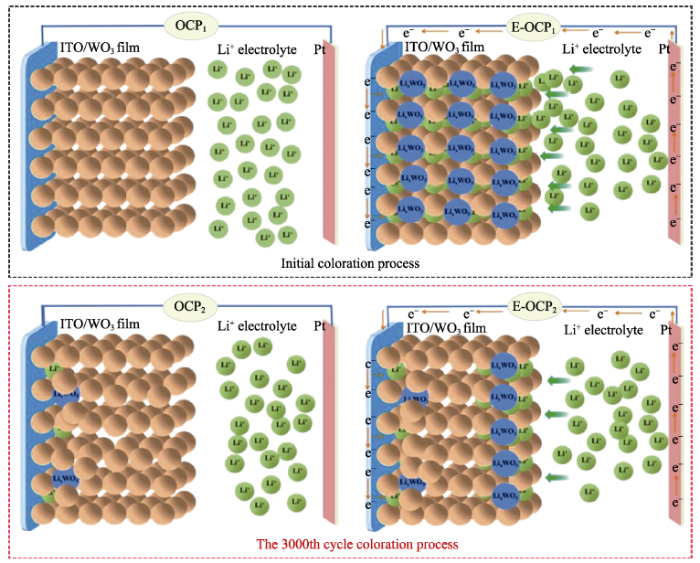
... 目前对WO3 薄膜和器件退化机制的研究很少, 通常认为薄膜和器件性能的下降是由于宿主结构中捕获离子的积累.北京工业大学严辉课题组[11 ] 将WO3 膜的降解过程分为漂白态和着色态的衰退.如图1 所示, 着色过程中插入离子电荷密度的降低是导致着色态退化的主要原因, 捕获离子的积累还会造成两电极间开路电位(OCP)的衰减, 减弱了驱动离子进入薄膜的电场力.该课题组还研究了插入离子数与WO3 薄膜EC性能和退化情况的关系[12 ] , 大量的离子插入虽然在一定程度上提高了薄膜的光调制能力, 但会严重破坏薄膜结构, 已被捕获的离子难以被提取出来, 最终导致WO3 薄膜的快速衰退. ...
Ions transport control in electrochromic WO3 film for the cyclic stability study
1
2020
... 目前对WO3 薄膜和器件退化机制的研究很少, 通常认为薄膜和器件性能的下降是由于宿主结构中捕获离子的积累.北京工业大学严辉课题组[11 ] 将WO3 膜的降解过程分为漂白态和着色态的衰退.如图1 所示, 着色过程中插入离子电荷密度的降低是导致着色态退化的主要原因, 捕获离子的积累还会造成两电极间开路电位(OCP)的衰减, 减弱了驱动离子进入薄膜的电场力.该课题组还研究了插入离子数与WO3 薄膜EC性能和退化情况的关系[12 ] , 大量的离子插入虽然在一定程度上提高了薄膜的光调制能力, 但会严重破坏薄膜结构, 已被捕获的离子难以被提取出来, 最终导致WO3 薄膜的快速衰退. ...
Directly grown high- performance WO3 films by a novel one-step hydrothermal method with significantly improved stability for electrochromic applications
2
2019
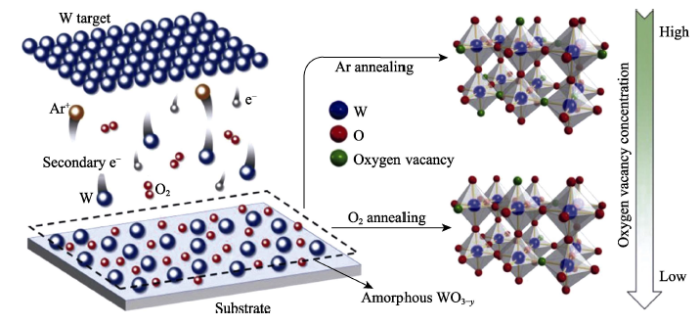
... 常用的WO3 薄膜生产方法有水热法[13 ] 、溶剂热法[14 ] 、溶胶-凝胶法[15 ] 、电化学沉积法[16 ] 、喷墨打印[17 ] 和磁控溅射法[18 ] 等.由于WO3 薄膜的制备方法多样, 每种方法的可调参数较多, 所以在不同工艺下制备的WO3 薄膜质量差异很大.水热法是一种高温高压控制晶体生长的方法, 但需要先在基底上制备晶种层, 电子科技大学贾春阳等[13 ] 研究了一种简单高效制备WO3 薄膜的一步水热法, 使用甘油作为自种剂, 无需预先制备晶种层, 制备出的WO3 薄膜具有15000次的高循环稳定性和78.1%的大光学调制幅度, 着褪色时间较短(5 s/6 s).河南大学蔡国发等[16 ] 采用了一种新颖的脉冲电化学沉积法制备高性能的多孔WO3 薄膜, 这种方法无需模板和热处理, 适用于不同的导电基底, 其中在ITO玻璃上制备的WO3 薄膜具有97.7%超大光学调制幅度和118.3 cm2 /C高着色效率.磁控溅射法是一种常用的物理制备方法, 北京航空航天大学刁训刚课题组[18 ] 采用磁控溅射法研究了WO3 薄膜在Ar和O2 气氛中退火后的性质, 如图2 所示, 发现在Ar气中氧空位浓度高, WO3 薄膜的EC性能更好, 但循环稳定性变差. ...
... [13 ]研究了一种简单高效制备WO3 薄膜的一步水热法, 使用甘油作为自种剂, 无需预先制备晶种层, 制备出的WO3 薄膜具有15000次的高循环稳定性和78.1%的大光学调制幅度, 着褪色时间较短(5 s/6 s).河南大学蔡国发等[16 ] 采用了一种新颖的脉冲电化学沉积法制备高性能的多孔WO3 薄膜, 这种方法无需模板和热处理, 适用于不同的导电基底, 其中在ITO玻璃上制备的WO3 薄膜具有97.7%超大光学调制幅度和118.3 cm2 /C高着色效率.磁控溅射法是一种常用的物理制备方法, 北京航空航天大学刁训刚课题组[18 ] 采用磁控溅射法研究了WO3 薄膜在Ar和O2 气氛中退火后的性质, 如图2 所示, 发现在Ar气中氧空位浓度高, WO3 薄膜的EC性能更好, 但循环稳定性变差. ...
Growth of vertically aligned hierarchical WO3 nano-architecture arrays on transparent conducting substrates with outstanding electrochromic performance
3
2014
... 目前对WO
3 薄膜和器件退化机制的研究很少, 通常认为薄膜和器件性能的下降是由于宿主结构中捕获离子的积累.北京工业大学严辉课题组
[11 ] 将WO
3 膜的降解过程分为漂白态和着色态的衰退.如
图1 所示, 着色过程中插入离子电荷密度的降低是导致着色态退化的主要原因, 捕获离子的积累还会造成两电极间开路电位(OCP)的衰减, 减弱了驱动离子进入薄膜的电场力.该课题组还研究了插入离子数与WO
3 薄膜EC性能和退化情况的关系
[12 ] , 大量的离子插入虽然在一定程度上提高了薄膜的光调制能力, 但会严重破坏薄膜结构, 已被捕获的离子难以被提取出来, 最终导致WO
3 薄膜的快速衰退.
图1 捕获离子对OCP和插入离子电荷密度影响的示意图<sup>[<xref ref-type="bibr" rid="b14">14</xref>]</sup> Schematic diagram of the effect of trapped ions on the OCP and charge density of inserted ions<sup>[<xref ref-type="bibr" rid="b14">14</xref>]</sup> Fig. 1 ![]()
1.3 WO<sub>3</sub>薄膜的性能优化 无机电致变色材料WO3 具有从透明态到深蓝色变化的大透过率调制范围和柔和舒适的颜色转换, 在智能窗的生产和应用中具有不可比拟的优势, 能够调节窗口的透过照明强度以提供舒适的室内环境、美学设计和提高建筑节能效率.然而, WO3 薄膜的致密性和较低的扩散系数使其切换时间非常长, 在需要快速响应的电子设备等领域表现得不尽人意, 提高WO3 的响应速度、着色效率仍是当前研究的重点, 改进制备方法、掺杂元素、设计纳米结构和复合材料是改善WO3 薄膜性能的几种常用手段. ...
... [
14 ]
Fig. 1 ![]()
1.3 WO<sub>3</sub>薄膜的性能优化 无机电致变色材料WO3 具有从透明态到深蓝色变化的大透过率调制范围和柔和舒适的颜色转换, 在智能窗的生产和应用中具有不可比拟的优势, 能够调节窗口的透过照明强度以提供舒适的室内环境、美学设计和提高建筑节能效率.然而, WO3 薄膜的致密性和较低的扩散系数使其切换时间非常长, 在需要快速响应的电子设备等领域表现得不尽人意, 提高WO3 的响应速度、着色效率仍是当前研究的重点, 改进制备方法、掺杂元素、设计纳米结构和复合材料是改善WO3 薄膜性能的几种常用手段. ...
... 常用的WO3 薄膜生产方法有水热法[13 ] 、溶剂热法[14 ] 、溶胶-凝胶法[15 ] 、电化学沉积法[16 ] 、喷墨打印[17 ] 和磁控溅射法[18 ] 等.由于WO3 薄膜的制备方法多样, 每种方法的可调参数较多, 所以在不同工艺下制备的WO3 薄膜质量差异很大.水热法是一种高温高压控制晶体生长的方法, 但需要先在基底上制备晶种层, 电子科技大学贾春阳等[13 ] 研究了一种简单高效制备WO3 薄膜的一步水热法, 使用甘油作为自种剂, 无需预先制备晶种层, 制备出的WO3 薄膜具有15000次的高循环稳定性和78.1%的大光学调制幅度, 着褪色时间较短(5 s/6 s).河南大学蔡国发等[16 ] 采用了一种新颖的脉冲电化学沉积法制备高性能的多孔WO3 薄膜, 这种方法无需模板和热处理, 适用于不同的导电基底, 其中在ITO玻璃上制备的WO3 薄膜具有97.7%超大光学调制幅度和118.3 cm2 /C高着色效率.磁控溅射法是一种常用的物理制备方法, 北京航空航天大学刁训刚课题组[18 ] 采用磁控溅射法研究了WO3 薄膜在Ar和O2 气氛中退火后的性质, 如图2 所示, 发现在Ar气中氧空位浓度高, WO3 薄膜的EC性能更好, 但循环稳定性变差. ...
Inkjet printing of Sol-Gel synthesized hydrated tungsten oxide nanoparticles for flexible electrochromic devices
1
2012
... 常用的WO3 薄膜生产方法有水热法[13 ] 、溶剂热法[14 ] 、溶胶-凝胶法[15 ] 、电化学沉积法[16 ] 、喷墨打印[17 ] 和磁控溅射法[18 ] 等.由于WO3 薄膜的制备方法多样, 每种方法的可调参数较多, 所以在不同工艺下制备的WO3 薄膜质量差异很大.水热法是一种高温高压控制晶体生长的方法, 但需要先在基底上制备晶种层, 电子科技大学贾春阳等[13 ] 研究了一种简单高效制备WO3 薄膜的一步水热法, 使用甘油作为自种剂, 无需预先制备晶种层, 制备出的WO3 薄膜具有15000次的高循环稳定性和78.1%的大光学调制幅度, 着褪色时间较短(5 s/6 s).河南大学蔡国发等[16 ] 采用了一种新颖的脉冲电化学沉积法制备高性能的多孔WO3 薄膜, 这种方法无需模板和热处理, 适用于不同的导电基底, 其中在ITO玻璃上制备的WO3 薄膜具有97.7%超大光学调制幅度和118.3 cm2 /C高着色效率.磁控溅射法是一种常用的物理制备方法, 北京航空航天大学刁训刚课题组[18 ] 采用磁控溅射法研究了WO3 薄膜在Ar和O2 气氛中退火后的性质, 如图2 所示, 发现在Ar气中氧空位浓度高, WO3 薄膜的EC性能更好, 但循环稳定性变差. ...
Ultra-large optical modulation of electrochromic porous WO3 film and the local monitoring of redox activity
2
2016
... 常用的WO3 薄膜生产方法有水热法[13 ] 、溶剂热法[14 ] 、溶胶-凝胶法[15 ] 、电化学沉积法[16 ] 、喷墨打印[17 ] 和磁控溅射法[18 ] 等.由于WO3 薄膜的制备方法多样, 每种方法的可调参数较多, 所以在不同工艺下制备的WO3 薄膜质量差异很大.水热法是一种高温高压控制晶体生长的方法, 但需要先在基底上制备晶种层, 电子科技大学贾春阳等[13 ] 研究了一种简单高效制备WO3 薄膜的一步水热法, 使用甘油作为自种剂, 无需预先制备晶种层, 制备出的WO3 薄膜具有15000次的高循环稳定性和78.1%的大光学调制幅度, 着褪色时间较短(5 s/6 s).河南大学蔡国发等[16 ] 采用了一种新颖的脉冲电化学沉积法制备高性能的多孔WO3 薄膜, 这种方法无需模板和热处理, 适用于不同的导电基底, 其中在ITO玻璃上制备的WO3 薄膜具有97.7%超大光学调制幅度和118.3 cm2 /C高着色效率.磁控溅射法是一种常用的物理制备方法, 北京航空航天大学刁训刚课题组[18 ] 采用磁控溅射法研究了WO3 薄膜在Ar和O2 气氛中退火后的性质, 如图2 所示, 发现在Ar气中氧空位浓度高, WO3 薄膜的EC性能更好, 但循环稳定性变差. ...
... [16 ]采用了一种新颖的脉冲电化学沉积法制备高性能的多孔WO3 薄膜, 这种方法无需模板和热处理, 适用于不同的导电基底, 其中在ITO玻璃上制备的WO3 薄膜具有97.7%超大光学调制幅度和118.3 cm2 /C高着色效率.磁控溅射法是一种常用的物理制备方法, 北京航空航天大学刁训刚课题组[18 ] 采用磁控溅射法研究了WO3 薄膜在Ar和O2 气氛中退火后的性质, 如图2 所示, 发现在Ar气中氧空位浓度高, WO3 薄膜的EC性能更好, 但循环稳定性变差. ...
Inkjet printed large area multifunctional smart windows
1
2017
... 常用的WO3 薄膜生产方法有水热法[13 ] 、溶剂热法[14 ] 、溶胶-凝胶法[15 ] 、电化学沉积法[16 ] 、喷墨打印[17 ] 和磁控溅射法[18 ] 等.由于WO3 薄膜的制备方法多样, 每种方法的可调参数较多, 所以在不同工艺下制备的WO3 薄膜质量差异很大.水热法是一种高温高压控制晶体生长的方法, 但需要先在基底上制备晶种层, 电子科技大学贾春阳等[13 ] 研究了一种简单高效制备WO3 薄膜的一步水热法, 使用甘油作为自种剂, 无需预先制备晶种层, 制备出的WO3 薄膜具有15000次的高循环稳定性和78.1%的大光学调制幅度, 着褪色时间较短(5 s/6 s).河南大学蔡国发等[16 ] 采用了一种新颖的脉冲电化学沉积法制备高性能的多孔WO3 薄膜, 这种方法无需模板和热处理, 适用于不同的导电基底, 其中在ITO玻璃上制备的WO3 薄膜具有97.7%超大光学调制幅度和118.3 cm2 /C高着色效率.磁控溅射法是一种常用的物理制备方法, 北京航空航天大学刁训刚课题组[18 ] 采用磁控溅射法研究了WO3 薄膜在Ar和O2 气氛中退火后的性质, 如图2 所示, 发现在Ar气中氧空位浓度高, WO3 薄膜的EC性能更好, 但循环稳定性变差. ...
Essential role of oxygen vacancy in electrochromic performance and stability for WO3 -y
4
2020
... 常用的WO3 薄膜生产方法有水热法[13 ] 、溶剂热法[14 ] 、溶胶-凝胶法[15 ] 、电化学沉积法[16 ] 、喷墨打印[17 ] 和磁控溅射法[18 ] 等.由于WO3 薄膜的制备方法多样, 每种方法的可调参数较多, 所以在不同工艺下制备的WO3 薄膜质量差异很大.水热法是一种高温高压控制晶体生长的方法, 但需要先在基底上制备晶种层, 电子科技大学贾春阳等[13 ] 研究了一种简单高效制备WO3 薄膜的一步水热法, 使用甘油作为自种剂, 无需预先制备晶种层, 制备出的WO3 薄膜具有15000次的高循环稳定性和78.1%的大光学调制幅度, 着褪色时间较短(5 s/6 s).河南大学蔡国发等[16 ] 采用了一种新颖的脉冲电化学沉积法制备高性能的多孔WO3 薄膜, 这种方法无需模板和热处理, 适用于不同的导电基底, 其中在ITO玻璃上制备的WO3 薄膜具有97.7%超大光学调制幅度和118.3 cm2 /C高着色效率.磁控溅射法是一种常用的物理制备方法, 北京航空航天大学刁训刚课题组[18 ] 采用磁控溅射法研究了WO3 薄膜在Ar和O2 气氛中退火后的性质, 如图2 所示, 发现在Ar气中氧空位浓度高, WO3 薄膜的EC性能更好, 但循环稳定性变差. ...
... [18 ]采用磁控溅射法研究了WO3 薄膜在Ar和O2 气氛中退火后的性质, 如图2 所示, 发现在Ar气中氧空位浓度高, WO3 薄膜的EC性能更好, 但循环稳定性变差. ...
... [
18 ]
Illustration of WO<sub>3</sub> thin films fabrication process, crystal structure and oxygen vacancy change induced by Ar/O<sub>2</sub> atmosphere annealing<sup>[<xref ref-type="bibr" rid="b18">18</xref>]</sup> Fig. 2 ![]()
1.3.2 元素掺杂 ...
... [
18 ]
Fig. 2 ![]()
1.3.2 元素掺杂 ...
Cobalt ions doped tungsten oxide nanowires achieved vertically aligned nanostructure with enhanced electrochromic properties
2
2020
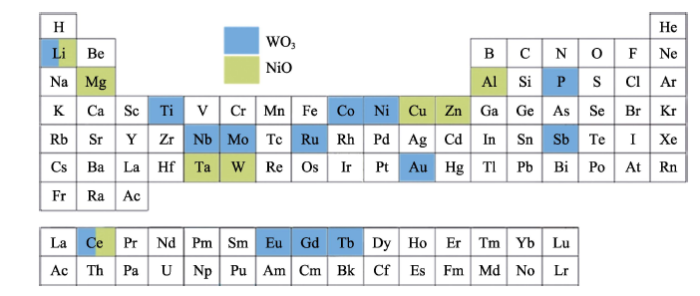
... 图3 展示了2016~2020年已研究的WO3 薄膜掺杂元素在元素周期表中的分布.Co[19 ] 、Ni[20 ] 、Mo[21 ,22 ] 、Nb[23 ] 、Ti[24 ,25 ] 、Ru[26 ] 、Au[27 ] 、Li[28 ] 、Sb[29 ] 等金属元素掺杂和Eu[30 ,31 ] 、Gd[32 ] 、Tb[33 ] 、Ce[34 ] 等稀土元素掺杂能明显增强WO3 薄膜的EC性能, 有些元素甚至还表现出其他的功能.中国科学技术大学徐春叶课题组[19 ] 发现Co离子掺杂的WO3 膜表面形貌变化显著, 表现出更高的透射率调制(680 nm处75.4%)和超过4000次的稳定性.该课题组还通过水热法将Tb离子掺杂到WO3 薄膜中[33 ] , 抑制了WO3 的定向生长, 引入的非晶态和多孔网状结构使WO3 薄膜具有良好的EC性能, 同时WO3 薄膜还具有光致发光的功能, 可以在260 nm紫外光下实现绿色发射.浙江大学涂江平课题组[23 ] 研究了Nb掺杂的WO3 薄膜, 具有超快的响应速度, 着色和漂白时间分别为3.6和2.1 s. ...
... [19 ]发现Co离子掺杂的WO3 膜表面形貌变化显著, 表现出更高的透射率调制(680 nm处75.4%)和超过4000次的稳定性.该课题组还通过水热法将Tb离子掺杂到WO3 薄膜中[33 ] , 抑制了WO3 的定向生长, 引入的非晶态和多孔网状结构使WO3 薄膜具有良好的EC性能, 同时WO3 薄膜还具有光致发光的功能, 可以在260 nm紫外光下实现绿色发射.浙江大学涂江平课题组[23 ] 研究了Nb掺杂的WO3 薄膜, 具有超快的响应速度, 着色和漂白时间分别为3.6和2.1 s. ...
Electrochromic properties of vertically aligned Ni-doped WO3 nanostructure films and their application in complementary electrochromic devices
1
2016
... 图3 展示了2016~2020年已研究的WO3 薄膜掺杂元素在元素周期表中的分布.Co[19 ] 、Ni[20 ] 、Mo[21 ,22 ] 、Nb[23 ] 、Ti[24 ,25 ] 、Ru[26 ] 、Au[27 ] 、Li[28 ] 、Sb[29 ] 等金属元素掺杂和Eu[30 ,31 ] 、Gd[32 ] 、Tb[33 ] 、Ce[34 ] 等稀土元素掺杂能明显增强WO3 薄膜的EC性能, 有些元素甚至还表现出其他的功能.中国科学技术大学徐春叶课题组[19 ] 发现Co离子掺杂的WO3 膜表面形貌变化显著, 表现出更高的透射率调制(680 nm处75.4%)和超过4000次的稳定性.该课题组还通过水热法将Tb离子掺杂到WO3 薄膜中[33 ] , 抑制了WO3 的定向生长, 引入的非晶态和多孔网状结构使WO3 薄膜具有良好的EC性能, 同时WO3 薄膜还具有光致发光的功能, 可以在260 nm紫外光下实现绿色发射.浙江大学涂江平课题组[23 ] 研究了Nb掺杂的WO3 薄膜, 具有超快的响应速度, 着色和漂白时间分别为3.6和2.1 s. ...
Fabrication of Mo-doped WO3 nanorod arrays on FTO substrate with enhanced electrochromic properties
1
2018
... 图3 展示了2016~2020年已研究的WO3 薄膜掺杂元素在元素周期表中的分布.Co[19 ] 、Ni[20 ] 、Mo[21 ,22 ] 、Nb[23 ] 、Ti[24 ,25 ] 、Ru[26 ] 、Au[27 ] 、Li[28 ] 、Sb[29 ] 等金属元素掺杂和Eu[30 ,31 ] 、Gd[32 ] 、Tb[33 ] 、Ce[34 ] 等稀土元素掺杂能明显增强WO3 薄膜的EC性能, 有些元素甚至还表现出其他的功能.中国科学技术大学徐春叶课题组[19 ] 发现Co离子掺杂的WO3 膜表面形貌变化显著, 表现出更高的透射率调制(680 nm处75.4%)和超过4000次的稳定性.该课题组还通过水热法将Tb离子掺杂到WO3 薄膜中[33 ] , 抑制了WO3 的定向生长, 引入的非晶态和多孔网状结构使WO3 薄膜具有良好的EC性能, 同时WO3 薄膜还具有光致发光的功能, 可以在260 nm紫外光下实现绿色发射.浙江大学涂江平课题组[23 ] 研究了Nb掺杂的WO3 薄膜, 具有超快的响应速度, 着色和漂白时间分别为3.6和2.1 s. ...
Electrodeposited Mo-doped WO3 film with large optical modulation and high areal capacitance toward electrochromic energy-storage applications
1
2018
... 图3 展示了2016~2020年已研究的WO3 薄膜掺杂元素在元素周期表中的分布.Co[19 ] 、Ni[20 ] 、Mo[21 ,22 ] 、Nb[23 ] 、Ti[24 ,25 ] 、Ru[26 ] 、Au[27 ] 、Li[28 ] 、Sb[29 ] 等金属元素掺杂和Eu[30 ,31 ] 、Gd[32 ] 、Tb[33 ] 、Ce[34 ] 等稀土元素掺杂能明显增强WO3 薄膜的EC性能, 有些元素甚至还表现出其他的功能.中国科学技术大学徐春叶课题组[19 ] 发现Co离子掺杂的WO3 膜表面形貌变化显著, 表现出更高的透射率调制(680 nm处75.4%)和超过4000次的稳定性.该课题组还通过水热法将Tb离子掺杂到WO3 薄膜中[33 ] , 抑制了WO3 的定向生长, 引入的非晶态和多孔网状结构使WO3 薄膜具有良好的EC性能, 同时WO3 薄膜还具有光致发光的功能, 可以在260 nm紫外光下实现绿色发射.浙江大学涂江平课题组[23 ] 研究了Nb掺杂的WO3 薄膜, 具有超快的响应速度, 着色和漂白时间分别为3.6和2.1 s. ...
Niobium doped tungsten oxide mesoporous film with enhanced electrochromic and electrochemical energy storage properties
2
2019
... 图3 展示了2016~2020年已研究的WO3 薄膜掺杂元素在元素周期表中的分布.Co[19 ] 、Ni[20 ] 、Mo[21 ,22 ] 、Nb[23 ] 、Ti[24 ,25 ] 、Ru[26 ] 、Au[27 ] 、Li[28 ] 、Sb[29 ] 等金属元素掺杂和Eu[30 ,31 ] 、Gd[32 ] 、Tb[33 ] 、Ce[34 ] 等稀土元素掺杂能明显增强WO3 薄膜的EC性能, 有些元素甚至还表现出其他的功能.中国科学技术大学徐春叶课题组[19 ] 发现Co离子掺杂的WO3 膜表面形貌变化显著, 表现出更高的透射率调制(680 nm处75.4%)和超过4000次的稳定性.该课题组还通过水热法将Tb离子掺杂到WO3 薄膜中[33 ] , 抑制了WO3 的定向生长, 引入的非晶态和多孔网状结构使WO3 薄膜具有良好的EC性能, 同时WO3 薄膜还具有光致发光的功能, 可以在260 nm紫外光下实现绿色发射.浙江大学涂江平课题组[23 ] 研究了Nb掺杂的WO3 薄膜, 具有超快的响应速度, 着色和漂白时间分别为3.6和2.1 s. ...
... [23 ]研究了Nb掺杂的WO3 薄膜, 具有超快的响应速度, 着色和漂白时间分别为3.6和2.1 s. ...
Ti-doped WO3 synthesized by a facile wet bath method for improved electrochromism
1
2017
... 图3 展示了2016~2020年已研究的WO3 薄膜掺杂元素在元素周期表中的分布.Co[19 ] 、Ni[20 ] 、Mo[21 ,22 ] 、Nb[23 ] 、Ti[24 ,25 ] 、Ru[26 ] 、Au[27 ] 、Li[28 ] 、Sb[29 ] 等金属元素掺杂和Eu[30 ,31 ] 、Gd[32 ] 、Tb[33 ] 、Ce[34 ] 等稀土元素掺杂能明显增强WO3 薄膜的EC性能, 有些元素甚至还表现出其他的功能.中国科学技术大学徐春叶课题组[19 ] 发现Co离子掺杂的WO3 膜表面形貌变化显著, 表现出更高的透射率调制(680 nm处75.4%)和超过4000次的稳定性.该课题组还通过水热法将Tb离子掺杂到WO3 薄膜中[33 ] , 抑制了WO3 的定向生长, 引入的非晶态和多孔网状结构使WO3 薄膜具有良好的EC性能, 同时WO3 薄膜还具有光致发光的功能, 可以在260 nm紫外光下实现绿色发射.浙江大学涂江平课题组[23 ] 研究了Nb掺杂的WO3 薄膜, 具有超快的响应速度, 着色和漂白时间分别为3.6和2.1 s. ...
Electrodeposition of Ti-doped hierarchically mesoporous silica microspheres/tungsten oxide nanocrystallines hybrid films and their electrochromic performance
1
2019
... 图3 展示了2016~2020年已研究的WO3 薄膜掺杂元素在元素周期表中的分布.Co[19 ] 、Ni[20 ] 、Mo[21 ,22 ] 、Nb[23 ] 、Ti[24 ,25 ] 、Ru[26 ] 、Au[27 ] 、Li[28 ] 、Sb[29 ] 等金属元素掺杂和Eu[30 ,31 ] 、Gd[32 ] 、Tb[33 ] 、Ce[34 ] 等稀土元素掺杂能明显增强WO3 薄膜的EC性能, 有些元素甚至还表现出其他的功能.中国科学技术大学徐春叶课题组[19 ] 发现Co离子掺杂的WO3 膜表面形貌变化显著, 表现出更高的透射率调制(680 nm处75.4%)和超过4000次的稳定性.该课题组还通过水热法将Tb离子掺杂到WO3 薄膜中[33 ] , 抑制了WO3 的定向生长, 引入的非晶态和多孔网状结构使WO3 薄膜具有良好的EC性能, 同时WO3 薄膜还具有光致发光的功能, 可以在260 nm紫外光下实现绿色发射.浙江大学涂江平课题组[23 ] 研究了Nb掺杂的WO3 薄膜, 具有超快的响应速度, 着色和漂白时间分别为3.6和2.1 s. ...
WO3 thin films doped with Ru by facile chemical method with enhanced electrochromic properties for electrochromic window application
1
2020
... 图3 展示了2016~2020年已研究的WO3 薄膜掺杂元素在元素周期表中的分布.Co[19 ] 、Ni[20 ] 、Mo[21 ,22 ] 、Nb[23 ] 、Ti[24 ,25 ] 、Ru[26 ] 、Au[27 ] 、Li[28 ] 、Sb[29 ] 等金属元素掺杂和Eu[30 ,31 ] 、Gd[32 ] 、Tb[33 ] 、Ce[34 ] 等稀土元素掺杂能明显增强WO3 薄膜的EC性能, 有些元素甚至还表现出其他的功能.中国科学技术大学徐春叶课题组[19 ] 发现Co离子掺杂的WO3 膜表面形貌变化显著, 表现出更高的透射率调制(680 nm处75.4%)和超过4000次的稳定性.该课题组还通过水热法将Tb离子掺杂到WO3 薄膜中[33 ] , 抑制了WO3 的定向生长, 引入的非晶态和多孔网状结构使WO3 薄膜具有良好的EC性能, 同时WO3 薄膜还具有光致发光的功能, 可以在260 nm紫外光下实现绿色发射.浙江大学涂江平课题组[23 ] 研究了Nb掺杂的WO3 薄膜, 具有超快的响应速度, 着色和漂白时间分别为3.6和2.1 s. ...
A thorough study on electrochromic properties of metal doped tungsten trioxide film prepared by a facile solution process
1
2018
... 图3 展示了2016~2020年已研究的WO3 薄膜掺杂元素在元素周期表中的分布.Co[19 ] 、Ni[20 ] 、Mo[21 ,22 ] 、Nb[23 ] 、Ti[24 ,25 ] 、Ru[26 ] 、Au[27 ] 、Li[28 ] 、Sb[29 ] 等金属元素掺杂和Eu[30 ,31 ] 、Gd[32 ] 、Tb[33 ] 、Ce[34 ] 等稀土元素掺杂能明显增强WO3 薄膜的EC性能, 有些元素甚至还表现出其他的功能.中国科学技术大学徐春叶课题组[19 ] 发现Co离子掺杂的WO3 膜表面形貌变化显著, 表现出更高的透射率调制(680 nm处75.4%)和超过4000次的稳定性.该课题组还通过水热法将Tb离子掺杂到WO3 薄膜中[33 ] , 抑制了WO3 的定向生长, 引入的非晶态和多孔网状结构使WO3 薄膜具有良好的EC性能, 同时WO3 薄膜还具有光致发光的功能, 可以在260 nm紫外光下实现绿色发射.浙江大学涂江平课题组[23 ] 研究了Nb掺杂的WO3 薄膜, 具有超快的响应速度, 着色和漂白时间分别为3.6和2.1 s. ...
Electrochromic properties of lithium-doped tungsten oxide prepared by electron beam evaporation
1
2019
... 图3 展示了2016~2020年已研究的WO3 薄膜掺杂元素在元素周期表中的分布.Co[19 ] 、Ni[20 ] 、Mo[21 ,22 ] 、Nb[23 ] 、Ti[24 ,25 ] 、Ru[26 ] 、Au[27 ] 、Li[28 ] 、Sb[29 ] 等金属元素掺杂和Eu[30 ,31 ] 、Gd[32 ] 、Tb[33 ] 、Ce[34 ] 等稀土元素掺杂能明显增强WO3 薄膜的EC性能, 有些元素甚至还表现出其他的功能.中国科学技术大学徐春叶课题组[19 ] 发现Co离子掺杂的WO3 膜表面形貌变化显著, 表现出更高的透射率调制(680 nm处75.4%)和超过4000次的稳定性.该课题组还通过水热法将Tb离子掺杂到WO3 薄膜中[33 ] , 抑制了WO3 的定向生长, 引入的非晶态和多孔网状结构使WO3 薄膜具有良好的EC性能, 同时WO3 薄膜还具有光致发光的功能, 可以在260 nm紫外光下实现绿色发射.浙江大学涂江平课题组[23 ] 研究了Nb掺杂的WO3 薄膜, 具有超快的响应速度, 着色和漂白时间分别为3.6和2.1 s. ...
Effects of Sb-doped SnO2 -WO3 nanocomposite on electrochromic performance
1
2019
... 图3 展示了2016~2020年已研究的WO3 薄膜掺杂元素在元素周期表中的分布.Co[19 ] 、Ni[20 ] 、Mo[21 ,22 ] 、Nb[23 ] 、Ti[24 ,25 ] 、Ru[26 ] 、Au[27 ] 、Li[28 ] 、Sb[29 ] 等金属元素掺杂和Eu[30 ,31 ] 、Gd[32 ] 、Tb[33 ] 、Ce[34 ] 等稀土元素掺杂能明显增强WO3 薄膜的EC性能, 有些元素甚至还表现出其他的功能.中国科学技术大学徐春叶课题组[19 ] 发现Co离子掺杂的WO3 膜表面形貌变化显著, 表现出更高的透射率调制(680 nm处75.4%)和超过4000次的稳定性.该课题组还通过水热法将Tb离子掺杂到WO3 薄膜中[33 ] , 抑制了WO3 的定向生长, 引入的非晶态和多孔网状结构使WO3 薄膜具有良好的EC性能, 同时WO3 薄膜还具有光致发光的功能, 可以在260 nm紫外光下实现绿色发射.浙江大学涂江平课题组[23 ] 研究了Nb掺杂的WO3 薄膜, 具有超快的响应速度, 着色和漂白时间分别为3.6和2.1 s. ...
A europium ion doped WO3 film with the bi-functionality of enhanced electrochromic switching and tunable red emission
1
2017
... 图3 展示了2016~2020年已研究的WO3 薄膜掺杂元素在元素周期表中的分布.Co[19 ] 、Ni[20 ] 、Mo[21 ,22 ] 、Nb[23 ] 、Ti[24 ,25 ] 、Ru[26 ] 、Au[27 ] 、Li[28 ] 、Sb[29 ] 等金属元素掺杂和Eu[30 ,31 ] 、Gd[32 ] 、Tb[33 ] 、Ce[34 ] 等稀土元素掺杂能明显增强WO3 薄膜的EC性能, 有些元素甚至还表现出其他的功能.中国科学技术大学徐春叶课题组[19 ] 发现Co离子掺杂的WO3 膜表面形貌变化显著, 表现出更高的透射率调制(680 nm处75.4%)和超过4000次的稳定性.该课题组还通过水热法将Tb离子掺杂到WO3 薄膜中[33 ] , 抑制了WO3 的定向生长, 引入的非晶态和多孔网状结构使WO3 薄膜具有良好的EC性能, 同时WO3 薄膜还具有光致发光的功能, 可以在260 nm紫外光下实现绿色发射.浙江大学涂江平课题组[23 ] 研究了Nb掺杂的WO3 薄膜, 具有超快的响应速度, 着色和漂白时间分别为3.6和2.1 s. ...
Effect of pH on the electrochromic and photoluminescent properties of Eu doped WO3 film
1
2018
... 图3 展示了2016~2020年已研究的WO3 薄膜掺杂元素在元素周期表中的分布.Co[19 ] 、Ni[20 ] 、Mo[21 ,22 ] 、Nb[23 ] 、Ti[24 ,25 ] 、Ru[26 ] 、Au[27 ] 、Li[28 ] 、Sb[29 ] 等金属元素掺杂和Eu[30 ,31 ] 、Gd[32 ] 、Tb[33 ] 、Ce[34 ] 等稀土元素掺杂能明显增强WO3 薄膜的EC性能, 有些元素甚至还表现出其他的功能.中国科学技术大学徐春叶课题组[19 ] 发现Co离子掺杂的WO3 膜表面形貌变化显著, 表现出更高的透射率调制(680 nm处75.4%)和超过4000次的稳定性.该课题组还通过水热法将Tb离子掺杂到WO3 薄膜中[33 ] , 抑制了WO3 的定向生长, 引入的非晶态和多孔网状结构使WO3 薄膜具有良好的EC性能, 同时WO3 薄膜还具有光致发光的功能, 可以在260 nm紫外光下实现绿色发射.浙江大学涂江平课题组[23 ] 研究了Nb掺杂的WO3 薄膜, 具有超快的响应速度, 着色和漂白时间分别为3.6和2.1 s. ...
Effect of Gd-doping on electrochromic properties of sputter deposited WO3 films
1
2018
... 图3 展示了2016~2020年已研究的WO3 薄膜掺杂元素在元素周期表中的分布.Co[19 ] 、Ni[20 ] 、Mo[21 ,22 ] 、Nb[23 ] 、Ti[24 ,25 ] 、Ru[26 ] 、Au[27 ] 、Li[28 ] 、Sb[29 ] 等金属元素掺杂和Eu[30 ,31 ] 、Gd[32 ] 、Tb[33 ] 、Ce[34 ] 等稀土元素掺杂能明显增强WO3 薄膜的EC性能, 有些元素甚至还表现出其他的功能.中国科学技术大学徐春叶课题组[19 ] 发现Co离子掺杂的WO3 膜表面形貌变化显著, 表现出更高的透射率调制(680 nm处75.4%)和超过4000次的稳定性.该课题组还通过水热法将Tb离子掺杂到WO3 薄膜中[33 ] , 抑制了WO3 的定向生长, 引入的非晶态和多孔网状结构使WO3 薄膜具有良好的EC性能, 同时WO3 薄膜还具有光致发光的功能, 可以在260 nm紫外光下实现绿色发射.浙江大学涂江平课题组[23 ] 研究了Nb掺杂的WO3 薄膜, 具有超快的响应速度, 着色和漂白时间分别为3.6和2.1 s. ...
Enhanced electrochromic switches and tunable green fluorescence based on terbium ion doped WO3 films
2
2019
... 图3 展示了2016~2020年已研究的WO3 薄膜掺杂元素在元素周期表中的分布.Co[19 ] 、Ni[20 ] 、Mo[21 ,22 ] 、Nb[23 ] 、Ti[24 ,25 ] 、Ru[26 ] 、Au[27 ] 、Li[28 ] 、Sb[29 ] 等金属元素掺杂和Eu[30 ,31 ] 、Gd[32 ] 、Tb[33 ] 、Ce[34 ] 等稀土元素掺杂能明显增强WO3 薄膜的EC性能, 有些元素甚至还表现出其他的功能.中国科学技术大学徐春叶课题组[19 ] 发现Co离子掺杂的WO3 膜表面形貌变化显著, 表现出更高的透射率调制(680 nm处75.4%)和超过4000次的稳定性.该课题组还通过水热法将Tb离子掺杂到WO3 薄膜中[33 ] , 抑制了WO3 的定向生长, 引入的非晶态和多孔网状结构使WO3 薄膜具有良好的EC性能, 同时WO3 薄膜还具有光致发光的功能, 可以在260 nm紫外光下实现绿色发射.浙江大学涂江平课题组[23 ] 研究了Nb掺杂的WO3 薄膜, 具有超快的响应速度, 着色和漂白时间分别为3.6和2.1 s. ...
... [33 ], 抑制了WO3 的定向生长, 引入的非晶态和多孔网状结构使WO3 薄膜具有良好的EC性能, 同时WO3 薄膜还具有光致发光的功能, 可以在260 nm紫外光下实现绿色发射.浙江大学涂江平课题组[23 ] 研究了Nb掺杂的WO3 薄膜, 具有超快的响应速度, 着色和漂白时间分别为3.6和2.1 s. ...
Ce-doped bundled ultrafine diameter tungsten oxide nanowires with enhanced electrochromic performance
1
2018
... 图3 展示了2016~2020年已研究的WO3 薄膜掺杂元素在元素周期表中的分布.Co[19 ] 、Ni[20 ] 、Mo[21 ,22 ] 、Nb[23 ] 、Ti[24 ,25 ] 、Ru[26 ] 、Au[27 ] 、Li[28 ] 、Sb[29 ] 等金属元素掺杂和Eu[30 ,31 ] 、Gd[32 ] 、Tb[33 ] 、Ce[34 ] 等稀土元素掺杂能明显增强WO3 薄膜的EC性能, 有些元素甚至还表现出其他的功能.中国科学技术大学徐春叶课题组[19 ] 发现Co离子掺杂的WO3 膜表面形貌变化显著, 表现出更高的透射率调制(680 nm处75.4%)和超过4000次的稳定性.该课题组还通过水热法将Tb离子掺杂到WO3 薄膜中[33 ] , 抑制了WO3 的定向生长, 引入的非晶态和多孔网状结构使WO3 薄膜具有良好的EC性能, 同时WO3 薄膜还具有光致发光的功能, 可以在260 nm紫外光下实现绿色发射.浙江大学涂江平课题组[23 ] 研究了Nb掺杂的WO3 薄膜, 具有超快的响应速度, 着色和漂白时间分别为3.6和2.1 s. ...
WO3 quantum-dots electrochromism
1
2020
... 上海大学高彦峰课题组[35 ] 报道了具有97.8%的超大光调制范围和20000次长循环寿命的WO3 量子点薄膜.刁训刚等[36 ] 采用电沉积法制备了具有二维网格结构的WO3 薄膜, 着色和漂白时间极短(1.27和0.93 s), 比平面WO3 薄膜(2.34和2.18 s)快得多, WO3 薄膜结构见图4 .浙江大学韩高荣课题组[37 ] 采用湿化学方法成功地制备了尺寸可调的电致变色WO3 纳米棒, WO3 纳米棒的平均长度和直径可从38 nm×3.2 nm增加到89 nm×4.5 nm, 简单地改变纳米棒的尺寸, 薄膜的响应速度可以提高近5倍. ...
Enhanced electrochromic performance of 2D grid-structured WO3 thin films
3
2018
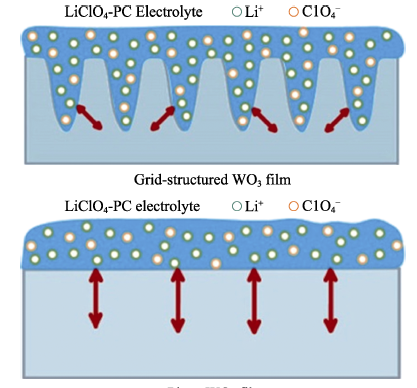
... 上海大学高彦峰课题组[35 ] 报道了具有97.8%的超大光调制范围和20000次长循环寿命的WO3 量子点薄膜.刁训刚等[36 ] 采用电沉积法制备了具有二维网格结构的WO3 薄膜, 着色和漂白时间极短(1.27和0.93 s), 比平面WO3 薄膜(2.34和2.18 s)快得多, WO3 薄膜结构见图4 .浙江大学韩高荣课题组[37 ] 采用湿化学方法成功地制备了尺寸可调的电致变色WO3 纳米棒, WO3 纳米棒的平均长度和直径可从38 nm×3.2 nm增加到89 nm×4.5 nm, 简单地改变纳米棒的尺寸, 薄膜的响应速度可以提高近5倍. ...
... [
36 ]
Electrochromic mechanism diagram of 2D grid-structured and plane WO<sub>3</sub> film<sup>[<xref ref-type="bibr" rid="b36">36</xref>]</sup> Fig. 4 ![]()
1.3.4 复合材料 ...
... [
36 ]
Fig. 4 ![]()
1.3.4 复合材料 ...
Improved electrochromic performance of WO3 films with size controlled nanorods
1
2018
... 上海大学高彦峰课题组[35 ] 报道了具有97.8%的超大光调制范围和20000次长循环寿命的WO3 量子点薄膜.刁训刚等[36 ] 采用电沉积法制备了具有二维网格结构的WO3 薄膜, 着色和漂白时间极短(1.27和0.93 s), 比平面WO3 薄膜(2.34和2.18 s)快得多, WO3 薄膜结构见图4 .浙江大学韩高荣课题组[37 ] 采用湿化学方法成功地制备了尺寸可调的电致变色WO3 纳米棒, WO3 纳米棒的平均长度和直径可从38 nm×3.2 nm增加到89 nm×4.5 nm, 简单地改变纳米棒的尺寸, 薄膜的响应速度可以提高近5倍. ...
Bifunctional urchin-like WO3 @PANI electrodes for superior electrochromic behavior and lithium-ion battery
1
2018
... 由于材料的固有特性, 单一的电致变色材料往往无法兼顾高的电致变色性能和长期稳定性, 利用复合材料的协同作用可以使材料获得更加丰富的功能, 如将有机和无机材料结合可以同时获得丰富的颜色变化、快速的切换时间和良好的循环稳定性.哈尔滨工业大学李垚等[38 ] 采用溶剂热法和电聚合法制备了WO3 @PANI海胆状结构的复合材料, 表现出紫色、绿色、黄色、灰色、蓝色等多种颜色变化, 长期循环性能优异.青岛科技大学聂广明课题组[39 ] 制备的聚(5-甲酰基吲哚)/WO3 蜂窝孔状纳米复合材料能在深绿色、黄色和黄绿色之间可逆切换, 着色效率高达137 cm2 /C. ...
A novel solid-state electrochromic supercapacitor with high energy storage capacity and cycle stability based on poly(5-formylindole)/WO3 honeycombed porous nanocomposites
1
2020
... 由于材料的固有特性, 单一的电致变色材料往往无法兼顾高的电致变色性能和长期稳定性, 利用复合材料的协同作用可以使材料获得更加丰富的功能, 如将有机和无机材料结合可以同时获得丰富的颜色变化、快速的切换时间和良好的循环稳定性.哈尔滨工业大学李垚等[38 ] 采用溶剂热法和电聚合法制备了WO3 @PANI海胆状结构的复合材料, 表现出紫色、绿色、黄色、灰色、蓝色等多种颜色变化, 长期循环性能优异.青岛科技大学聂广明课题组[39 ] 制备的聚(5-甲酰基吲哚)/WO3 蜂窝孔状纳米复合材料能在深绿色、黄色和黄绿色之间可逆切换, 着色效率高达137 cm2 /C. ...
Zur kenntnis der nickelhydroxidelektrode—I. über das nickel (II)-hydroxidhydrat
1
1966
... NiO晶体是NaCl型面心立方结构, 在实际制备时NiO薄膜通常为非化学计量比的P型半导体, 存在Ni2+ 空位.NiO在碱性溶液和在含Li+ 电解液等不同类型电解质中的电致变色机制完全不同.在碱性溶液如KOH中的变化可参考Bode模型[40 ] , NiO的变色过程是从透明的Ni(OH)2 转化到有色的NiOOH, 光谱吸收与Ni2+ 和Ni3+ 之间的电荷转移有关.Passerini等[41 ] 初步提出了NiO薄膜在LiClO4 -PC中的变色机制, 首先NiO通过不可逆反应变成透明的Liy x + 离子和电子的共同嵌入脱出使Liy x ( y - z ) NiOx
Electrochromism of thin-film nickel-oxide electrodes
1
1992
... NiO晶体是NaCl型面心立方结构, 在实际制备时NiO薄膜通常为非化学计量比的P型半导体, 存在Ni2+ 空位.NiO在碱性溶液和在含Li+ 电解液等不同类型电解质中的电致变色机制完全不同.在碱性溶液如KOH中的变化可参考Bode模型[40 ] , NiO的变色过程是从透明的Ni(OH)2 转化到有色的NiOOH, 光谱吸收与Ni2+ 和Ni3+ 之间的电荷转移有关.Passerini等[41 ] 初步提出了NiO薄膜在LiClO4 -PC中的变色机制, 首先NiO通过不可逆反应变成透明的Liy x + 离子和电子的共同嵌入脱出使Liy x ( y - z ) NiOx
Electrochromic degradation in nickel oxide thin film: a self-discharge and dissolution phenomenon
1
2005
... WO3 和NiO组成的互补型电致变色器件的循环寿命在很大程度上受到NiO薄膜衰退的限制.对于NiO在碱性电解质中的衰退机制, Bouessaya等[42 ] 认为是Ni(OH)2 发生自放电导致薄膜被部分降解.NiO在含Li+ 的非水电解质中的衰退与WO3 相似, Li+ 被“深陷阱”捕获导致不可逆脱出, 增加了离子扩散阻力, 从而使NiO薄膜性能下降.刁训刚等[43 ] 利用聚焦离子束切割器结合二次离子质谱实验研究了NiO薄膜在无机全固态器件中的退化情况, 发现不可逆捕获的Li+ 在NiO薄膜中累积, NiO薄膜结构从疏松变得致密. ...
Life-cycling and uncovering cation-trapping evidence of a monolithic inorganic electrochromic device: glass/ITO/WO3 /LiTaO3 /NiO/ITO
1
2018
... WO3 和NiO组成的互补型电致变色器件的循环寿命在很大程度上受到NiO薄膜衰退的限制.对于NiO在碱性电解质中的衰退机制, Bouessaya等[42 ] 认为是Ni(OH)2 发生自放电导致薄膜被部分降解.NiO在含Li+ 的非水电解质中的衰退与WO3 相似, Li+ 被“深陷阱”捕获导致不可逆脱出, 增加了离子扩散阻力, 从而使NiO薄膜性能下降.刁训刚等[43 ] 利用聚焦离子束切割器结合二次离子质谱实验研究了NiO薄膜在无机全固态器件中的退化情况, 发现不可逆捕获的Li+ 在NiO薄膜中累积, NiO薄膜结构从疏松变得致密. ...
Synthesis and water oxidation electrocatalytic and electrochromic behaviours of mesoporous nickel oxide thin film electrodes
1
2019
... 同WO3 的制备方法类似, NiO的制备主要有旋涂[44 ] 、水热[45 ,46 ] 、溶胶-凝胶[47 ] 、电沉积[48 ] 和溅射[49 ] 等方法.严辉等[50 ] 采用溶胶-凝胶法制备了NiO薄膜, 并研究了退火温度对NiO薄膜的影响, 经350 ℃退火的NiO薄膜具有50.7%的透过率调制范围和71.4 cm2 /C的着色效率.李垚等[51 ] 通过连续改变磁控溅射时的基底温度, 制备了一种晶体结构从有序到无序连续变化的NiO薄膜, 如图5 所示, 这种NiO薄膜很好地兼顾了优异的EC性能和良好的循环稳定性. ...
A high-performance electrochromic device assembled with hexagonal WO3 and NiO/PB composite nanosheet electrodes towards energy storage smart window
1
2020
... 同WO3 的制备方法类似, NiO的制备主要有旋涂[44 ] 、水热[45 ,46 ] 、溶胶-凝胶[47 ] 、电沉积[48 ] 和溅射[49 ] 等方法.严辉等[50 ] 采用溶胶-凝胶法制备了NiO薄膜, 并研究了退火温度对NiO薄膜的影响, 经350 ℃退火的NiO薄膜具有50.7%的透过率调制范围和71.4 cm2 /C的着色效率.李垚等[51 ] 通过连续改变磁控溅射时的基底温度, 制备了一种晶体结构从有序到无序连续变化的NiO薄膜, 如图5 所示, 这种NiO薄膜很好地兼顾了优异的EC性能和良好的循环稳定性. ...
Preparation and properties of NiO/PB hybrid electrochromic film
1
2017
... 同WO3 的制备方法类似, NiO的制备主要有旋涂[44 ] 、水热[45 ,46 ] 、溶胶-凝胶[47 ] 、电沉积[48 ] 和溅射[49 ] 等方法.严辉等[50 ] 采用溶胶-凝胶法制备了NiO薄膜, 并研究了退火温度对NiO薄膜的影响, 经350 ℃退火的NiO薄膜具有50.7%的透过率调制范围和71.4 cm2 /C的着色效率.李垚等[51 ] 通过连续改变磁控溅射时的基底温度, 制备了一种晶体结构从有序到无序连续变化的NiO薄膜, 如图5 所示, 这种NiO薄膜很好地兼顾了优异的EC性能和良好的循环稳定性. ...
UV treatment for enhanced electrochromic properties of spin coated NiO thin films
1
2019
... 同WO3 的制备方法类似, NiO的制备主要有旋涂[44 ] 、水热[45 ,46 ] 、溶胶-凝胶[47 ] 、电沉积[48 ] 和溅射[49 ] 等方法.严辉等[50 ] 采用溶胶-凝胶法制备了NiO薄膜, 并研究了退火温度对NiO薄膜的影响, 经350 ℃退火的NiO薄膜具有50.7%的透过率调制范围和71.4 cm2 /C的着色效率.李垚等[51 ] 通过连续改变磁控溅射时的基底温度, 制备了一种晶体结构从有序到无序连续变化的NiO薄膜, 如图5 所示, 这种NiO薄膜很好地兼顾了优异的EC性能和良好的循环稳定性. ...
Optimization of low value electrodeposition parameters of nano-structured NiO electrochromic thin films
1
2019
... 同WO3 的制备方法类似, NiO的制备主要有旋涂[44 ] 、水热[45 ,46 ] 、溶胶-凝胶[47 ] 、电沉积[48 ] 和溅射[49 ] 等方法.严辉等[50 ] 采用溶胶-凝胶法制备了NiO薄膜, 并研究了退火温度对NiO薄膜的影响, 经350 ℃退火的NiO薄膜具有50.7%的透过率调制范围和71.4 cm2 /C的着色效率.李垚等[51 ] 通过连续改变磁控溅射时的基底温度, 制备了一种晶体结构从有序到无序连续变化的NiO薄膜, 如图5 所示, 这种NiO薄膜很好地兼顾了优异的EC性能和良好的循环稳定性. ...
The effect of the oxygen ratio control of DC reactive magnetron sputtering on as-deposited non stoichiometric NiO thin films
1
2017
... 同WO3 的制备方法类似, NiO的制备主要有旋涂[44 ] 、水热[45 ,46 ] 、溶胶-凝胶[47 ] 、电沉积[48 ] 和溅射[49 ] 等方法.严辉等[50 ] 采用溶胶-凝胶法制备了NiO薄膜, 并研究了退火温度对NiO薄膜的影响, 经350 ℃退火的NiO薄膜具有50.7%的透过率调制范围和71.4 cm2 /C的着色效率.李垚等[51 ] 通过连续改变磁控溅射时的基底温度, 制备了一种晶体结构从有序到无序连续变化的NiO薄膜, 如图5 所示, 这种NiO薄膜很好地兼顾了优异的EC性能和良好的循环稳定性. ...
The influence of crystallinity on the electrochromic properties and durability of NiO thin films
1
2017
... 同WO3 的制备方法类似, NiO的制备主要有旋涂[44 ] 、水热[45 ,46 ] 、溶胶-凝胶[47 ] 、电沉积[48 ] 和溅射[49 ] 等方法.严辉等[50 ] 采用溶胶-凝胶法制备了NiO薄膜, 并研究了退火温度对NiO薄膜的影响, 经350 ℃退火的NiO薄膜具有50.7%的透过率调制范围和71.4 cm2 /C的着色效率.李垚等[51 ] 通过连续改变磁控溅射时的基底温度, 制备了一种晶体结构从有序到无序连续变化的NiO薄膜, 如图5 所示, 这种NiO薄膜很好地兼顾了优异的EC性能和良好的循环稳定性. ...
Controllable crystallinity of nickel oxide film with enhanced electrochromic properties
3
2018
... 同WO3 的制备方法类似, NiO的制备主要有旋涂[44 ] 、水热[45 ,46 ] 、溶胶-凝胶[47 ] 、电沉积[48 ] 和溅射[49 ] 等方法.严辉等[50 ] 采用溶胶-凝胶法制备了NiO薄膜, 并研究了退火温度对NiO薄膜的影响, 经350 ℃退火的NiO薄膜具有50.7%的透过率调制范围和71.4 cm2 /C的着色效率.李垚等[51 ] 通过连续改变磁控溅射时的基底温度, 制备了一种晶体结构从有序到无序连续变化的NiO薄膜, 如图5 所示, 这种NiO薄膜很好地兼顾了优异的EC性能和良好的循环稳定性. ...
... [
51 ]
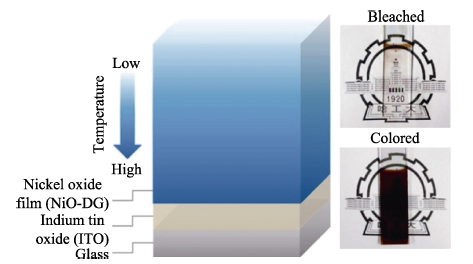
Schematic of the crystallinity gradient in NiO film and photos of NiO film in colored and bleached state<sup>[<xref ref-type="bibr" rid="b51">51</xref>]</sup> Fig. 5 ![]()
2.3.2 元素掺杂 ...
... [
51 ]
Fig. 5 ![]()
2.3.2 元素掺杂 ...
Efficiency enhancement of electrochromic performance in NiO thin film
2
2019
... 近期对氧化镍薄膜元素掺杂的研究集中在金属元素掺杂, 如Cu[52 ] 、Li[53 ] 、W[54 ] 和Li-Mg[55 ] 、Li-Ta[56 ] 双元素共掺杂等, 见图3 .Firat等[52 ] 研究了Cu掺杂NiO薄膜的形貌和EC性能, Cu掺杂的NiO薄膜具有极短的颜色响应时间, 着色为1.77 s, 褪色为2.26 s.Lee等[54 ] 采用直流反应磁控溅射法, 以钨镍合金为靶材制备了W掺杂的NiO薄膜, W掺杂能使纯NiO膜在电化学循环过程中由深陷阱位点引起的退化降至最低.刁训刚等[55 ] 使用射频磁控溅射法在NiO薄膜中共掺杂了Mg和Li, 通过预锂化扩大了NiO的间隙, 改善了短波长下NiO薄膜的EC性能. ...
... [52 ]研究了Cu掺杂NiO薄膜的形貌和EC性能, Cu掺杂的NiO薄膜具有极短的颜色响应时间, 着色为1.77 s, 褪色为2.26 s.Lee等[54 ] 采用直流反应磁控溅射法, 以钨镍合金为靶材制备了W掺杂的NiO薄膜, W掺杂能使纯NiO膜在电化学循环过程中由深陷阱位点引起的退化降至最低.刁训刚等[55 ] 使用射频磁控溅射法在NiO薄膜中共掺杂了Mg和Li, 通过预锂化扩大了NiO的间隙, 改善了短波长下NiO薄膜的EC性能. ...
Lattice and electronic structure variations in critical lithium doped nickel oxide thin film for superior anode electrochromism
1
2019
... 近期对氧化镍薄膜元素掺杂的研究集中在金属元素掺杂, 如Cu[52 ] 、Li[53 ] 、W[54 ] 和Li-Mg[55 ] 、Li-Ta[56 ] 双元素共掺杂等, 见图3 .Firat等[52 ] 研究了Cu掺杂NiO薄膜的形貌和EC性能, Cu掺杂的NiO薄膜具有极短的颜色响应时间, 着色为1.77 s, 褪色为2.26 s.Lee等[54 ] 采用直流反应磁控溅射法, 以钨镍合金为靶材制备了W掺杂的NiO薄膜, W掺杂能使纯NiO膜在电化学循环过程中由深陷阱位点引起的退化降至最低.刁训刚等[55 ] 使用射频磁控溅射法在NiO薄膜中共掺杂了Mg和Li, 通过预锂化扩大了NiO的间隙, 改善了短波长下NiO薄膜的EC性能. ...
Investigation of all-solid-state electrochromic devices with durability enhanced tungsten-doped nickel oxide as a counter electrode
2
2020
... 近期对氧化镍薄膜元素掺杂的研究集中在金属元素掺杂, 如Cu[52 ] 、Li[53 ] 、W[54 ] 和Li-Mg[55 ] 、Li-Ta[56 ] 双元素共掺杂等, 见图3 .Firat等[52 ] 研究了Cu掺杂NiO薄膜的形貌和EC性能, Cu掺杂的NiO薄膜具有极短的颜色响应时间, 着色为1.77 s, 褪色为2.26 s.Lee等[54 ] 采用直流反应磁控溅射法, 以钨镍合金为靶材制备了W掺杂的NiO薄膜, W掺杂能使纯NiO膜在电化学循环过程中由深陷阱位点引起的退化降至最低.刁训刚等[55 ] 使用射频磁控溅射法在NiO薄膜中共掺杂了Mg和Li, 通过预锂化扩大了NiO的间隙, 改善了短波长下NiO薄膜的EC性能. ...
... [54 ]采用直流反应磁控溅射法, 以钨镍合金为靶材制备了W掺杂的NiO薄膜, W掺杂能使纯NiO膜在电化学循环过程中由深陷阱位点引起的退化降至最低.刁训刚等[55 ] 使用射频磁控溅射法在NiO薄膜中共掺杂了Mg和Li, 通过预锂化扩大了NiO的间隙, 改善了短波长下NiO薄膜的EC性能. ...
Enhanced electrochromism in short wavelengths for NiO:(Li, Mg) films in full inorganic device ITO/NiO:(Li, Mg)/Ta2 O5 /WO3 /ITO
2
2018
... 近期对氧化镍薄膜元素掺杂的研究集中在金属元素掺杂, 如Cu[52 ] 、Li[53 ] 、W[54 ] 和Li-Mg[55 ] 、Li-Ta[56 ] 双元素共掺杂等, 见图3 .Firat等[52 ] 研究了Cu掺杂NiO薄膜的形貌和EC性能, Cu掺杂的NiO薄膜具有极短的颜色响应时间, 着色为1.77 s, 褪色为2.26 s.Lee等[54 ] 采用直流反应磁控溅射法, 以钨镍合金为靶材制备了W掺杂的NiO薄膜, W掺杂能使纯NiO膜在电化学循环过程中由深陷阱位点引起的退化降至最低.刁训刚等[55 ] 使用射频磁控溅射法在NiO薄膜中共掺杂了Mg和Li, 通过预锂化扩大了NiO的间隙, 改善了短波长下NiO薄膜的EC性能. ...
... [55 ]使用射频磁控溅射法在NiO薄膜中共掺杂了Mg和Li, 通过预锂化扩大了NiO的间隙, 改善了短波长下NiO薄膜的EC性能. ...
Improved electrochromic performance of NiO-based thin films by lithium and tantalum co-doping
1
2018
... 近期对氧化镍薄膜元素掺杂的研究集中在金属元素掺杂, 如Cu[52 ] 、Li[53 ] 、W[54 ] 和Li-Mg[55 ] 、Li-Ta[56 ] 双元素共掺杂等, 见图3 .Firat等[52 ] 研究了Cu掺杂NiO薄膜的形貌和EC性能, Cu掺杂的NiO薄膜具有极短的颜色响应时间, 着色为1.77 s, 褪色为2.26 s.Lee等[54 ] 采用直流反应磁控溅射法, 以钨镍合金为靶材制备了W掺杂的NiO薄膜, W掺杂能使纯NiO膜在电化学循环过程中由深陷阱位点引起的退化降至最低.刁训刚等[55 ] 使用射频磁控溅射法在NiO薄膜中共掺杂了Mg和Li, 通过预锂化扩大了NiO的间隙, 改善了短波长下NiO薄膜的EC性能. ...
Room-temperature fabrication of NiO films for electrochromic application by electrophoretic deposition (EPD): from single layers to devices
1
2019
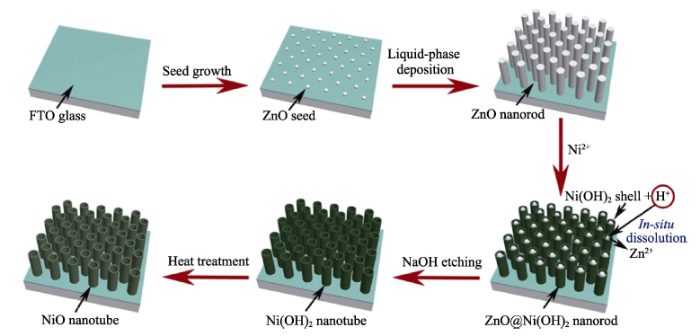
... 设计纳米结构的NiO可以缩短离子的扩散距离, 提高NiO薄膜的响应速度, 多孔纳米结构还能为离子传输提供通道, 有效提高NiO薄膜的循环稳定性.Wu等[57 ] 使用电泳沉积法制备了晶粒尺寸在10.36 nm左右的NiO纳米晶薄膜, 在550 nm处具有较大的光调制幅度(54.1%), 切换速度较快(t c =7.3 s, t b =3.9 s).如图6 所示, 李垚等[58 ] 报道了一种简便ZnO模板辅助水解法制备的NiO纳米管阵列膜, 具有极大的透过率调制(78.5%)和快速的开关响应时间(t c =3.92 s, t b =3.43 s).Ren等[59 ] 采用光敏溶胶-凝胶法制备了多孔阵列的NiO图案膜, 与致密的NiO膜相比, 多孔NiO图案膜具有更好的电致变色性能和更长的使用寿命(3000次). ...
Facile preparation of aligned NiO nanotube arrays for electrochromic application
3
2018
... 设计纳米结构的NiO可以缩短离子的扩散距离, 提高NiO薄膜的响应速度, 多孔纳米结构还能为离子传输提供通道, 有效提高NiO薄膜的循环稳定性.Wu等[57 ] 使用电泳沉积法制备了晶粒尺寸在10.36 nm左右的NiO纳米晶薄膜, 在550 nm处具有较大的光调制幅度(54.1%), 切换速度较快(t c =7.3 s, t b =3.9 s).如图6 所示, 李垚等[58 ] 报道了一种简便ZnO模板辅助水解法制备的NiO纳米管阵列膜, 具有极大的透过率调制(78.5%)和快速的开关响应时间(t c =3.92 s, t b =3.43 s).Ren等[59 ] 采用光敏溶胶-凝胶法制备了多孔阵列的NiO图案膜, 与致密的NiO膜相比, 多孔NiO图案膜具有更好的电致变色性能和更长的使用寿命(3000次). ...
... [
58 ]
Facile preparation of aligned NiO nanotube arrays<sup>[<xref ref-type="bibr" rid="b58">58</xref>]</sup> Fig. 6 ![]()
2.3.4 复合材料 ...
... [
58 ]
Fig. 6 ![]()
2.3.4 复合材料 ...
Preparation of a porous NiO array-patterned film and its enhanced electrochromic performance
1
2018
... 设计纳米结构的NiO可以缩短离子的扩散距离, 提高NiO薄膜的响应速度, 多孔纳米结构还能为离子传输提供通道, 有效提高NiO薄膜的循环稳定性.Wu等[57 ] 使用电泳沉积法制备了晶粒尺寸在10.36 nm左右的NiO纳米晶薄膜, 在550 nm处具有较大的光调制幅度(54.1%), 切换速度较快(t c =7.3 s, t b =3.9 s).如图6 所示, 李垚等[58 ] 报道了一种简便ZnO模板辅助水解法制备的NiO纳米管阵列膜, 具有极大的透过率调制(78.5%)和快速的开关响应时间(t c =3.92 s, t b =3.43 s).Ren等[59 ] 采用光敏溶胶-凝胶法制备了多孔阵列的NiO图案膜, 与致密的NiO膜相比, 多孔NiO图案膜具有更好的电致变色性能和更长的使用寿命(3000次). ...
Trifunctional NiO-Ag-NiO electrodes for ITO-free electrochromic supercapacitors
1
2017
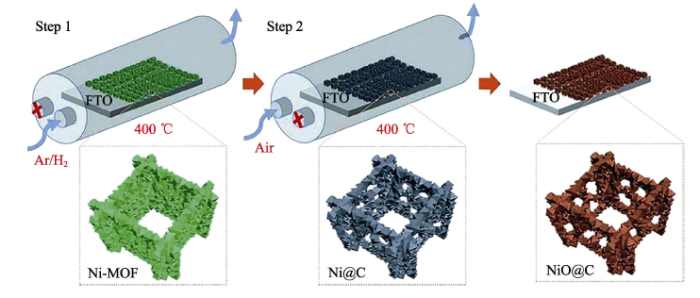
... NiO薄膜的低导电性导致了开关速度慢、着色效率低的问题, 利用复合材料的协同作用可以改善NiO薄膜的电致变色性能.中国科学院长春光学精密机械与物理研究所刘星元团队[60 ] 采用简单的一步电子束沉积法, 在室温条件下成功地制备了透明、导电、无需ITO的NiO/Ag/NiO膜, 该薄膜在可见光区平均透过率超过70%.东华大学王宏志课题组[61 ] 通过金属有机骨架(MOF)的两步热解法制备了分级多孔NiO@C薄膜, 制备流程见图7 , 调节C的含量可改善薄膜的电化学和EC性能, 最佳C含量的多孔NiO@C薄膜具有极快的切换速度(t c = 0.46 s, t b =0.25 s)、超高的着色效率(113.5 cm2 /C)和显著的循环稳定性20000次). ...
Regulation of carbon content in MOF-derived hierarchical-porous NiO@C films for high- performance electrochromism
3
2019
... NiO薄膜的低导电性导致了开关速度慢、着色效率低的问题, 利用复合材料的协同作用可以改善NiO薄膜的电致变色性能.中国科学院长春光学精密机械与物理研究所刘星元团队[60 ] 采用简单的一步电子束沉积法, 在室温条件下成功地制备了透明、导电、无需ITO的NiO/Ag/NiO膜, 该薄膜在可见光区平均透过率超过70%.东华大学王宏志课题组[61 ] 通过金属有机骨架(MOF)的两步热解法制备了分级多孔NiO@C薄膜, 制备流程见图7 , 调节C的含量可改善薄膜的电化学和EC性能, 最佳C含量的多孔NiO@C薄膜具有极快的切换速度(t c = 0.46 s, t b =0.25 s)、超高的着色效率(113.5 cm2 /C)和显著的循环稳定性20000次). ...
... [
61 ]
Preparation procedures of the hierarchical-porous NiO@C film<sup>[<xref ref-type="bibr" rid="b61">61</xref>]</sup> Fig. 7 ![]()
3 基于WO<sub>3</sub>和NiO的电致变色器件 传统的电致变色器件为五层结构, WO3 和NiO通常作为电致变色层和离子存储层, 二者中间是离子传导层, 两侧是用于传输电子的透明导电层.电致变色器件的整体性能不仅与各层薄膜的性质有关, 还取决于层与层之间的协同作用和器件结构的设计. ...
... [
61 ]
Fig. 7 ![]()
3 基于WO<sub>3</sub>和NiO的电致变色器件 传统的电致变色器件为五层结构, WO3 和NiO通常作为电致变色层和离子存储层, 二者中间是离子传导层, 两侧是用于传输电子的透明导电层.电致变色器件的整体性能不仅与各层薄膜的性质有关, 还取决于层与层之间的协同作用和器件结构的设计. ...
Optimized properties of innovative ElectroChromic Device using ITO/Ag/ITO electrodes
1
2019
... ITO的研究和应用最多, ITO不仅具有较低的电阻率和高可见光透过率, 还具有与基底结合牢固、抗擦伤的优点.然而单层的ITO存在电导率与透过率难以平衡的问题, 因此一种新的“电介质/金属/电介质”三层结构透明导电膜得到了人们的关注.刁训刚等[62 ] 采用磁控溅射法在玻璃基底上制备了具有低电阻和高透明性的堆叠ITO/Ag/ITO(IAI)电极.IAI(50 nm/5 nm/30 nm)薄膜的薄层电阻低至7.4 Ω, 在NiOx 3 电致变色薄膜和完整的Glass/IAI/ NiOx 4 -PC-PMMA/WO3 /IAI/Glass器件中均表现出优异的性能.为了解决ITO导电薄膜中In元素稀少、有毒造成的高成本和污染性的问题, 该课题组还研究了AZO薄膜的性能[63 ] , 其品质因数高达12.14×10⁻³ Ω-1 , 平均透射率为92.2%, 但AZO的电学性能还有待提高. ...
Influence of thickness on the structure, electrical, optical and electrochromic properties of AZO thin films and their inorganic all-solid-state devices
1
2017
... ITO的研究和应用最多, ITO不仅具有较低的电阻率和高可见光透过率, 还具有与基底结合牢固、抗擦伤的优点.然而单层的ITO存在电导率与透过率难以平衡的问题, 因此一种新的“电介质/金属/电介质”三层结构透明导电膜得到了人们的关注.刁训刚等[62 ] 采用磁控溅射法在玻璃基底上制备了具有低电阻和高透明性的堆叠ITO/Ag/ITO(IAI)电极.IAI(50 nm/5 nm/30 nm)薄膜的薄层电阻低至7.4 Ω, 在NiOx 3 电致变色薄膜和完整的Glass/IAI/ NiOx 4 -PC-PMMA/WO3 /IAI/Glass器件中均表现出优异的性能.为了解决ITO导电薄膜中In元素稀少、有毒造成的高成本和污染性的问题, 该课题组还研究了AZO薄膜的性能[63 ] , 其品质因数高达12.14×10⁻³ Ω-1 , 平均透射率为92.2%, 但AZO的电学性能还有待提高. ...
An all-thin-film inorganic electrochromic device monolithically fabricated on flexible PET/ITO substrate by magnetron sputtering
1
2015
... 另外, 具有高机械稳定性的柔性透明导电膜的研究也备受关注.刁训刚等[64 ] 采用磁控溅射法在柔性透明PET基底上沉积ITO薄膜, 并继续逐层沉积NiOx 3 /WO3 /ITO制成了柔性无机电致变色器件, 具有较高着色效率(68.5 cm2 /C).由于ITO本身的刚性限制, 在柔性基底上制备的ITO薄膜效果不佳, 许多新的柔性透明导电材料如金属纳米线、金属网格[65 ] 、石墨烯、碳纳米管和PEDOT:PSS[66 ,67 ] 等导电聚合物已经得到广泛研究, 并有希望成为ITO的替代品. ...
Flexible transparent conducting electrodes based on metal meshes for organic optoelectronic device applications: a review
1
2019
... 另外, 具有高机械稳定性的柔性透明导电膜的研究也备受关注.刁训刚等[64 ] 采用磁控溅射法在柔性透明PET基底上沉积ITO薄膜, 并继续逐层沉积NiOx 3 /WO3 /ITO制成了柔性无机电致变色器件, 具有较高着色效率(68.5 cm2 /C).由于ITO本身的刚性限制, 在柔性基底上制备的ITO薄膜效果不佳, 许多新的柔性透明导电材料如金属纳米线、金属网格[65 ] 、石墨烯、碳纳米管和PEDOT:PSS[66 ,67 ] 等导电聚合物已经得到广泛研究, 并有希望成为ITO的替代品. ...
Direct inkjet-patterning of energy efficient flexible electrochromics
1
2018
... 另外, 具有高机械稳定性的柔性透明导电膜的研究也备受关注.刁训刚等[64 ] 采用磁控溅射法在柔性透明PET基底上沉积ITO薄膜, 并继续逐层沉积NiOx 3 /WO3 /ITO制成了柔性无机电致变色器件, 具有较高着色效率(68.5 cm2 /C).由于ITO本身的刚性限制, 在柔性基底上制备的ITO薄膜效果不佳, 许多新的柔性透明导电材料如金属纳米线、金属网格[65 ] 、石墨烯、碳纳米管和PEDOT:PSS[66 ,67 ] 等导电聚合物已经得到广泛研究, 并有希望成为ITO的替代品. ...
Highly stable transparent conductive silver grid/PEDOT:PSS electrodes for integrated bifunctional flexible electrochromic supercapacitors
1
2016
... 另外, 具有高机械稳定性的柔性透明导电膜的研究也备受关注.刁训刚等[64 ] 采用磁控溅射法在柔性透明PET基底上沉积ITO薄膜, 并继续逐层沉积NiOx 3 /WO3 /ITO制成了柔性无机电致变色器件, 具有较高着色效率(68.5 cm2 /C).由于ITO本身的刚性限制, 在柔性基底上制备的ITO薄膜效果不佳, 许多新的柔性透明导电材料如金属纳米线、金属网格[65 ] 、石墨烯、碳纳米管和PEDOT:PSS[66 ,67 ] 等导电聚合物已经得到广泛研究, 并有希望成为ITO的替代品. ...
Electrochemical investigation of electrochromic devices based on NiO and WO3 films using different lithium salts electrolytes
1
2017
... 液态电解质的离子迁移率最高, 能为电致变色器件提供快速的可逆反应, 北京航空材料研究院颜悦团队[68 ] 分别研究了LiClO4 、LiPF6 、LiTFSI三种含有不同锂盐的液体电解质对NiO、WO3 薄膜和Glass/ITO/WO3 /Li+ /NiO/ITO/Glass结构电致变色器件的影响, 不同电致变色膜在同一电解液中的电压和阻抗具有明显差异.液态电解质虽然具有优异的离子电导率, 但其腐蚀性和流动性往往造成封装上的困难和漏液风险, 构建多孔结构的离子传导层或引入吸附毡均是比较有效的解决策略. ...
An aramid nanofibers-based gel polymer electrolyte with high mechanical and heat endurance for all-solid-state NIR electrochromic devices
1
2019
... 凝胶电解质由于透明度高、导电性好和机械稳定性优异的特点而备受青睐, 可用于柔性器件中, 如PMMA-LiClO4 等.苏州纳米所赵志刚等[69 ] 研制了一种新型的独立芳纶纳米纤维凝胶聚合物电解质, 具有良好的耐热性和成膜能力, 利于WO3 和NiO电致变色器件的组装.Wootthikanokkhan等[70 ] 将明胶、乙烯-丙烯酸共聚物离聚物树脂(EAA)与甘油、LiClO4 、甲醛等混合制成凝胶电解质, 实现了很高的离子电导率(4.46 μS/cm). ...
Effects of ethylene-acrylic acid ionomer on thermomechanical and electrochromic properties of electrochromic devices using gelatin-based electrolytes
1
2020
... 凝胶电解质由于透明度高、导电性好和机械稳定性优异的特点而备受青睐, 可用于柔性器件中, 如PMMA-LiClO4 等.苏州纳米所赵志刚等[69 ] 研制了一种新型的独立芳纶纳米纤维凝胶聚合物电解质, 具有良好的耐热性和成膜能力, 利于WO3 和NiO电致变色器件的组装.Wootthikanokkhan等[70 ] 将明胶、乙烯-丙烯酸共聚物离聚物树脂(EAA)与甘油、LiClO4 、甲醛等混合制成凝胶电解质, 实现了很高的离子电导率(4.46 μS/cm). ...
Thickness dependent surface roughness of sputtered Li2.5 TaOx
2
2018
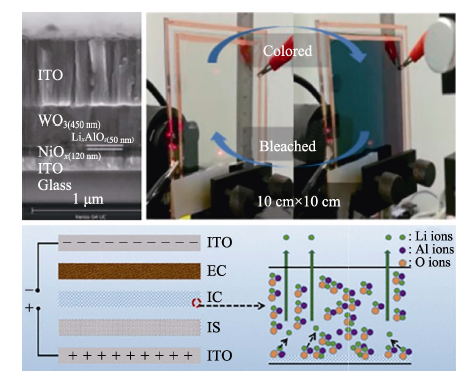
... 固态电解质具有良好的稳定性和耐候性, 便于封装和大规模制备, 在全固态电致变色器件中具有极其重要的地位, 如Ta2 O5 [71 ] 、ZrO2 [72 ] 、LiF[73 ] 、LiPON[74 ] 等.锂基固态电解质的研究较为成熟, 李垚课题组[73 ] 采用电阻蒸发法制备了LiF无机固态电解质, 在无机全固态glass/ITO/WO3 /LiF/NiO/ITO器件中表现出良好的性能.中国科学院上海硅酸盐研究所包山虎团队[75 ] 通过锂铝靶共溅射制备出的Lix z x x z 3 /ITO), 如图8 所示.固态电解质在应用和制备上具有独特的便捷性, 但是离子电导率低的问题仍是当前固态电解质的研究重点. ...
... 刁训刚等[71 ] 采用磁控溅射法在单层的ITO玻璃上连续溅射沉积制备了单片式电致变色器件(Glass/ ITO/WO3 /Li2.5 TaOx 2.5 TaOx 3 / LiClO4 -PC-PMMA/NiOx [77 ] , 具有超过50000次的超高循环耐久性. ...
Enhanced transmittance modulation of ITO/NiOx 2 :H/WO3 /ITO electrochromic devices
1
2016
... 固态电解质具有良好的稳定性和耐候性, 便于封装和大规模制备, 在全固态电致变色器件中具有极其重要的地位, 如Ta2 O5 [71 ] 、ZrO2 [72 ] 、LiF[73 ] 、LiPON[74 ] 等.锂基固态电解质的研究较为成熟, 李垚课题组[73 ] 采用电阻蒸发法制备了LiF无机固态电解质, 在无机全固态glass/ITO/WO3 /LiF/NiO/ITO器件中表现出良好的性能.中国科学院上海硅酸盐研究所包山虎团队[75 ] 通过锂铝靶共溅射制备出的Lix z x x z 3 /ITO), 如图8 所示.固态电解质在应用和制备上具有独特的便捷性, 但是离子电导率低的问题仍是当前固态电解质的研究重点. ...
All solid state electrochromic devices based on the LiF electrolyte
2
2020
... 固态电解质具有良好的稳定性和耐候性, 便于封装和大规模制备, 在全固态电致变色器件中具有极其重要的地位, 如Ta2 O5 [71 ] 、ZrO2 [72 ] 、LiF[73 ] 、LiPON[74 ] 等.锂基固态电解质的研究较为成熟, 李垚课题组[73 ] 采用电阻蒸发法制备了LiF无机固态电解质, 在无机全固态glass/ITO/WO3 /LiF/NiO/ITO器件中表现出良好的性能.中国科学院上海硅酸盐研究所包山虎团队[75 ] 通过锂铝靶共溅射制备出的Lix z x x z 3 /ITO), 如图8 所示.固态电解质在应用和制备上具有独特的便捷性, 但是离子电导率低的问题仍是当前固态电解质的研究重点. ...
... [73 ]采用电阻蒸发法制备了LiF无机固态电解质, 在无机全固态glass/ITO/WO3 /LiF/NiO/ITO器件中表现出良好的性能.中国科学院上海硅酸盐研究所包山虎团队[75 ] 通过锂铝靶共溅射制备出的Lix z x x z 3 /ITO), 如图8 所示.固态电解质在应用和制备上具有独特的便捷性, 但是离子电导率低的问题仍是当前固态电解质的研究重点. ...
The role of interface between LiPON solid electrolyte and electrode in inorganic monolithic electrochromic devices
1
2018
... 固态电解质具有良好的稳定性和耐候性, 便于封装和大规模制备, 在全固态电致变色器件中具有极其重要的地位, 如Ta2 O5 [71 ] 、ZrO2 [72 ] 、LiF[73 ] 、LiPON[74 ] 等.锂基固态电解质的研究较为成熟, 李垚课题组[73 ] 采用电阻蒸发法制备了LiF无机固态电解质, 在无机全固态glass/ITO/WO3 /LiF/NiO/ITO器件中表现出良好的性能.中国科学院上海硅酸盐研究所包山虎团队[75 ] 通过锂铝靶共溅射制备出的Lix z x x z 3 /ITO), 如图8 所示.固态电解质在应用和制备上具有独特的便捷性, 但是离子电导率低的问题仍是当前固态电解质的研究重点. ...
High performance and excellent stability of all-solid-state electrochromic devices based on a Li1.85 AlOz
3
2019
... 固态电解质具有良好的稳定性和耐候性, 便于封装和大规模制备, 在全固态电致变色器件中具有极其重要的地位, 如Ta2 O5 [71 ] 、ZrO2 [72 ] 、LiF[73 ] 、LiPON[74 ] 等.锂基固态电解质的研究较为成熟, 李垚课题组[73 ] 采用电阻蒸发法制备了LiF无机固态电解质, 在无机全固态glass/ITO/WO3 /LiF/NiO/ITO器件中表现出良好的性能.中国科学院上海硅酸盐研究所包山虎团队[75 ] 通过锂铝靶共溅射制备出的Lix z x x z 3 /ITO), 如图8 所示.固态电解质在应用和制备上具有独特的便捷性, 但是离子电导率低的问题仍是当前固态电解质的研究重点. ...
... [
75 ]
Schematic diagram of large-scale all-solid-state device structure and photograph<sup>[<xref ref-type="bibr" rid="b75">75</xref>]</sup> Fig. 8 ![]()
3.3 器件结构设计 WO3 和NiO薄膜组成的电致变色器件通常具有标准的“三明治”结构, 离子传导层中的阳离子在电场的作用下会从NiO薄膜中脱出并嵌入到WO3 薄膜中, 使WO3 和NiO电致变色膜同时着色, 反之二者同时褪色.表1 总结了近五年来由WO3 和NiO组成的电致变色器件的结构与响应时间(t c 、t b )、着色效率(CE)和光调制范围(ΔT )等性能对比. ...
... [
75 ]
Fig. 8 ![]()
3.3 器件结构设计 WO3 和NiO薄膜组成的电致变色器件通常具有标准的“三明治”结构, 离子传导层中的阳离子在电场的作用下会从NiO薄膜中脱出并嵌入到WO3 薄膜中, 使WO3 和NiO电致变色膜同时着色, 反之二者同时褪色.表1 总结了近五年来由WO3 和NiO组成的电致变色器件的结构与响应时间(t c 、t b )、着色效率(CE)和光调制范围(ΔT )等性能对比. ...
Electrochromic properties and performance of NiOx
2016
Electrolytes-relevant cyclic durability of nickel oxide thin films as an ion-storage layer in an all-solid-state complementary electrochromic device
1
2016
... 刁训刚等[71 ] 采用磁控溅射法在单层的ITO玻璃上连续溅射沉积制备了单片式电致变色器件(Glass/ ITO/WO3 /Li2.5 TaOx 2.5 TaOx 3 / LiClO4 -PC-PMMA/NiOx [77 ] , 具有超过50000次的超高循环耐久性. ...
Preparation and Properties of All-solid-state Inorganic Thin Film Glass/ITO/WO3 /LiNbO3 /NiOx
2016
Improved performance of co-sputtered Ni-Ti oxide films for all-solid-state electrochromic devices
2016
Polyvinyl butyral-based gel polymer electrolyte films for solid-state laminated electrochromic devices
2017
Optical, electrical, and electrochemical properties of indium tin oxide thin films studied in different layer-structures and their corresponding inorganic all-thin-film solid-state electrochromic devices
2017
Electrochemical studies of silicon nitride electron blocking layer for all-solid-state inorganic electrochromic device
2017
Annealing effects of NiO thin films for all-solid-state electrochromic devices
2017
Electro-optical performance of inorganic monolithic electrochromic device with a pulsed DC sputtered Lix y
2018
A novel hybrid quasi-solid polymer electrolyte based on porous PVB and modified PEG for electrochromic application
2018
Properties of all-thin-film glass/ITO/WO3 :H/Ta2 O5 /NiOx
2018
High performance all-solid-state electrochromic device based on Lix y
2019
Charge-transfer kinetics and cyclic properties of inorganic all-solid-state electrochromic device with remarkably improved optical memory
2
2018
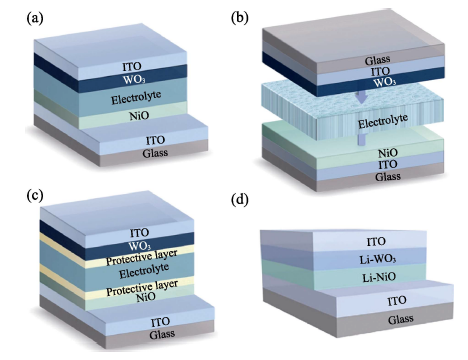
... 电解质层阻挡电子的能力较差, 容易造成器件漏电流和差的光学记忆效应, 因此人们在五层结构ECD的基础上提出了七层结构器件, 如图9 (c)所示.在电解质层两侧增加保护层如ZrO2 [98 ] 、Ta2 O5 [88 ] 等, 可以使器件获得更高的着色效率、更好的光记忆效果和更长的循环寿命, 但响应速度和透光率会因此受到一定影响.刁训刚等[88 ] 制备了七层结构ECD(ITO/NiOx 2 O5 /LiNbO3 /Ta2 O5 /WO3 /ITO), 相比于无Ta2 O5 保护的五层结构器件来说具有低漏电流、98 cm2 /C的高着色效率和10000次循环寿命. ...
... [88 ]制备了七层结构ECD(ITO/NiOx 2 O5 /LiNbO3 /Ta2 O5 /WO3 /ITO), 相比于无Ta2 O5 保护的五层结构器件来说具有低漏电流、98 cm2 /C的高着色效率和10000次循环寿命. ...
Fabrication of an all solid-state electrochromic device using zirconium dioxide as an ion-conducting layer
2018
The effects of lithiation process on the performance of all-solid-state electrochromic devices
2018
An all-solid-state electrochromic device based on WO3 -Nb2 O5 composite films prepared by fast-alternating bipolar-pulsed reactive magnetron sputtering
2019
Fast-switching quasi-solid state electrochromic full device based on mesoporous WO3 and NiO thin films
2019
High-temperature adaptive and robust ultra-thin inorganic all-solid-state smart electrochromic energy storage devices
2019
Reactively sputtered WO3 thin films for the application in all thin film electrochromic devices
2019
Preparation and performance of fast-response ITO/Li-NiO/Li-WO3 /ITO all-solid-state electrochromic devices by evaporation method
2
2020
... (a) Monolithic ECD; (b) Laminated ECD; (c) Seven-layered ECD; (d) Four-layered ECD[95 ] ...
... 锂化是一种常见的提升薄膜电致变色性能的手段, 将Li+ 引入到电致变色薄膜中替代电解质是一种新的器件结构设计思路, 李垚等[95 ] 提出了一种四层结构ITO/Li-NiO/Li-WO3 /ITO全固态电致变色器件, 将Li+ 直接蒸发在WO3 和NiO薄膜上, 取代了传统结构中的离子传导层, 如图9 (d)所示, Li+ 直接在WO3 和NiO层之间转移使得器件的总电阻变低, 响应速度变快, 但这种结构对器件光调制幅度和稳定性的影响还有待进一步的研究.总之, 每种器件结构都有其独特的优势, 并由各组成成分的综合性能决定, 在实际生产设计时应针对不同的应用场景和使用需求选择合适的组分和器件结构. ...
Electrochromic properties of ITO/WO3 /LiClO4 - PC-PMMA-ACN/NiO/ITO framework
2020
Enhanced electrochromic performance on anodic nickel oxide inorganic device via lithium and aluminum co-doping
2020
Improved performance of all-thin-film electrochromic devices with two ZrO2 protective layers
1
2018
... 电解质层阻挡电子的能力较差, 容易造成器件漏电流和差的光学记忆效应, 因此人们在五层结构ECD的基础上提出了七层结构器件, 如图9 (c)所示.在电解质层两侧增加保护层如ZrO2 [98 ] 、Ta2 O5 [88 ] 等, 可以使器件获得更高的着色效率、更好的光记忆效果和更长的循环寿命, 但响应速度和透光率会因此受到一定影响.刁训刚等[88 ] 制备了七层结构ECD(ITO/NiOx 2 O5 /LiNbO3 /Ta2 O5 /WO3 /ITO), 相比于无Ta2 O5 保护的五层结构器件来说具有低漏电流、98 cm2 /C的高着色效率和10000次循环寿命. ...