无机材料学报 ›› 2026, Vol. 41 ›› Issue (7): 965-973.DOI: 10.15541/jim20250496 CSTR: 32189.14.10.15541/jim20250496
沈雪松1( ), 谢凯峰2,3, 薛强3, 郑国柱3, 肖国萍2, 陈婷3(), 陈文淼1(), 王绍荣3
收稿日期:2025-12-14
修回日期:2026-02-26
出版日期:2026-07-20
网络出版日期:2026-04-03
通讯作者:
陈 婷, 副教授. E-mail: chenting@cumt.edu.cn;作者简介:沈雪松(1990-), 男, 博士. E-mail: shenxuesong@nctifc.com
基金资助:
SHEN Xuesong1(), XIE Kaifeng2,3, XUE Qiang3, ZHENG Guozhu3, XIAO Guoping2, CHEN Ting3(), CHEN Wenmiao1(), WANG Shaorong3
Received:2025-12-14
Revised:2026-02-26
Published:2026-07-20
Online:2026-04-03
Contact:
CHEN Ting, associate professor. E-mail: chenting@cumt.edu.cn;About author:SHEN Xuesong (1990-), male, PhD. E-mail: shenxuesong@nctifc.com
Supported by:摘要:
为实现可逆固体氧化物电池(RSOCs)在中低温下的高效运行, 开发高性能空气电极至关重要。本研究针对传统La0.6Sr0.4Co0.2Fe0.8O3-δ-Gd0.2Ce0.8O3-δ (LSCF-GDC)空气电极在中低温下氧还原反应(ORR)和氧析出反应(OER)活性不足的问题, 采用简单经济的浸渍法, 在LSCF-GDC空气电极骨架上构建纳米催化剂。通过系统优化空气电极烧结温度、催化剂种类及负载量, 确定Pr0.5Sr0.5CoO3-δ (PSC)为最优的改性催化剂。改性后对称电池在600 ℃下的极化阻抗(Rp)为0.16 Ω·cm2, 较空白LSCF-GDC空气电极降低了71.4% (0.56 Ω·cm2)。这是因为PSC纳米颗粒协同优化了氧扩散、表面交换与离子传导过程, 显著提升了ORR/OER动力学。在单电池测试中, 700 ℃、燃料电池(FC)模式下的峰值功率密度为1.23 W·cm-2, 较空白LSCF-GDC电池性能提升92.19%; FC与电解池(EC)模式下稳定性均显著增强。PSC表面修饰是全面提升LSCF-GDC空气电极综合性能的有效策略, 对推进中低温RSOCs技术发展具有重要意义。
中图分类号:
沈雪松, 谢凯峰, 薛强, 郑国柱, 肖国萍, 陈婷, 陈文淼, 王绍荣. 表面修饰LSCF-GDC多相复合空气电极的高效构筑与性能优化[J]. 无机材料学报, 2026, 41(7): 965-973.
SHEN Xuesong, XIE Kaifeng, XUE Qiang, ZHENG Guozhu, XIAO Guoping, CHEN Ting, CHEN Wenmiao, WANG Shaorong. High-efficiency Construction and Performance Optimization of Surface-modified LSCF-GDC Multiphase Composite Air Electrodes[J]. Journal of Inorganic Materials, 2026, 41(7): 965-973.
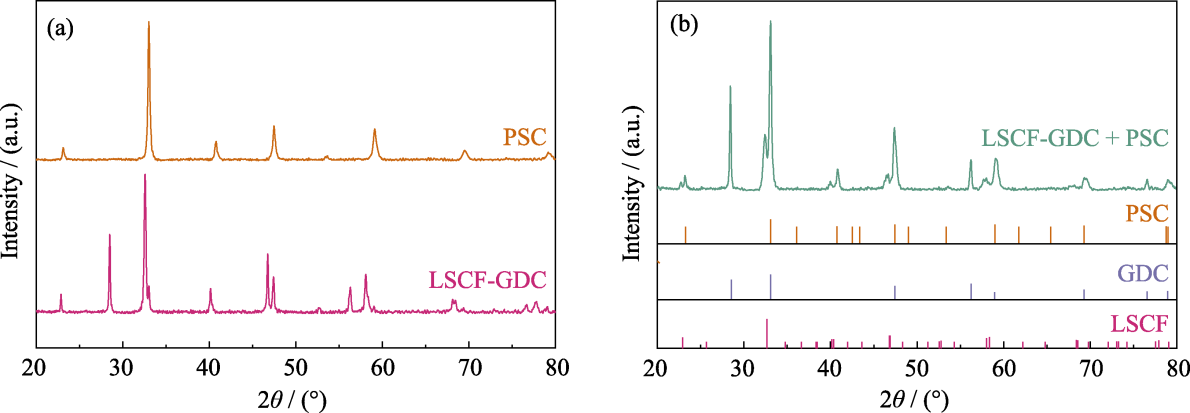
图1 (a) PSC、LSCF-GDC、(b) LSCF-GDC+PSC粉末混合煅烧后的XRD图谱
Fig. 1 XRD patterns of (a) PSC, LSCF-GDC, and (b) mixed LSCF-GDC+PSC powders after calcination
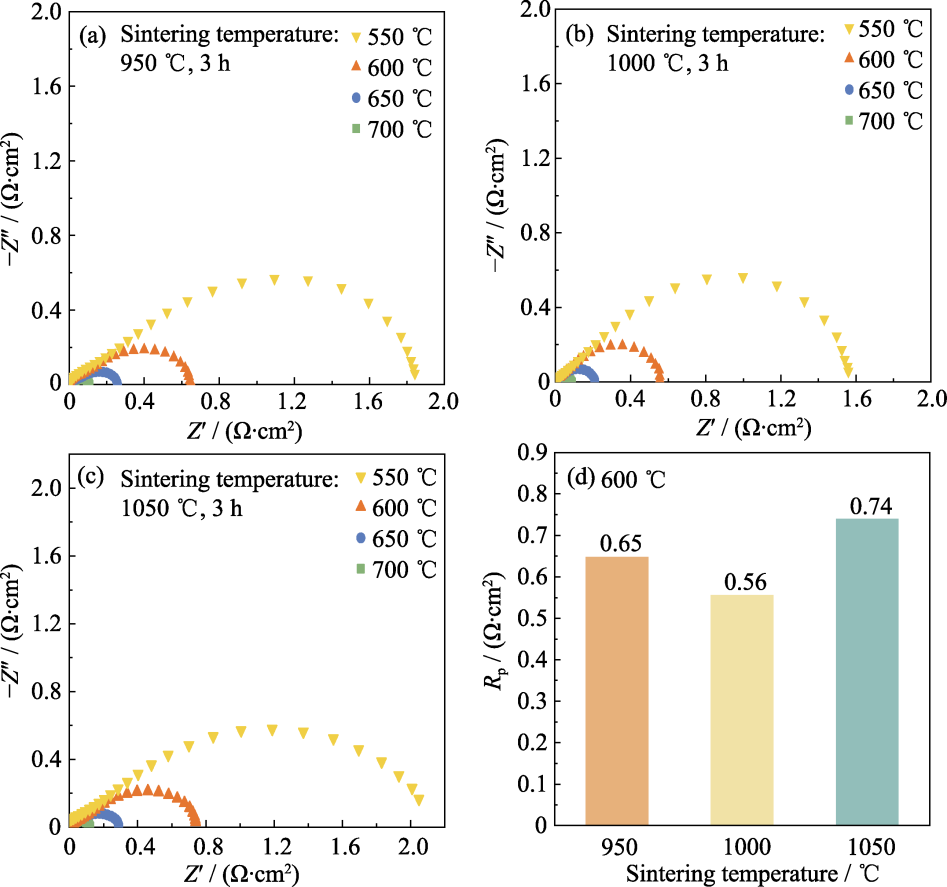
图2 (a) 950、(b) 1000、(c) 1050 ℃烧结的LSCF-GDC空气电极的对称电池在550~700 ℃的EIS谱图; (d)不同温度烧结的LSCF-GDC空气电极在600 ℃时的Rp
Fig. 2 EIS spectra of symmetrical cells at 550-700 ℃ with LSCF-GDC air electrode sintered at (a) 950, (b) 1000, and (c) 1050 ℃; (d) Rp at 600 ℃ for LSCF-GDC air electrode sintered at different temperatures
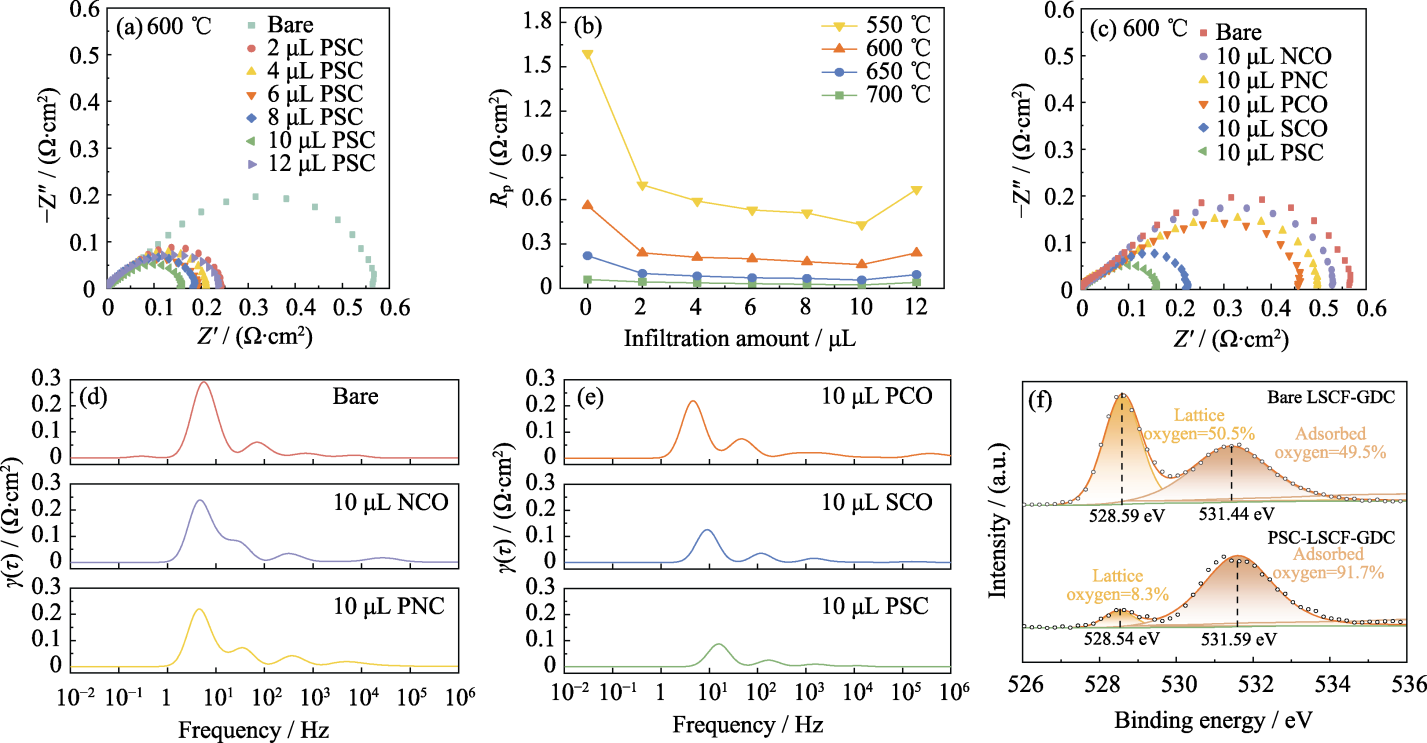
图3 (a) 600 ℃、空气气氛下不同PSC浸渍量的LSCF-GDC空气电极的EIS谱图; (b) 不同温度和不同浸渍量下LSCF-GDC空气电极的Rp变化曲线; (c) 600 ℃、空气气氛下经10 µL不同浸渍液修饰的LSCF-GDC空气电极的EIS谱图; (d, e) 基于EIS谱图的DRT分析; (f) PSC-LSCF-GDC和空白LSCF-GDC空气电极的O1s XPS谱图
Fig. 3 (a) EIS spectra of LSCF-GDC air electrodes with different PSC infiltration amounts in an air environment at 600 ℃; (b) Rp of LSCF-GDC air electrodes measured at different temperatures and infiltration amounts; (c) EIS spectra of LSCF-GDC air electrodes modified with 10 µL of different infiltration solutions in an air environment at 600 ℃; (d, e) DRT analysis based on EIS spectra; (f) O1s XPS spectra of PSC-LSCF-GDC and bare LSCF-GDC air electrodes
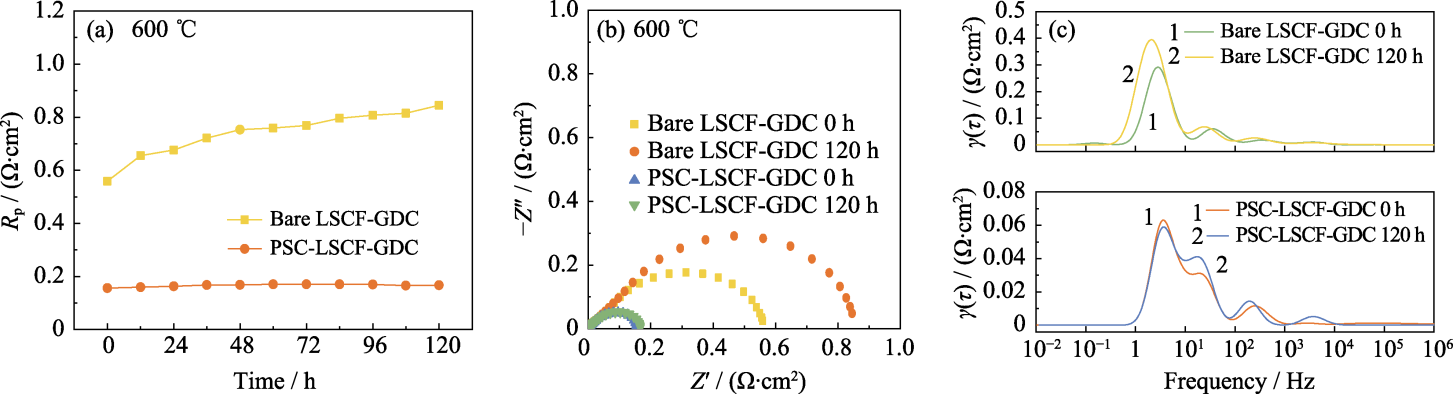
图4 (a) 600 ℃、空气气氛下PSC-LSCF-GDC与空白LSCF-GDC对称电池的Rp随时间的变化曲线; (b, c) PSC-LSCF-GDC与空白LSCF-GDC对称电池在0和120 h的(b) EIS谱图和(c) DRT曲线
Fig. 4 (a) Rp varied with time of symmetric cells with PSC-LSCF-GDC and bare LSCF-GDC air electrodes measured at 600 ℃ in air environment; (b) EIS spectra and (c) DRT curves of symmetric cells with PSC-LSCF-GDC and bare LSCF-GDC air electrodes at 0 and 120 h
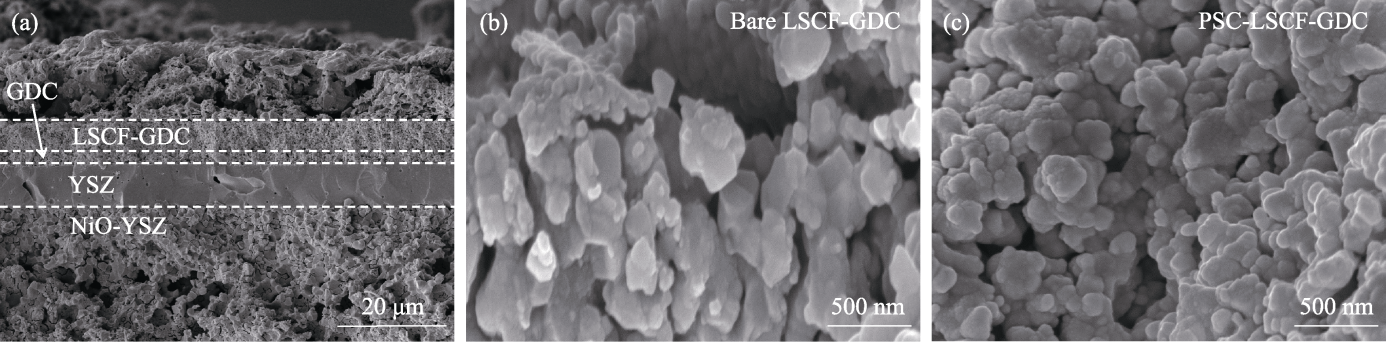
图5 (a) 构型为NiO-SSZ/SSZ/GDC/LSCF-GDC的单电池横截面SEM照片; (b)空白LSCF-GDC与 (c) PSC-LSCF-GDC电极的SEM照片
Fig. 5 (a) Cross-sectional SEM image of a single cell with the configuration NiO-SSZ/SSZ/GDC/LSCF-GDC; (b, c) SEM images of (b) bare LSCF-GDC and (c) PSC-LSCF-GDC air electrodes
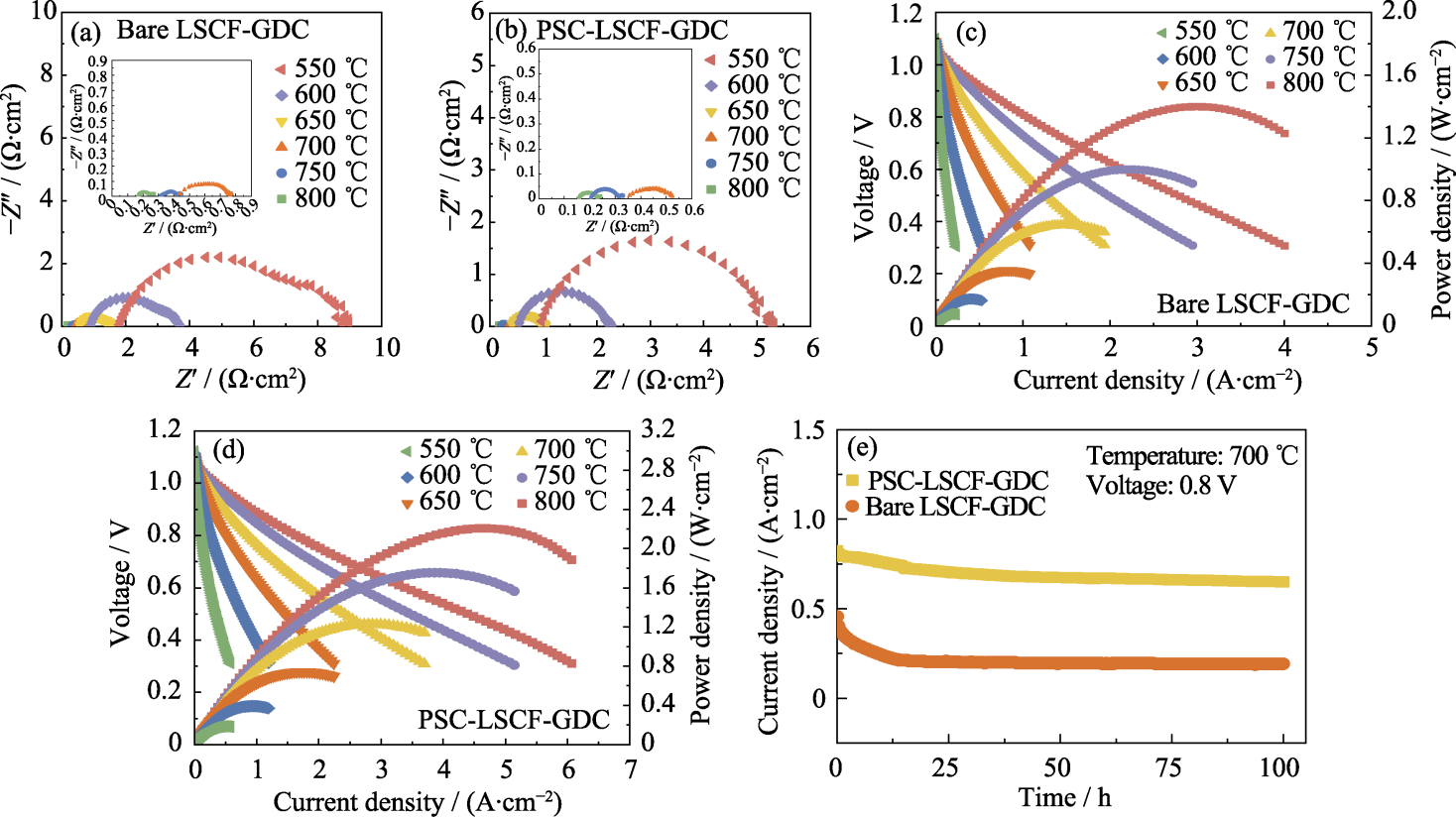
图6 (a~d)在550~800 ℃下, (a, c)空白LSCF-GDC和(b, d) PSC-LSCF-GDC单电池在FC模式下的(a, b) EIS谱图和(c, d) I-V-P曲线; (e)单电池在700 ℃的稳定性测试
Fig. 6 (a, b) EIS spectra and (c, d) I-V-P curves of (a, c) bare LSCF-GDC and (b, d) PSC- LSCF-GDC single cells in FC mode at 550-800 ℃; (e) Stability test of single cells at 700 ℃
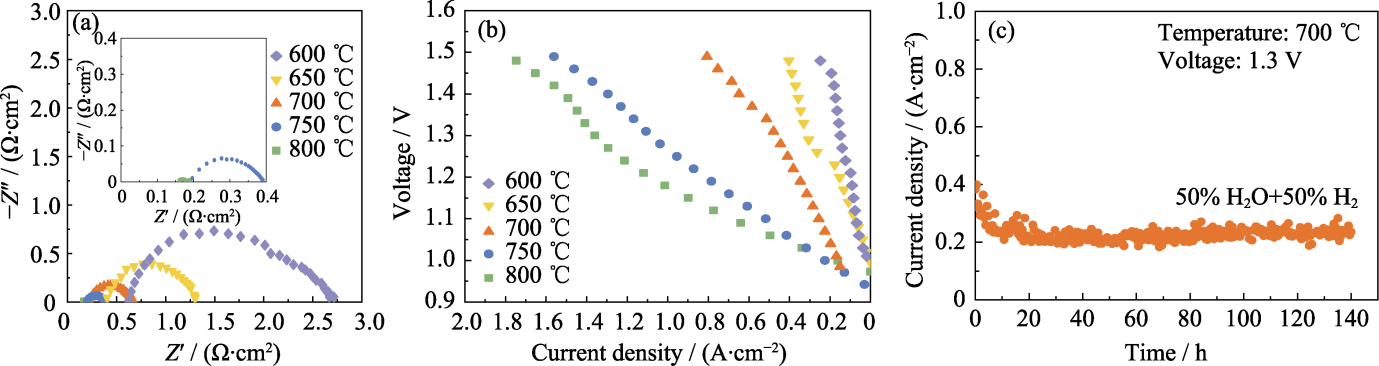
图7 在600~800 ℃、50% H2O+50% H2气氛下, PSC-LSCF-GDC单电池EC模式下的(a) EIS曲线、(b) I-V曲线和(c) 700 ℃时的稳定性测试
Fig. 7 (a) EIS spectra, (b) I-V curves and (c) stability test at 700 ℃ of the single cell with PSC-LSCF-GDC air electrode in EC mode under an atmosphere of 50% H2O+50% H2 at 600-800 ℃
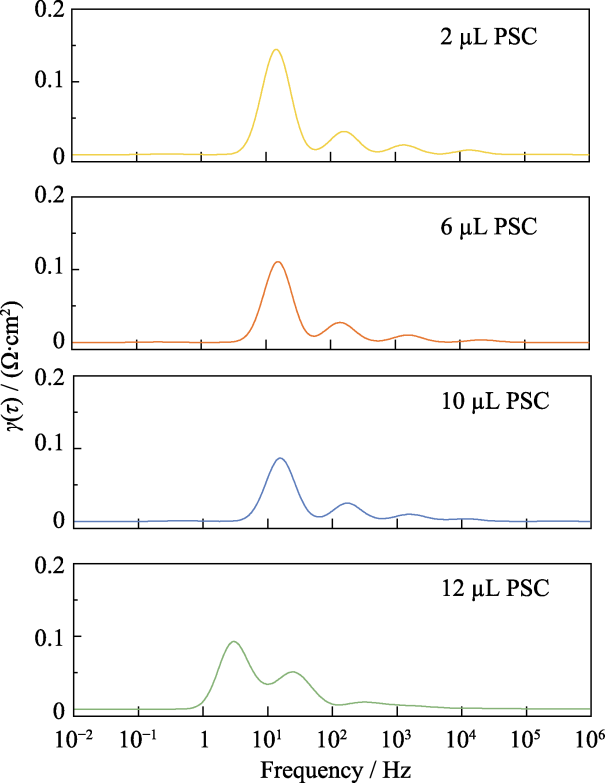
图S1 不同PSC浸渍量的LSCF-GDC空气电极的DRT曲线
Fig. S1 DRT curves of LSCF-GDC air electrodes with different PSC infiltration amounts
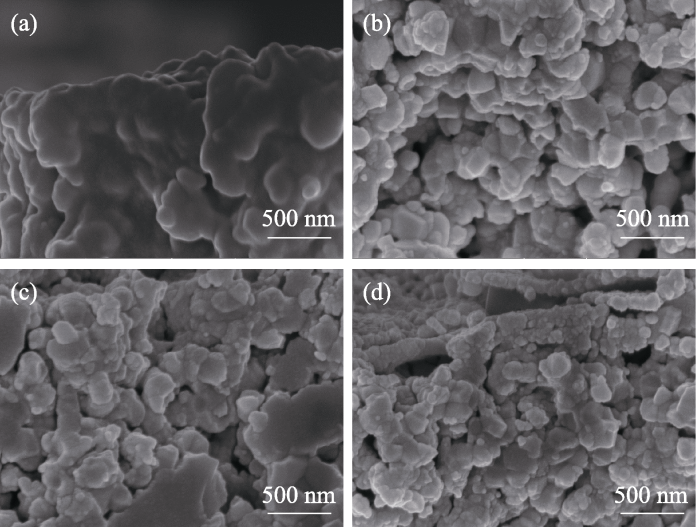
图S2 浸渍(a) 2、(b) 6、(c) 10和(d) 12 μL PSC催化剂溶液的LSCF-GDC空气电极的SEM照片
Fig. S2 SEM images of LSCF-GDC air electrodes infiltrated with (a) 2, (b) 6, (c) 10, and (d) 12 μL PSC catalyst solution

图S3 Rohm和Rp拟合的等效电路图
Fig. S3 Equivalent circuit diagram fitted with Rohm and Rp
| [1] |
XU Q D, GUO Z J, XIA L C, et al. A comprehensive review of solid oxide fuel cells operating on various promising alternative fuels. Energy Conversion and Management, 2022, 253: 115175.
DOI URL |
| [2] | SAMREEN A, ALI M S, HUZAIFA M, et al. Advancements in perovskite-based cathode materials for solid oxide fuel cells: a comprehensive review. The Chemical Record, 2024, 24(1): e202300247. |
| [3] |
DUBOIS A, RICOTE S, BRAUN R J. Benchmarking the expected stack manufacturing cost of next generation, intermediate- temperature protonic ceramic fuel cells with solid oxide fuel cell technology. Journal of Power Sources, 2017, 369: 65.
DOI URL |
| [4] |
YANG G M, SU C, SHI H G, et al. Toward reducing the operation temperature of solid oxide fuel cells: our past 15 years of efforts in cathode development. Energy & Fuels, 2020, 34(12): 15169.
DOI URL |
| [5] |
ZHANG Y, KNIBBE R, SUNARSO J, et al. Recent progress on advanced materials for solid-oxide fuel cells operating below 500 ℃. Advanced Materials, 2017, 29(48): 1700132.
DOI URL |
| [6] |
ZHOU Y C, ZHANG W L, KANE N, et al. An efficient bifunctional air electrode for reversible protonic ceramic electrochemical cells. Advanced Functional Materials, 2021, 31(40): 2105386.
DOI URL |
| [7] |
DUAN C C, KEE R, ZHU H Y, et al. Highly efficient reversible protonic ceramic electrochemical cells for power generation and fuel production. Nature Energy, 2019, 4(3): 230.
DOI |
| [8] |
CHOI S, YOO S, KIM J, et al. Highly efficient and robust cathode materials for low-temperature solid oxide fuel cells: PrBa0.5Sr0.5Co2-xFexO5+δ. Scientific Reports, 2013, 3: 2426.
DOI |
| [9] |
DUAN C C, TONG J H, SHANG M, et al. Readily processed protonic ceramic fuel cells with high performance at low temperatures. Science, 2015, 349(6254): 1321.
DOI PMID |
| [10] | 付梦雨, 金英敏, 李栋, 等. 浸渍Gd0.2Ce0.8O1.9对固体氧化物燃料电池La0.8Sr0.2Co0.2Fe0.8O3-δ阴极铬中毒影响的研究. 陶瓷学报, 2022, 43(1): 54. |
| [11] | 张璐, 宦道明, 夏长荣. 固体氧化物燃料电池氧化物修饰镧锶钴铁阴极研究进展. 陶瓷学报, 2022, 43(5): 799. |
| [12] |
YOON K J, BISWAS M, KIM H J, et al. Nano-tailoring of infiltrated catalysts for high-temperature solid oxide regenerative fuel cells. Nano Energy, 2017, 36: 9.
DOI URL |
| [13] |
REHMAN S U, SONG H S, KIM H S, et al. A dynamic infiltration technique to synthesize nanolayered cathodes for high performance and robust solid oxide fuel cells. Journal of Energy Chemistry, 2022, 70: 201.
DOI URL |
| [14] |
ZHANG X Y, WANG C X, LIU K, et al. Significantly enhanced stability and activity of a perovskite oxygen electrode for reversible protonic ceramic electrochemical cells by heterointerface engineering. Journal of Advanced Ceramics, 2025, 14(7): 9221108.
DOI URL |
| [15] |
SONG Y F, CHEN Y B, WANG W, et al. Self-assembled triple-conducting nanocomposite as a superior protonic ceramic fuel cell cathode. Joule, 2019, 3(11): 2842.
DOI URL |
| [16] |
SHIN J F, XU W, ZANELLA M, et al. Self-assembled dynamic perovskite composite cathodes for intermediate temperature solid oxide fuel cells. Nature Energy, 2017, 2(3): 16214.
DOI |
| [17] |
LIU T, HUANG S, ZHU S Y, et al. Preparation of cobalt-free composite cathode for efficient high-temperature hydrogen fuel cell via one-pot synthesis method. Journal of Inorganic Materials, 2025, 40(12): 1349.
DOI URL |
| [18] |
KIM J H, KIM J K, SEO H G, et al. Ex-solved Ag nanocatalysts on a Sr-free parent scaffold authorize a highly efficient route of oxygen reduction. Advanced Functional Materials, 2020, 30(27): 2001326.
DOI URL |
| [19] |
HU S M, LI J, ZENG Y, et al. A mini review of the recent progress of electrode materials for low-temperature solid oxide fuel cells. Physical Chemistry Chemical Physics, 2023, 25(8): 5926.
DOI PMID |
| [20] | 薛强, 郑国柱, 吴宇成, 等. 纳米技术在低温可逆固体氧化物电池空气极中的应用及研究进展. 硅酸盐学报, 2025, 53(11): 3404. |
| [21] |
WANG T P, LI Q N, LIU X C, et al. Nanofabrication technologies for low-temperature solid oxide cells: a comprehensive review of techniques, challenges, and future perspectives. Energy Reviews, 2025, 4(4): 100163.
DOI URL |
| [22] |
CHEN Y, CHOI Y M, YOO S, et al. A highly efficient multi-phase catalyst dramatically enhances the rate of oxygen reduction. Joule, 2018, 2(5): 938.
DOI URL |
| [23] |
ZENG D P, XU K, ZHU F, et al. Enhancing the oxygen reduction reaction activity and durability of a solid oxide fuel cell cathode by surface modification of a hybrid coating. International Journal of Hydrogen Energy, 2023, 48(62): 23992.
DOI URL |
| [24] | WU L, ZHENG H Y, YANG X, et al. Enhanced oxygen evolution rate and anti-interfacial delamination property of the SrCo0.9Ta0.1O3-δ@La0.6Sr0.4Co0.2Fe0.8O3-δ oxygen-electrode for solid oxide electrolysis cells. ACS Applied Materials & Interfaces, 2023, 15(45): 52673. |
| [25] |
SONG Z H, PAN H, WAN G C, et al. Enhancing durability of solid oxide cells for hydrogen production from seawater by designing nano-structured Sm0.5Sr0.5Co3-δ infiltrated air electrodes. International Journal of Hydrogen Energy, 2023, 48(70): 27095.
DOI URL |
| [26] |
CHEN S N, FENG W W, ZHAO Y, et al. Modified La0.6Sr0.4Co0.2Fe0.8O3-δ cathode with the infiltration of Bi0.8Ca0.2FeO3-δ for intermediate- temperature solid oxide fuel cells. Ceramics International, 2025, 51(4): 5234.
DOI URL |
| [27] | ZHANG L, XU Y S, XU K, et al. Improving the activity and stability of La0.6Sr0.4Co0.2Fe0.8O3-δ cathode through surface modification with an electro-catalyst. Small, 2025, 21(42): e05019. |
| [28] |
BIAN W J, WU W, WANG B M, et al. Revitalizing interface in protonic ceramic cells by acid etch. Nature, 2022, 604: 479.
DOI |
| [29] |
DAI H L, DU H Z, LIU Z, et al. Multi-element doped SrFeO3- based cathodes with balanced thermal expansion for proton- conducting solid oxide fuel cells. Journal of Advanced Ceramics, 2025, 14(10): 9221165.
DOI URL |
| [30] | 赵浩宇, 吕秋秋, 朱腾龙. 固体氧化物燃料电池电解质与阴极界面研究进展及展望. 硅酸盐学报, 2025, 53(12): 3790. |
| [31] | DING D, LI X X, LAI S Y, et al. Enhancing SOFC cathode performance by surface modification through infiltration. Energy & Environmental Science, 2014, 7(2): 552. |
| [32] |
YANG C H, LI J, YANG C C, et al. A highly active and robust air electrode for reversible protonic ceramic cells: advanced performance achieved by low-Lewis-acid-strength cation doping strategy. ACS Materials Letters, 2024, 6(8): 3540.
DOI URL |
| [33] |
WU L, SUN J Q, QI H Y, et al. Boosting steam tolerance and electrochemical performance of an La0.6Sr0.4Co0.2Fe0.8O3-δ-based air electrode for protonic ceramic electrochemical cells. Journal of Materials Chemistry A, 2024, 12: 25979.
DOI URL |
| [1] | 李锐,王浩,付强,田子玉,王建旭,马小健,杨剑,钱逸泰. 构建亲锂铜基3D集流体实现金属锂的均匀沉积[J]. 无机材料学报, 2020, 35(8): 882-888. |
| [2] | 翁晓琳, 刘佩佩, 张亚鹏, 刘江, 刘美林. 新型多孔导电陶瓷负载银阴极在锌空气电池中的应用[J]. 无机材料学报, 2018, 33(8): 854-860. |
| [3] | 吕玉珍, 孙 倩,李 超, 单秉亮, 齐 波, 李成榕. 油酸修饰TiO2纳米棒的溶剂热合成及形貌调控研究[J]. 无机材料学报, 2017, 32(7): 719-724. |
| [4] | 马新国, 严杰, 陈紫梦, 祝林, 徐国旺, 黄楚云, 吕辉. Pt和Au修饰锐钛矿型TiO2(101)面的第一性原理研究[J]. 无机材料学报, 2016, 31(3): 291-297. |
| [5] | 刘 沁, 袁 文, 高学平. TiO2(B)表面修饰富锂层状氧化物Li(Li0.17Ni0.2Mn0.58Co0.05)O2正极材料[J]. 无机材料学报, 2014, 29(12): 1257-1264. |
| [6] | 檀满林, 王彦涛, 张维丽, 符冬菊, 李冬霜, 王晓伟, 马 清, 陈建军, 李廷凯. 基于PEG修饰的ZnO量子点光学特性研究[J]. 无机材料学报, 2014, 29(10): 1039-1043. |
| [7] | 吕玉珍, 张胜男, 杜岳凡, 陈牧天, 李成榕. 油酸修饰对纳米二氧化钛在变压器油中分散性的影响[J]. 无机材料学报, 2013, 28(06): 594-598. |
| [8] | 胡 宾, 潘 卉, 余来贵, 王龙阁, 赵 磊, 张治军. 水杨酸原位表面改性纳米TiO2的制备及性能研究[J]. 无机材料学报, 2011, 26(11): 1181-1186. |
| [9] | 周艳玲,高 源,吕昔琴,常 江. 沸水处理对45S5生物活性玻璃/聚乳酸复合膜性能的影响[J]. 无机材料学报, 2010, 25(4): 354-358. |
| [10] | 田 言,刘峻峰,任南琪,黄玉东. PyDDP表面修饰纳米硼钼剂的制备及极压性能研究[J]. 无机材料学报, 2009, 24(6): 1249-1253. |
| [11] | 钟振兴,韦 奇,王 飞,李群艳,聂祚仁,邹景霞. 后接枝法合成氨丙基修饰的周期性介孔氧化硅材料[J]. 无机材料学报, 2008, 23(2): 408-412. |
| [12] | 朱磊,江红,王滨,魏佳,朱红. 纳米氧化锌的表面修饰及其机理的研究[J]. 无机材料学报, 2007, 22(2): 219-222. |
| [13] | 毛立群,丁彦,张治军,党鸿辛. 丙烯酸表面修饰法制备纳晶TiO2薄膜的研究[J]. 无机材料学报, 2004, 19(2): 391-396. |
| [14] | 王家邦,杨辉,陆静娟,丁新更. 氧化铝空心球的表面修饰[J]. 无机材料学报, 2003, 18(4): 823-829. |
| [15] | 姚建曦,赵高凌,韩高荣. 聚乙烯吡咯烷酮硫脲修饰CdS纳米粒子的制备[J]. 无机材料学报, 2003, 18(2): 445-450. |
| 阅读次数 | ||||||
|
全文 |
|
|||||
|
摘要 |
|
|||||