Methane is the second greenhouse gas contributing greatly to global warming, about 80 times of CO2. Considering background of global warming and atmospheric methane growth, to catalyze total oxidation of atmospheric methane is of great importance to mitigate greenhouse effects and slow this global warming. However, catalytic oxidation of methane has always been a big challenge due to its high structural stability. In this article, research progress in total oxidation of methane under thermal-, photo- and photothermal-catalysis was reviewed. High temperature in thermal catalysis increases the energy loss and accelerates the deactivation of catalysts speedingly. Therefore, development of catalysts that oxidize methane under moderate temperatures is the main research interests. Photocatalysis provides a way to eliminate methane at ambient conditions with the assistance of solar energy, but the reaction rates are lower than that in thermal catalysis. It is worth mentioning that photothermal catalysis, developed in recent years, can achieve efficiently catalytic total oxidation of methane under mild conditions, showing a high potential application prospect. This article reviews development of three modes of catalysis, analyzes their different reaction mechanisms, advantages and disadvantages under different reaction conditions. Finally, prospects and challenges of this catalytic total oxidation are pointed out, which is expected to provide references for future research on this field.
Keywords:catalytic oxidation of methane;
thermal catalysis;
photocatalysis;
photothermal catalysis;
review
SUN Chen, ZHAO Kunfeng, YI Zhiguo. Research Progress in Catalytic Total Oxidation of Methane. Journal of Inorganic Materials, 2023, 38(11): 1245-1256 DOI:10.15541/jim20230117
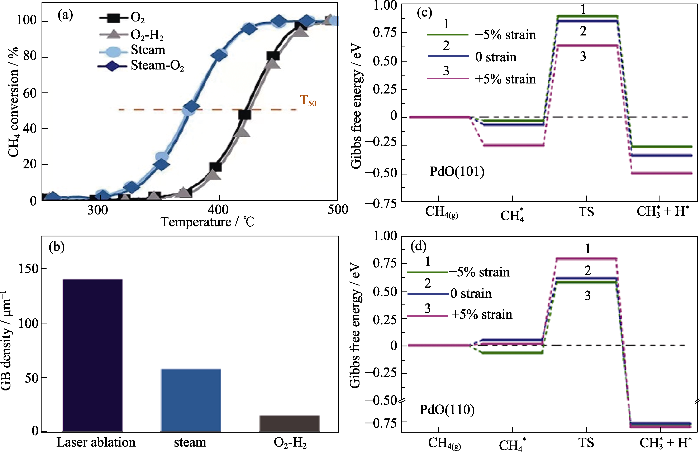
Fig. 2
Performance tests and theoretical calculations of catalysts[28]
(a) Light-off curves and T50 values of Pd/Al2O3 after O2 (600 ℃), O2-H2, steam (600 ℃), and steam-O2 pretreatments; (b) GB density statistical histogram of laser-generated Pd/Al2O3 and Pd/Al2O3 after steam (600 ℃) and O2-H2 pretreatments; (c, d) Calculated free energy diagrams for breaking the first C-H bond in CH4 on PdO(101) and PdO(110), respectively. Reprinted from Ref. [28] with permission, Copyright 2021 AAAS
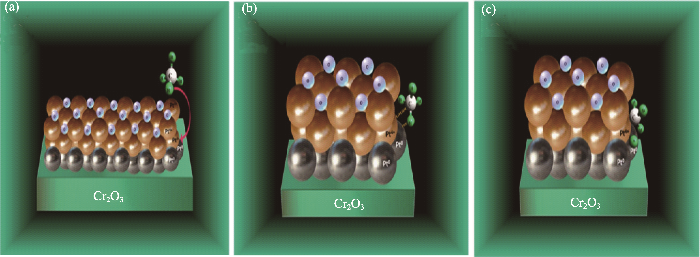
Fig. 3
Proposed model for the CH4 dissociative adsorption over Pt0−Pt4+ dipoles saturated with chemisorbtion oxygen atoms[30]
(a) Reactants: CH4 in the gas phase and 1% Pt/Cr2O3; (b) CH4 polarization by Pt0−Pt4+ site and formation of a transition state; (c) Abstraction of the first hydrogen on the adsorbed CH4 molecule
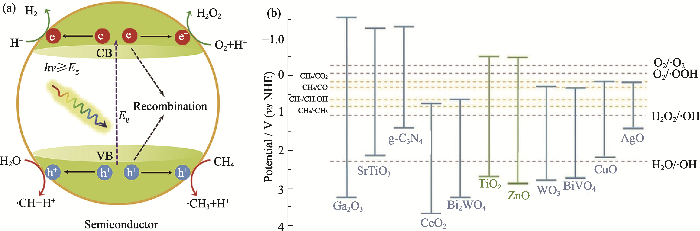
Fig. 4
(a) Schematic diagram of methane activation over semiconductor-based photocatalysts[1]; (b) Schematic diagram of band structures of commonly used semiconductors and redox potentials of different reactants[55]
Fig. 5
Application of ZnO-based semiconductor in photocatalytic total oxidation of methane
(a) Time evolution of photocatalytic total oxidation of methane over 0.1% Ag-decorated ZnO nanocatalysts at different CH4 concentrations[56] (Reprinted from Ref. [56] with permission, Copyright 2016 Springer Nature); (b) Time evolution of photocatalytic total oxidation of methaneover various catalysts with a CH4 input of 100 μL/L[58] (Reprinted from Ref. [58] with permission, Copyright 2019 Royal Society of Chemistry); (c) Catalytic activity of total oxidation of methane (top) and the crystal morphology (bottom) of a ZnO nanosheet and nanorod[59] (Reprinted from Ref. [59] with permission, Copyright 2019 American Chemical Society)
Fig. 6
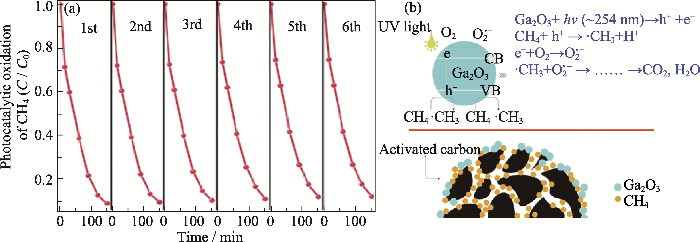
Ga2O3/AC photocatalytic total oxidation of methane and schematic diagram of oxidation mechanism[60]
(a) Recycled test of photocatalytic oxidation of CH4 over 15% Ga2O3/AC; (b) Proposed mechanism for photocatalytic oxidation of CH4 over Ga2O3/AC composites. Reprinted from Ref. [60] with permission, Copyright 2017 Royal Society of Chemistry
Fig. 7
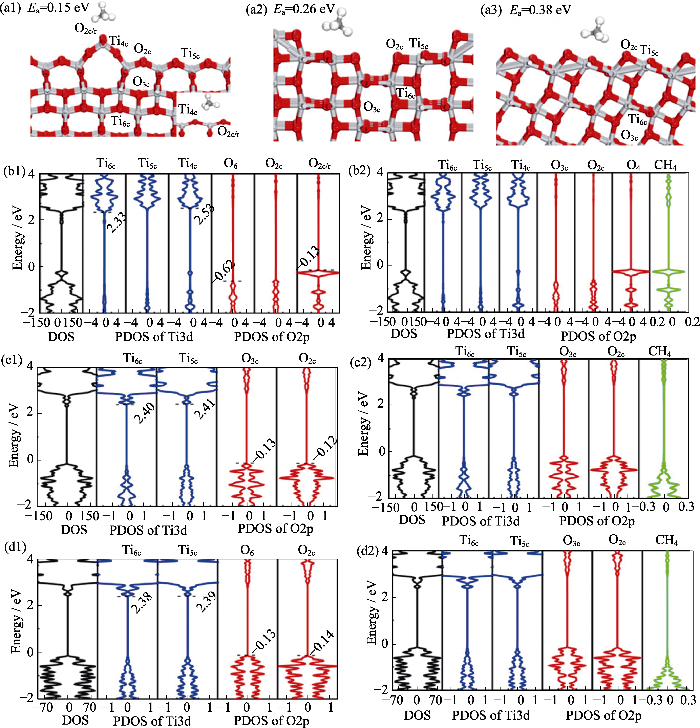
Adsorption energy calculations of surface methane and DFT calculation of different TiO2 [61]
(a1-a3) Most stable adsorption configurations of CH4 on (a1) anatase TiO2(001)-(1×4), (a2) anatase TiO2(100)-(1×2), and (a3) anatase TiO2(101) surfaces. Gray and red balls represent Ti and O atoms, respectively; (b1, b2, c1,c2, d1, d2) Calculated PDOS of (b1) bare and (b2) CH4-adsorbed anatase TiO2(001)-(1×4) surfaces, (c1) bare and (c2) CH4-adsorbed anatase TiO2(100)-(12) surfaces, and (d1) bare and (d2) CH4-adsorbed anatase TiO2-(101) surfaces. Reprinted from Ref. 61 with permission, Copyright 2022 American Chemical Society
Table 2
表2
表2甲烷完全催化氧化光催化剂的性能比较
Table 2 Comparison of performances of photocatalysts for total oxidation of methane by photocatalysis
Fig. 8
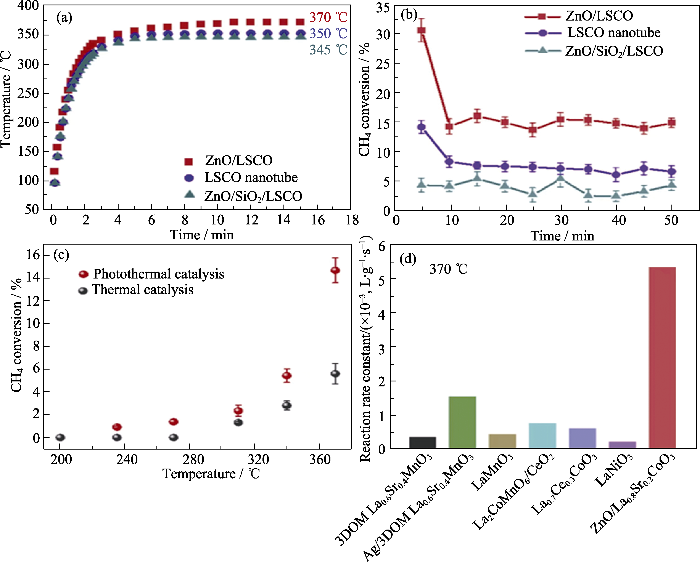
Tests of ZnO/LSCO photocatalysis and photothermal cocatalysis for methane total oxidation[70]
(a) Temperature profiles on these monolithic catalysts under irradiation of Xe lamp; (b) CH4 photothermal conversions over these monolithic catalysts under Xe lamp irradiation; (c) Comparison of CH4 conversion for ZnO/LSCO under Xe lamp irradiation and direct thermal heating (furnace) at the same temperature; (d) Activity comparison of methane oxidation with previous studies by normalized reaction rate constant. Reprinted from Ref. [70] with permission, Copyright 2008 American Chemical Society
Fig. 9
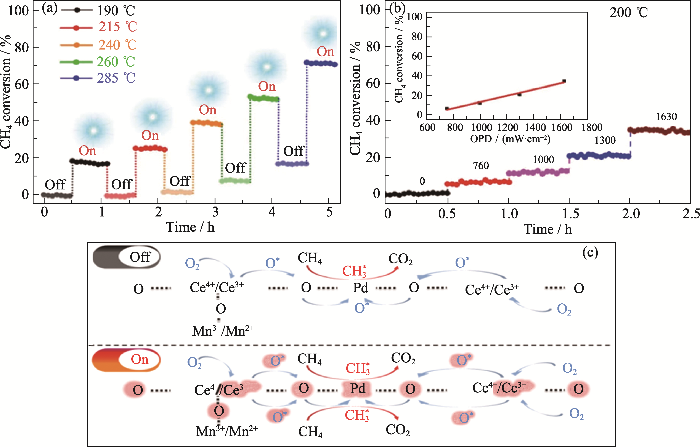
HPMC photothermal co-catalyzed methane total oxidation performance (a, b) and its mechanism (c)[71]
(a) Cycling stability test of HPMC; (b) Methane conversion measured at 200 ℃ with different optical power (OPD); (c) Reaction mechanism of HPMC catalyzed methane combustion. Reprinted from Ref. [71] with permission, Copyright 2021 Wiley
The conversion of methane to upgraded fuels and higher-value chemicals such as hydrogen, methanol, and olefins is a promising technology in the supply of chemicals and energy. However, current commercial methane conversion technology suffers from intense energy consumption. It is highly desirable to develop novel technologies for methane conversion with improved efficiency and lower cost. Solar energy, the most abundant and clean renewable energy, has been utilized as a new stimulus to drive methane conversion under mild conditions. In this review, recent achievements in solar-energy-mediated catalytic methane conversion are highlighted. We focus on the photocatalytic conversion of methane in photocatalytic systems, photoelectrochemical systems, and photoenhanced thermocatalytic systems. We discuss the challenges and prospects of future research on solar-energy-mediated methane conversion and aim to acquire in-depth understanding of the photo-mediated activation of the C-H bond and provide guidelines for the design of highly efficient catalysts.
NEWTONM A, KNORPPA J, SUSHKEVICHV L, et al.
Active sites and mechanisms in the direct conversion of methane to methanol using Cu in zeolitic hosts: a critical examination
In this critical review we examine the current state of our knowledge in respect of the nature of the active sites in copper containing zeolites for the selective conversion of methane to methanol. We consider the varied experimental evidence arising from the application of X-ray diffraction, and vibrational, electronic, and X-ray spectroscopies that exist, along with the results of theory. We aim to establish both what is known regarding these elusive materials and how they function, and also where gaps in our knowledge still exist, and offer suggestions and strategies as to how these might be closed such that the rational design of more effective and efficient materials of this type for the selective conversion of methane might proceed further.
SCHWACHP, PANX, BAOX.
Direct conversion of methane to value-added chemicals over heterogeneous catalysts: challenges and prospects
The quest for an efficient process to convert methane efficiently to fuels and high value-added chemicals such as olefins and aromatics is motivated by their increasing demands and recently discovered large reserves and resources of methane. Direct conversion to these chemicals can be realized either oxidatively via oxidative coupling of methane (OCM) or nonoxidatively via methane dehydroaromatization (MDA), which have been under intensive investigation for decades. While industrial applications are still limited by their low yield (selectivity) and stability issues, innovations in new catalysts and concepts are needed. The newly emerging strategy using iron single sites to catalyze methane conversion to olefins, aromatics, and hydrogen (MTOAH) attracted much attention when it was reported. Because the challenge lies in controlled dehydrogenation of the highly stable CH and selective C-C coupling, we focus mainly on the fundamentals of C-H activation and analyze the reaction pathways toward selective routes of OCM, MDA, and MTOAH. With this, we intend to provide some insights into their reaction mechanisms and implications for future development of highly selective catalysts for direct conversion of methane to high value-added chemicals.
VOOSEP.
Ominous feedback loop may be accelerating methane emissions
Various efforts have been carried out to convert methane to more useful chemicals and hydrogen. However, due to its high stability, high energy is usually consumed for its conversion, which still remains as a problem to be solved. Recently, photocatalysis has been proposed to be one of the answers to break the thermodynamic barrier. This tutorial review provides a brief history about developments in the methane conversion and specially highlights the developments in the photocatalytic conversion of methane, such as methane coupling and methane conversion with other molecules.
CHENJ, ARANDIYANH, GAOX, et al.
Recent advances in catalysts for methane combustion
As a primary type of clean energy, methane is also the second most important greenhouse gas after CO<sub>2</sub> due to the high global warming potential. Large quantities of lean methane (0.1-1.0 vol%) are emitted into the atmosphere without any treatment during coal mine, oil, and natural gas production, thus lead-ing to energy loss and greenhouse effect. In general, it is challenging to utilize lean methane due to its low concentration and flow instability, while catalytic combustion is a vital pathway to realize an efficient utilization of lean methane owing to the reduced emissions of polluting gases (e.g., NO<sub>x</sub> and CO) during the reaction. In particular, to efficiently convert lean methane, it necessitates both the designs of highly active and stable heterogeneous catalysts that accelerate lean methane combustion at low temperatures and smart reactors that enable autothermal operation by optimizing heat management. In this review, we discuss the in-depth development, challenges, and prospects of catalytic lean methane combustion technology in various configurations, with particular emphasis on heat management from the point of view of material design combined with reactor configuration. The target is to describe a framework that can correlate the guiding principles among catalyst design, device innovation and system optimization, inspiring the development of groundbreaking combustion technology for the efficient utilization of lean methane.
SCHWARTZW R, CIUPARUD, PFEFFERLEL D.
Combustion of methane over palladium-based catalysts: catalytic deactivation and role of the support
The Journal of Physical Chemistry C, 2012, 116(15):8587.
The oxygen evolution reaction (OER) dominates the efficiency of electrocatalytic water splitting owing to its sluggish kinetics. Perovskite oxides (ABO<sub>3</sub>) have emerged as promising candidates to accelerate the OER process owing to their high intrinsic activities and tailorable properties. Fe ions in perovskite oxides have been proved to be a highly catalytic element for OER, while some Fe-based perovskites such as SrTi<sub>0.8</sub>Fe<sub>0.2</sub>O<sub>3-d</sub> (STF) and La<sub>0.66</sub>Ti<sub>0.8</sub>Fe<sub>0.2</sub>O<sub>3-d</sub> (LTF) exhibit inferior OER activity. Yet the essential reason is still unclear and the effective method to promote the activity of such perovskite is also lacking. Herein, an in-situ exsolution strategy was proposed to boost the OER by migrating Fe from the bulk to the surface. Significantly enhanced OER activity was achieved on STF and LTF perovskites with surface-decorated oxygen vacancies and Fe nanoparticles. In addition, theoretical calculation confirmed that the oxygen vacancies and Fe nanoparticle on surface could lower the overpotential of OER by facilitating the adsorption of OH<sup>-</sup>. From this study, migration of the active elements in perovskite is found to be an effective strategy to increase the quantity and activity of active sites, providing new insights and under-standing for designing efficient OER catalysts.
YUQ, LIUC, LIX, et al.
N-doping activated defective Co3O4 as an efficient catalyst for low-temperature methane oxidation
Strong metal-support interaction assisted redispersion strategy for obtaining ultrafine and stable IrO2/Ir active sites with exceptional methane oxidation activity
New insights into the role of Pd-Ce interface for methane activation on monolithic supported Pd catalysts: a step forward the development of novel PGM three-way catalysts for natural gas fueled engines
Direct methane conversion into value-added products has become increasingly important. Because of inertness of methane, cleaving the first C-H bond has been very difficult, requiring high reaction temperature on the heterogeneous catalysts. Once the first C-H bond becomes activated, the remaining C-H bonds are successively dissociated on the metal surface, hindering the direct methane conversion into chemicals. Here, a single-atom Rh catalyst dispersed on ZrO surface has been synthesized and used for selective activation of methane. The Rh single atomic nature was confirmed by extended X-ray fine structure analysis, electron microscopy images, and diffuse reflectance infrared Fourier transform spectroscopy. A model of the single-atom Rh/ZrO catalyst was constructed by density functional theory calculations, and it was shown that CH intermediates can be energetically stabilized on the single-atom catalyst. The direct conversion of methane was performed using HO in the aqueous solution or using O in gas phase as oxidants. Whereas Rh nanoparticles produced CO only, the single-atom Rh catalyst produced methanol in aqueous phase or ethane in gas phase.
LIQ, OUYANGY, LIH, et al.
Photocatalytic conversion of methane: recent advancements and pospects
Angewandte Chemie International Edition, 2022, 61(2):e202108069.
Design and synthesis of porous M-ZnO/CeO2 microspheres as efficient plasmonic photocatalysts for nonpolar gaseous molecules oxidation: insight into the role of oxygen vacancy defects and M=Ag, Au nanoparticles
Catalytic oxidation of methane under mild conditions remains a challenge in the industrial catalytic processes. Herein, we report a highly efficient CuO/ZnO nanocomposite photocatalyst for methane oxidation under ambient conditions. It was found that both the CH4 photooxidative activity and stability over ZnO are considerably improved by Loading a tiny amount of CuO, though CuO itself exhibits no activity on methane oxidation. On the basis of the experimental results in conjunction with in situ electron paramagnetic resonance (EPR) and Fourier transform infrared spectroscopy (FTIR) studies, the photocatalytic reaction process of CH4 over CuO/ZnO composite microstructures is comprehensively discussed.
LIZ, BODAM A, PANX, et al.
Photocatalytic oxidation of small molecular hydrocarbons over ZnO nanostructures: the difference between methane and ethylene and the impact of polar and nonpolar facets
... [1]和(b)常用半导体的能带结构和不同反应物的氧化还原电位示意图[55](a) Schematic diagram of methane activation over semiconductor-based photocatalysts<sup>[<xref ref-type="bibr" rid="b1">1</xref>]</sup>; (b) Schematic diagram of band structures of commonly used semiconductors and redox potentials of different reactants<sup>[<xref ref-type="bibr" rid="b55">55</xref>]</sup>Fig. 4
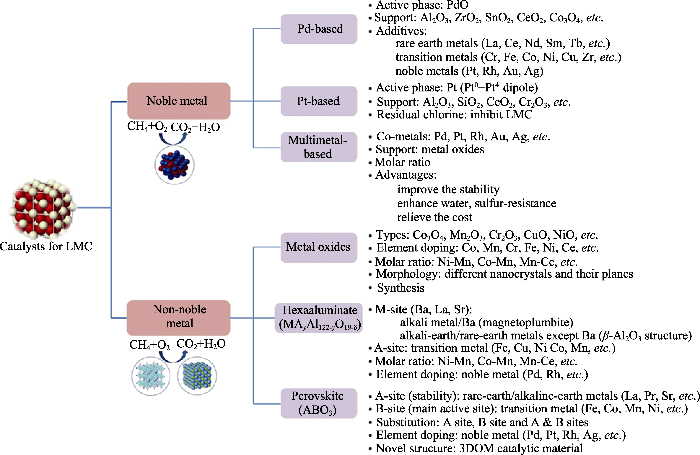
Summary of catalyst properties for the total oxidation of methane by thermal catalysis<sup>[<xref ref-type="bibr" rid="b17">17</xref>]</sup>Fig. 12.1 贵金属担载型催化剂
... [28]Performance tests and theoretical calculations of catalysts<sup>[<xref ref-type="bibr" rid="b28">28</xref>]</sup>
(a) Light-off curves and T50 values of Pd/Al2O3 after O2 (600 ℃), O2-H2, steam (600 ℃), and steam-O2 pretreatments; (b) GB density statistical histogram of laser-generated Pd/Al2O3 and Pd/Al2O3 after steam (600 ℃) and O2-H2 pretreatments; (c, d) Calculated free energy diagrams for breaking the first C-H bond in CH4 on PdO(101) and PdO(110), respectively. Reprinted from Ref. [28] with permission, Copyright 2021 AAAS ...
... [28]
(a) Light-off curves and T50 values of Pd/Al2O3 after O2 (600 ℃), O2-H2, steam (600 ℃), and steam-O2 pretreatments; (b) GB density statistical histogram of laser-generated Pd/Al2O3 and Pd/Al2O3 after steam (600 ℃) and O2-H2 pretreatments; (c, d) Calculated free energy diagrams for breaking the first C-H bond in CH4 on PdO(101) and PdO(110), respectively. Reprinted from Ref. [28] with permission, Copyright 2021 AAAS ...
... (a) Light-off curves and T50 values of Pd/Al2O3 after O2 (600 ℃), O2-H2, steam (600 ℃), and steam-O2 pretreatments; (b) GB density statistical histogram of laser-generated Pd/Al2O3 and Pd/Al2O3 after steam (600 ℃) and O2-H2 pretreatments; (c, d) Calculated free energy diagrams for breaking the first C-H bond in CH4 on PdO(101) and PdO(110), respectively. Reprinted from Ref. [28] with permission, Copyright 2021 AAAS ...
Promoting effect of alkali metal cations on the catalytic performance of Pd/H-ZSM-5 in the combustion of lean methane
... [30]Proposed model for the CH<sub>4</sub> dissociative adsorption over Pt<sup>0</sup>−Pt<sup>4+ </sup>dipoles saturated with chemisorbtion oxygen atoms<sup>[<xref ref-type="bibr" rid="b30">30</xref>]</sup>
(a) Reactants: CH4 in the gas phase and 1% Pt/Cr2O3; (b) CH4 polarization by Pt0−Pt4+ site and formation of a transition state; (c) Abstraction of the first hydrogen on the adsorbed CH4 molecule ...
... [30]
(a) Reactants: CH4 in the gas phase and 1% Pt/Cr2O3; (b) CH4 polarization by Pt0−Pt4+ site and formation of a transition state; (c) Abstraction of the first hydrogen on the adsorbed CH4 molecule ...
... Comparison of properties of catalysts for total oxidation of methane by thermal catalysisTable 1
Catalyst
Tc* /℃
Ea/(kJ·mol-1)
Feed gas
GHSV/(mL·g-1·h-1)
Stability
Ref.
Pd-Ce@SiO2
T100=350
100.4
1% CH4, 21% O2, bal. N2
36000
25 h
[39]
Pd/TiO2
T99=370
83.1
1% CH4, 10% O2, bal. N2
30000
4 cycles
[40]
Pd/Na-MOR
T50=335
75
1% CH4, 4% O2, bal. N2
70000
90 h
[41]
Pd-Pt/CeO2
T50=325
74
680 μg/mL CH4, 14% O2, 5% CO2, bal. N2
300000
12 h#
[42]
Au/Al2O3
T50=480
73
0.8% CH4, 3.2% O2, bal. He,
15000
/
[32]
Rh/ZrO2
T50=400
/
1% CH4, 2% O2, bal. He
15000
/
[31]
Ir/TiO2-H
T50=267
55.5
1% CH4, 20% O2, bal. N2
30000
50 h
[43]
Ag/MnLaO3
T50=580
74
2% CH4, 98% air
12000
/
[44]
Pt/Cr2O3
T50=350
/
0.2% CH4, 10% O2, bal. N2
30000
/
[30]
MgO
T50=225
/
1% CH4, 99% air
6000
70 h
[45]
LaCoO3
T50=470
/
0.8% CH4, 5% O2, bal. N2
60000
/
[46]
NiCo2O4
T100=350
/
5% CH4, 25% O2, bal. Ar
24000
48 h#
[47]
La0.6Sr0.4MnO3
T50=566
56.6
2% CH4, 20% O2, bal. N2
30000
/
[48]
CoAlOx/CeO2
T50=415
92.2
10% CH4, 25% O2, bal. Ar
24000
50 h
[49]
*: the temperature at c% methane conversion; #: H2O-resistant stability ...
Confined ultrathin Pd-Ce nanowires with outstanding moisture and SO2 tolerance in methane combustion
1
2018
... Comparison of properties of catalysts for total oxidation of methane by thermal catalysisTable 1
Catalyst
Tc* /℃
Ea/(kJ·mol-1)
Feed gas
GHSV/(mL·g-1·h-1)
Stability
Ref.
Pd-Ce@SiO2
T100=350
100.4
1% CH4, 21% O2, bal. N2
36000
25 h
[39]
Pd/TiO2
T99=370
83.1
1% CH4, 10% O2, bal. N2
30000
4 cycles
[40]
Pd/Na-MOR
T50=335
75
1% CH4, 4% O2, bal. N2
70000
90 h
[41]
Pd-Pt/CeO2
T50=325
74
680 μg/mL CH4, 14% O2, 5% CO2, bal. N2
300000
12 h#
[42]
Au/Al2O3
T50=480
73
0.8% CH4, 3.2% O2, bal. He,
15000
/
[32]
Rh/ZrO2
T50=400
/
1% CH4, 2% O2, bal. He
15000
/
[31]
Ir/TiO2-H
T50=267
55.5
1% CH4, 20% O2, bal. N2
30000
50 h
[43]
Ag/MnLaO3
T50=580
74
2% CH4, 98% air
12000
/
[44]
Pt/Cr2O3
T50=350
/
0.2% CH4, 10% O2, bal. N2
30000
/
[30]
MgO
T50=225
/
1% CH4, 99% air
6000
70 h
[45]
LaCoO3
T50=470
/
0.8% CH4, 5% O2, bal. N2
60000
/
[46]
NiCo2O4
T100=350
/
5% CH4, 25% O2, bal. Ar
24000
48 h#
[47]
La0.6Sr0.4MnO3
T50=566
56.6
2% CH4, 20% O2, bal. N2
30000
/
[48]
CoAlOx/CeO2
T50=415
92.2
10% CH4, 25% O2, bal. Ar
24000
50 h
[49]
*: the temperature at c% methane conversion; #: H2O-resistant stability ...
Construction and evolution of active palladium species on phase-regulated reducible TiO2 for methane combustion
1
2021
... Comparison of properties of catalysts for total oxidation of methane by thermal catalysisTable 1
Catalyst
Tc* /℃
Ea/(kJ·mol-1)
Feed gas
GHSV/(mL·g-1·h-1)
Stability
Ref.
Pd-Ce@SiO2
T100=350
100.4
1% CH4, 21% O2, bal. N2
36000
25 h
[39]
Pd/TiO2
T99=370
83.1
1% CH4, 10% O2, bal. N2
30000
4 cycles
[40]
Pd/Na-MOR
T50=335
75
1% CH4, 4% O2, bal. N2
70000
90 h
[41]
Pd-Pt/CeO2
T50=325
74
680 μg/mL CH4, 14% O2, 5% CO2, bal. N2
300000
12 h#
[42]
Au/Al2O3
T50=480
73
0.8% CH4, 3.2% O2, bal. He,
15000
/
[32]
Rh/ZrO2
T50=400
/
1% CH4, 2% O2, bal. He
15000
/
[31]
Ir/TiO2-H
T50=267
55.5
1% CH4, 20% O2, bal. N2
30000
50 h
[43]
Ag/MnLaO3
T50=580
74
2% CH4, 98% air
12000
/
[44]
Pt/Cr2O3
T50=350
/
0.2% CH4, 10% O2, bal. N2
30000
/
[30]
MgO
T50=225
/
1% CH4, 99% air
6000
70 h
[45]
LaCoO3
T50=470
/
0.8% CH4, 5% O2, bal. N2
60000
/
[46]
NiCo2O4
T100=350
/
5% CH4, 25% O2, bal. Ar
24000
48 h#
[47]
La0.6Sr0.4MnO3
T50=566
56.6
2% CH4, 20% O2, bal. N2
30000
/
[48]
CoAlOx/CeO2
T50=415
92.2
10% CH4, 25% O2, bal. Ar
24000
50 h
[49]
*: the temperature at c% methane conversion; #: H2O-resistant stability ...
Stable complete methane oxidation over palladium based zeolite catalysts
1
2018
... Comparison of properties of catalysts for total oxidation of methane by thermal catalysisTable 1
Catalyst
Tc* /℃
Ea/(kJ·mol-1)
Feed gas
GHSV/(mL·g-1·h-1)
Stability
Ref.
Pd-Ce@SiO2
T100=350
100.4
1% CH4, 21% O2, bal. N2
36000
25 h
[39]
Pd/TiO2
T99=370
83.1
1% CH4, 10% O2, bal. N2
30000
4 cycles
[40]
Pd/Na-MOR
T50=335
75
1% CH4, 4% O2, bal. N2
70000
90 h
[41]
Pd-Pt/CeO2
T50=325
74
680 μg/mL CH4, 14% O2, 5% CO2, bal. N2
300000
12 h#
[42]
Au/Al2O3
T50=480
73
0.8% CH4, 3.2% O2, bal. He,
15000
/
[32]
Rh/ZrO2
T50=400
/
1% CH4, 2% O2, bal. He
15000
/
[31]
Ir/TiO2-H
T50=267
55.5
1% CH4, 20% O2, bal. N2
30000
50 h
[43]
Ag/MnLaO3
T50=580
74
2% CH4, 98% air
12000
/
[44]
Pt/Cr2O3
T50=350
/
0.2% CH4, 10% O2, bal. N2
30000
/
[30]
MgO
T50=225
/
1% CH4, 99% air
6000
70 h
[45]
LaCoO3
T50=470
/
0.8% CH4, 5% O2, bal. N2
60000
/
[46]
NiCo2O4
T100=350
/
5% CH4, 25% O2, bal. Ar
24000
48 h#
[47]
La0.6Sr0.4MnO3
T50=566
56.6
2% CH4, 20% O2, bal. N2
30000
/
[48]
CoAlOx/CeO2
T50=415
92.2
10% CH4, 25% O2, bal. Ar
24000
50 h
[49]
*: the temperature at c% methane conversion; #: H2O-resistant stability ...
Engineering catalyst supports to stabilize PdOx two-dimensional rafts for water-tolerant methane oxidation
1
2021
... Comparison of properties of catalysts for total oxidation of methane by thermal catalysisTable 1
Catalyst
Tc* /℃
Ea/(kJ·mol-1)
Feed gas
GHSV/(mL·g-1·h-1)
Stability
Ref.
Pd-Ce@SiO2
T100=350
100.4
1% CH4, 21% O2, bal. N2
36000
25 h
[39]
Pd/TiO2
T99=370
83.1
1% CH4, 10% O2, bal. N2
30000
4 cycles
[40]
Pd/Na-MOR
T50=335
75
1% CH4, 4% O2, bal. N2
70000
90 h
[41]
Pd-Pt/CeO2
T50=325
74
680 μg/mL CH4, 14% O2, 5% CO2, bal. N2
300000
12 h#
[42]
Au/Al2O3
T50=480
73
0.8% CH4, 3.2% O2, bal. He,
15000
/
[32]
Rh/ZrO2
T50=400
/
1% CH4, 2% O2, bal. He
15000
/
[31]
Ir/TiO2-H
T50=267
55.5
1% CH4, 20% O2, bal. N2
30000
50 h
[43]
Ag/MnLaO3
T50=580
74
2% CH4, 98% air
12000
/
[44]
Pt/Cr2O3
T50=350
/
0.2% CH4, 10% O2, bal. N2
30000
/
[30]
MgO
T50=225
/
1% CH4, 99% air
6000
70 h
[45]
LaCoO3
T50=470
/
0.8% CH4, 5% O2, bal. N2
60000
/
[46]
NiCo2O4
T100=350
/
5% CH4, 25% O2, bal. Ar
24000
48 h#
[47]
La0.6Sr0.4MnO3
T50=566
56.6
2% CH4, 20% O2, bal. N2
30000
/
[48]
CoAlOx/CeO2
T50=415
92.2
10% CH4, 25% O2, bal. Ar
24000
50 h
[49]
*: the temperature at c% methane conversion; #: H2O-resistant stability ...
Strong metal-support interaction assisted redispersion strategy for obtaining ultrafine and stable IrO2/Ir active sites with exceptional methane oxidation activity
1
2021
... Comparison of properties of catalysts for total oxidation of methane by thermal catalysisTable 1
Catalyst
Tc* /℃
Ea/(kJ·mol-1)
Feed gas
GHSV/(mL·g-1·h-1)
Stability
Ref.
Pd-Ce@SiO2
T100=350
100.4
1% CH4, 21% O2, bal. N2
36000
25 h
[39]
Pd/TiO2
T99=370
83.1
1% CH4, 10% O2, bal. N2
30000
4 cycles
[40]
Pd/Na-MOR
T50=335
75
1% CH4, 4% O2, bal. N2
70000
90 h
[41]
Pd-Pt/CeO2
T50=325
74
680 μg/mL CH4, 14% O2, 5% CO2, bal. N2
300000
12 h#
[42]
Au/Al2O3
T50=480
73
0.8% CH4, 3.2% O2, bal. He,
15000
/
[32]
Rh/ZrO2
T50=400
/
1% CH4, 2% O2, bal. He
15000
/
[31]
Ir/TiO2-H
T50=267
55.5
1% CH4, 20% O2, bal. N2
30000
50 h
[43]
Ag/MnLaO3
T50=580
74
2% CH4, 98% air
12000
/
[44]
Pt/Cr2O3
T50=350
/
0.2% CH4, 10% O2, bal. N2
30000
/
[30]
MgO
T50=225
/
1% CH4, 99% air
6000
70 h
[45]
LaCoO3
T50=470
/
0.8% CH4, 5% O2, bal. N2
60000
/
[46]
NiCo2O4
T100=350
/
5% CH4, 25% O2, bal. Ar
24000
48 h#
[47]
La0.6Sr0.4MnO3
T50=566
56.6
2% CH4, 20% O2, bal. N2
30000
/
[48]
CoAlOx/CeO2
T50=415
92.2
10% CH4, 25% O2, bal. Ar
24000
50 h
[49]
*: the temperature at c% methane conversion; #: H2O-resistant stability ...
Manganese- lanthanum oxides modified with silver for the catalytic combustion of methane
1
2004
... Comparison of properties of catalysts for total oxidation of methane by thermal catalysisTable 1
Catalyst
Tc* /℃
Ea/(kJ·mol-1)
Feed gas
GHSV/(mL·g-1·h-1)
Stability
Ref.
Pd-Ce@SiO2
T100=350
100.4
1% CH4, 21% O2, bal. N2
36000
25 h
[39]
Pd/TiO2
T99=370
83.1
1% CH4, 10% O2, bal. N2
30000
4 cycles
[40]
Pd/Na-MOR
T50=335
75
1% CH4, 4% O2, bal. N2
70000
90 h
[41]
Pd-Pt/CeO2
T50=325
74
680 μg/mL CH4, 14% O2, 5% CO2, bal. N2
300000
12 h#
[42]
Au/Al2O3
T50=480
73
0.8% CH4, 3.2% O2, bal. He,
15000
/
[32]
Rh/ZrO2
T50=400
/
1% CH4, 2% O2, bal. He
15000
/
[31]
Ir/TiO2-H
T50=267
55.5
1% CH4, 20% O2, bal. N2
30000
50 h
[43]
Ag/MnLaO3
T50=580
74
2% CH4, 98% air
12000
/
[44]
Pt/Cr2O3
T50=350
/
0.2% CH4, 10% O2, bal. N2
30000
/
[30]
MgO
T50=225
/
1% CH4, 99% air
6000
70 h
[45]
LaCoO3
T50=470
/
0.8% CH4, 5% O2, bal. N2
60000
/
[46]
NiCo2O4
T100=350
/
5% CH4, 25% O2, bal. Ar
24000
48 h#
[47]
La0.6Sr0.4MnO3
T50=566
56.6
2% CH4, 20% O2, bal. N2
30000
/
[48]
CoAlOx/CeO2
T50=415
92.2
10% CH4, 25% O2, bal. Ar
24000
50 h
[49]
*: the temperature at c% methane conversion; #: H2O-resistant stability ...
Low-temperature methane oxidation triggered by peroxide radicals over noble-metal-free MgO Catalyst
1
2020
... Comparison of properties of catalysts for total oxidation of methane by thermal catalysisTable 1
Catalyst
Tc* /℃
Ea/(kJ·mol-1)
Feed gas
GHSV/(mL·g-1·h-1)
Stability
Ref.
Pd-Ce@SiO2
T100=350
100.4
1% CH4, 21% O2, bal. N2
36000
25 h
[39]
Pd/TiO2
T99=370
83.1
1% CH4, 10% O2, bal. N2
30000
4 cycles
[40]
Pd/Na-MOR
T50=335
75
1% CH4, 4% O2, bal. N2
70000
90 h
[41]
Pd-Pt/CeO2
T50=325
74
680 μg/mL CH4, 14% O2, 5% CO2, bal. N2
300000
12 h#
[42]
Au/Al2O3
T50=480
73
0.8% CH4, 3.2% O2, bal. He,
15000
/
[32]
Rh/ZrO2
T50=400
/
1% CH4, 2% O2, bal. He
15000
/
[31]
Ir/TiO2-H
T50=267
55.5
1% CH4, 20% O2, bal. N2
30000
50 h
[43]
Ag/MnLaO3
T50=580
74
2% CH4, 98% air
12000
/
[44]
Pt/Cr2O3
T50=350
/
0.2% CH4, 10% O2, bal. N2
30000
/
[30]
MgO
T50=225
/
1% CH4, 99% air
6000
70 h
[45]
LaCoO3
T50=470
/
0.8% CH4, 5% O2, bal. N2
60000
/
[46]
NiCo2O4
T100=350
/
5% CH4, 25% O2, bal. Ar
24000
48 h#
[47]
La0.6Sr0.4MnO3
T50=566
56.6
2% CH4, 20% O2, bal. N2
30000
/
[48]
CoAlOx/CeO2
T50=415
92.2
10% CH4, 25% O2, bal. Ar
24000
50 h
[49]
*: the temperature at c% methane conversion; #: H2O-resistant stability ...
Nanocasted synthesis of mesoporous LaCoO3 perovskite with extremely high surface area and excellent activity in methane combustion
1
2008
... Comparison of properties of catalysts for total oxidation of methane by thermal catalysisTable 1
Catalyst
Tc* /℃
Ea/(kJ·mol-1)
Feed gas
GHSV/(mL·g-1·h-1)
Stability
Ref.
Pd-Ce@SiO2
T100=350
100.4
1% CH4, 21% O2, bal. N2
36000
25 h
[39]
Pd/TiO2
T99=370
83.1
1% CH4, 10% O2, bal. N2
30000
4 cycles
[40]
Pd/Na-MOR
T50=335
75
1% CH4, 4% O2, bal. N2
70000
90 h
[41]
Pd-Pt/CeO2
T50=325
74
680 μg/mL CH4, 14% O2, 5% CO2, bal. N2
300000
12 h#
[42]
Au/Al2O3
T50=480
73
0.8% CH4, 3.2% O2, bal. He,
15000
/
[32]
Rh/ZrO2
T50=400
/
1% CH4, 2% O2, bal. He
15000
/
[31]
Ir/TiO2-H
T50=267
55.5
1% CH4, 20% O2, bal. N2
30000
50 h
[43]
Ag/MnLaO3
T50=580
74
2% CH4, 98% air
12000
/
[44]
Pt/Cr2O3
T50=350
/
0.2% CH4, 10% O2, bal. N2
30000
/
[30]
MgO
T50=225
/
1% CH4, 99% air
6000
70 h
[45]
LaCoO3
T50=470
/
0.8% CH4, 5% O2, bal. N2
60000
/
[46]
NiCo2O4
T100=350
/
5% CH4, 25% O2, bal. Ar
24000
48 h#
[47]
La0.6Sr0.4MnO3
T50=566
56.6
2% CH4, 20% O2, bal. N2
30000
/
[48]
CoAlOx/CeO2
T50=415
92.2
10% CH4, 25% O2, bal. Ar
24000
50 h
[49]
*: the temperature at c% methane conversion; #: H2O-resistant stability ...
Understanding complete oxidation of methane on spinel oxides at a molecular level
1
2015
... Comparison of properties of catalysts for total oxidation of methane by thermal catalysisTable 1
Catalyst
Tc* /℃
Ea/(kJ·mol-1)
Feed gas
GHSV/(mL·g-1·h-1)
Stability
Ref.
Pd-Ce@SiO2
T100=350
100.4
1% CH4, 21% O2, bal. N2
36000
25 h
[39]
Pd/TiO2
T99=370
83.1
1% CH4, 10% O2, bal. N2
30000
4 cycles
[40]
Pd/Na-MOR
T50=335
75
1% CH4, 4% O2, bal. N2
70000
90 h
[41]
Pd-Pt/CeO2
T50=325
74
680 μg/mL CH4, 14% O2, 5% CO2, bal. N2
300000
12 h#
[42]
Au/Al2O3
T50=480
73
0.8% CH4, 3.2% O2, bal. He,
15000
/
[32]
Rh/ZrO2
T50=400
/
1% CH4, 2% O2, bal. He
15000
/
[31]
Ir/TiO2-H
T50=267
55.5
1% CH4, 20% O2, bal. N2
30000
50 h
[43]
Ag/MnLaO3
T50=580
74
2% CH4, 98% air
12000
/
[44]
Pt/Cr2O3
T50=350
/
0.2% CH4, 10% O2, bal. N2
30000
/
[30]
MgO
T50=225
/
1% CH4, 99% air
6000
70 h
[45]
LaCoO3
T50=470
/
0.8% CH4, 5% O2, bal. N2
60000
/
[46]
NiCo2O4
T100=350
/
5% CH4, 25% O2, bal. Ar
24000
48 h#
[47]
La0.6Sr0.4MnO3
T50=566
56.6
2% CH4, 20% O2, bal. N2
30000
/
[48]
CoAlOx/CeO2
T50=415
92.2
10% CH4, 25% O2, bal. Ar
24000
50 h
[49]
*: the temperature at c% methane conversion; #: H2O-resistant stability ...
Three-dimensionally ordered macroporous La0.6Sr0.4MnO3 with high surface areas: active catalysts for the combustion of methane
1
2013
... Comparison of properties of catalysts for total oxidation of methane by thermal catalysisTable 1
Catalyst
Tc* /℃
Ea/(kJ·mol-1)
Feed gas
GHSV/(mL·g-1·h-1)
Stability
Ref.
Pd-Ce@SiO2
T100=350
100.4
1% CH4, 21% O2, bal. N2
36000
25 h
[39]
Pd/TiO2
T99=370
83.1
1% CH4, 10% O2, bal. N2
30000
4 cycles
[40]
Pd/Na-MOR
T50=335
75
1% CH4, 4% O2, bal. N2
70000
90 h
[41]
Pd-Pt/CeO2
T50=325
74
680 μg/mL CH4, 14% O2, 5% CO2, bal. N2
300000
12 h#
[42]
Au/Al2O3
T50=480
73
0.8% CH4, 3.2% O2, bal. He,
15000
/
[32]
Rh/ZrO2
T50=400
/
1% CH4, 2% O2, bal. He
15000
/
[31]
Ir/TiO2-H
T50=267
55.5
1% CH4, 20% O2, bal. N2
30000
50 h
[43]
Ag/MnLaO3
T50=580
74
2% CH4, 98% air
12000
/
[44]
Pt/Cr2O3
T50=350
/
0.2% CH4, 10% O2, bal. N2
30000
/
[30]
MgO
T50=225
/
1% CH4, 99% air
6000
70 h
[45]
LaCoO3
T50=470
/
0.8% CH4, 5% O2, bal. N2
60000
/
[46]
NiCo2O4
T100=350
/
5% CH4, 25% O2, bal. Ar
24000
48 h#
[47]
La0.6Sr0.4MnO3
T50=566
56.6
2% CH4, 20% O2, bal. N2
30000
/
[48]
CoAlOx/CeO2
T50=415
92.2
10% CH4, 25% O2, bal. Ar
24000
50 h
[49]
*: the temperature at c% methane conversion; #: H2O-resistant stability ...
Effects of preparation methods on CoAlOx/CeO2catalysts for methane catalytic combustion
1
2018
... Comparison of properties of catalysts for total oxidation of methane by thermal catalysisTable 1
Catalyst
Tc* /℃
Ea/(kJ·mol-1)
Feed gas
GHSV/(mL·g-1·h-1)
Stability
Ref.
Pd-Ce@SiO2
T100=350
100.4
1% CH4, 21% O2, bal. N2
36000
25 h
[39]
Pd/TiO2
T99=370
83.1
1% CH4, 10% O2, bal. N2
30000
4 cycles
[40]
Pd/Na-MOR
T50=335
75
1% CH4, 4% O2, bal. N2
70000
90 h
[41]
Pd-Pt/CeO2
T50=325
74
680 μg/mL CH4, 14% O2, 5% CO2, bal. N2
300000
12 h#
[42]
Au/Al2O3
T50=480
73
0.8% CH4, 3.2% O2, bal. He,
15000
/
[32]
Rh/ZrO2
T50=400
/
1% CH4, 2% O2, bal. He
15000
/
[31]
Ir/TiO2-H
T50=267
55.5
1% CH4, 20% O2, bal. N2
30000
50 h
[43]
Ag/MnLaO3
T50=580
74
2% CH4, 98% air
12000
/
[44]
Pt/Cr2O3
T50=350
/
0.2% CH4, 10% O2, bal. N2
30000
/
[30]
MgO
T50=225
/
1% CH4, 99% air
6000
70 h
[45]
LaCoO3
T50=470
/
0.8% CH4, 5% O2, bal. N2
60000
/
[46]
NiCo2O4
T100=350
/
5% CH4, 25% O2, bal. Ar
24000
48 h#
[47]
La0.6Sr0.4MnO3
T50=566
56.6
2% CH4, 20% O2, bal. N2
30000
/
[48]
CoAlOx/CeO2
T50=415
92.2
10% CH4, 25% O2, bal. Ar
24000
50 h
[49]
*: the temperature at c% methane conversion; #: H2O-resistant stability ...
Structure- activity relationship in Pd/CeO2 methane oxidation catalysts
New insights into the role of Pd-Ce interface for methane activation on monolithic supported Pd catalysts: a step forward the development of novel PGM three-way catalysts for natural gas fueled engines
... [55](a) Schematic diagram of methane activation over semiconductor-based photocatalysts<sup>[<xref ref-type="bibr" rid="b1">1</xref>]</sup>; (b) Schematic diagram of band structures of commonly used semiconductors and redox potentials of different reactants<sup>[<xref ref-type="bibr" rid="b55">55</xref>]</sup>Fig. 4
... (a) Time evolution of photocatalytic total oxidation of methane over 0.1% Ag-decorated ZnO nanocatalysts at different CH4 concentrations[56] (Reprinted from Ref. [56] with permission, Copyright 2016 Springer Nature); (b) Time evolution of photocatalytic total oxidation of methaneover various catalysts with a CH4 input of 100 μL/L[58] (Reprinted from Ref. [58] with permission, Copyright 2019 Royal Society of Chemistry); (c) Catalytic activity of total oxidation of methane (top) and the crystal morphology (bottom) of a ZnO nanosheet and nanorod[59] (Reprinted from Ref. [59] with permission, Copyright 2019 American Chemical Society) ...
... (Reprinted from Ref. [56] with permission, Copyright 2016 Springer Nature); (b) Time evolution of photocatalytic total oxidation of methaneover various catalysts with a CH4 input of 100 μL/L[58] (Reprinted from Ref. [58] with permission, Copyright 2019 Royal Society of Chemistry); (c) Catalytic activity of total oxidation of methane (top) and the crystal morphology (bottom) of a ZnO nanosheet and nanorod[59] (Reprinted from Ref. [59] with permission, Copyright 2019 American Chemical Society) ...
... Comparison of performances of photocatalysts for total oxidation of methane by photocatalysisTable 2
Catalyst
Reaction conditions
Yield/(μmol·h-1)
Ref.
TiO2
Batch reactor, 3×10⁵ Pa CH4, Xe lamp, RT
1.1
[62]
TiO2
Batch reactor, 2×10⁶ Pa CH4, 5 bar O2, Xe lamp, RT
Design and synthesis of porous M-ZnO/CeO2 microspheres as efficient plasmonic photocatalysts for nonpolar gaseous molecules oxidation: insight into the role of oxygen vacancy defects and M=Ag, Au nanoparticles
... (a) Time evolution of photocatalytic total oxidation of methane over 0.1% Ag-decorated ZnO nanocatalysts at different CH4 concentrations[56] (Reprinted from Ref. [56] with permission, Copyright 2016 Springer Nature); (b) Time evolution of photocatalytic total oxidation of methaneover various catalysts with a CH4 input of 100 μL/L[58] (Reprinted from Ref. [58] with permission, Copyright 2019 Royal Society of Chemistry); (c) Catalytic activity of total oxidation of methane (top) and the crystal morphology (bottom) of a ZnO nanosheet and nanorod[59] (Reprinted from Ref. [59] with permission, Copyright 2019 American Chemical Society) ...
... (Reprinted from Ref. [58] with permission, Copyright 2019 Royal Society of Chemistry); (c) Catalytic activity of total oxidation of methane (top) and the crystal morphology (bottom) of a ZnO nanosheet and nanorod[59] (Reprinted from Ref. [59] with permission, Copyright 2019 American Chemical Society) ...
... Comparison of performances of photocatalysts for total oxidation of methane by photocatalysisTable 2
Catalyst
Reaction conditions
Yield/(μmol·h-1)
Ref.
TiO2
Batch reactor, 3×10⁵ Pa CH4, Xe lamp, RT
1.1
[62]
TiO2
Batch reactor, 2×10⁶ Pa CH4, 5 bar O2, Xe lamp, RT
Photocatalytic oxidation of small molecular hydrocarbons over ZnO nanostructures: the difference between methane and ethylene and the impact of polar and nonpolar facets
... (a) Time evolution of photocatalytic total oxidation of methane over 0.1% Ag-decorated ZnO nanocatalysts at different CH4 concentrations[56] (Reprinted from Ref. [56] with permission, Copyright 2016 Springer Nature); (b) Time evolution of photocatalytic total oxidation of methaneover various catalysts with a CH4 input of 100 μL/L[58] (Reprinted from Ref. [58] with permission, Copyright 2019 Royal Society of Chemistry); (c) Catalytic activity of total oxidation of methane (top) and the crystal morphology (bottom) of a ZnO nanosheet and nanorod[59] (Reprinted from Ref. [59] with permission, Copyright 2019 American Chemical Society) ...
... (Reprinted from Ref. [59] with permission, Copyright 2019 American Chemical Society) ...
... Comparison of performances of photocatalysts for total oxidation of methane by photocatalysisTable 2
Catalyst
Reaction conditions
Yield/(μmol·h-1)
Ref.
TiO2
Batch reactor, 3×10⁵ Pa CH4, Xe lamp, RT
1.1
[62]
TiO2
Batch reactor, 2×10⁶ Pa CH4, 5 bar O2, Xe lamp, RT
... [60]Ga<sub>2</sub>O<sub>3</sub>/AC photocatalytic total oxidation of methane and schematic diagram of oxidation mechanism<sup>[<xref ref-type="bibr" rid="b60">60</xref>]</sup>
(a) Recycled test of photocatalytic oxidation of CH4 over 15% Ga2O3/AC; (b) Proposed mechanism for photocatalytic oxidation of CH4 over Ga2O3/AC composites. Reprinted from Ref. [60] with permission, Copyright 2017 Royal Society of Chemistry ...
... [60]
(a) Recycled test of photocatalytic oxidation of CH4 over 15% Ga2O3/AC; (b) Proposed mechanism for photocatalytic oxidation of CH4 over Ga2O3/AC composites. Reprinted from Ref. [60] with permission, Copyright 2017 Royal Society of Chemistry ...
... (a) Recycled test of photocatalytic oxidation of CH4 over 15% Ga2O3/AC; (b) Proposed mechanism for photocatalytic oxidation of CH4 over Ga2O3/AC composites. Reprinted from Ref. [60] with permission, Copyright 2017 Royal Society of Chemistry ...
Spontaneous bulk-surface charge separation of TiO2-{001} nanocrystals leads to high activity in photocatalytic methane combustion
... [61]Adsorption energy calculations of surface methane and DFT calculation of different TiO<sub>2 </sub><sup>[<xref ref-type="bibr" rid="b61">61</xref>]</sup>
(a1-a3) Most stable adsorption configurations of CH4 on (a1) anatase TiO2(001)-(1×4), (a2) anatase TiO2(100)-(1×2), and (a3) anatase TiO2(101) surfaces. Gray and red balls represent Ti and O atoms, respectively; (b1, b2, c1,c2, d1, d2) Calculated PDOS of (b1) bare and (b2) CH4-adsorbed anatase TiO2(001)-(1×4) surfaces, (c1) bare and (c2) CH4-adsorbed anatase TiO2(100)-(12) surfaces, and (d1) bare and (d2) CH4-adsorbed anatase TiO2-(101) surfaces. Reprinted from Ref. 61 with permission, Copyright 2022 American Chemical Society ...
... [61]
(a1-a3) Most stable adsorption configurations of CH4 on (a1) anatase TiO2(001)-(1×4), (a2) anatase TiO2(100)-(1×2), and (a3) anatase TiO2(101) surfaces. Gray and red balls represent Ti and O atoms, respectively; (b1, b2, c1,c2, d1, d2) Calculated PDOS of (b1) bare and (b2) CH4-adsorbed anatase TiO2(001)-(1×4) surfaces, (c1) bare and (c2) CH4-adsorbed anatase TiO2(100)-(12) surfaces, and (d1) bare and (d2) CH4-adsorbed anatase TiO2-(101) surfaces. Reprinted from Ref. 61 with permission, Copyright 2022 American Chemical Society ...
... [70]Tests of ZnO/LSCO photocatalysis and photothermal cocatalysis for methane total oxidation<sup>[<xref ref-type="bibr" rid="b70">70</xref>]</sup>
(a) Temperature profiles on these monolithic catalysts under irradiation of Xe lamp; (b) CH4 photothermal conversions over these monolithic catalysts under Xe lamp irradiation; (c) Comparison of CH4 conversion for ZnO/LSCO under Xe lamp irradiation and direct thermal heating (furnace) at the same temperature; (d) Activity comparison of methane oxidation with previous studies by normalized reaction rate constant. Reprinted from Ref. [70] with permission, Copyright 2008 American Chemical Society ...
... [70]
(a) Temperature profiles on these monolithic catalysts under irradiation of Xe lamp; (b) CH4 photothermal conversions over these monolithic catalysts under Xe lamp irradiation; (c) Comparison of CH4 conversion for ZnO/LSCO under Xe lamp irradiation and direct thermal heating (furnace) at the same temperature; (d) Activity comparison of methane oxidation with previous studies by normalized reaction rate constant. Reprinted from Ref. [70] with permission, Copyright 2008 American Chemical Society ...
... (a) Temperature profiles on these monolithic catalysts under irradiation of Xe lamp; (b) CH4 photothermal conversions over these monolithic catalysts under Xe lamp irradiation; (c) Comparison of CH4 conversion for ZnO/LSCO under Xe lamp irradiation and direct thermal heating (furnace) at the same temperature; (d) Activity comparison of methane oxidation with previous studies by normalized reaction rate constant. Reprinted from Ref. [70] with permission, Copyright 2008 American Chemical Society ...
Highly active PdO/Mn3O4/CeO2 nanocomposites supported on one dimensional halloysite nanotubes for photoassisted thermal catalytic methane combustion
... [71]HPMC photothermal co-catalyzed methane total oxidation performance (a, b) and its mechanism (c)<sup>[<xref ref-type="bibr" rid="b71">71</xref>]</sup>
(a) Cycling stability test of HPMC; (b) Methane conversion measured at 200 ℃ with different optical power (OPD); (c) Reaction mechanism of HPMC catalyzed methane combustion. Reprinted from Ref. [71] with permission, Copyright 2021 Wiley ...
... [71]
(a) Cycling stability test of HPMC; (b) Methane conversion measured at 200 ℃ with different optical power (OPD); (c) Reaction mechanism of HPMC catalyzed methane combustion. Reprinted from Ref. [71] with permission, Copyright 2021 Wiley ...
... (a) Cycling stability test of HPMC; (b) Methane conversion measured at 200 ℃ with different optical power (OPD); (c) Reaction mechanism of HPMC catalyzed methane combustion. Reprinted from Ref. [71] with permission, Copyright 2021 Wiley ...