Journal of Inorganic Materials >
Preparation of Special Ceramics by Microwave Heating: a Review
Received date: 2022-01-04
Revised date: 2022-03-08
Online published: 2022-03-17
Supported by
National Natural Science Foundation of China(U21A2064)
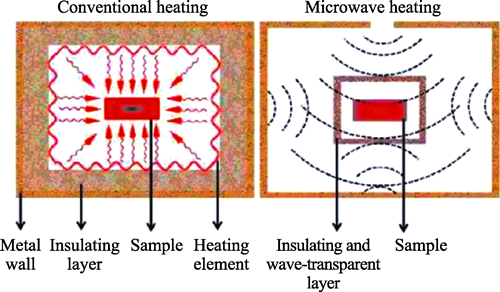
Special ceramics are widely used in aerospace, electronics, information, new energy, machinery, chemical industry, and other emerging industries. Their high temperature preparation process is still dominated by traditional gas kilns and electric heating furnaces with high carbon emissions and high energy consumption. The energy conservation-emission reduction situation is grim at present. Therefore, China is facing great pressure to achieve ‘double carbon’ goal, badly needing research and promotion of clean and efficient heating technology. Microwave heating uses the dielectric loss of the material itself to absorb microwave and convert electromagnetic energy into heat energy at molecular level. In this way, heat is generated simultaneously both inside and outside the whole material, leading the temperature gradient very low in the whole material. In addition to the volumetric heating, selective heating, power redistribution, thermal upheaval, and microwave plasma effect are important characteristics of microwave sintering. Microwave heating has the advantages of energy conservation, environmental protection, improved product performance and reduced combustion carbon emissions. There are many reports on microwave synthesis of various oxides, carbides, nitrides ceramic powders, and microwave sintering ceramic composites domestic and abroad. In this paper, the basic theories of microwave sintering and microwave mixed sintering are reviewed firstly, and then the latest research progress on preparation of ceramic powders by microwave heating and ceramic materials preparation by microwave sintering is introduced. Finally, microwave heating used in sintering of ceramic engineering products is introduced, which shows the superiority of microwave sintering. The key problems and the future development direction of special ceramics prepared by microwave sintering are also proposed.
CHEN Yongqiang , WANG Yixue , ZHANG Fan , LI Hongxia , DONG Binbin , MIN Zhiyu , ZHANG Rui . Preparation of Special Ceramics by Microwave Heating: a Review[J]. Journal of Inorganic Materials, 2022 , 37(8) : 841 -852 . DOI: 10.15541/jim20220002
| [1] | URKOVI L, VESELI R, GABELICA I, et al. A review of microwave-assisted sintering technique. Transactions of Famena, 2021, 45(1): 1-16. |
| [2] | 田永赉, 陶金陵, 郭景坤. 新型微波烧结陶瓷装置的研制. 科学通报, 1990, 21: 1641-1643. |
| [3] | SUTTON W H. Microwave processing of ceramics-an overview. MRS Online Proceeding Library Archive, 1992, 269: 3-20 |
| [4] | AGRAWAL D. Microwave sintering of ceramics, composites and metal powders. Sintering of Advanced Materials, 2010: 222-248. |
| [5] | BINNER D J. Microwave processing of materials. Materials and Design, 1991, 12(4): 231. |
| [6] | Yl A, JZA B, BING D A. Transparent MgAl2O4ceramics prepared by microwave sintering and hot isostatic pressing. Ceramics International, 2020, 46(16): 25738-25740. |
| [7] | THRIDANDAPANI R R, FOLZ D C, CLARK D E. Effect of electric field (2.45 GHz) on sintering behavior of fully stabilized zirconia. Journal of the European Ceramic Society, 2015, 35(7): 2145-2152. |
| [8] | BROSNANR K H, MESSING G L, AGRAWAL D K. Microwave sintering of alumina at 2.45 GHz. 104th Meeting of the American Ceramic Society, 2003, 86(8): 1308-1312. |
| [9] | CHAIX J M. Microwave sintering of ceramics. Reference Module in Materials Science and Materials Engineering, 2020, 1: 327-341. |
| [10] | BORRELL A, SALVADOR M D. Advanced ceramic materials sintered by microwave technology. Sintering Technology-Method and Application, 2018: 3-24. |
| [11] | STUART H. Ceramic processing and sintering. Materials & Design, 1996, 17(1): 55-56. |
| [12] | LAKSHMANAN A. Sintering to transparency of polycrystalline ceramic materials. Sintering of Ceramics-New Emerging Techniques, 2012, 16: 530-552. |
| [13] | MANIERE C, ZAHRAH T, OLEVSKY E A. Inherent heating instability of direct microwave sintering process: sample analysis for porous 3Y-ZrO2. Scripta Materialia, 2017, 128: 49-52. |
| [14] | MANIERE C, ZAHRAH T, OLEVSKY E A. Fully coupled electromagnetic-thermal-mechanical comparative simulation of direct vs hybrid microwave sintering of 3Y-ZrO2. Journal of the American Ceramic Society, 2017, 100(6): 2439-2450. |
| [15] | HALIM A, SUDIN I, WAN F, et al. Formation of yttria aluminium garnet by microwave sintering. Materials Science Forum, 2020, 1010: 222-227. |
| [16] | VLEUGELS J, DEURSEN J V, ROEY O V, et al. Hybrid microwave sintering of titanium biomedical implants. 13th International Conference on Microwave and High Frequency Heating, France, 2011: 305-308. |
| [17] | BINNER J, VAIDHYANATHAN B, CARNEY T. Microwave hybrid sintering of nanostructured YSZ ceramics. Advances in Science and Technology, 2006, 45: 835-844. |
| [18] | AKINWEKOMI A D, YEUNG K W, TANG C Y, et al. Finite element simulation of hybrid microwave sintering based on power approach. International Journal of Advanced Manufacturing Technology, 2020, 110(9/10): 1-13. |
| [19] | HEUGUET R, MARINEL S, THUAULT A, et al. Effects of the susceptor dielectric properties on the microwave sintering of alumina. Journal of the American Ceramic Society, 2013, 96(12): 3728-3736. |
| [20] | DUBE D, RAMESH P, CHENG J, et al. Experimental evidence of redistribution of fields during processing in a high-power microwave cavity. Applied Physics Letters, 2004, 85(16): 3632-3634. |
| [21] | PIAN X X, FAN B B, CHEN H, et al. Preparation of m-ZrO2compacts by microwave sintering. Ceramics International, 2014, 40(7): 10483-10488. |
| [22] | YADOJI P, PEELAMEDU R, AGRAWAL D, et al. Microwave sintering of Ni-Zn ferrites: comparison with conventional sintering. Materials Science & Engineering B, 2003, 98(3): 269-278. |
| [23] | LEONELLI C, VERONESI P, DENTI L, et al. Microwave assisted sintering of green metal parts. Journal of Materials Processing Technology, 2008, 205(1): 489-496. |
| [24] | ROY R, AGRAWAL D, CHENG J P, et al. Full sintering of powdered-metal bodies in a microwave field. Nature, 1999, 399: 668-670. |
| [25] | FAN S H, ZHENG H, GAO Q C, et al. Preparation of Al2O3-mullite thermal insulation materials with AlF3 and SiC as aids by microwave sintering. International Journal of Applied Ceramic Technology, 2020, 17(5): 2250-2258. |
| [26] | SONG X Y, LIU X M, ZHANG J X. Neck formation and self-adjusting mechanism of neck growth of conducting powders in spark plasma sintering. Journal of American Ceramic Society, 2006, 89: 494-500. |
| [27] | ZHANG X Y, GAO Q C, SONG B Z, et al. Effect of C: SiO2 ratio on heating behavior and photoluminescence property of SiC by microwave. Science of Advanced Materials, 2021, 13: 591-596. |
| [28] | SHEN Z, JOHNSSON M, ZHE Z, et al. Spark plasma sintering of alumina. Journal of the American Ceramic Society, 2010, 85(8): 1921-1927. |
| [29] | CHEN Y Q, LI S, LI W, et al. Effect of SiCp addition on microstructure and mechanical properties of ZTA ceramics by microwave sintering. Solid State Phenomena, 2018, 281: 217-223. |
| [30] | GIL-FLORES L, SALVADOR M D, PENARANDA-FOLX F L, et al. Microstructure and mechanical properties of 5.8 GHz microwave-sintered ZrO2 /Al2O3 ceramics. Ceramics International, 2019, 45(14): 18059-18064. |
| [31] | ZHAO T, LU H, XIANG H, et al. Preparation of high purity α-Al2O3 particles derived from industrial waste solution via microwave calcining and seeding technique. Materials Research Express, 2018, 6(1): 1-11. |
| [32] | LE T, WANG T, RAVINDRA A V, et al. Fast synthesis of submicron zeolite Y using microwave heating. Kinetics and Catalysis, 2021, 62(3): 436-444. |
| [33] | VOLLATH D, SZABO D V, HAU J, et al. Synthesis and properties of ceramic nanoparticles and nanocomposites. Journal of the European Ceramic Society, 1997, 17(11): 1317-1324. |
| [34] | 戴长虹, 张显鹏, 张劲松, 等. 微波法合成AlN纳米微粉. 金属学报, 1996, 32(11): 1221-1226. |
| [35] | 曹传宝, 喻维杰, 彭定坤, 等. 微波等离子体化学气相淀积纳米级 ZrO2薄膜. 无机材料学报, 1992, 7(3): 323-328. |
| [36] | WILLERT-PORADA M, KRUMMEL T, ROHDE B. Ceramic powders generated by metallorganic and microwave processing. MRS Proc., 1992, 269: 199. |
| [37] | 彭金辉, Volla D. 微波加热在陶瓷材料中的应用. 稀有金属, 1997, 21(5): 363-365. |
| [38] | LI J, TAKASHI S, MASAYOSHI F. Rapid carbothermal synthesis of nanostructured silicon carbide particles and whiskers from rice husk by microwave heating method. Advanced Powder Technology, 2013, 24(5): 838-843. |
| [39] | TONY V C S, VOON C H, LEE C C, et al. Novel synthesis of silicon carbide nanotubes by microwave heating of blended silicon dioxide and multi-walled carbon nanotubes: the effect of the heating temperature. Ceramics International, 2016, 42(15): 17642-17649. |
| [40] | LAI Y Q, SUN Z, JIANG L X, et al. Rapid sintering of ceramic solid electrolytes LiZr2(PO4)3 and Li1.2Ca0.1Zr1.9(PO4)3 using a microwave sintering process at low temperatures. Ceramics International, 2019, 45(8): 11068-11072. |
| [41] | ENRIQUE C P, JENIFER S, ANAELISE M C, et al. Microwave synthesis of silica nanoparticles and its application for methylene blue adsorption, Journal of Environmental Chemical Engineering, 2018, 6(1): 649-659. |
| [42] | ANA P, ANA S, DANIELA N, et al. Ultra-fast microwave synthesis of ZnO nanorods on cellulose substrates for UV sensor applications. Materials, 2017, 10(11): 1308. |
| [43] | CHEN H, FAN B B, XIN Z, et al. Preparation of α-Al2O3 powder by microwave pyrolysis. Key Engineering Materials, 2014, 602-603: 88-92. |
| [44] | 张昕. 微波烧结Al2O3/SiC复合材料研究. 郑州: 郑州大学硕士学位论文, 2013. |
| [45] | 陈浩. 微波热解制备氧化锆纳米粉体的工艺及机理研究. 郑州: 郑州大学硕士学位论文, 2014. |
| [46] | HUANG X M, ZORMAN C. MEHREGANY A, et al. Nanodevice motion at microwave frequencies. Nature, 2003, 421(6922): 496-496. |
| [47] | PIERSON H O. Handbook of refractory carbides and nitrides. Noyes Publications, USA, 1996: 248-275. |
| [48] | HILLERY M T. Properties of silicon carbide. Engineering Science & Education Journal, 1997, 6(6): 212-212. |
| [49] | WANG J K, ZHANG Y Z, LI J Y, et al. Catalytic effect of cobalt on microwave synthesis of β-SiC powder. Powder Technology, 2017, 317: 209-215. |
| [50] | LIU S, WANG J G. Tunable magnetic properties of SiC obtained by microwave heating. Journal of Alloys and Compounds, 2018, 731: 369-374. |
| [51] | VOON C H, LIM B Y, GOPINATH S C B, et al. Green synthesis of silicon carbide nanowhiskers by microwave heating of blends of palm kernel shell and silica. IOP Conference Series: Materials Science and Engineering, 2016, 160(1): 012057. |
| [52] | LI J, SHIRAI T, JI M F. Rapid carbothermal synthesis of nanostructured silicon carbide particles and whiskers from rice husk by microwave heating method. Advanced Powder Technology, 2013, 24(5): 838-843. |
| [53] | ZHAN H J, ZHANG N, WU D. Controlled synthesis of β-SiC with a novel microwave sintering method. Materials Letters, 2019, 255(15): 126586. |
| [54] | WANG J, HUANG S, LIU S, et al. EBSD characterization of the growth mechanism of SiC synthesized via direct microwave heating. Materials Characterization, 2016, 114: 54-61. |
| [55] | 郝斌, 刘剑, 刘进强. 微波烧结制备碳化硅晶须的影响因素. 材料热处理学报, 2013, 34(8): 1-5. |
| [56] | 解亚军. 微波合成SiC晶体的工艺研究. 郑州: 郑州大学硕士学位论文, 2016. |
| [57] | SONG B, ZHAO B, FAN L, et al. Investigation on heating behavior during the preparation of SiC crystals by microwave sintering. International Journal of Applied Ceramic Technology, 2017, 14: 833-1025. |
| [58] | WEI S, GUAN L, SONG B, et al. Seeds-induced synthesis of SiC by microwave heating. Ceramics International, 2019, 45: 9771-9775. |
| [59] | SONG B, ZHAO B, LU Y, et al. Investigation on the growth mechanism of SiC whiskers during microwave synthesis. Physical Chemistry Chemical Physics, 2018, 20: 25799-25805. |
| [60] | ZHANG X, SONG B, ZHANG Y, et al. Influences of pre-forming on preparation of SiC by microwave heating. Ceramics International, 2018, 44: 21309-21313. |
| [61] | LI X, FAN B, LU H, et al. Investigation on preparation of Na0.5K0.5NbO3 nanoparticles by microwave heating method. Materials Research Express, 2018, 5(11): 1-10. |
| [62] | 李杏瑞, 范冰冰, 邵刚, 等. 微波法制备CaZrO3掺杂铌酸钾钠压电粉体研究. 第十九届全国高技术陶瓷学术年会论文集, 湖北, 2016: 17. |
| [63] | 张世豪, 范冰冰, 高前程, 等. 反应温度和添加剂含量对微波合成碳化硼微观形貌的影响. 人工晶体学报, 2017, 46(3): 463-467. |
| [64] | 种小川, 肖国庆, 丁冬海, 等. 碳化硼粉体合成方法的研究进展. 材料导报, 2019, 33(15): 2524-2531. |
| [65] | CHAN D A, DASGUPTA S, BOSE S, et al. Microwave sintering of calcium phosphate ceramics. Materials Science and Engineering, 2009, 29: 1144-1149. |
| [66] | KO A, YL A, PM B, et al. Influence of microwave sintering on electrical properties of BCTZ lead free piezoelectric ceramics. Journal of the European Ceramic Society, 2020, 40(4): 1212-1216. |
| [67] | RAMESH P, ZULKIFLI N, TAN C Y, et al. Comparison between microwave and conventional sintering on the properties and microstructural evolution of tetragonal zirconia. Ceramics International, 2018, 44: 8922-8927. |
| [68] | MANGKONSU C, KUNIO I, BUNHAN L, et al. The effect of microwave sintering on the microstructure and properties of calcium phosphate ceramic. Procedia Chemistry, 2016, 19: 498-504. |
| [69] | SAHA R. Microwave sintering of ceramics for dentistry: part 2, Dentistry, 2015, 5(7): 5-8. |
| [70] | CHEN Y, FAN B, YANG B, et al. Microwave sintering and fracture behavior of zirconia ceramics. Ceramics International, 2019, 45(14): 17675-17680. |
| [71] | CROQUESEL J, CARRY C P, CHAIX J M, et al. Direct microwave sintering of alumina in a single mode cavity: magnesium doping effects. Journal of the European Ceramic Society, 2018, 38(4): 1841-1845. |
| [72] | CROQUESEL J, BOUVARD D, CHAIX J M, et al. Direct microwave sintering of pure alumina in a single mode cavity: grain size and phase transformation effects. Acta Materialia, 2016, 116: 53-62. |
| [73] | FIGIEL P, ROZMUS M, SMUK B. Properties of alumina ceramics obtained by conventional and non-conventional methods for sintering ceramics. Journal of Achievements in Materials and Manufacturing Engineering, 2011, 48(1): 71-78. |
| [74] | MOHAMED A M A, MATLI P R, RAJURU R R. Microwave fast sintering of double perovskite ceramic materials. Advanced Ceramic Processing, 2015. |
| [75] | BORRELL A, SALVADOR M D, PENARANDA-FOIX F L, et al. Microwave sintering of zirconia materials: mechanical and microstructural properties. International Journal of Applied Ceramic Technology, 2013, 10(2): 313-320. |
| [76] | SHUKLA M, GHOSH S, DANDAPAT N, et al. Comparative study on conventional sintering with microwave sintering and vacuum sintering of Y2O3-Al2O3-ZrO2 ceramics. Journal of Materials Science and Chemical Engineering, 2016, 4(2): 71-78. |
| [77] | CHENG J, AGRAWAL D, ZHANG Y, et al. Microwave sintering of transparent alumina. Materials Letters, 2002, 56(4): 587-592. |
| [78] | WEI C, FU C, HU W, et al. Effects of microwave sintering power on microstructure, dielectric, ferroelectric and magnetic properties of bismuth ferrite ceramics. Journal of Alloys and Compounds, 2013, 554(6): 64-71. |
| [79] | 郑立辉, 程寓, 汪家傲, 等. 基于辅热材料的微波烧结陶瓷刀具温度场研究. 中国陶瓷工业, 2021, 28: 1-4. |
| [80] | YANG M, WANG H, CHEN R, et al. Comparison of the microwave and conventional sintering of Li2TiO3 ceramic pebbles. Ceramics International, 2018, 44: 19672-19677. |
| [81] | CURTO H, THUAULT A, JEAN F, et al. Coupling additive manufacturing and microwave sintering: a fast processing route of alumina ceramics. Journal of the European Ceramic Society, 2020, 40(7): 2548-2554. |
| [82] | ALVARO P, MARLA D. S, FELIPE L, et al. Effect of microwave sintering on microstructure and mechanical properties in Y-TZP materials used for dental applications. Ceramics International, 2015, 41(5): 7125-7132. |
| [83] | MWKA B, YIKB C, MAHA B, et al. Microwave hybrid sintering of Al2O3 and Al2O3-ZrO2 composites, and effects of ZrO2 crystal structure on mechanical properties, thermal properties, and sintering kinetics. Ceramics International, 2020, 46(7): 9002-9010. |
| [84] | XIAO C, HAN B B. Preparation of porous silicon nitride ceramics by microwave sintering and its performance evaluation. Journal of Materials Research and Technology, 2019, 8(6): 5984-5995. |
| [85] | XU W, YIN Z, YUAN J, et al. Effects of sintering additives on mechanical properties and microstructure of Si3N4 ceramics by microwave sintering. Materials Science and Engineering A, 2016, 684(1): 127-134. |
| [86] | DANG X, WEI M, ZHANG R, et al. Crucial effect of SiC particles on in situ synthesized mullite whisker reinforced Al2O3-SiC composite during microwave sintering. Processing and Application of Ceramics, 2017, 11(2): 106-112. |
| [87] | DANG X, WEI M, FAN B B, et al. Effects of in situ synthesized mullite whisker on mechanical properties of Al2O3-SiC composite by microwave sintering. Materials Research Express, 2017, 4(6): 065015. |
| [88] | 范冰冰, 陈勇强, 李红霞, 等. 一种同步补偿微波混合共烧结方法. CN106673671A |
| [89] | CHEN Y, FAN B, GANG S, et al. Preparation of large size ZTA ceramics with eccentric circle shape by microwave sintering. Journal of Advanced Ceramics, 2016, 5(4): 291-297. |
| [90] | EXARE C, KIAT J M, GUIBLIN N, et al. Structural evolution of ZTA composites during synthesis and processing. Journal of the European Ceramic Society, 2015, 35(4): 1273-1283. |
| [91] | PIAN X, SHAO G, FAN B, et al. Rapid densification of SiC ceramic rollers by microwave sintering. Advances in Applied Ceramics, 2015, 114: 28-32. |
/
| 〈 |
|
〉 |