Journal of Inorganic Materials >
Degradation Mechanism of Silver Nanowire Transparent Conductive Films: a Review
Received date: 2019-03-04
Revised date: 2019-04-28
Online published: 2019-06-15
Supported by
National Natural Science Foundation of China(51771187)
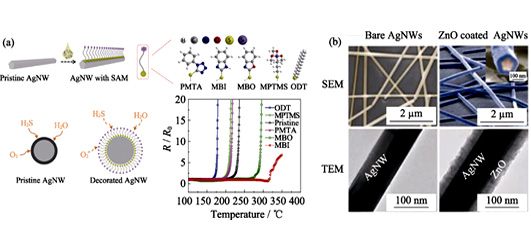
Silver nanowire transparent conductive film is one of the new indium-free electrode materials. It has attracted increasing attention from academia and industry due to its superior optoelectronic properties and excellent flexibility. It has been employed in a wide variety of applications in displays, touch panels, solar cells, smart heaters, electromagnetic interference shielding, and so on. However, silver nanowire transparent conductive film has a serious stability issue in service, for example, break or spheroidization above 300 ℃ under fulfidation, accelerating the degradation under ultraviolet light, pores for mation or even breakdown due to electromigration. In this review, the degradation phenomena is thoroughly introduced, the degradation mechanisms is analyzed, and the remedy strategy of degradation is discussed.
Chang-Hui YE , Yu-Jia GU , Gui-Xin WANG , Li-Li BI . Degradation Mechanism of Silver Nanowire Transparent Conductive Films: a Review[J]. Journal of Inorganic Materials, 2019 , 34(12) : 1257 -1264 . DOI: 10.15541/jim20190098
| [1] | SHANG Z, LI J, FAN C , et al . In situ study on surface roughening in radiation-resistant Ag nanowires. Nanotechnology, 2018,29(21):215708. |
| [2] | BELLET D, LAGRANGE M, SANNICOLO T , et al. Transparent electrodes based on silver nanowire networks: from physical considerations towards device integration. Materials, 2017,10(6):570. |
| [3] | SUN Y, GATES B, MAYERS B , et al. Crystalline silver nanowires by soft solution processing. Nano Lett., 2002,2(2):165-168. |
| [4] | LEE J Y, CONNOR S T, CUI Y , et al. Solution-processed metal nanowire mesh transparent electrodes. Nano Lett., 2008,8(2):689-692. |
| [5] | LIANG G, YI M, HU H , et al. Coaxial-structured weavable and wearable electroluminescent fibers. Adv. Electron. Mater., 2017,3(12):1700401. |
| [6] | SCHUETTE W M, BUHRO W E . Silver chloride as a heterogeneous nucleant for the growth of silver nanowires. ACS Nano, 2013,7(5):3844-3853. |
| [7] | CHEN C, ZHAO Y, WEI W , et al. Fabrication of silver nanowire transparent conductive films with an ultra-low haze and ultra-high uniformity and their application in transparent electronics. J. Mater. Chem. C, 2017,5(9):2240-2246. |
| [8] | VOLOE L, PETERSON P J . The atmospheric sulfidation of silver in a tubular corrosion reactor. Corros. Sci., 1989,29(10):1179-1196. |
| [9] | FRANEY J P, KAMMLOTT G W, GRAEDEL T E . The corrosion of silver by atmospheric sulfurous gases. Corros. Sci., 1989,25(2):113-143. |
| [10] | ELECHIGUERRA J L, LOPEZ L L, LIU C , et al. Corrosion at the nanoscale: the case of silver nanowires and nanoparticles. Chem. Mater., 2005,17(24):6042-6052. |
| [11] | GRAEDEL T E, FRANEY J P, GUALTIERI G J , et al. On the mechanism of silver and copper sulfidation by atmospheric H2S and OCS. Corros. Sci., 1985,25(12):1163-1180. |
| [12] | KHAN A, NGUYEN V H, ROJAS D M , et al. Stability enhancement of ailver nanowire networks with conformal ZnO coatings deposited by atmospheric pressure spatial atomic layer deposition. ACS Appl. Mater. Interfaces, 2018,10(22):19208-19217. |
| [13] | ZHANG X, YAN X, CHEN J , et al. Large-size graphene microsheets as a protective layer for transparent conductive silver nanowire film heaters. Carbon, 2014,69:437-443. |
| [14] | HWANG B, AN Y, LEE H , et al. Highly flexible and transparent Ag nanowire electrode encapsulated with ultra-thin Al2O3: thermal, ambient, and mechanical stabilities. Sci. Rep., 2017,7:41336. |
| [15] | AHN Y, JEONG Y, LEE Y . Improved thermal oxidation stability of solution-processable silver nanowire transparent electrode by reduced graphene oxide. ACS Appl. Mater. Interfaces, 2012,4(12):6410-6414. |
| [16] | LAGRANGE M, LANGLEY D P, GIUSTI G , et al. Optimization of silver nanowire-based transparent electrodes: effects of density, size and thermal annealing. Nanoscale, 2015,7(41):17410-17423. |
| [17] | LAGRANGE M, SANNICOLO T, ROJAS D M , et al. Understanding the mechanisms leading to failure in metallic nanowire- based transparent heaters, and solution for stability enhancement. Nanotechnology, 2017,28(5):055709. |
| [18] | KHALIGH H H, XU L, KHOSROPOUR A , et al. The Joule heating problem in silver nanowire transparent electrodes. Nanotechnology, 2017,28(42):425703. |
| [19] | SANNICOLO T, CHARVIN N, FLANDIN L , et al. Electrical mapping of silver nanowire networks: a versatile tool for imaging network homogeneity and degradation dynamics during failure. ACS Nano, 2018,12(5):4648-4659. |
| [20] | FANTANAS D, BRUNTON A, HENLEY S J , et al. Investigation of the mechanism for current induced network failure for spray deposited silver nanowires. Nanotechnology, 2018,29(46):465705. |
| [21] | KHALIGH H H, GOLDTHORPE I A . Failure of silver nanowire transparent electrodes under current flow. Nanoscale Res.Lett., 2013, 8(1):235. |
| [22] | CHEN D, ZHAO F, TONG K , et al. Mitigation of electrical failure of silver nanowires under current flow and the application for long lifetime organic light-emitting diodes. Adv. Electron. Mater., 2016,2(8):1600167. |
| [23] | WANG J, JIU J, ZHANG S , et al. The comprehensive effects of visible light irradiation on silver nanowire transparent electrode. Nanotechnology, 2018,29(43):435701. |
| [24] | LEE G P, SHI Y, LAVOIE E , et al. Light-driven transformation processes of anisotropic silver nanoparticles. ACS Nano, 2013,7(7):5911-5921. |
| [25] | GRILLET N, MANCHON D, COTTANCIN E , et al. Photo- oxidation of individual silver nanoparticles: a real-time tracking of optical and morphological changes. J. Phys. Chem. C, 2013,117(5):2274-2282. |
| [26] | SINDERMANN S P, LATZ A, SPODDIG D , et al. Lattice degradation by moving voids during reversible electromigration. J. Appl. Phys., 2014,116(3):034502. |
| [27] | CHEUK K W, PEI K, CHAN P K L . Degradation mechanism of a junction-free transparent silver network electrode. RSC Adv., 2016,6(77):73769-73775. |
| [28] | LIU G S, XU Y, KONG Y , et al. Comprehensive stability improvement of silver nanowire networks via self-assembled mercapto inhibitors. ACS Appl. Mater. Interfaces, 2018,10(43):37699-37708. |
| [29] | DENG B, HSU P C, CHEN G , et al. Roll-to-roll encapsulation of metal nanowires between graphene and plastic substrate for high-performance flexible transparent electrodes. Nano Lett., 2015,15(6):4206-4213. |
| [30] | RAMASAMY P, SEO D M, KIM S H , et al. Effects of TiO2 shells on optical and thermal properties of silver nanowires. J. Mater. Chem., 2012,22(23):11651-11657. |
| [31] | CHEN D, LIANG J, LIU C , et al. Thermally stable silver nanowire-polyimide transparent electrode based on atomic layer deposition of zinc oxide on silver nanowires. Adv. Funct. Mater., 2015,25(48):7512-7520. |
/
| 〈 |
|
〉 |