无机材料学报 ›› 2026, Vol. 41 ›› Issue (11): 1658-1666.DOI: 10.15541/jim20260054
南天翔1,2( ), 王立昇1, 郭立童1,2(), 吴震1, 陶雪钰1, 范贺良1, 郑明1, 冯培忠1
收稿日期:2026-01-31
修回日期:2026-04-29
出版日期:2026-05-19
网络出版日期:2026-05-19
通讯作者:
郭立童, 教授. E-mail: litongguo@cumt.edu.cn作者简介:南天翔(1994-), 男, 副教授. E-mail: tianxiang.nan@cumt.edu.cn
基金资助:
NAN Tianxiang1,2(), WANG Lisheng1, GUO Litong1,2(), WU Zhen1, TAO Xueyu1, FAN Heliang1, ZHENG Ming1, FENG Peizhong1
Received:2026-01-31
Revised:2026-04-29
Published:2026-05-19
Online:2026-05-19
Contact:
GUO Litong, professor. E-mail: litongguo@cumt.edu.cnAbout author:NAN Tianxiang (1994-), male, associate professor. E-mail: tianxiang.nan@cumt.edu.cn
Supported by:摘要:
有机污染废水的高效处理对水环境安全和实现资源可持续发展具有重要意义。目前, 基于过一硫酸盐(PMS)的高级氧化技术虽在降解有机物方面展示出独特优势, 但开发兼具高活性、稳定性与低成本的实用型催化剂仍是该领域面临的主要挑战。本研究采用基于等离子辅助球磨的制备技术合成了煤基稀土-过渡金属多组分催化剂(Vm@PC-FeCoNiSm), 并将其应用于PMS体系降解有机污染物盐酸四环素(TC)。结果表明, 所制备的催化剂具有均匀的微棒状形貌和微-介孔复合结构, 比表面积达789.2 m2/g。在PMS 2.0 mmol/L、催化剂0.10 g/L条件下, Vm@PC-FeCoNiSm可在30 min内降解96.3%的TC, 其效率显著优于未经等离子处理的对比样品。经过五次循环使用后, 降解效率仍保持在91%以上, 且在实际水体中仍能稳定发挥降解性能。该降解过程由自由基(O2•-、•OH、SO4•-)与非自由基(1O2)共同驱动, 其中O2•-与1O2起主导作用, 稀土元素Sm与过渡金属间的电子协同效应是提升PMS活化效率与生成高活性物种的关键。本研究不仅为复杂有机废水的深度处理提供了高性能新材料, 也为煤基碳材料与稀土元素在环境催化中的高值化应用提供了新策略与理论依据。
中图分类号:
南天翔, 王立昇, 郭立童, 吴震, 陶雪钰, 范贺良, 郑明, 冯培忠. 等离子辅助球磨制备煤基稀土催化剂及其对盐酸四环素的降解性能[J]. 无机材料学报, 2026, 41(11): 1658-1666.
NAN Tianxiang, WANG Lisheng, GUO Litong, WU Zhen, TAO Xueyu, FAN Heliang, ZHENG Ming, FENG Peizhong. Preparation of Coal-based Rare Earth Catalysts via Plasma-assisted Ball Milling and Performance in the Degradation of Tetracycline Hydrochloride[J]. Journal of Inorganic Materials, 2026, 41(11): 1658-1666.
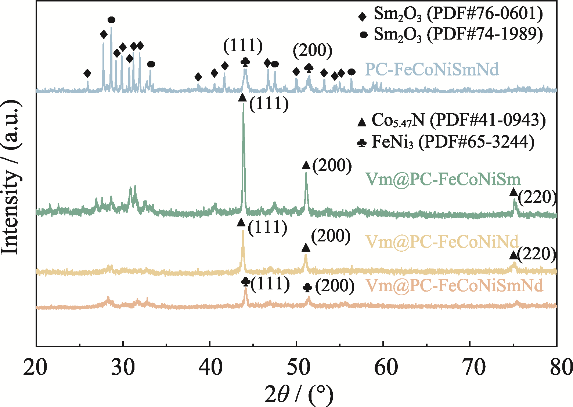
图1 不同稀土元素掺杂的催化剂与普通球磨工艺制备的复合催化剂的XRD图谱
Fig. 1 XRD patterns of catalysts doped with various rare earth elements and composite catalysts via general ball milling process
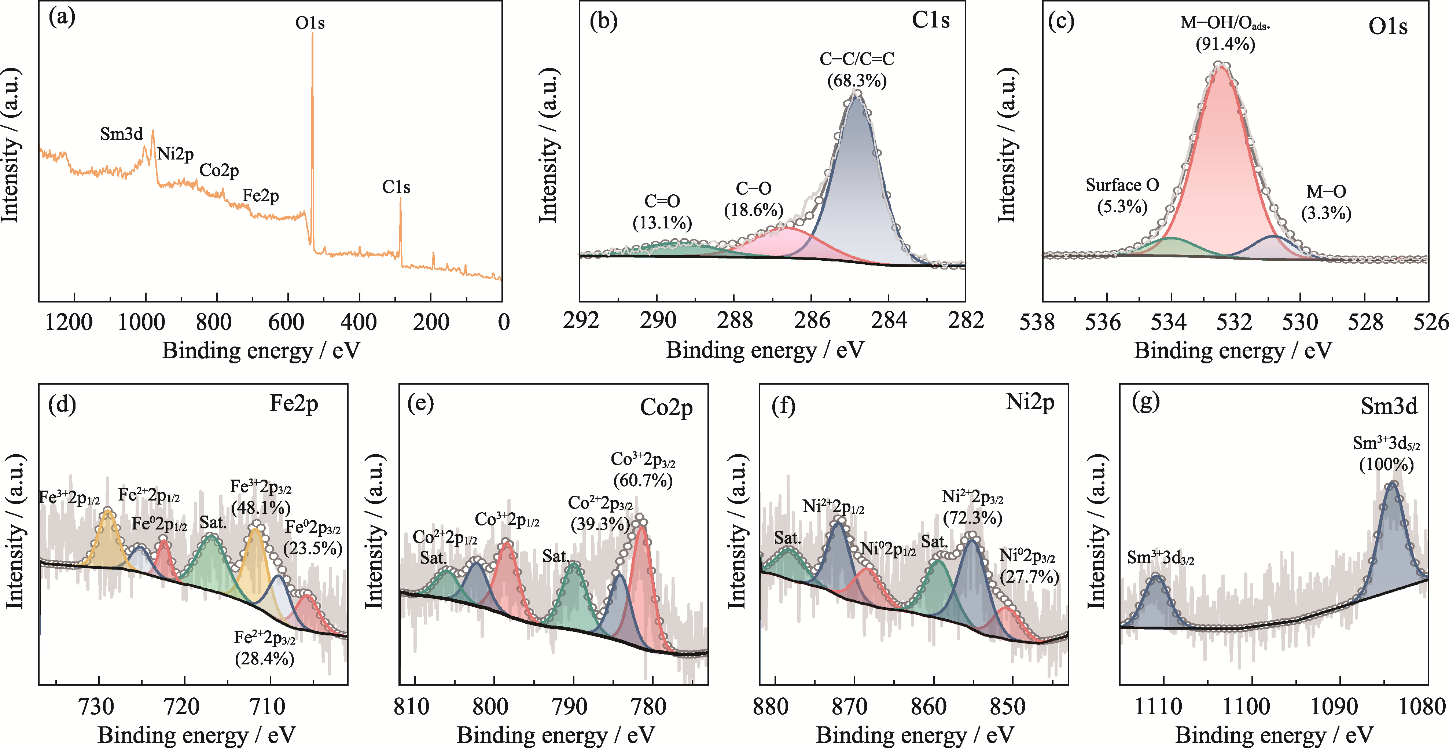
图2 Vm@PC-FeCoNiSm催化剂的XPS图谱
Fig. 2 XPS spectra of the Vm@PC-FeCoNiSm catalyst (a) Survey; (b) C1s; (c) O1s; (d) Fe2p; (e) Co2p; (f) Ni2p; (g) Sm3d
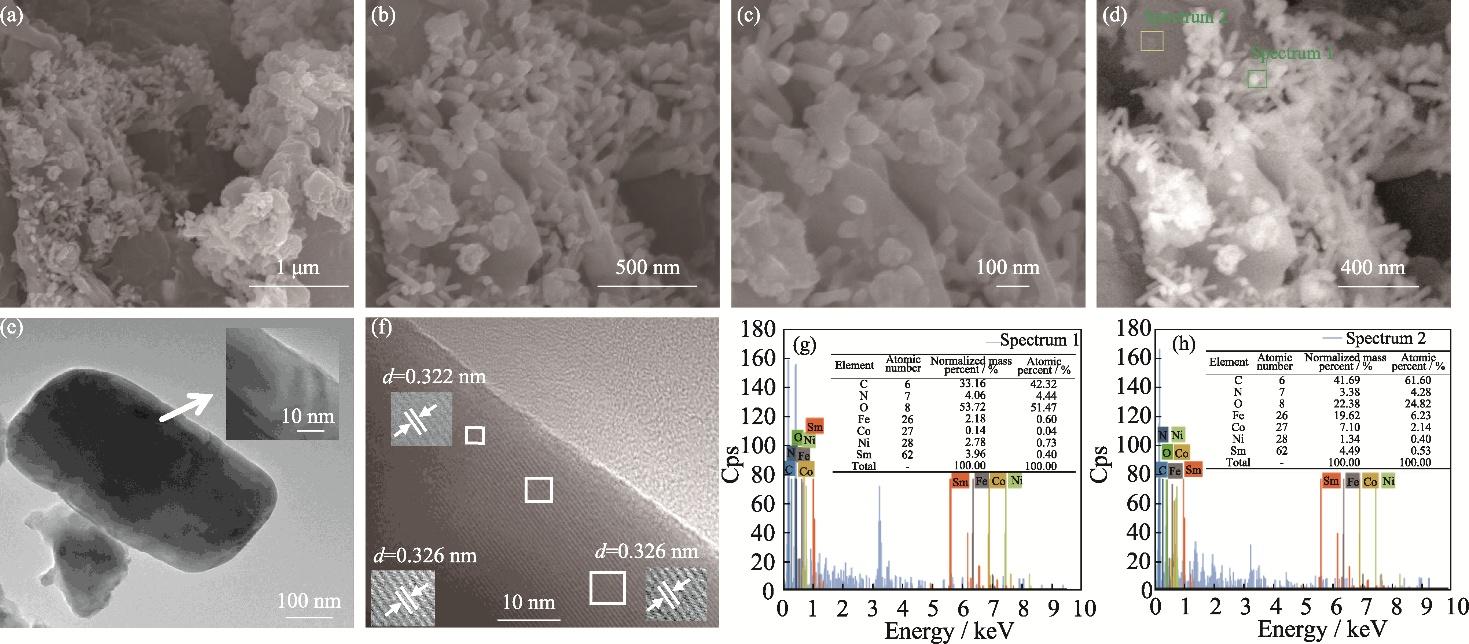
图3 Vm@PC-FeCoNiSm催化剂的(a~d) SEM照片、(e, f) HRTEM照片及(g, h) EDS分析
Fig. 3 (a-d) SEM images, (e, f) HRTEM images, and (g, h) EDS analysis of the Vm@PC-FeCoNiSm catalyst
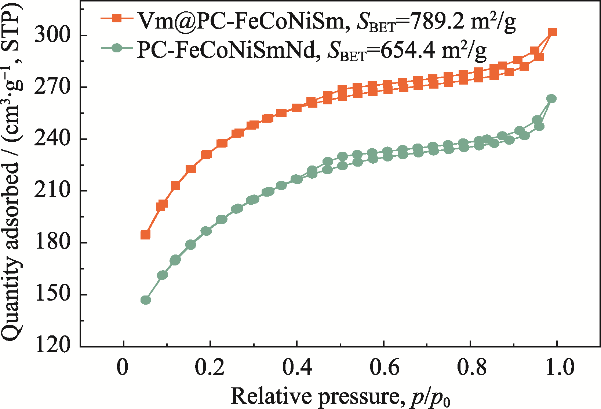
图4 77 K下氮气吸附-解吸等温线
Fig. 4 Nitrogen adsorption-desorption isotherms at 77 K
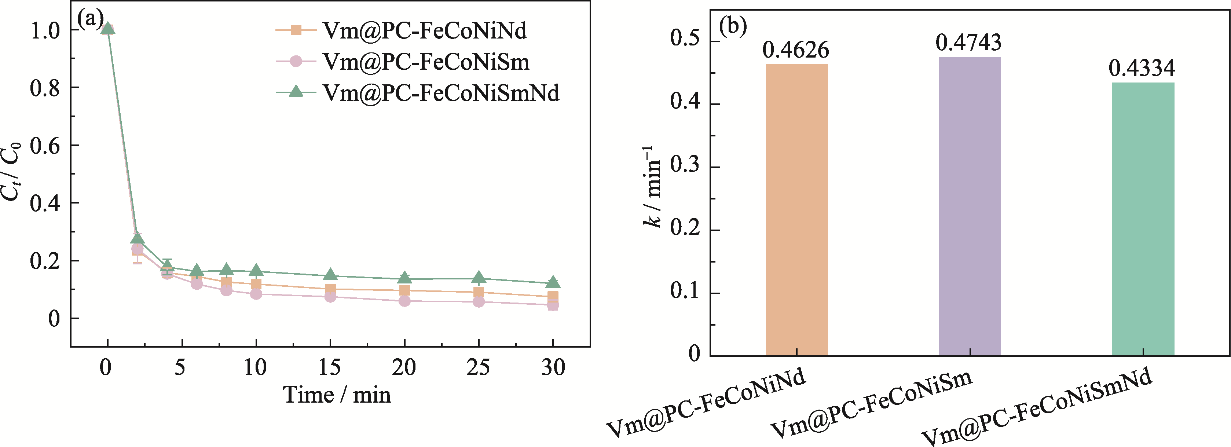
图5 PMS体系下不同稀土掺杂催化剂对(a) TC降解和(b)反应速率常数的影响
Fig. 5 Effects of different rare earth-doped catalysts on (a) TC degradation and (b) reaction rate constants in PMS system
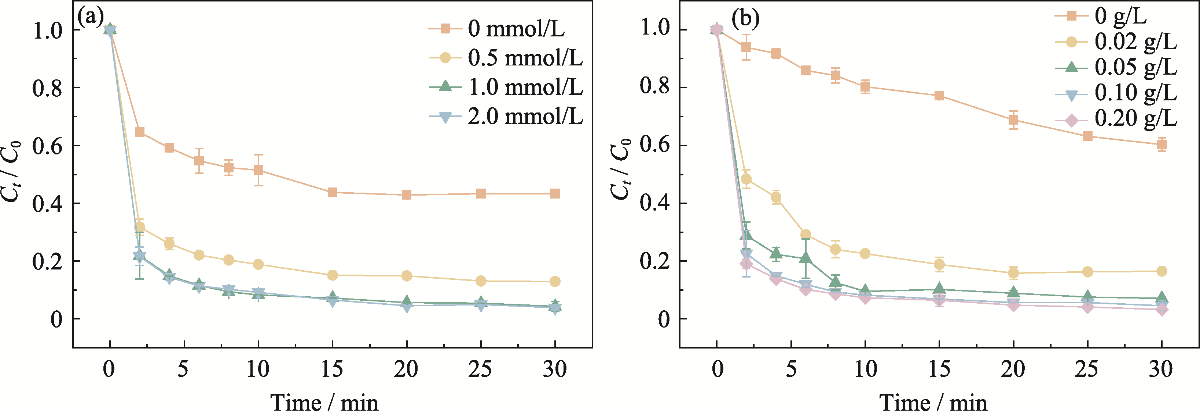
图6 PMS体系下(a) PMS添加量和(b)催化剂用量对TC降解的影响
Fig. 6 Effects of (a) PMS dosage and (b) catalyst dosage on TC degradation in PMS system
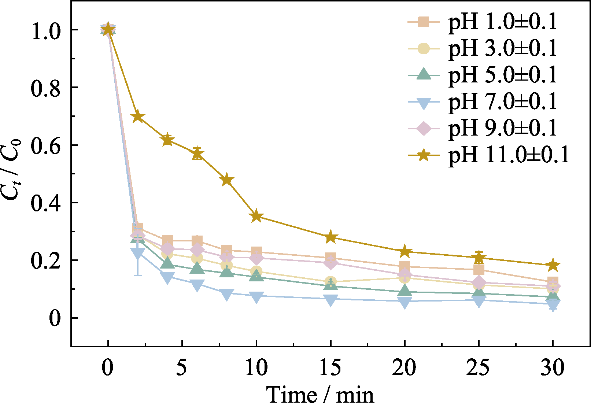
图7 PMS体系下溶液初始pH对TC降解的影响
Fig. 7 Effect of initial pH on TC degradation in PMS system
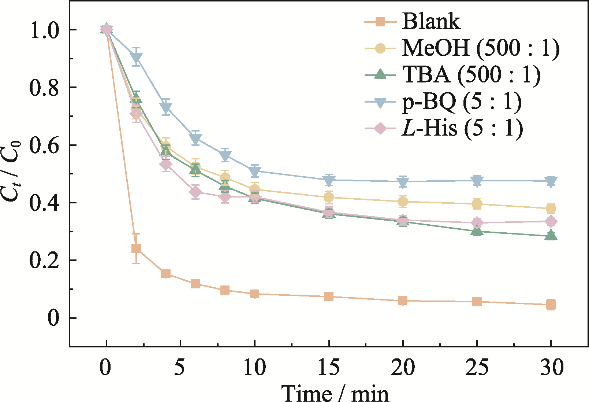
图8 淬灭剂对TC降解的影响
Fig. 8 Effect of quenchers on TC degradation
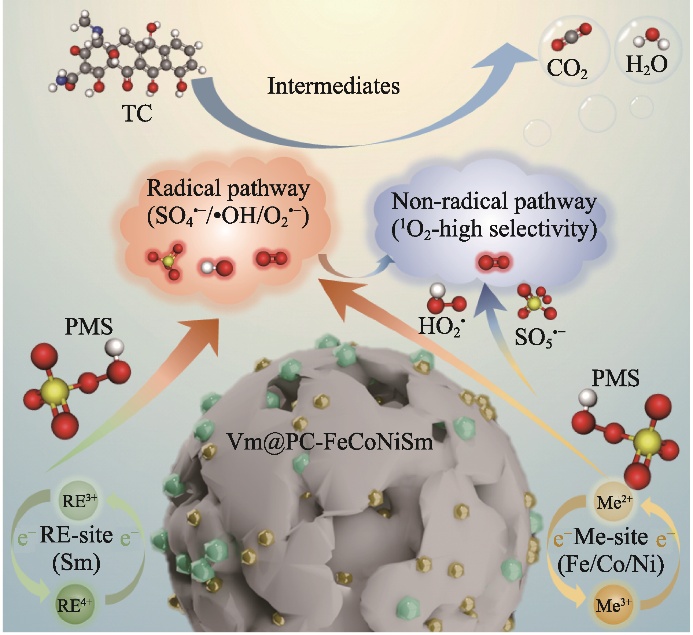
图9 煤基稀土催化剂降解TC机理示意图
Fig. 9 Mechanism of TC degradation by coal-based rare earth catalysts
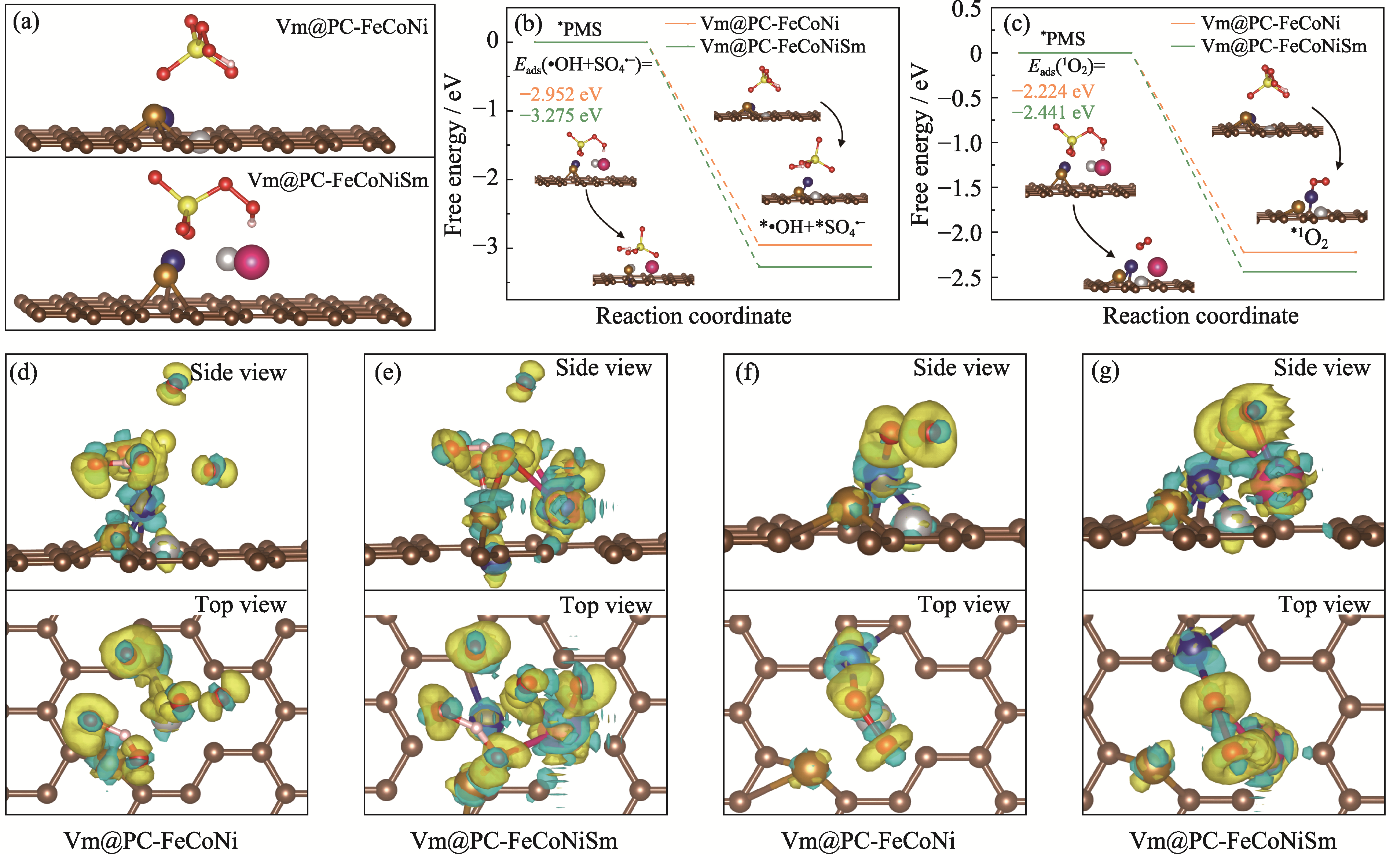
图10 (a)催化剂吸附PMS模型; (b)吸附自由基反应能量变化; (c)吸附非自由基反应能量变化; (d, e)自由基吸附的差分电荷密度; (f, g)非自由基吸附的差分电荷密度
Fig. 10 (a) PMS adsorption on the catalysts; (b) Energy changes during the adsorption step in radical pathways; (c) Energy changes during the adsorption step in non-radical pathways; (d, e) Differential charge density for radical adsorption; (f, g) Differential charge density for non-radical adsorption
| Catalyst | Composition | Carbon source/carrier | Preparation method | Degradation efficiency, time | Ref. |
|---|---|---|---|---|---|
| SHQC | Sulfur heterocyclic organic quinone | Quinones | Precursor synthesis+heat treatment | 90.3%, 120 min | [ |
| 4%PdO/CFO/CK | PdO/CuFe2O4 | Coal-bearing strata kaolinite | Hydrothermal method | 91.96%, 20 min | [ |
| FONC@PAC | Fe3O4 | Powdered activated charcoal | Co-precipitation | 86.9%, 90 min | [ |
| Er-Co3O4 | Er/Co3O4 | - | Co-precipitation+calcination | 82.0%, 4 min | [ |
| PC-FeCoNiSmNd | Fe/Co/Ni/Sm/Nd | Pulverized coal | Ball milling + pyrolysis | 95.7%, 30 min | [ |
| Vm@PC-FeCoNiSm | Fe/Co/Ni/Sm | Pulverized coal | Plasma-assisted ball milling + pyrolysis | 96.3%, 30 min | This work |
表1 与其他文献中TC降解性能的比较[25-29]
Table 1 Comparison of TC degradation performance with other reported studies[25-29]
| Catalyst | Composition | Carbon source/carrier | Preparation method | Degradation efficiency, time | Ref. |
|---|---|---|---|---|---|
| SHQC | Sulfur heterocyclic organic quinone | Quinones | Precursor synthesis+heat treatment | 90.3%, 120 min | [ |
| 4%PdO/CFO/CK | PdO/CuFe2O4 | Coal-bearing strata kaolinite | Hydrothermal method | 91.96%, 20 min | [ |
| FONC@PAC | Fe3O4 | Powdered activated charcoal | Co-precipitation | 86.9%, 90 min | [ |
| Er-Co3O4 | Er/Co3O4 | - | Co-precipitation+calcination | 82.0%, 4 min | [ |
| PC-FeCoNiSmNd | Fe/Co/Ni/Sm/Nd | Pulverized coal | Ball milling + pyrolysis | 95.7%, 30 min | [ |
| Vm@PC-FeCoNiSm | Fe/Co/Ni/Sm | Pulverized coal | Plasma-assisted ball milling + pyrolysis | 96.3%, 30 min | This work |
| Element | C | H | O | N | S |
|---|---|---|---|---|---|
| Content/% (in mass) | 83.55 | 0.14 | 2.11 | 0.35 | 0.20 |
表S1 实验所用无烟煤化学成分分析
Table S1 Chemical composition of the coal used in the experiment
| Element | C | H | O | N | S |
|---|---|---|---|---|---|
| Content/% (in mass) | 83.55 | 0.14 | 2.11 | 0.35 | 0.20 |
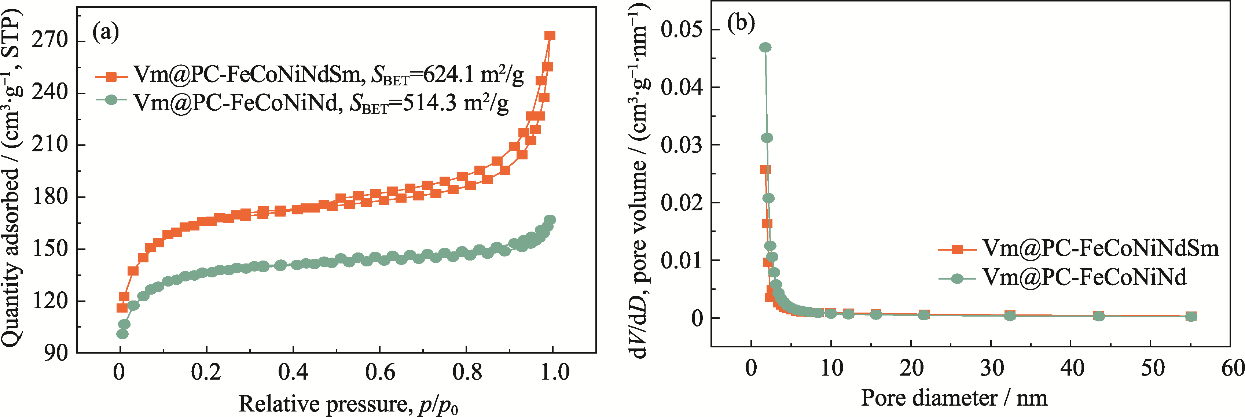
图S1 (a)77 K下Vm@PC-FeCoNiNd和Vm@PC-FeCoNiSmNd的氮气吸附-解吸等温线及(b)基于BJH模型的孔径分布曲线
Fig. S1 (a) Nitrogen adsorption-desorption isotherms of Vm@PC-FeCoNiNd and Vm@PC-FeCoNiSmNd at 77 K and (b) pore size distributions derived from the BJH model
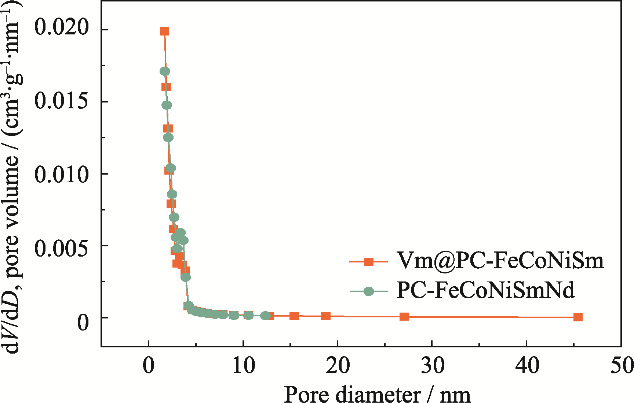
图S2 PC-FeCoNiSmNd和Vm@PC-FeCoNiSm的BJH孔径分布曲线
Fig. S2 Pore size distributions of PC-FeCoNiSmNd and Vm@PC-FeCoNiSm derived from the BJH model
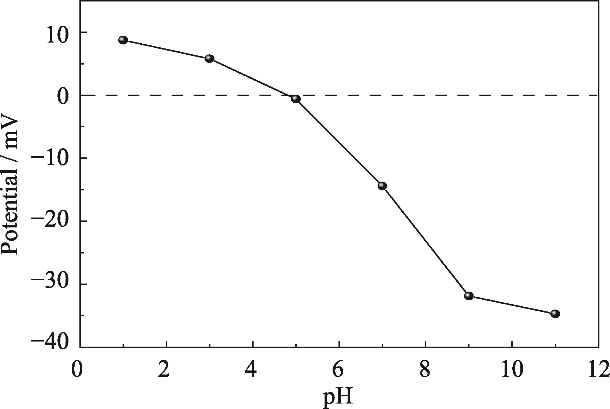
图S3 PMS体系下催化剂表面Zeta电位随pH的变化规律
Fig. S3 pH-dependent Zeta potential of the catalyst surface in PMS system
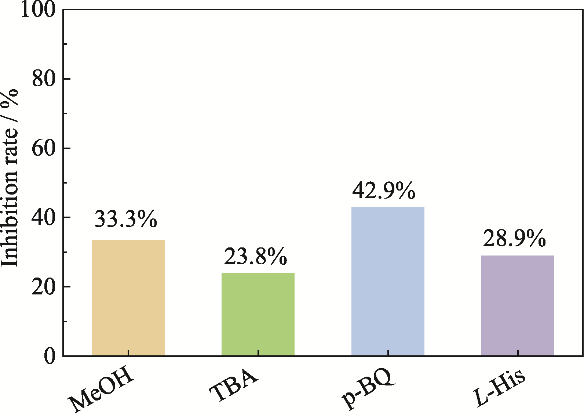
图S4 不同淬灭剂对TC降解的抑制率
Fig. S4 Inhibition rate of various quenchers on TC degradation
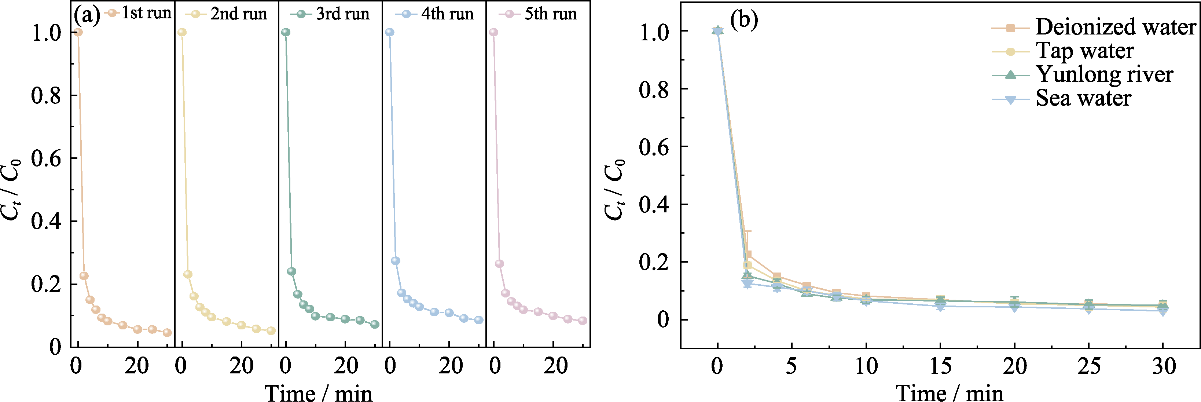
图S5 (a)不同循环次数和(b)不同水基质体系下Vm@PC-FeCoNiSm的降解TC性能
Fig. S5 Degradation of TC by Vm@PC-FeCoNiSm under (a) different cycle numbers and (b) different aqueous matrix systems
| Chemical formulation | NaCl | MgCl2 | Na2SO4 | CaCl2 | KCl | NaHCO3 | KBr | H3BO3 | SrCl2 |
|---|---|---|---|---|---|---|---|---|---|
| Concentration/(g·L-1) | 24.530 | 5.220 | 4.090 | 1.160 | 0.695 | 0.201 | 0.101 | 0.027 | 0.025 |
表S2 实验所用模拟海水配方(盐度35‰)
Table S2 Formulation of simulated seawater used in the experiment (salinity 35‰)
| Chemical formulation | NaCl | MgCl2 | Na2SO4 | CaCl2 | KCl | NaHCO3 | KBr | H3BO3 | SrCl2 |
|---|---|---|---|---|---|---|---|---|---|
| Concentration/(g·L-1) | 24.530 | 5.220 | 4.090 | 1.160 | 0.695 | 0.201 | 0.101 | 0.027 | 0.025 |
| [1] | RUAN T, LI P Y, WANG H T, et al. Identification and prioritization of environmental organic pollutants: from an analytical and toxicological perspective. Chemical Reviews, 2023, 123(17):10584. |
| [2] | LI F, LIU K W, BAO Y P, et al. Molecular level removal of antibiotic resistant bacteria and genes: a review of interfacial chemical in advanced oxidation processes. Water Research, 2024, 254: 121373. |
| [3] | PRIYA E, KUMAR S, VERMA C, et al. A comprehensive review on technological advances of adsorption for removing nitrate and phosphate from waste water. Journal of Water Process Engineering, 2022, 49: 103159. |
| [4] | QUINLIVAN P A, LI L, KNAPPE D R U. Effects of activated carbon characteristics on the simultaneous adsorption of aqueous organic micropollutants and natural organic matter. Water Research, 2005, 39(8):1663. |
| [5] | GRASSET C, GROENEVELD M, TRANVIK L J, et al. Hydrophilic species are the most biodegradable components of freshwater dissolved organic matter. Environmental Science & Technology, 2023, 57(36):13463. |
| [6] | DHAMORIKAR R S, LADE V G, KEWALRAMANI P V, et al. Review on integrated advanced oxidation processes for water and wastewater treatment. Journal of Industrial and Engineering Chemistry, 2024, 138: 104. |
| [7] | LIU L, WU N, OUYANG M, et al. Enhancement effect induced by the second metal to promote ozone catalytic oxidation of VOCs. Environmental Science & Technology, 2024, 58(15):6725. |
| [8] | LI X K, YANG R, ZOU L, et al. Reassessing the role of thermal convection in simultaneous water production and pollutant degradation in interfacial photothermal-photocatalytic systems. Advanced Materials, 2025, 37(4):2416283. |
| [9] | WANG J L, WANG S Z. Activation of persulfate (PS) and peroxymonosulfate (PMS) and application for the degradation of emerging contaminants. Chemical Engineering Journal, 2018, 334: 1502. |
| [10] | GUO Y, HUANG S J, GUO Y, et al. Efficient degradation of organic pollutants by enhanced interfacial internal electric field induced via various crystallinity carbon nitride homojunction. Applied Catalysis B: Environmental, 2022, 312: 121388. |
| [11] | LI C X, GUGGENBERGER P, HAN S W, et al. Ultrathin covalent organic framework anchored on graphene for enhanced organic pollutant removal. Angewandte Chemie International Edition, 2022, 61(35):e202206564. |
| [12] | ZHOU Y R, LI Y H, HOU Y L, et al. Core-shell catalysts for the elimination of organic contaminants in aqueous solution: a review. Chemical Engineering Journal, 2023, 455: 140604. |
| [13] | ZHAN S J, HUANG H T, HE C, et al. Controllable synthesis of substitutional and interstitial nitrogen-doped ceria: the effects of doping sites on enhanced catalytic ozonation of organic pollutants. Applied Catalysis B: Environmental, 2023, 321: 122040. |
| [14] | DAI S F, HOWER J C, FINKELMAN R B, et al. Organic associations of non-mineral elements in coal: a review. International Journal of Coal Geology, 2020, 218: 103347. |
| [15] | JING X X, CHEN B Q, ZHAI J X, et al. Ni-Co-B-RE (Sm, Dy, Tb) composite electrodes: preparation by chemical deposition method and electrocatalytic hydrogen evolution performance. Journal of Inorganic Materials, 2024, 39(5):467. |
| [16] | 王繁强, 施麒, 刘辛, 等. 机械合金化-射频等离子球化制备WMoTaNbV难熔高熵合金球形粉末. 稀有金属材料与工程, 2024, 53(12):3428. |
| [17] | DONG Z L, PENG Y F, ZHANG X H, et al. Plasma assisted milling treatment for improving mechanical and electrical properties of in-situ grown graphene/copper composites. Composites Communications, 2021, 24: 100619. |
| [18] | SACHS M, HARNETT-CAULFIELD L, PASTOR E, et al. Metal-centred states control carrier lifetimes in transition metal oxide photocatalysts. Nature Chemistry, 2025, 17(9):1348. |
| [19] | BABUPONNUSAMI A, MUTHUKUMAR K. Advanced oxidation of phenol: a comparison between Fenton, electro-Fenton, sono-electro-Fenton and photo-electro-Fenton processes. Chemical Engineering Journal, 2012, 183: 1. |
| [20] | CHENG C F, ZHANG F N, CHENG F H, et al. The effect of plasma-assisted ball milling on preparation and sintering behavior of (Zr0.1429Hf0.1429Ce0.1429Y0.2857La0.2857)O2-δ high entropy fluorite oxide. Ceramics International, 2023, 49(8):13092. |
| [21] | QI J Y, QI X K, PAN Y, et al. Sm doped NiO catalysts with excellent H2O resistance for N2O decomposition under simulated nitric acid plant exhaust condition. Applied Surface Science, 2023, 611: 155657. |
| [22] | JOURSHABANI M, SHARIATINIA Z, BADIEI A. Synthesis and characterization of novel Sm2O3/S-doped g-C3N4 nanocomposites with enhanced photocatalytic activities under visible light irradiation. Applied Surface Science, 2018, 427: 375. |
| [23] | SUN N, CHEN J, ZHANG Z L, et al. A bifurcated dendritic SrCO3-TiO2/CdS heterostructure with oxygen vacancy for boosting photocatalytic 2e- ORR of H2O2 production and simultaneous antibiotic degradation: synergy and mechanism insight. Fuel, 2025, 386: 134185. |
| [24] | XIAO Y, JIANG Y H, WANG Q Y, et al. Hydrophobic recoverable flower-like ZnIn2S4/Sn3O4 as photocatalytic heterostructure for efficient photocatalytic hydrogen production and sewage decontamination. Journal of Environmental Chemical Engineering, 2025, 13(6):119806. |
| [25] | XIONG Y H, CHEN B C, XU T T, et al. Modulation of C=O groups concentration in carbon-based materials to enhance peroxymonosulfate activation towards degradation of organic contaminant: Mechanism of the non-radical oxidation pathway. Environmental Research, 2025, 275: 121442. |
| [26] | ZHU L, SONG W, LIU C Y, et al. Efficient degradation of tetracycline hydrochloride by activated peroxymonosulfate with PdO/CuFe2O4/coal-bearing strata kaolinite composite. Journal of Physics and Chemistry of Solids, 2024, 187: 111884. |
| [27] | ZHOU J H, LI X S, YUAN J, et al. Efficient degradation and toxicity reduction of tetracycline by recyclable ferroferric oxide doped powdered activated charcoal via peroxymonosulfate (PMS) activation. Chemical Engineering Journal, 2022, 441: 136061. |
| [28] | JIN T T, ZHU Z Q, ZAHRA T, et al. Preparation of rare earth metal doped with Co3O4 composite catalyst and its properties and thermodynamics studies on tetracycline degradation. Industrial & Engineering Chemistry Research, 2024, 63(30):13090. |
| [29] | WU Z, WANG L S, WANG X H, et al. Design of FeCoNiSmNd-co-doped porous carbon catalysts from pulverized coal for radical and non-radical peroxymonosulfate activation in organic pollutant degradation. Journal of Industrial and Engineering Chemistry, 2026, 158: 198. |
| [1] | 曹青青, 陈翔宇, 吴健豪, 王筱卓, 王乙炫, 王禹涵, 李春颜, 茹菲, 李兰, 陈智. SiO2增强自敏性氮化碳微球可见光降解盐酸四环素的研究[J]. 无机材料学报, 2024, 39(7): 787-792. |
| [2] | 王兆阳, 秦鹏, 蒋胤, 冯小波, 杨培志, 黄富强. 三明治结构钌插层二氧化钛光催化四环素降解性能研究[J]. 无机材料学报, 2024, 39(4): 383-389. |
| [3] | 刘子阳, 耿振, 李朝阳. 牡蛎壳为原料制备医用CaCO3/HA复合生物材料[J]. 无机材料学报, 2020, 35(5): 601-607. |
| [4] | 强小虎,李彬彬,黄大建,周松毅. 氧化硼对聚磷酸钙纤维力学和降解性能的影响[J]. 无机材料学报, 2019, 34(2): 201-206. |
| 阅读次数 | ||||||
|
全文 |
|
|||||
|
摘要 |
|
|||||