无机材料学报 ›› 2026, Vol. 41 ›› Issue (10): 1481-1488.DOI: 10.15541/jim20260019
余俊龙1( ), 蒋胤2, 郭江涛2, 杨培志2, 冯小波1()
收稿日期:2026-01-13
修回日期:2026-02-11
出版日期:2026-10-20
网络出版日期:2026-04-03
通讯作者:
冯小波, 教授. E-mail: fengxiaobo1220@gmail.com作者简介:余俊龙(2000-), 男, 硕士研究生. E-mail: 1661815134@qq.com
基金资助:
YU Junlong1(), JIANG Yin2, GUO Jiangtao2, YANG Peizhi2, FENG Xiaobo1()
Received:2026-01-13
Revised:2026-02-11
Published:2026-10-20
Online:2026-04-03
Contact:
FENG Xiaobo, professor. E-mail: fengxiaobo1220@gmail.comAbout author:YU Junlong (2000-), male, Master candidate. E-mail: 1661815134@qq.com
Supported by:摘要:
黑磷量子点(Black phosphorus quantum dots, BPQDs)因其可调的带隙与高载流子迁移率在能源领域备受关注, 但其高质量可控制备仍是当前技术瓶颈。本研究提出了一种基于微波辅助液相剥离技术的简便、低成本、高效的BPQDs合成策略, 并探究其在提升场效应直流发电机(Field-effect direct-current generator, FENG)性能中的应用。通过系统调控微波温度、时间及前驱体/溶剂配比, 筛选出最佳工艺参数为150 ℃, 6 h, 1 : 2。在此条件下, 成功制备出平均尺寸低至1.47 nm且分布均匀的高质量BPQDs。与传统方法相比, 该策略在制备效率及产物结构完整性方面均展现出显著优势。进一步地, 将所制备的BPQDs与导电聚合物PEDOT:PSS复合, 构建了FENG的活性摩擦层。实验结果表明, 引入BPQDs后, 器件的输出性能显著提升; 相较于纯PEDOT:PSS器件, 平均峰值电流提升43.6%; 系统研究还发现, 通过升高合成温度减小BPQDs尺寸, 可线性提升器件的输出电压、电流及电荷转移速率, 在150 ℃时获得最佳输出。性能提升可归因于超小BPQDs优异的电学特性及其大比表面积对界面极化与电荷存储的促进作用。本工作不仅为BPQDs的绿色、可控制备提供了高效新方法, 还通过柔性自供能系统应用, 展示了其在能源转换领域的广阔应用潜力。
中图分类号:
余俊龙, 蒋胤, 郭江涛, 杨培志, 冯小波. 微波辅助可控合成黑磷量子点增强PEDOT:PSS场效应直流发电机性能[J]. 无机材料学报, 2026, 41(10): 1481-1488.
YU Junlong, JIANG Yin, GUO Jiangtao, YANG Peizhi, FENG Xiaobo. Controlled Microwave-assisted Synthesis of Black Phosphorus Quantum Dots Boosting PEDOT:PSS Field-effect Direct-current Generator Performance[J]. Journal of Inorganic Materials, 2026, 41(10): 1481-1488.
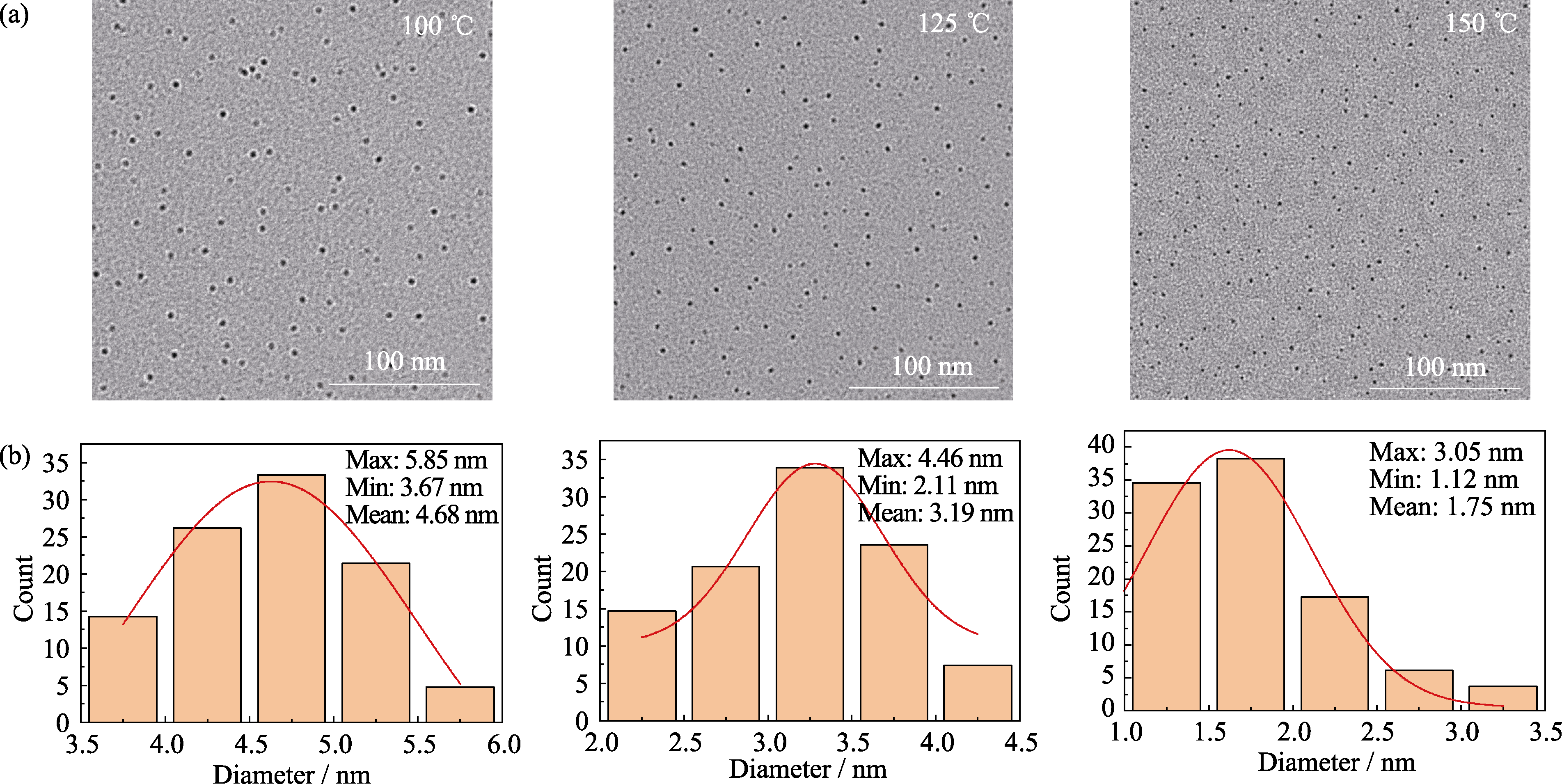
图1 不同温度下制备的BPQDs的(a) TEM照片和(b)粒径分布图
Fig. 1 (a) TEM images and (b) particle size distribution histograms of BPQDs synthesized at different temperatures
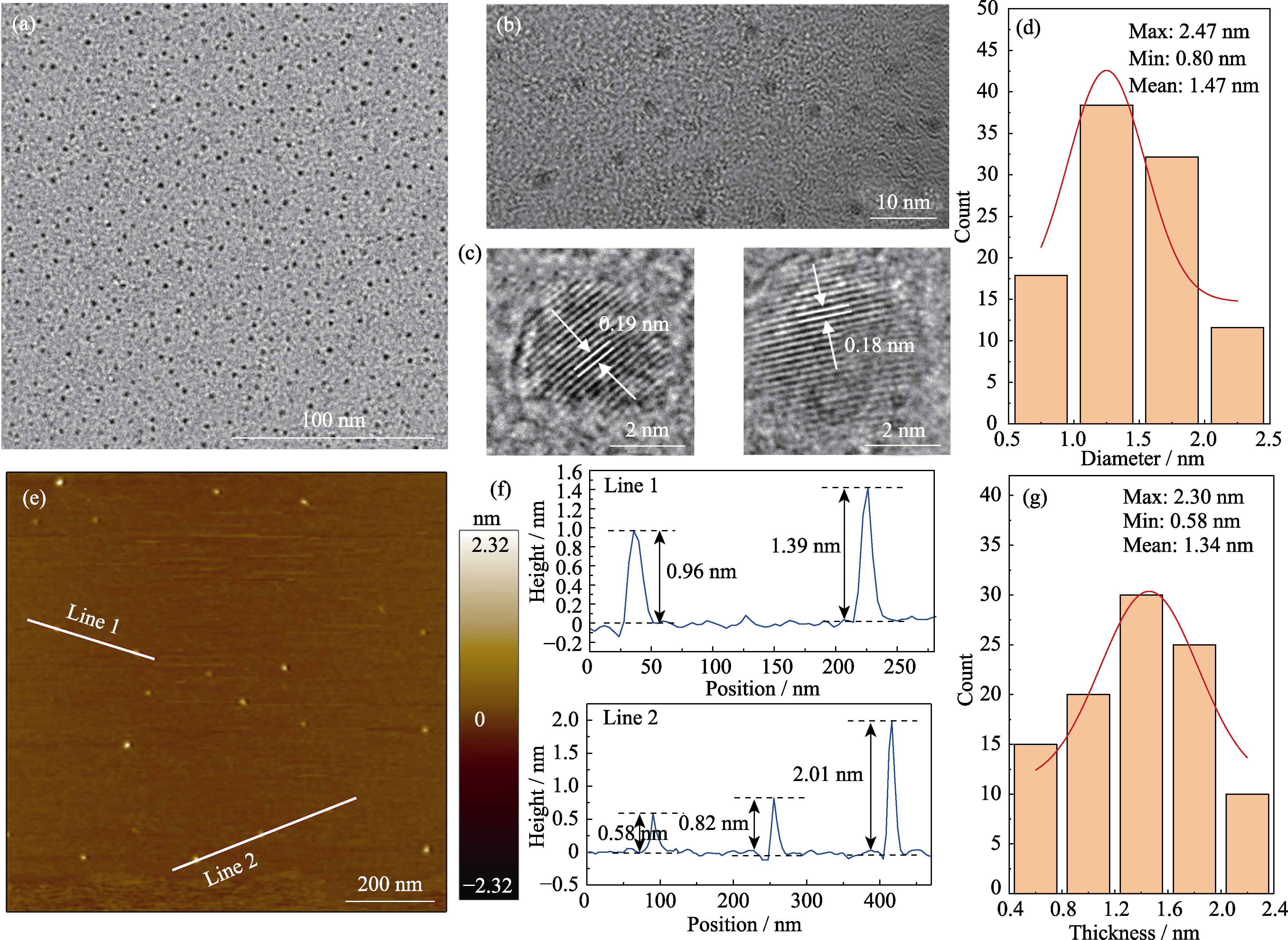
图2 BPQDs的形态与结构表征
Fig. 2 Morphology and structural characterization of BPQDs (a) TEM image; (b) Magnified TEM image; (c) High resolution TEM images showing lattice fringes; (d) Lateral size distribution histogram measured from TEM images; (e) AFM topographic image; (f) Corresponding height profiles along the white line in (e); (g) Height (thickness) distribution histogram measured from AFM image. Colorful figures are available on website
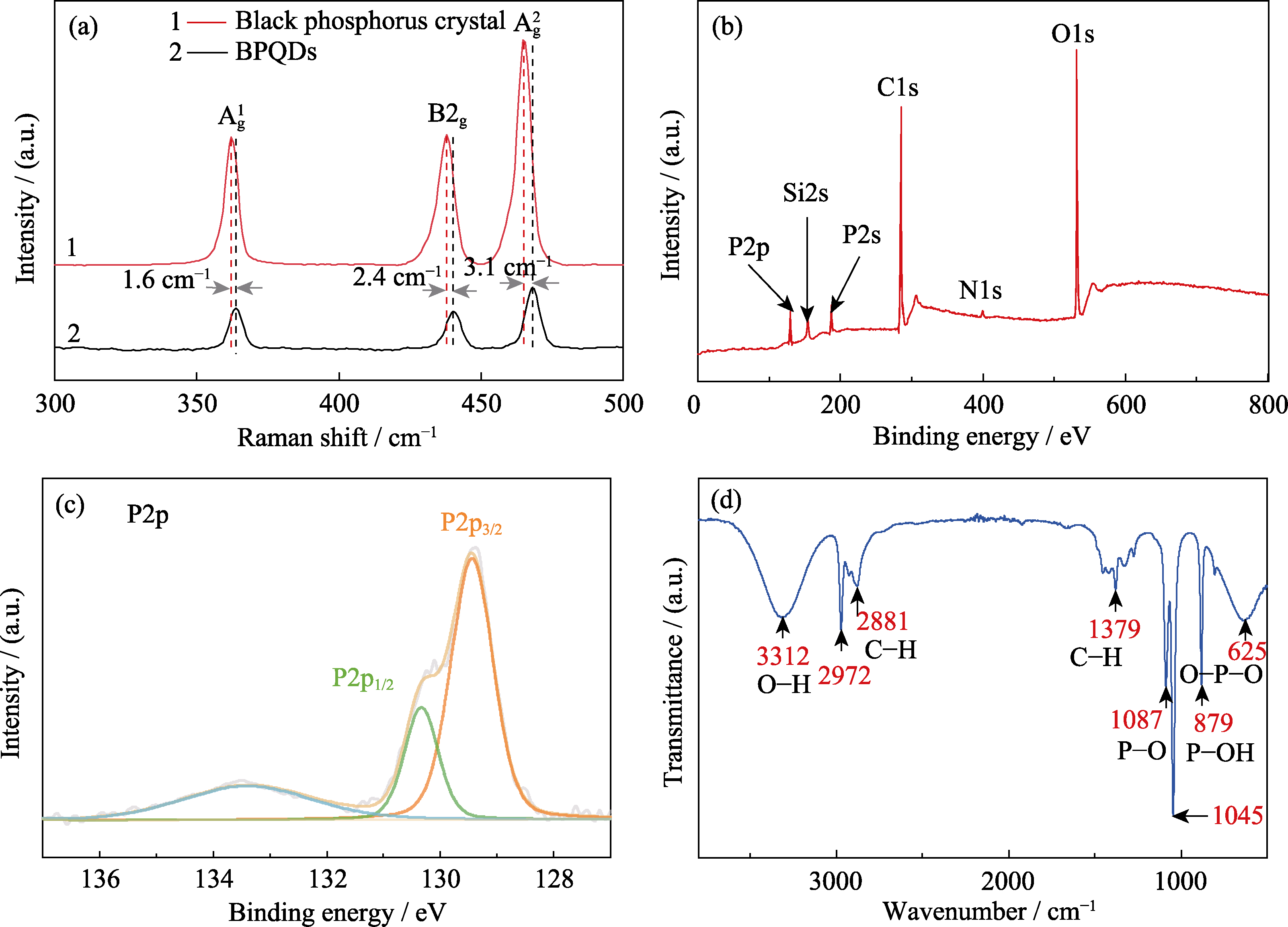
图3 BP和BPQDs的结构与化学表征
Fig. 3 Structural and chemical characterization of bulk BP and BPQDs (a) Comparison of Raman spectra for bulk BP and BPQDs; (b) XPS full survey spectrum of BPQDs; (c) High-resolution XPS spectrum with peak deconvolution for the P2p region of BPQDs; (d) FT-IR spectrum of BPQDs
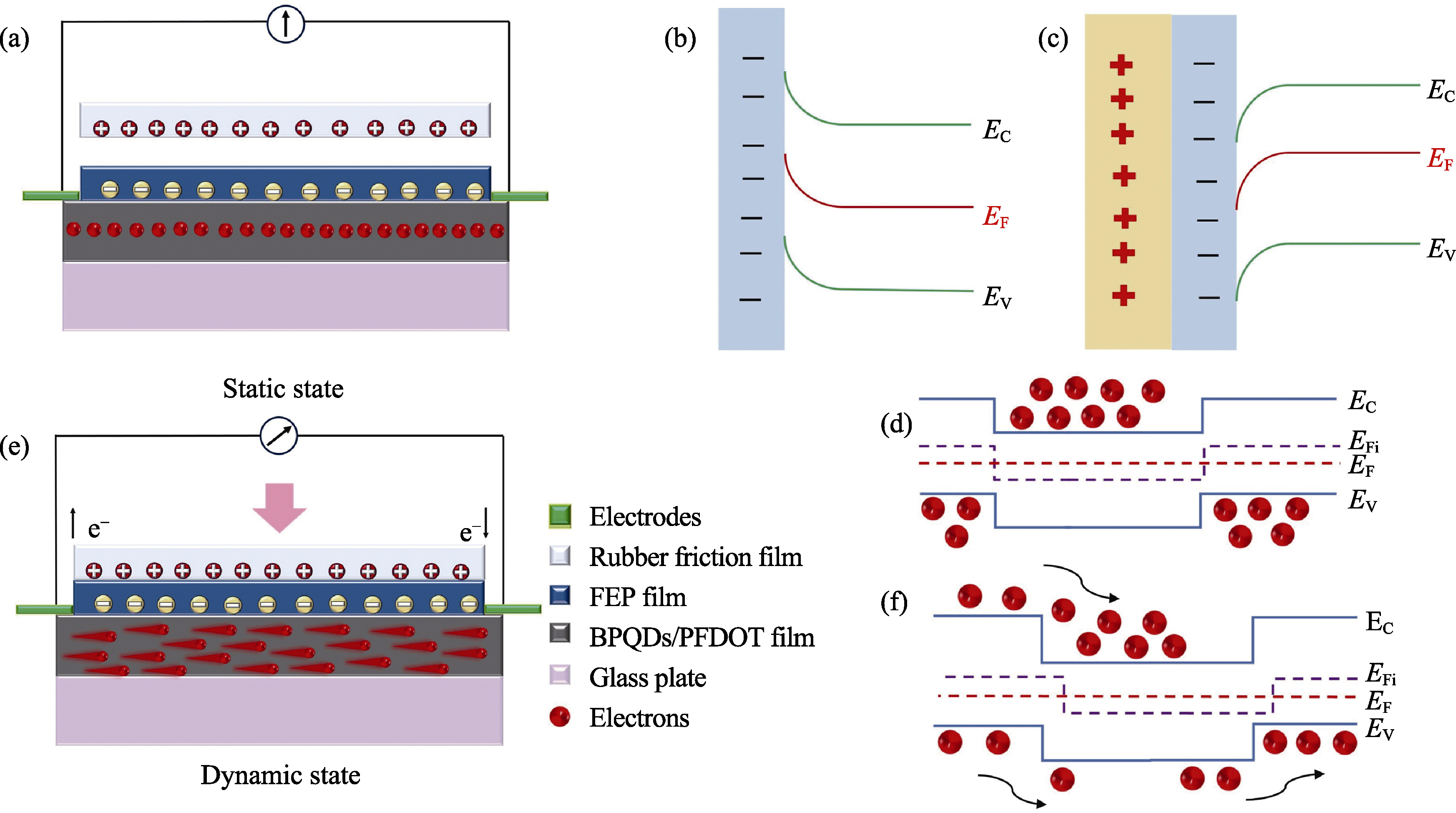
图4 FENG装置的原理与结构
Fig. 4 Working principle and structure of the FENG device (a) Electrostatic charge region; (b) Band bending in the non-contact region; (c) Band bending in the contact region; (d) Energy band diagram of the entire BPQDs/PEDOT:PSS surface; (e) Schematic of dynamic electrostatic charge inducing carrier transport in the BPQDs/PEDOT:PSS layer, leading to electrical energy generation in the external circuit; (f) Energy band diagram of the entire BPQDs/PEDOT:PSS surface when the rubber friction layer contacts the FEP film
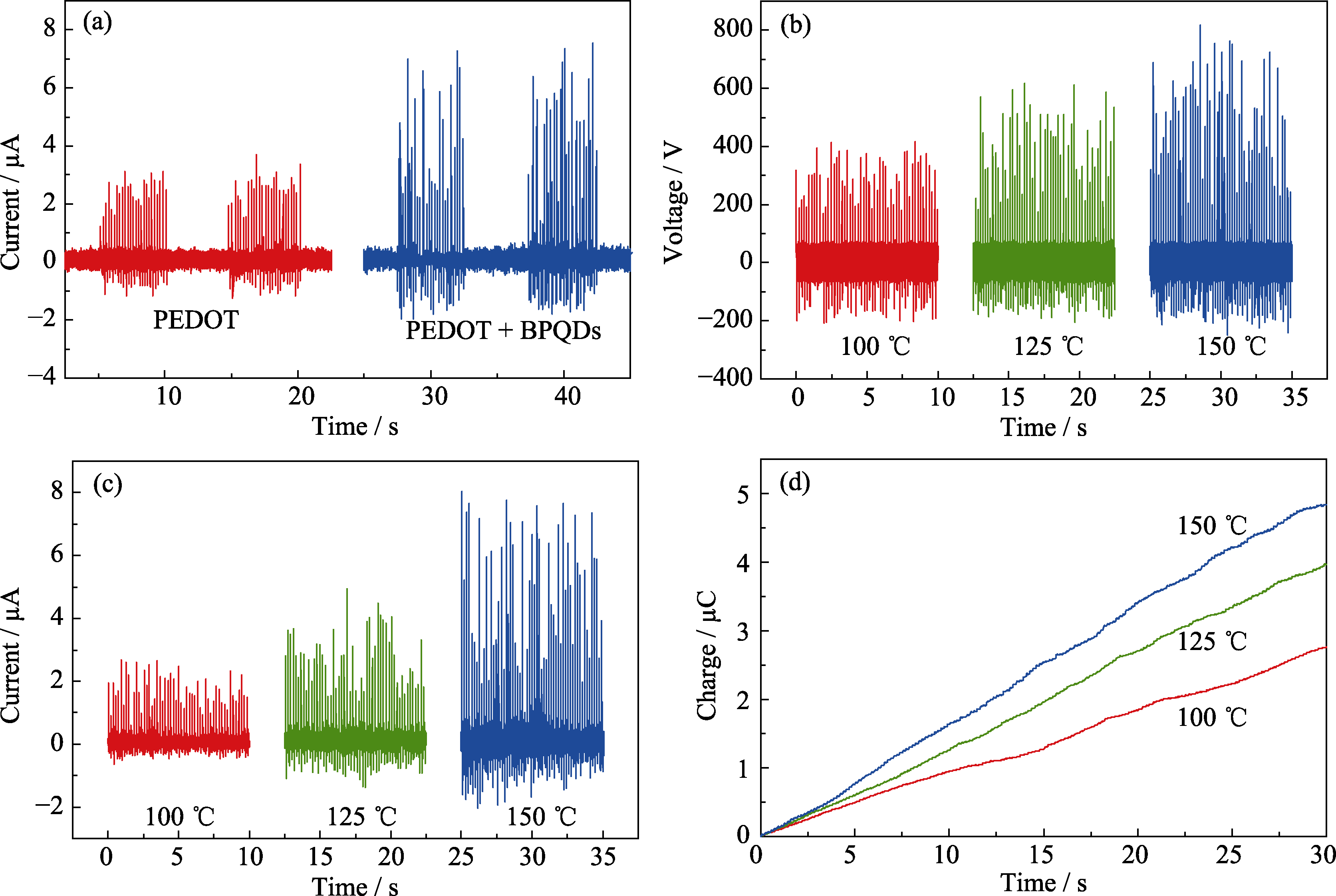
图5 器件的电学性能测试
Fig. 5 Electrical characterization of devices (a) Effect of BPQDs on the electrical performance of the FENG; (b-d) Influence of BPQDs prepared at different temperatures on the FENG’s (b) voltage, (c) current, and (d) transferred charge

图S1 不同微波处理时间下BPQDs的TEM照片
Fig. S1 TEM images of BPQDs under different microwave processing time (a) 1 h; (b) 2 h; (c) 3 h; (d) 4 h; (e) 5 h; (f) 6 h
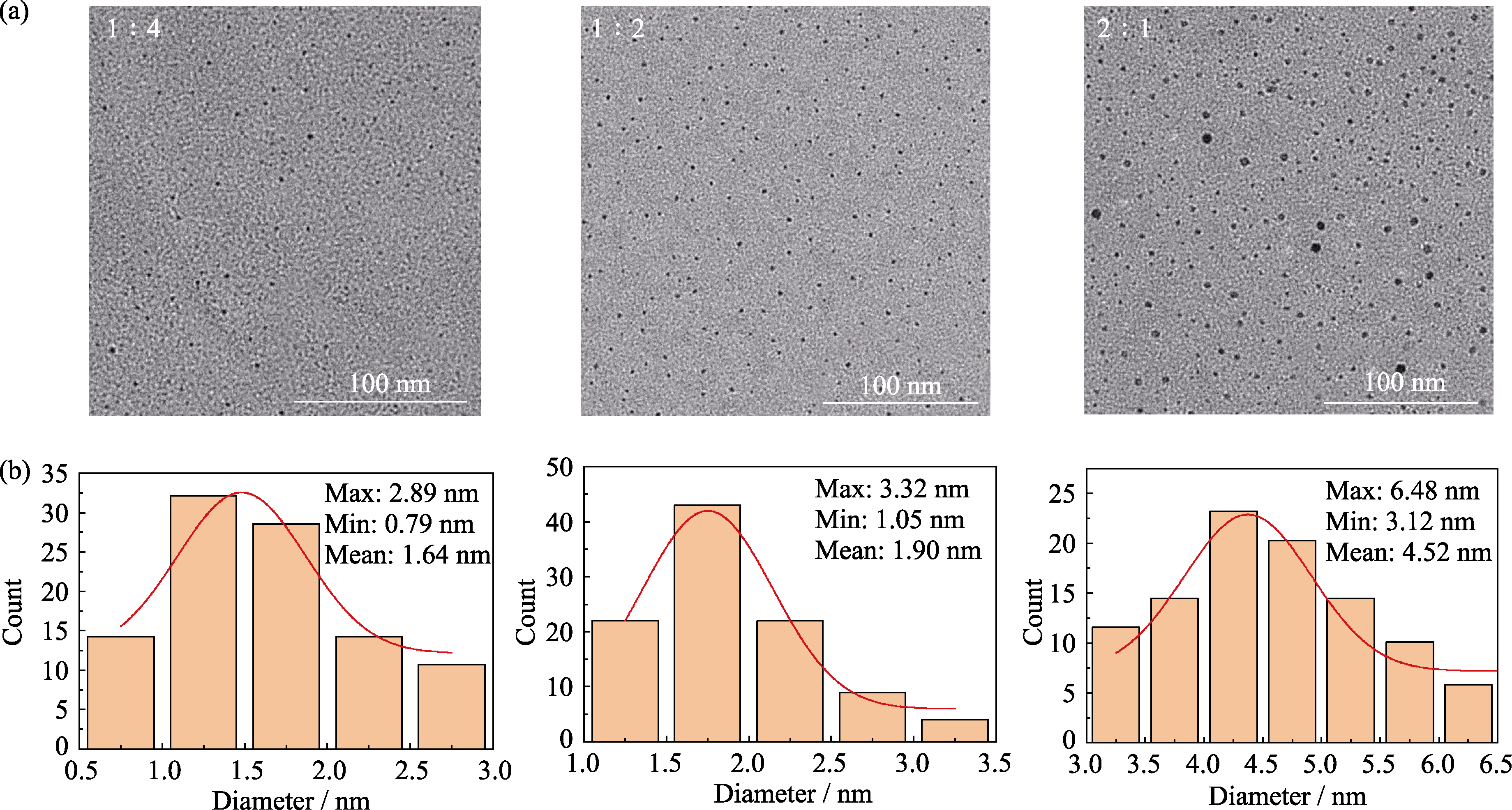
图S2 不同黑磷前驱体和无水乙醇配比下制备的BPQDs的(a) TEM照片和(b)粒径分布图
Fig. S2 (a) TEM images and (b) particle size distribution histograms of BPQDs prepared with different ratios of black phosphorus precursors to anhydrous ethanol
| Comparison dimension | Core filler | Filler characteristics | Composite films fabrication | Operating mode | Key advantages | Output performance | Outstanding mechanism | Ref. |
|---|---|---|---|---|---|---|---|---|
| BPQDs/ PEDOT:PSS | BPQDs | Zero-dimensional quantum dots (1.47 nm), Tunable size/ bandgap, strong quantum confinement effect | Solution mixing followed by spin-coating | Contact- separation mode | Linearly tunable performance and ultrasmall size with size-dependent charge transfer rate | Output voltage up to 800 V and 43.6% increase in average peak current | Establishing a “synthesis temperature-size- output performance” linear tunability: dominant role of quantum confinemen | This work |
| MXene/ PEDOT:PSS | MXene (Ti3C2Tx) | High conductivity, layered structure, large lateral size | Vacuum filtering | Contact- separation mode | Ultrahigh sensitivity, fast response, and device integration | Output voltage ~29.6 V (10 N) | Intimate interface facilitates charge transport for high-sensitivity sensing | [S1] |
| Graphene/ PEDOT:PSS | CVD graphene | 2D monolayer, high conductivity, PEDOT:PSS- modified interface | Spin-coating | Contact- separation mode | High transparency, high flexibility, and versatile surface engineering | Output voltage of 52 V and current density of 2.4 µA/cm2 | Enhanced electrode conductivity and work function for improved overall output | [S2] |
表S1 BPQDs与MXene作为PEDOT:PSS纳米填料的特性对比
Table S1 Comparison of the characteristics between BPQDs and MXene as nanofillers in PEDOT:PSS
| Comparison dimension | Core filler | Filler characteristics | Composite films fabrication | Operating mode | Key advantages | Output performance | Outstanding mechanism | Ref. |
|---|---|---|---|---|---|---|---|---|
| BPQDs/ PEDOT:PSS | BPQDs | Zero-dimensional quantum dots (1.47 nm), Tunable size/ bandgap, strong quantum confinement effect | Solution mixing followed by spin-coating | Contact- separation mode | Linearly tunable performance and ultrasmall size with size-dependent charge transfer rate | Output voltage up to 800 V and 43.6% increase in average peak current | Establishing a “synthesis temperature-size- output performance” linear tunability: dominant role of quantum confinemen | This work |
| MXene/ PEDOT:PSS | MXene (Ti3C2Tx) | High conductivity, layered structure, large lateral size | Vacuum filtering | Contact- separation mode | Ultrahigh sensitivity, fast response, and device integration | Output voltage ~29.6 V (10 N) | Intimate interface facilitates charge transport for high-sensitivity sensing | [S1] |
| Graphene/ PEDOT:PSS | CVD graphene | 2D monolayer, high conductivity, PEDOT:PSS- modified interface | Spin-coating | Contact- separation mode | High transparency, high flexibility, and versatile surface engineering | Output voltage of 52 V and current density of 2.4 µA/cm2 | Enhanced electrode conductivity and work function for improved overall output | [S2] |
| [1] |
LIU H, NEAL A T, ZHU Z, et al. Phosphorene: an unexplored 2D semiconductor with a high hole mobility. ACS Nano, 2014, 8(4): 4033.
DOI PMID |
| [2] | 李黎嘉, 从春晓. 二维黑磷的光电特性及光电器件研究进展. 发光学报, 2023, 44(6): 995. |
| [3] | CHANG T Y, CHEN P L, YAN J H, et al. Ultra-broadband, high speed, and high-quantum-efficiency photodetectors based on black phosphorus. ACS Applied Materials & Interfaces, 2019, 12(1): 1201. |
| [4] |
SONG H, MU H R, YUAN J, et al. Boosting the efficiency of quantum dot-sensitized solar cells over 15% through light- harvesting enhancement. SusMat, 2023, 3(4): 543.
DOI URL |
| [5] |
MAITY A, SUI X Y, PU H T, et al. Sensitive field-effect transistor sensors with atomically thin black phosphorus nanosheets. Nanoscale, 2020, 12(3): 1500.
DOI PMID |
| [6] |
REN X, ZHANG F, ZHANG X L. Synthesis of black phosphorus quantum dots with high quantum yield by pulsed laser ablation for cell bioimaging. Chemistry-An Asian Journal, 2018, 13(14): 1842.
DOI URL |
| [7] |
WANG J, LIANG D, QU Z H, et al. PEGylated-folic acid- modified black phosphorus quantum dots as near-infrared agents for dual-modality imaging-guided selective cancer cell destruction. Nanophotonics, 2020, 9(8): 2425.
DOI URL |
| [8] |
WANG Z, LIU Z M, SU C K, et al. Biodegradable black phosphorus-based nanomaterials in biomedicine: theranostic applications. Current Medicinal Chemistry, 2019, 26(10): 1788.
DOI PMID |
| [9] |
ZHU C Y, XU F, ZHANG L, et al. Ultrafast preparation of black phosphorus quantum dots for efficient humidity sensing. Chemistry-A European Journal, 2016, 22(22): 7357.
DOI PMID |
| [10] |
XU Y H, WANG Z, GUO Z, et al. Solvothermal synthesis and ultrafast photonics of black phosphorus quantum dots. Advanced Optical Materials, 2016, 4(8): 1223.
DOI URL |
| [11] |
TANG W W, JIANG Z Q, WANG B G, et al. Black phosphorus quantum dots: a new-type of water-based high-efficiency lubricant additive. Friction, 2021, 9: 1528.
DOI |
| [12] |
PRASANNACHANDRAN R, VINEESH T V, ANIL A, et al. Functionalized phosphorene quantum dots as efficient electrocatalyst for oxygen evolution reaction. ACS Nano, 2018, 12(11): 11511.
DOI PMID |
| [13] |
SUN Z B, XIE H H, TANG S Y, et al. Ultrasmall black phosphorus quantum dots: synthesis and use as photothermal agents. Angewandte Chemie International Edition, 2015, 54(39): 11526.
DOI URL |
| [14] | 杜凯翔. 黑磷单晶及其量子点的制备研究. 昆明: 云南师范大学硕士学位论文, 2020. |
| [15] |
YANG Y, GAO J, ZHANG Z, et al. Black phosphorus based photocathodes in wideband bifacial dye-sensitized solar cells. Advanced Materials, 2016, 28(40): 8937.
DOI URL |
| [16] |
ZHANG Z M, XIN X, YAN Q F, et al. Two-step heating synthesis of sub-3 millimeter-sized orthorhombic black phosphorus single crystal by chemical vapor transport reaction method. Science China Materials, 2016, 59(2): 122.
DOI URL |
| [17] |
FEI R X, YANG L. Lattice vibrational modes and Raman scattering spectra of strained phosphorene. Applied Physics Letters, 2014, 105(8): 083120.
DOI URL |
| [18] |
LEE H U, PARK S Y, LEE S C, et al. Black phosphorus (BP) nanodots for potential biomedical applications. Small, 2016, 12(2): 214.
DOI PMID |
| [19] |
QU Y, LOU B, REN J, et al. Construction of hollow TiO2/black phosphorus quantum dots (BPQDs) with cavity reflection associated oriented electron transfer effects for enhanced photocatalytic efficiency. Materials Research Bulletin, 2025, 187: 113384.
DOI URL |
| [20] |
LIU T F, SUN L L, DONG X Y, et al. Low-work-function PEDOT formula as a stable interlayer and cathode for organic solar cells. Advanced Functional Materials, 2021, 31(51): 2107250.
DOI URL |
| [21] | LEE A Y, RA H S, KWAK D H, et al. Hybrid black phosphorus/ zero-dimensional quantum dot phototransistors: tunable photodoping and enhanced photoresponsivity. ACS Applied Materials & Interfaces, 2018, 10(18): 16033. |
| [22] |
LEI W Y, PANG X, GE G L, et al. Recent progress on black phosphorus quantum dots for full-spectrum solar-to-chemical energy conversion. Nano Today, 2021, 39: 101183.
DOI URL |
| [23] |
LIU J Y, WANG Z K, WANG S, et al. Achieving 87% of theoretical output charge density by optimizing charge behaviors in polydimethylsiloxane/CaCu3Ti4O12-based triboelectric nanogenerators. Research, 2025, 8: 0921.
DOI URL |
| [24] | ZHANG Z C, YAN Q Y, LIU Z R, et al. Flexible MXene composed triboelectric nanogenerator via facile vacuum-assistant filtration method for self-powered biomechanical sensing. Nano Energy, 2021, 89: 106257. |
| [25] | YANG J, LIU P B, WEI X Z, et al. Surface engineering of graphene composite transparent electrodes for high performance flexible triboelectric nanogenerators and self-powered sensors. ACS Applied Materials & Interfaces, 2017, 9(36): 30992. |
| [26] | SUN Z X, LUO T C, GAO P, et al. Machine-learning-designed BCZT-SBT heterointerface unlocks fatigue-resistant energy storage. Advanced Materials, 2026, 38(8): e19635. |
| [27] | SUN Z X, DIWU L M, GAO R Y, et al. Machine learning-driven ultra-high energy storage performance in ferro-superparaelectric capacitors. Advanced Functional Materials, 2026, 36(10): e16412. |
| [28] |
SUN Z X, XIN H Y, DIWU L M, et al. Flexible high-temperature piezoelectric nanogenerators for dual-mode energy harvesting and safety monitoring in harsh environments. Chemical Engineering Journal, 2026, 528: 171919.
DOI URL |
| [29] | XING F J, GAO X B, GAO W, et al. High-entropy energy for self-powered systems. SmartSys, 2025, 1(2): e70001. |
| [1] | 李江, 丁继扬, 黄新友. 稀土离子掺杂Gd2O2S闪烁陶瓷的研究进展[J]. 无机材料学报, 2021, 36(8): 789-806. |
| [2] | 马亚楠, 刘宇飞, 余晨旭, 张传坤, 罗时军, 高义华. 不同横向尺寸单层Ti3C2Tx纳米片的制备及其电化学性能研究[J]. 无机材料学报, 2020, 35(1): 93-98. |
| [3] | 彭 犇, 邱桂博, 岳昌盛, 张 梅, 郭 敏. 一维β-SiAlON材料可控合成[J]. 无机材料学报, 2014, 29(7): 706-710. |
| [4] | 柳志杰, 李祥高, 王世荣. 纳米TiO2电泳粒子表面电荷的可控制备[J]. 无机材料学报, 2012, 27(6): 649-654. |
| [5] | 向礼琴,尹剑波,高文帅,赵晓鹏. 准单分散球形二氧化钛颗粒的可控制备研究[J]. 无机材料学报, 2007, 22(2): 253-258. |
| [6] | 郑丹,田娟,张熙贵,夏保佳,张宝宏. 适用于微型燃料电池扩散层的多孔硅的可控制备工艺研究[J]. 无机材料学报, 2006, 21(6): 1367-1372. |
| 阅读次数 | ||||||
|
全文 |
|
|||||
|
摘要 |
|
|||||