


目前用于去除VOCs的催化剂主要分为两类: 贵金属催化剂[4,5]和金属氧化物催化剂[6,7]。与金属氧化物催化剂相比, 贵金属催化剂通常表现出更优异的催化活性、选择性和稳定性, 尤其是钯基催化剂, 它在VOCs催化氧化领域具有较高的催化活性、抗烧结性能和成本相对较低等优点, 从而引起了广泛关注[8]。一般来说, 制备方法是影响催化剂催化活性的重要因素之一, 常用的制备方法有浸渍法[9,10]和沉积-沉淀法[11,12]等, 但这些传统方法制备的Pd纳米粒子容易发生团聚, 分散不均; 颗粒的大小、形状和分布难以控制, 得到的催化剂活性、稳定性和选择性均较差, 因此需开发出简单和绿色的制备方法。文献[13]首先制备金属纳米颗粒, 然后通过直接吸附法将其吸附在载体上制备负载型催化剂, 与传统方法相比, 该方法可以有效地控制金属颗粒的粒径和晶体结构, 而且可以减少载体对催化性能的影响, 调节活性组分在载体上的分散度[14]。
众所周知, 二氧化铈具有优异的氧化还原性能和储氧能力[15], 这有助于提高氧化铈的催化性能。事实上, 氧化铈的氧化还原特性会促使氧空位的产生, 从而使其具有较高的储氧能力, 有助于提高载体的耐热性、负载贵金属的分散性并减少催化剂表面结焦。另外, 氧化铈具有储存和释放氧的能力, 可以提供晶格氧, 防止贵金属的烧结。在另一种金属氧化物(如Al2O3)中加入铈可以提高金属氧化物的催化活性[16]。Ramírez-lópez等[17]认为Pd/CeO2-Al2O3催化剂中的氧化铈有利于形成金属钯颗粒, 这是甲烷活化所必需的。Hosseini等[18]发现氧化铈提高了Pd/Al2O3-斜发沸石-CeO2催化剂在甲苯氧化中的稳定性和催化活性。上述研究结果表明, 加入CeO2对材料的物理化学性质有一定的影响, 同时提高了材料的催化活性。
在前期研究的基础上[19], 本工作采用直接吸附法将Pd纳米颗粒负载于Al2O3和CeO2/γ-Al2O3载体上, 成功制备了低负载量的Pd/γ-Al2O3和Pd/CeO2/γ- Al2O3组合型催化剂, 并将其用于催化氧化甲苯, 研究了Pd/CeO2/γ-Al2O3催化剂各种物理特性和对VOCs的催化氧化性能, 并探究引入Ce对Pd催化剂的影响。
1 实验方法
1.1 催化剂的制备
1.1.1 金属前驱体Pd2(dba)3的制备
根据文献[20]合成了有机金属前驱体Pd2(dba)3: 将9.8 mmol (2.3 g)二亚苄基丙酮(dba), 23.8 mmol (1.95 g) CH3COONa和75 mL无水甲醇分别加入到100 mL圆底烧瓶中, 50 ℃搅拌溶解, 随后将2.96 mmol (0.53 g)PdCl2加入到上述溶液中, 40 ℃搅拌反应4 h, 冷却至0 ℃, 得到紫色沉淀, 抽滤, 用15 mL去离子水洗2次后, 用10 mL丙酮水洗3次, 干燥, 即得到深紫色的Pd2(dba)3。
1.1.2 Pd/γ-Al2O3催化剂的制备
将0.47 mmol (0.43 g, 其中含Pd 0.10 g)的Pd2(dba)3溶解于100 mL碳酸丙二醇酯(PC)中, 放入250 mL电动磁力搅拌釜中, 充入氢气至4 MPa后于40 ℃下搅拌反应3 h, 即获得质量浓度为1.0 g/L的Pd纳米溶液。将1 g γ-Al2O3载体加入到一定量的上述溶液中, 搅拌浸渍24 h, 过滤干燥后, 在450 ℃下煅烧2 h, 即得负载量为0.03%(质量分数, 下同)的Pd/γ-Al2O3催化剂。
1.1.3 Pd/CeO2/γ-Al2O3催化剂的制备
通过两步法制备具有0.03wt%的Pd负载量和2wt%的Ce负载量Pd/CeO2/γ-Al2O3催化剂: 首先采用湿法浸渍制备CeO2/γ-Al2O3, 将0.062 g Ce(NO3)3·6H2O充分溶解在去离子水中后向溶液中加入γ-Al2O3, 吸附完全后将样品在60 ℃下干燥, 再在450 ℃下煅烧3 h; 然后采用与制备Pd/γ-Al2O3相同的步骤将Pd纳米颗粒沉积在CeO2/γ-Al2O3上, 得到Pd/CeO2/γ- Al2O3催化剂。
1.2 催化剂的表征
采用工作电压为60 kV的JEOL JEM-1200EX透射电子显微镜观察纳米颗粒的大小和分布。采用Rigaku D/Max-2500/PC型的X射线衍射仪测试催化剂的晶体结构, 使用Cu Kα衍射线, 工作电压为40 kV, 电流为100 mA, 扫描范围为20°~80°。采用日本岛津Kratos AXIS Ultra DLD型X射线光电子能谱仪测试催化剂表面的元素成分、价态和相对含量。采用Autochem 3010E型化学吸附仪检测催化剂的还原性能。在Micromeritics ASAP 2010型物理吸附仪上测催化剂的比表面积和孔结构等参数。
1.3 催化剂的评价
在常规固定床反应器中对催化剂的反应活性进行评价, 取用0.5 g催化剂置于反应管的中部, 采用0 ℃鼓泡法将甲苯饱和蒸汽引入反应管, 通过调节质量流量计, 控制空气流速(Gas Hourly Space Velocity, GHSV)在18000~54000 mL/(g·h), 调节流量计使甲苯浓度控制在0.1%(体积分数)。采用火焰离子化检测器(FID)和热导检测器(TCD)的气相色谱(Fuli, GC 9790)仪对尾气中的甲苯和二氧化碳产物的浓度进行在线测量, 测定不同温度下VOCs的转化率和CO2的选择性, 并将VOCs实现98%转化率时的温度记为T98。
2 结果与讨论
2.1 催化性能
在甲苯体积分数为0.1%, 空速为18000 mL/(g·h)条件下, Pd/γ-Al2O3, Pd/CeO2/γ-Al2O3和CeO2/γ-Al2O3催化剂上甲苯、丙酮和乙酸乙酯的转化率随温度的变化关系如图1。Pd/CeO2/γ-Al2O3催化剂催化氧化甲苯、丙酮和乙酸乙酯的活性高于Pd/γ-Al2O3和CeO2/γ-Al2O3, 其中Pd/CeO2/γ-Al2O3催化氧化甲苯、丙酮和乙酸乙酯的T98分别为205、220和275 ℃, 比Pd/γ-Al2O3 (220、235和295 ℃)的T98分别降低了15、15和20 ℃, 比CeO2/γ-Al2O3 (265、285和360 ℃) 的T98分别降低60、65和90 ℃。结果表明, 加入Ce改性之后, Pd/CeO2/γ-Al2O3催化剂比Pd/γ-Al2O3具有更高的催化活性。此外, 催化剂催化氧化三种VOCs的活性顺序为: 甲苯>丙酮>乙酸乙酯, 表明PdO物种在甲苯的催化氧化中起到了关键作用[21]。对比三种催化剂的催化效果也表明PdO和CeO2之间存在强烈的协同作用, 而不仅仅是PdO和CeO2的单独作用。
图1
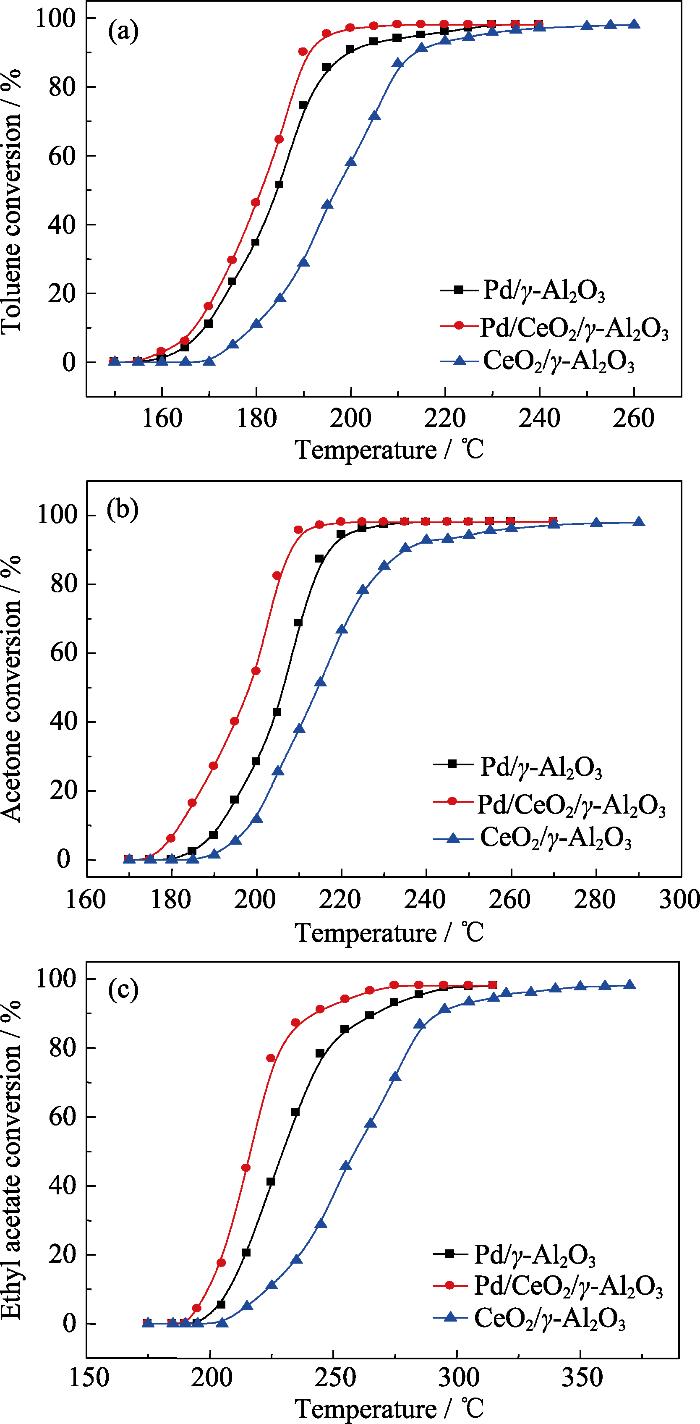
图1
Pd/γ-Al2O3和Pd/CeO2/γ-Al2O3催化剂催化氧化(a)甲苯, (b)丙酮和(c)乙酸乙酯
Fig. 1
Catalytic oxidation of VOCs(a) toluene, (b) acetone, (c) ethyl acetate over Pd/γ-Al2O3 and Pd/CeO2/γ-Al2O3
为了研究空速对Pd/CeO2/γ-Al2O3上催化氧化甲苯的影响, 在各种空速下对甲苯进行了催化氧化实验, 结果如图2所示, 空速增大对Pd/CeO2/γ-Al2O3的催化活性产生了负影响, 甲苯和催化剂接触的时间缩短, 使其不能充分氧化, 从而降低了催化活性。当GHSV为18000 mL/(g·h)时, Pd/CeO2/γ-Al2O3的T98值为205 ℃, 而在GHSV为36000和54000 mL/(g·h)时, T98值为220和235 ℃, 表明Pd/CeO2/γ-Al2O3在较宽的空速范围内具有较高的催化活性。
图2
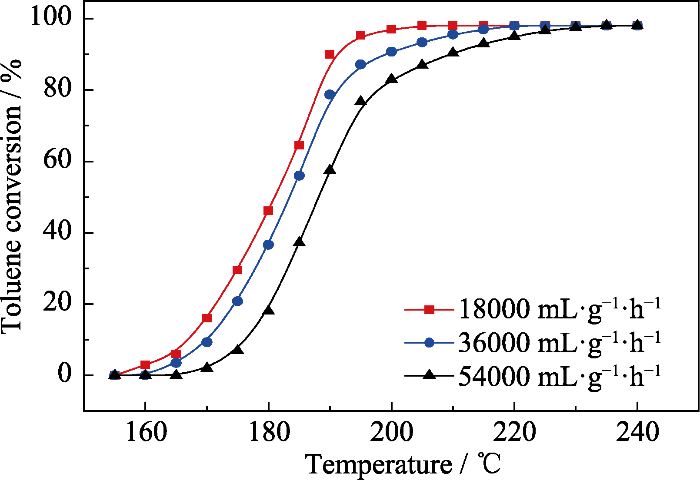
图2
不同空速下Pd/CeO2/γ-Al2O3催化氧化甲苯的研究
Fig. 2
Catalytic oxidation of toluene over Pd/CeO2/γ-Al2O3 at various GHSVs
为了进一步研究Pd/CeO2/γ-Al2O3催化剂的稳定性和CO2选择性, 在205 ℃, 空速为18000 mL/(g·h), 甲苯体积分数为0.1%的条件下进行了活性稳定性试验, 结果如图3所示。在反应过程中, 仅检测到CO2和H2O, 并未检测到CO或小的有机分子。在0~50 h内, Pd/CeO2/γ-Al2O3对CO2的选择性为100%, 甲苯转化率在98%以上, 表明Pd/CeO2/γ-Al2O3具有较高的催化活性, 稳定性和选择性。
图3
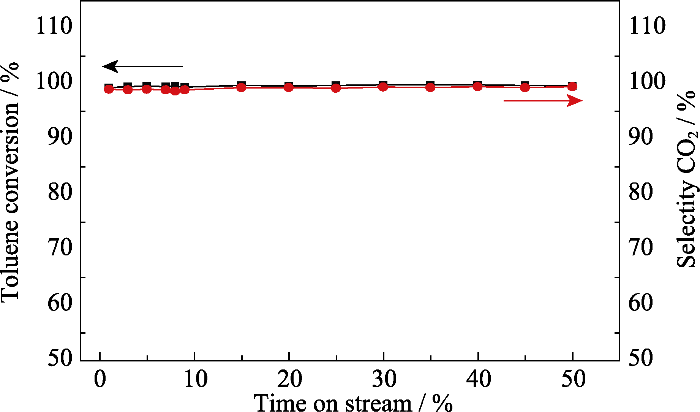
图3
Pd/CeO2/γ-Al2O3对甲苯氧化的稳定性和对CO2选择性试验
Fig. 3
Stability tests for toluene oxidation with time-on- stream over Pd/CeO2/γ-Al2O3
水存在于大多数化学反应中, 本实验研究了水蒸气对催化剂的影响, 结果如图4所示。当加入5.0vol%的水蒸气时, 甲苯转化率瞬间降低, 这表明水分子对催化反应产生负影响。当水蒸气被切断时, 甲苯的转化率恢复到其原始水平, 表明催化剂活性的降低可能是由于催化剂表面上的H2O和氧气存在竞争吸附[22]。根据文献[23,24], 水分子可以通过准平衡吸附-解吸步骤阻断活性Pd或PdO位置。当通入H2O时, 水蒸气会与活性氧反应形成高浓度的OH*并分散在催化剂表面, 然后与不饱和的Pd和PdO位点反应形成无活性的Pd-氢氧化物, 降低催化剂的活性。当切断水的供应时, Pd-氢氧化物化合物又分解成活性Pd和PdO位点, 从而恢复催化剂的催化活性。
图4
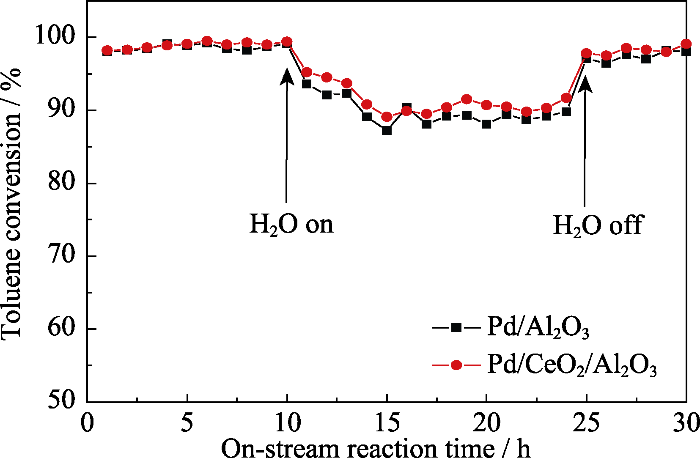
图4
水蒸气对Pd/ Al2O3 和Pd/Ce2O/Al2O3两种催化剂的催化活性的影响
Fig. 4
Effect of water vapor on toluene conversion over the Pd/Al2O3 and Pd/Ce2O/Al2O3 catalyst under the conditions of toluene concentration = 1×10⁻³, water vapor concentration = 5.0vol% and GHSV = 18000 mL/(g·h)
2.2 催化剂的物理结构参数
表1 为Al2O3、Pd/Al2O3和Pd/CeO2/Al2O3三种样品的物理结构参数
Table 1
| Sample | Surface area /(m2·g-1) | Pore size/nm | Pore volume /(cm3·g-1) |
|---|---|---|---|
| γ-Al2O3 | 357 | 5.13 | 0.53 |
| Pd/γ-Al2O3 | 345 | 5.07 | 0.52 |
| Pd/CeO2/γ-Al2O3 | 339 | 5.02 | 0.49 |
图5显示了γ-Al2O3、Pd/γ-Al2O3和Pd/CeO2/γ- Al2O3的XRD图谱。Pd/γ-Al2O3只在2θ=37.7°、45.9°和66.9°(PDF 79-1558)出现γ-Al2O3的特征衍射峰; 加入Ce改性后得到的Pd/CeO2/γ-Al2O3的γ-Al2O3的特征衍射峰强度明显减弱, 而在2θ= 28.5°、33.1°、47.5°、56.3°、59.1°和69.4°(PDF 89-8436)出现很强的CeO2的特征衍射峰, 表明引入Ce削弱了γ-Al2O3 的衍射峰, 这可能是因为氧化铈破坏了γ-Al2O3的结构[15]。PdO在2θ=33.5°、33.8°, 54.7°(PDF 41-1107)衍射峰和Pd在2θ=40.2°、46.8°、68.3°(PDF 87-0639)衍射峰在Pd/γ-Al2O3和Pd/CeO2/γ-Al2O3两种催化剂中均未被检测到, 说明纳米粒子均匀地分散在载体上或者Pd的负载量低于XRD的检测下限使XRD无法检测到[27]。
图5
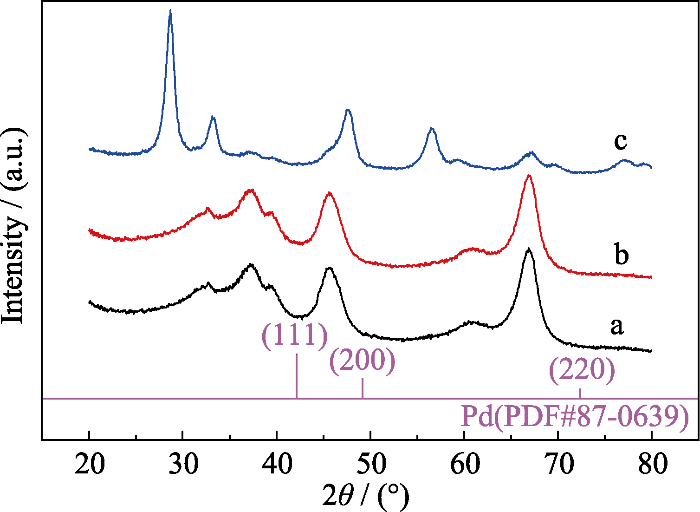
图5
(a)γ-Al2O3, (b)Pd/γ-Al2O3, (c)Pd/CeO2/γ-Al2O3样品的XRD图谱
Fig. 5
XRD patterns of (a) γ-Al2O3, (b) Pd/γ-Al2O3 and (c) Pd/CeO2/γ-Al2O3
图6显示了Pd/γ-Al2O3和Pd/CeO2/γ-Al2O3的TEM照片及其Pd纳米粒子的粒径分布。由图6可知分散在Pd/γ-Al2O3和Pd/CeO2/γ-Al2O3上的Pd纳米粒子平均粒径约为5和6 nm, 结果表明在Pd/γ- Al2O3和Pd/CeO2/γ-Al2O3制备过程中, 溶剂PC使纳米粒子高度分散于γ-Al2O3和CeO2/γ-Al2O3表面, 并抑制纳米粒子的聚集。与Pd/γ-Al2O3相比, Pd/CeO2/γ- Al2O3中PdO纳米粒子的平均粒径增大, 表明引入Ce后, PdO纳米粒子和非化学计量的CeO2之间发生了强相互作用[28], 从而提高了Pd/CeO2/γ-Al2O的催化性能。
图6
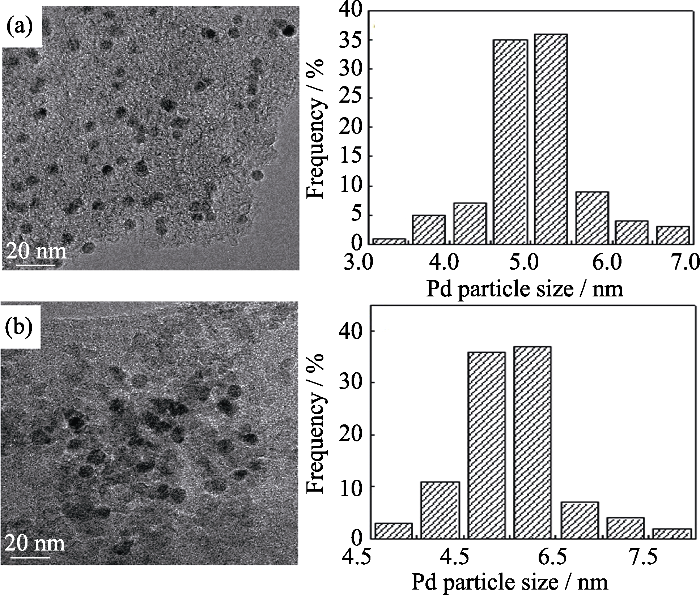
图6
(a)Pd/γ-Al2O3和(b)Pd/CeO2/γ-Al2O3的TEM照片及其Pd纳米粒子的粒径分布图
Fig. 6
TEM images and Pd NPs size distribution of (a) Pd/γ-Al2O3 and (b) Pd/CeO2/γ-Al2O3
图7显示Pd/γ-Al2O3和Pd/CeO2/γ-Al2O3在Pd 3d上的XPS谱图以及Pd/CeO2/γ-Al2O3的Ce 3d XPS谱图。对于Pd/γ-Al2O3催化剂, Pd 3d5/2轨道在结合能为335.4和336.2 eV处, 可分出两个峰, 分别归属于Pd0和PdO; 同样, Pd 3d3/2轨道在结合能为340.7和341.5 eV处, 可分出两个峰, 分别归属于Pd0和PdO[29,30]。对于Pd/CeO2/γ-Al2O3, Pd 3d5/2和Pd 3d3/2轨道仅在336.2和341.5 eV拟合出PdO峰, 未拟合出Pd的峰。根据文献[31,32], Ce 3d5/2和3d3/2可分出8个峰, 分别用字母u和v表示, 其中u‴ (916.7 eV), u″(907.5 eV), u (901 eV)和v‴(898.4 eV), v″(888.2 eV), v(882.5 eV)归属于Ce4+; u(903.4 eV)和v(885.5 eV)归属于Ce3+。分峰后Pd/γ-Al2O3、Pd/CeO2/γ-Al2O3表面Pd0和PdO的相对含量以及Pd/CeO2/γ-Al2O3中Ce3+和Ce4+的相对含量见表2。由表2可以看出, Pd/γ-Al2O3表面的PdO占Pd物种总含量的65.8%, 而Pd/CeO2/γ-Al2O3表面PdO含为100%。结果表明, 加入Ce提高了Pd/CeO2/γ-Al2O3表面PdO活性物种的含量[33]; 另一方面, 虽然Pd/CeO2/γ-Al2O3表面的Ce3+的相对含量比Ce4+低, 但是Pd/CeO2/γ-Al2O3表面仍然存在Ce3+, 表明Pd/CeO2/γ-Al2O3表面存在更多的氧空穴, 有利于氧气的吸附和活化形成晶格氧, 具有更高的氧迁移能力[34], 这是Pd/CeO2/γ-Al2O3具有高催化活性的重要因素。
图7
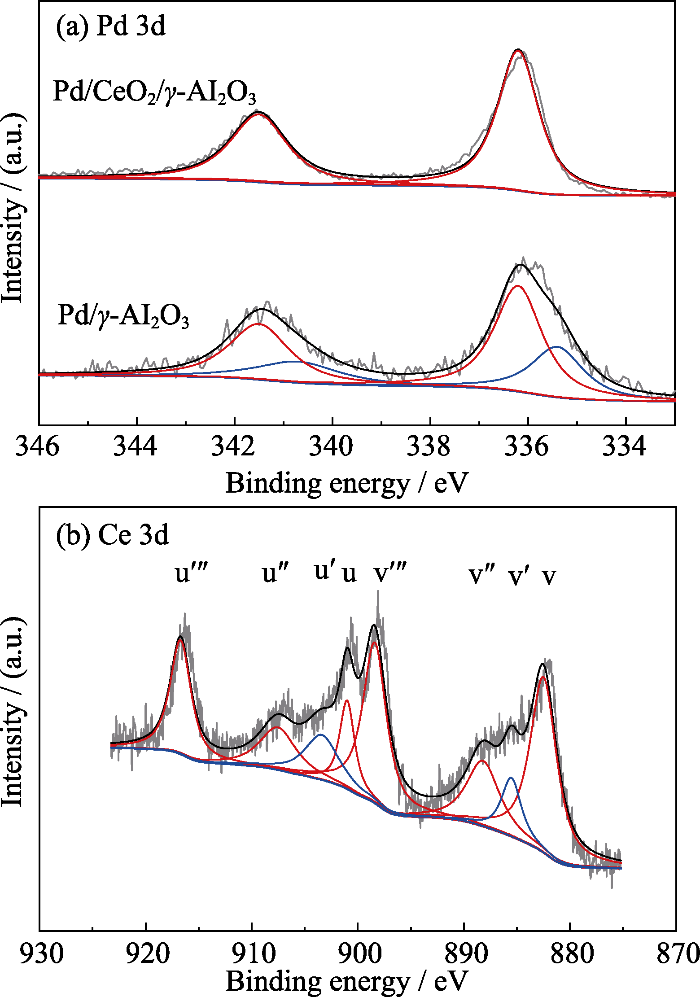
图7
Pd/γ-Al2O3和Pd/CeO2/γ-Al2O3中(a)Pd 3d和(b)Ce 3d图谱
Fig. 7
XPS spectra of (a) Pd 3d and (b) Ce 3d for Pd/γ-Al2O3 and Pd/CeO2/γ-Al2O3
表2 Pd/γ-Al2O3和Pd/CeO2/γ-Al2O3的XPS表征结果
Table 2
| Catalyst | Relative content/wt% | |||
|---|---|---|---|---|
| Pd | PdO | Ce3+ | Ce4+ | |
| Pd/γ-Al2O3 | 34.2 | 65.8 | — | — |
| Pd/CeO2/γ-Al2O3 | 0 | 100 | 14.5 | 85.5 |
图8显示了Pd/γ-Al2O3和Pd/CeO2/γ-Al2O3的H2-TPR曲线, 从图中可看出, Pd/γ-Al2O3催化剂在110和300 ℃附近出现两个耗氢峰, 110 ℃的还原峰归属于催化剂表面的PdO颗粒的还原, 300 ℃的还原峰是还原与γ-Al2O3载体存在强相互作用的PdO颗粒所致[35,36]。Pd/CeO2/γ-Al2O3催化剂在60 ℃附近出现一个强而尖锐的耗氢峰, 这是还原催化剂表面的PdO颗粒所致[35], 350 ℃附近出现的耗氢峰是还原催化剂表面的非化学计量的CeO2所致[17, 37]。加入Ce改性后, Pd/CeO2/γ-Al2O3表面的PdO的还原温度明显降低, 表明非化学计量的CeO2与PdO之间存在强相互作用, Pd/CeO2/γ-Al2O3具有更强的还原能力, 因此催化氧化VOCs具有更高的活性。
图8
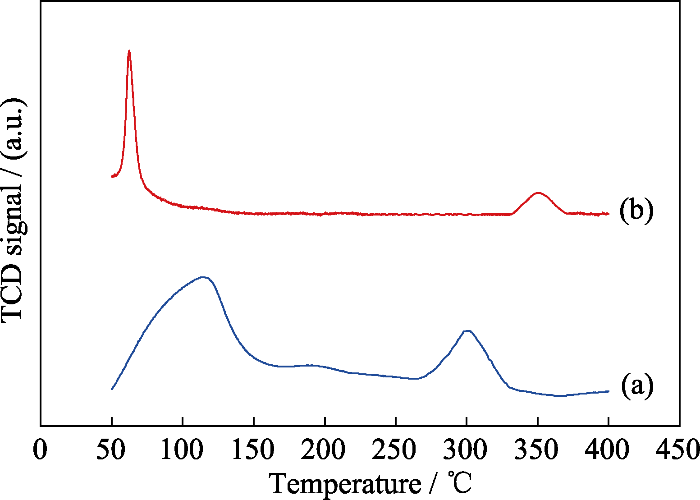
图8
(a)Pd/γ-Al2O3和(b)Pd/CeO2/γ-Al2O3的H2-TPR图谱
Fig. 8
H2-TPR profiles of (a) Pd/γ-Al2O3 and (b) Pd/CeO2/γ- Al2O3
3 结论
用直接吸附法制备了低负载量的Pd/-Al2O3和Pd/CeO2/γ-Al2O3催化剂。与Pd/γ-Al2O3催化剂相比, Pd/CeO2/γ-Al2O3催化剂保持了较高的比表面积、较小的Pd纳米粒子和高分散度。加入Ce改性后, 提高了PdO的含量, 高含量的PdO是Pd/CeO2/γ-Al2O3催化剂催化氧化VOCs具有高活性的重要因素; Ce3+能够提供更多的氧空穴, 促进Pd/CeO2/γ-Al2O3催化剂表面活性氧的形成; 同时在非化学计量的CeO2与PdO之间存在强相互作用, 使Pd/CeO2/γ-Al2O3催化剂具有更强的低温还原能力。在VOCs体积分数为0.1%、空速为18000 mL/(g·h)条件下, Pd/CeO2/γ-Al2O3催化剂催化氧化甲苯、丙酮和乙酸乙酯的T98分别为205、220和275 ℃。经50 h连续反应测试, 甲苯的转化率始终保持在98%以上, Pd/CeO2/γ-Al2O3催化剂具有良好的催化活性和稳定性, 对于改性的Pd基催化剂用于催化氧化VOCs具有一定的参考价值。
参考文献
Ionic liquid technology to recover volatile organic compounds (VOCs)
Supported gold catalysts for the total oxidation of volatile organic compounds
Removal of volatile organic compounds from polluted air
Low temperature catalytic oxidation of volatile organic compounds: a review
Nanostructured macro-mesoporous zirconia impregnated by noble metal for catalytic total oxidation of toluene
Catalytic oxidation of volatile organic compounds (VOCs)-a review
Catalytic combustion of volatile organic compounds over group IB metal catalysts on Fe2O3
Properties and performance of Pd based catalysts for catalytic oxidation of volatile organic compounds
Activated carbon fibers impregnated with Pd and Pt catalysts for toluene removal
Catalytic oxidation of toluene over Pd/Co3AlO catalysts derived from hydrotalcite-like compounds: effects of preparation methods
Effect of preparation method on the surface characteristics and activity of the Pd/OMS-2 catalysts for the oxidation of carbon monoxide, toluene, and ethyl acetate
Effect of preparation method on the catalytic activity of Au/CeO2 for VOCs oxidation
Hydrogenation of o-chloronitrobenzene by platinum nanoparticles on activated carbon
Low-temperature total oxidation of toluene over assembled Pt/TiO2 catalyst
On the promoting effect of the addition of ceria to platinum based alumina catalysts for VOCs oxidation
Preferential CO oxidation on Ce-promoted Pt/γ-Al2O3 catalysts under H2-rich atmosphere
Complete catalytic oxidation of methane over Pd/CeO2-Al2O3: the influence of different ceria loading
Sono- dispersion of ceria and palladium in preparation and characterization of Pd/Al2O3-clinoptilolite-CeO2 nanocatalyst for treatment of polluted air via low temperature VOC oxidation
A Self-assembled Pd/γ-Al2O3 catalyst with low loading for catalytic oxidation of toluene
Pd-catalyzed Heck arylation of cycloalkenes-studies on selectivity comparing homogeneous and heterogeneous catalysts
Pd/Ce0.9 Cu0.1O1.9-Y2O3 catalysts for catalytic combustion of toluene and ethyl acetate
Toluene oxidation on Pd catalysts supported by CeO2-Y2O3 washcoated cordierite honeycomb
Nanometric palladium confined in mesoporous silica as efficient catalysts for toluene oxidation at low temperature
Structure and reactivity of PdOx/ZrO2 catalysts for methane oxidation at low temperatures
Improved Pd/γ-Al2O3-Ce catalysts for benzene combustion
Removal of volatile organic compounds at low temperature by a self-assembled Pt/γ-Al2O3 catalyst
Comparative sonochemically synthesis of CeO2-doped Pd/clinoptilolite and Pd/Al2O3 nanocatalysts used in total oxidation of toluene at low temperatures for polluted air treatment
Synergistic effect between Pd and nonstoichiometric cerium oxide for oxygen activation in methane oxidation
Structural and chemical states of palladium in Pd/Al2O3 catalysts underself-sustained oscillations in reaction of CO oxidation
Preparation of Pd-Au/C catalysts with different alloying degree and their electrocatalytic performance for formic acid oxidation
Preferential oxidation of CO in H2 stream over Au/MnO2-CeO2 catalysts
Synthesis and characterization of CuO/Ce1-x TixO2 catalysts used for low-temperature CO oxidation
Effect of the loading sequence of CeO2 and Pd over Al2O3 on the catalytic performance of Pd-only close-coupled catalysts
Pd catalysts supported on MnCeOx mixed oxides and their catalytic application in solvent- free aerobic oxidation of benzyl alcohol: support composition and structure sensitivity
Effect of the reduction temperature on the catalytic activity of Pd-supported catalysts
Pd Redispersion by spreading of PdO in O2 treated Pd/Al2O3
The effect of ceria content on the properties of Pd/CeO2/Al2O3 catalysts for steam reforming of methane


