王超飞 , 鲁双
, 鲁双
WANG Chao-Fei, LU Shuang
中图分类号: TQ174
文献标识码: A
文章编号: 1000-324X(2016)06-0581-07
通讯作者:
收稿日期: 2015-11-2
修回日期: 2015-12-29
网络出版日期: 2016-06-20
版权声明: 2016 无机材料学报编委会 This is an open-access article distributed under the terms of the Creative Commons Attribution License, which permits unrestricted use, distribution, and reproduction in any medium, provided the original author and source are credited.
基金资助:
作者简介:
作者简介: 王超飞(1990-), 男, 硕士研究生. E-mail: zqwcf527@163.com
展开
摘要
在乙醇胺和水组成的混合溶剂中, Mn(Ac)2与氧化石墨烯一步反应得到还原石墨烯(RGO)与黑锰矿纳米颗粒(Mn3O4)组成的复合材料Mn3O4@RGO。以Mn3O4@RGO为正极, RGO为负极, 组装得到了具有优良储能性能的非对称型超级电容器Mn3O4@RGO//RGO。基于活性物质的总质量, 电容器的最大能量密度可达21.7 Wh/kg, 相应的功率密度为0.5 kW/kg; 同时, 最大功率密度为8 kW/kg时, 对应的能量密度为11.1 Wh/kg。Mn3O4@RGO//RGO还表现出良好的循环稳定性, 在经历5000次循环后, 比电容依然保持88.4%。电容器的良好储能性能可归因于在RGO表面生长的高密度Mn3O4纳米颗粒和RGO的良好导电性能。
关键词:
Abstract
Supercapacitors have attracted dramatic attentions in recent years for their apparent advantages, such as fast charge/discharge rate, high power density and high stability. However, it is still a challenge to improve their energy density for their practical applications. One of the strategies to overcome this drawback is to broaden the working voltage of the devices through assembling asymmetric supercapacitors. Herein, Mn3O4@RGO nanocomposites were successfully synthesized by using one-pot approach with Mn(Ac)2 and GO in the mixed solvent of ethanolamine and water (3:1) without adding any surfactant. The asymmetric supercapacitors (Mn3O4@RGO//RGO) assembled with Mn3O4@RGO and RGO exhibit excellent performances in energy storage. The asymmetric supercapacitors can achieve a maximum energy density of 21.7 Wh/kg at power density of 500 W/kg and a maximum power density of 8 kW/kg at energy density of 11.1 Wh/kg, based on the total mass of active materials. The Mn3O4@RGO//RGO supercapacitors also demonstrated excellent durability retaining 88.4% of their specific capacitances even after 5000 charge/discharge cycles. The excellent performances of Mn3O4@RGO//RGO devices in energy storage can be attributed to high density of Mn3O4 nanoparticles grown directly on the surfaces of RGO nanosheets, which can dramatically improve the conductivity of materials.
Keywords:
为了应对全球性能源危机与环境挑战, 人们对储能器件提出了越来越高的要求[1]。超级电容器以其高功率密度、长循环寿命以及较短的充电时间等[2]优异性能在应急备用电源系统、混合动力和不间断电源等领域得到广泛应用[3]。但是, 超级电容器的能量密度通常比较低, 应用最广泛的碳基超级电容器的能量密度一般只有4~5 Wh/kg, 远远低于二次电池的储能密度(20~150 Wh/kg)[4-6]。因此, 在不牺牲高功率密度和循环寿命的前提下, 迫切需要提高超级电容器的能量密度。
研究发现, 通过构建非对称超级电容器可以显著提高其能量密度, 是设计新型高性能超级电容器的有效途径之一[7]。非对称超级电容器的一极是双电层电极, 另一极为法拉第赝电容电极, 能综合双电层电容器的高充放电倍率、长循环寿命和法拉第电容器的高能量密度的优点。另外, 由于非对称超级电容器采用两类具有不同电压窗口的电极材料作为电极, 可以显著提高电容器的工作电压, 从而达到提高电容器能量密度的目的。
各种电极材料诸如过渡金属氧化物、金属氢氧化物和导电聚合物在非对称超级电容器中都已得到广泛研究[8-9], 其中, 锰基电极材料以其高比电容、低成本、原材料来源丰富和环境友好等优点得到广泛关注。但是, 相关研究主要集中在基于MnO2的非对称型超级电容器上[10-15]。作为一种重要的锰基氧化物材料, 黑锰矿(Mn3O4)以其独特的结构特性和物理化学性能在能源储存、磁性能和催化剂方面有广泛的应用[16-18]。但是, 基于Mn3O4的超级电容器, 特别是非对称的超级电容器研究少有报道[19-20], 这可能是由于Mn3O4的导电性较差造成的[21]。
为了提高过渡金属氧化物的导电性, 一个重要的途径是将其与质量轻且高导电性的碳材料复合[22]。石墨烯以其超高比表面积, 优越的导电性能、机械性能和电化学稳定性成为制作超级电容器的理想电极材料[23]。本工作采用溶剂热一步法成功制备了Mn3O4@RGO复合纳米材料, 并对材料的结构特性和电化学性能进行了研究。再以Mn3O4@RGO为正极, 还原石墨烯(RGO)为负极, 成功组装得到新型非对称超级电容器Mn3O4@RGO//RGO, 并研究了器件在Na2SO4电解液中的超级电容性能。
所用的化学试剂均为分析纯级, 生产厂商均为上海国药化学试剂有限公司。
通过改进的Hummers方法制备GO[24]。为了更好地将GO剥离成氧化石墨烯片, 首先将GO (50 mg) 加入含去离子水 (30 mL) 的烧杯中超声120 min获得均一的GO分散液; 然后将2.5 mmol 醋酸锰 (MnAc2) 和10mL乙醇胺 (EA) 加入到混合溶液中; 接着在室温下磁力搅拌1 h; 最后将获得的混合溶液转入聚四氟乙烯反应釜中, 在120℃下反应12 h。待反应釜自然冷却至室温后, 离心分离, 分别用去离子水和无水乙醇各洗涤三次后, 在60℃干燥24 h, 得到黑色固体粉末。GO在120℃下能被乙醇胺的水溶液还原成 RGO, 因此获得的黑色粉末为Mn3O4@RGO复合材料, 经测量石墨烯的质量百分比为20%。
为了参照比较, 按照以上方法, 在不加MnAc2条件下制备了单一的RGO。
采用德国Bruck D8 Advance X射线衍射仪 (Cu Kα λ=0.15406 nm, 管电压40 kV, 管电流20 mA) 对产物进行物相分析; 采用日本电子JSM-7001F场发射扫描电子显微镜观察产品的尺寸和形貌; 采用日本电子JEM-2100高分辨透射电子显微镜观察样品的微观结构和晶型; 采用美国热电尼高力仪器公司的Nicolet 5700傅里叶红外光谱仪表征材料的功能基团。
单电极的电化学性能测试采用三电极体系, 非对称超级电容器的电化学性能测试采用两电级体系, 电解液均为 1 mol/L Na2SO4溶液。在三电极体系中, 涂覆有活性物质的泡沫镍、铂丝电极和饱和甘汞电极(SCE) 分别作为工作电极、辅助电极和参比电极。以涂有2 mg Mn3O4@RGO的电极和2 mg RGO的电极组成非对称超级电容器。所有的工作电极均由80%的活性材料、10%的粘结剂聚四氟乙烯和10%的导电剂乙炔黑组成。混合物涂覆在1 cm2泡沫镍表面上, 100℃干燥12 h后, 在10 MPa下压片后获得工作电极。在CHI 660D电化学工作站上测试循环伏安 (CV) 曲线。采用CT2001A LAND电池测试系统进行恒电流充放电测试。超级电容器的比电容可根据充放电测试曲线计算, 公式如下[25]:
C = I∆t/m∆V (1)
其中, C是电容器的比电容 (F/g); I是充放电电流 (A); ∆t是放电时间 (s); ∆V是测试电压窗口; m是活性物质质量。所有的电化学测试均在室温下进行。
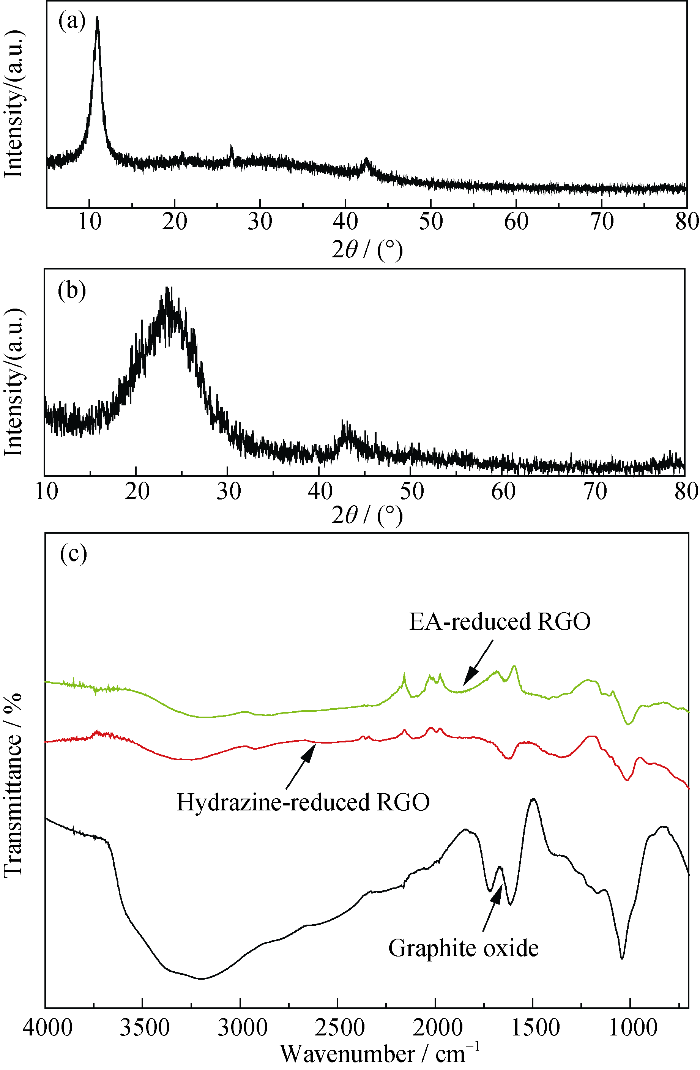
图1(a)、(b)为GO和经乙醇胺 (EA) 还原的RGO的XRD图谱。如图1(a)所示, 在2θ=10.3°处出现了GO典型的单一尖峰, 对应的层间距为0.86 nm; 而RGO在2θ=24° 和 42°处有两个宽的衍射峰(图1(b)), 对应的层间距分别为0.37和0.21 nm。
图1 (a) GO 和 (b) RGO的XRD 图谱, (c) GO与不同试剂还原的RGO的FT-IR图谱
Fig. 1 XRD patterns of (a) GO and (b) RGO, and (c) their FT-IR spectra
文献[26]研究表明, 有机溶剂能够还原氧化石墨烯。为了确认EA具有类似的还原能力, 实验比较了利用EA 和水和肼(NH2NH2)还原GO的FT-IR图谱(图1(c))。从图1(c)可以看到, GO在3496 cm-1处有很强的O-H振动峰, 在1725 cm-1处有C=O伸缩振动峰, 在1396 cm-1 处有O-H弯曲振动峰, 在1230 cm-1和1048 cm-1处则分别为C-OH和C-O的伸缩振动峰[27]。采用传统水合肼还原的RGO与采用EA还原的RGO的FT-IR图谱特征相似[28], 即所有GO的特征峰明显衰减或消失, 说明该GO都得到了较好的还原。
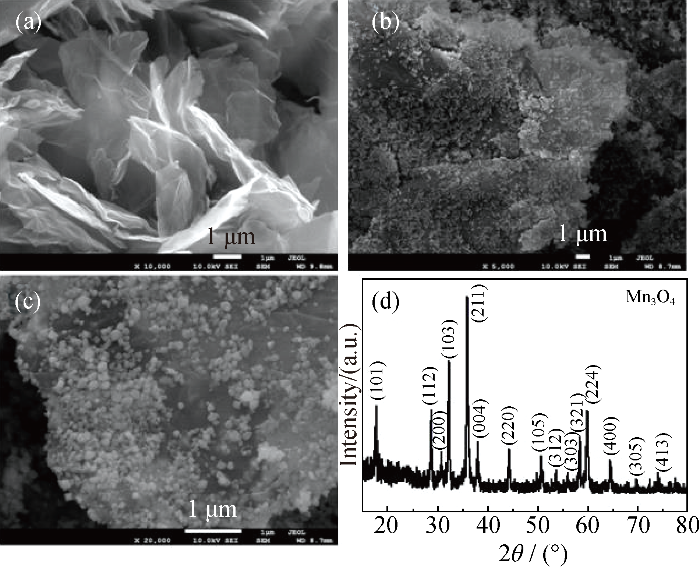
图2(a)为EA还原GO得到的RGO的FESEM照片, RGO呈薄纱片状结构, 尽管RGO表面出现明显的褶皱, 但是表面光滑。而生长了Mn3O4纳米颗粒的RGO (图2(b)、(c)) 则在表面密集分布着纳米颗粒, 纳米颗粒的直径在100~200 nm之间。XRD分析(图2(d))显示表明该复合材料由Mn3O4和RGO两相组成, 主要衍射峰位置与尖晶石型Mn3O4的标准图谱 (JCPDS 24-0734)[29]对应, 几乎没有任何杂质峰, 但是RGO的衍射峰非常弱, 说明在该复合材料中Mn3O4结晶度和纯度都很高。
图2 (a) RGO和(b、c)Mn3O4@RGO的FESEM照片, (d)Mn3O4@RGO的XRD图谱
Fig. 2 FESEM and images of (a) RGO and (b-c) Mn3O4@RGO nanocomposites, (d) XRD pattern of Mn3O4@RGO nanocomposites
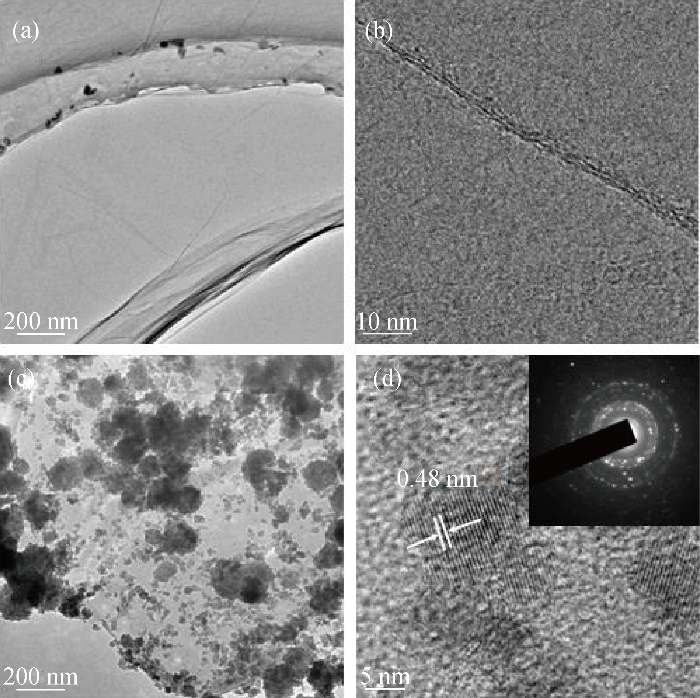
图3(a)、(b)是RGO的TEM 和 HRTEM 照片, 低倍TEM照片显示RGO呈透明薄片, 与图2(a)显示一致。RGO褶皱处的HRTEM照片显示其层数为2层, 因为该褶皱为两层RGO折叠, 说明该RGO为单层结构。图3(c)、(d)为Mn3O4@RGO纳米复合材料的TEM和HRTEM照片。从图3(c)可以看到生长在RGO表面的Mn3O4颗粒主要分为两种: 一种粒径在200 nm左右, 与图2显示一致; 一种则只有 10 nm 左右, 该粒径较小难以在扫描电镜下观察到。图3(d)为Mn3O4@RGO的HRTEM照片, 其晶面间距经测量为0.48 nm, 对应Mn3O4的 (101)晶面[21]。图3(d)中插图为该复合材料的选区电子衍射照片, 衍射环特征说明该Mn3O4呈多晶结构。另外, 尽管生长在RGO表面的Mn3O4纳米颗粒粒径不够均一, 但其仍然能够与RGO紧密结合, 即使是长时间超声处理也很难将其剥离。
图3 (a、b) RGO和(c、d) Mn3O4@RGO的TEM 和HRTEM图片, 插图为对应的SAED照片
Fig. 3 TEM and HRTEM images of RGO (a-b) and Mn3O4@RGO nanocomposites (c,d), with inset in (d) showing the corresponding SAED pattern
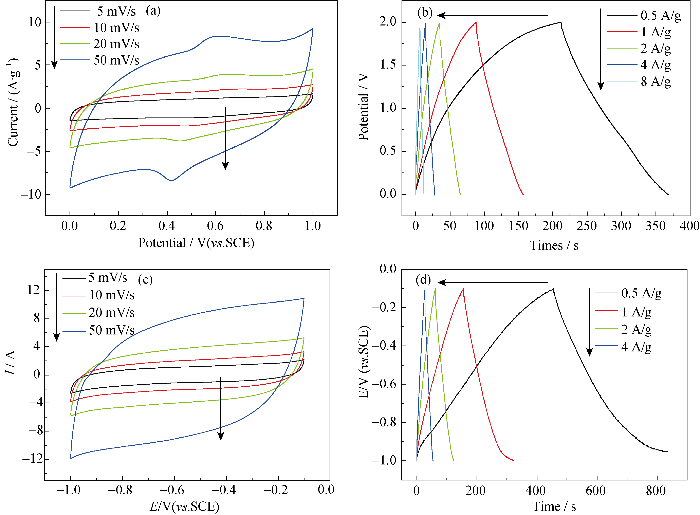
图4(a)给出了Mn3O4@RGO电极材料在1 mol/L Na2SO4电解液中, 0~1.0 V电化学窗口内, 不同扫速下的循环伏安(CV)曲线, 从图中可以看出, 该CV曲线呈一个类矩形状, 表明该材料具有很好的超级电容特征和很低的接触电阻[30]。同时, 该CV曲线还有一对较明显的氧化还原峰, 对应于Mn3O4的法拉第赝电容过程。截至目前, Mn3O4电容材料的储能机理仍然不清晰。一般认为, 氧化锰的赝电容主要来自锰的不同价态Mn(III)/Mn(II)、Mn(IV)/Mn(III)和Mn(VI)/Mn(IV)之间的相互转换, 期间涉及可逆的氧化还原反应[31]。
图4 (a、b) Mn3O4@RGO电极和(c、d) RGO电极的CV曲线和恒流充放电曲线
Fig. 4 CV curves of Mn3O4@RGO nanocomposites (a) and RGO (c) measured in a three-electrode cell in 1 mol/L Na2SO4 electrolytes at different scan rates, and charge-discharge curves of supercapacitors constructed with Mn3O4@RGO nanocomposites (b) and RGO (d) in 1 mol/L Na2SO4 electrolytes measured at different current densities
图4(b)为Mn3O4@RGO电极材料在0~1.0 V范围内的恒流充放电曲线。根据公式 (1) 计算得到该材料的比电容在0.5、1、2、4和8 A/g充放电条件下, 质量比电容分别为 191.5、189、168、140 和112 F/g。图4(c)给出了RGO电极在-1.0 ~ -0.1 V电化学窗口内, 在1 mol/L Na2SO4 电解液中, 不同扫描速率下的CV曲线。从图4(c)中可以看出, RGO电极的循环伏安曲线中没有氧化还原峰, 其形状倾向于矩形, 说明RGO电极的容量来自双电层电容的贡献。图4(d)为在相应的电位窗口 -1.0 ~ -0.1 V内RGO电极的恒流充放电曲线, 由公式 (1) 计算得到RGO的比电容在0.5、1、2和4 A/g充放电条件下分别为210、183.3、135.6、115.6 F/g。
构建非对称超级电容器, 电极之间的电荷平衡遵从关系式q+ = q-。而电荷则由电极比电容(C), 充放电过程的电压窗口(∆V)和电极上活性物质的量(m)决定, 遵从如下等式[32]:
q = C×∆V×m (2)
为了正负电荷平衡q+ = q-, 质量平衡须遵如下等式:
m+/m-=(C-×∆V-)/(C+×∆V+) (3)
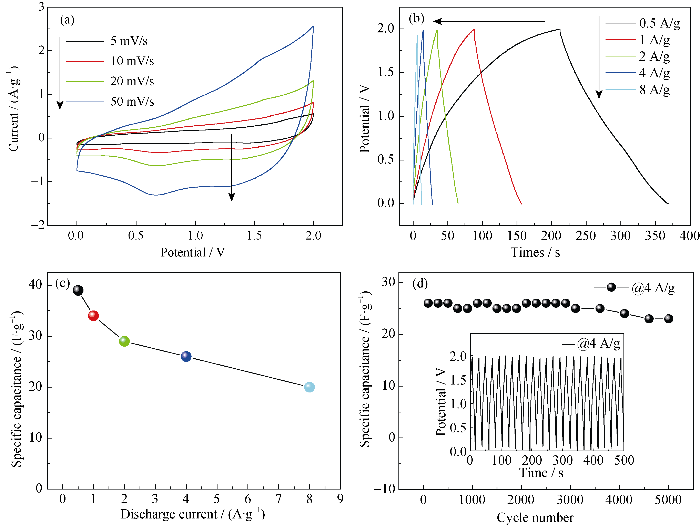
在装配非对称电容器的过程中, 基于Mn3O4@RGO和RGO各自的比电容和电压窗口, 计算得到1 mol/L Na2SO4中电极活性物质的最佳配比为m(Mn3O4@RGO)/m(RGO) = 0.97, 约为1。图5(a)是Mn3O4@RGO//RGO非对称超级电容器在1 mol/L Na2SO4 (电压范围0~2 V) 中, 不同扫速下的CV曲线, 由图可知, 该CV曲线也呈现一个类矩形状, 但是电化学窗口增宽到0~2 V。图5(b)为Mn3O4@RGO//RGO在不同电流密度下的恒电流充放电曲线, 从图中可以看出该充放电曲线具有很好的线性与对称性, 说明该非对称超级电容器具有理想的电容特性。根据公式(1), 基于两极片上所涂活性物质的总质量, 计算得到该非对称电容器在0.5、1、2、4和8 A/g充放电下的比电容分别为39、34、29、26和20 F/g, 如图5(c)所示。
图5 Mn3O4@RGO//RGO非对称两电极超级电容器的CV曲线(a), 恒流充放电曲线(b), 不同充放电电流密度下的质量比电容(c), 以及循环稳定性测试(d), 插图为前20次的循环测试曲线
Fig. 5 (a) Cyclic voltammograms at different scan rates, (b) charge/discharge curves and (c) specific capacitances at different current densities for Mn3O4@RGO//RGO asymmetric supercapacitor in 1 mol/L Na2SO4 electrolytes, and (d) charge-discharge cycling test of Mn3O4@RGO//RGO asymmetric supercapacitor at current density of 4 A/g. Inset shows the galvanostatic charge-discharge cyclic curves of the first twenty cycles at 4 A/g
循环稳定性同样也是评价超级电容器实际应用的一个重要指标。图5 (d) 是在充放电电流密度 4 A/g下, 在1 mol/L Na2SO4电解液中, 电化学窗口0~2 V内, 循环测试5000次的比电容变化曲线。该材料在前3000次循环测试中保持非常好的稳定性, 但是3000次后开始缓慢衰减, 这是由于电极中粘结剂的消耗, 使活性物质粘结不牢脱落等原因造成的[33], 但是该材料经5000次循环后比电容依然保持88.4%, 说明该非对称电容器的循环稳定性很好。图5 (d) 插图为该非对称超级电容器前20次的循环充放电曲线, 由曲线的高对称性可知, 该非对称超级电容器具有很高的循环可逆性。
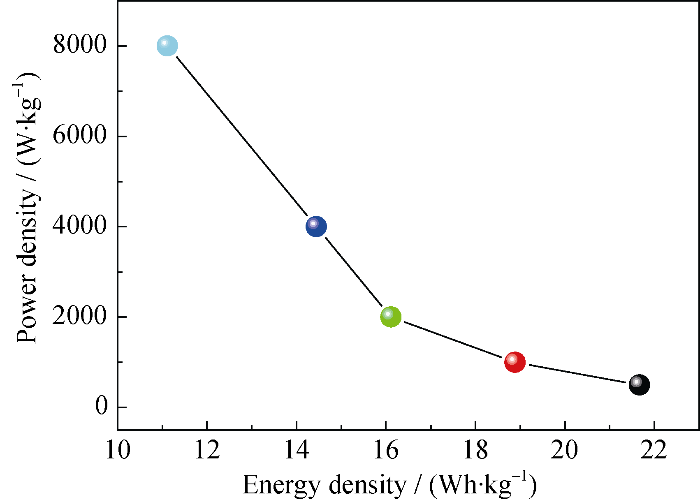
为了进一步评估非对称电容器的电化学性能, 根据公式(4)和(5)[34]可以计算得出该电容器活性材料能量密度和功率密度之间的关系。
E=0.5C∆V2/3.6 (4)
P=E×3600/∆t (5)
其中, C是根据公式 (1) 所计算电容器的比电容, ∆V是电容器的电压范围, ∆t是放电时间。
计算结果如图6所示, 由图可知, 该Mn3O4@RGO//RGO非对称超级电容器在Na2SO4溶液中, 最大能量密度可达21.7 Wh/kg, 对应的功率密度为0.5 kW/kg; 最大功率密度可达8 kW/kg, 对应的能量密度为11.1 Wh/kg。相比较而言, 此能量密度远高于对称型超级电容器 (通常低于10 Wh/kg), 也高于水系电解质中Mn3O4基非对称超级电容器, 如Mn3O4@RGO//氮掺杂RGO(微波水热合成, 11 Wh/kg)[35]和Mn3O4//RGO (9.6 Wh/kg)[29]。另外, 该非对称超级电容器能量和功率方面与铅酸电池(26到34 Wh/kg)[36]和Ni-Cd电池(30到40 Wh/kg)[37]都有一定的可比性。相比于基于碳材料的商业超级电容器的储能密度, 本研究的电容器则有明显的优势。
图6 Mn3O4@RGO//RGO非对称超级电容器的比能量与比功率密度图
Fig. 6 Ragone plots of Mn3O4@RGO//RGO asymmetric supercapacitors
Mn3O4@RGO//RGO非对称超级电容器的电容性能优异可以从以下3个方面分析: 1)该非对称超级电容器在 Na2SO4电解质中能够获得一个高工作电压区间0~2.0 V; 2)Mn3O4一步直接生长在RGO表面上, 能够与RGO匹配良好[38], 降低了复合材料之间的接触电阻, 为复合材料提供了良好的机械稳定性和快速可逆法拉第反应所需的高导电性和高离子传导性; 3)负极材料RGO主要通过双电层电容存储, 能够进行快速的电子传输, 而且能与正极材料进行很好的匹配。
采用溶剂热一步法成功制备了Mn3O4@RGO纳米复合材料。使用Mn3O4@RGO作为正极, RGO作为负极构筑新型非对称超级电容器获得了较高的储能密度。Mn3O4@RGO//RGO非对称超级电容器在 1 mol/L Na2SO4电解液中最大能量密度可达21.7 Wh/kg, 相应的功率密度为0.5 kW/kg; 最大功率密度可达8 kW/kg, 相应的能量密度为11.1 Wh/kg。Mn3O4@RGO//RGO超级电容器在恒电流充放电循环5000次后, 质量比电容依然保持88.4%, 表现出极好的循环稳定性。Mn3O4@RGO复合材料优秀的能量储存性能具有广阔的应用前景。
| [1] |
A novel hydrothermal synthesis and characterisation of porous Mn3O4 for supercapacitors with high rate capability. |
| [2] |
Ultrasound assisted synthesis of Mn3O4 nanoparticles anchored graphene nanosheets for supercapacitor applications. |
| [3] |
Materials for electrochemical capacitors . |
| [4] |
S NCHEZ B M, DOBSON P J, et al. The role of nanomaterials in redox-based supercapacitors for next generation energy storage devices. |
| [5] |
Laser scribing of high-performance and flexible graphene-based electrochemical capacitors.
|
| [6] |
|
| [7] |
Electrolyte and composition effects on the performances of asymmetric supercapacitors constructed with Mn3O4 nanoparticles-graphene nanocomposites . |
| [8] |
Novel MnOOH-graphene nanocomposites: Preparation, characterization and electrochemical properties for supercapacitors. |
| [9] |
One-pot synthesis of MnOOH nanorods on graphenefor asymmetric supercapacitors. |
| [10] |
Asymmetric supercapacitors based on graphene/MnO2 and activated carbon nanofiber electrodes with high power and energy density. |
| [11] |
A new cheap asymmetric aqueous supercapacitor: Activated carbon//NaMnO2.
|
| [12] |
Porous and single crystalline Co3O4 nanospheres for pseudocapacitors with enhanced performance.
|
| [13] |
High-voltage asymmetric supercapacitors operating in aqueous electrolyte. Appl.Phys.
|
| [14] |
Stretchable supercapacitors based on buckled single-walled carbon‐nanotube macrofilms.
|
| [15] |
Ultrathin MnO2 nanofibers grown on graphitic carbon spheres as high-performance asymmetric supercapacitor electrodes. |
| [16] |
A facile and template-free hydrothermal synthesis of Mn3O4 nanorods on graphene sheets for supercapacitor electrodes with long cycle stability. |
| [17] |
Facile synthesis and characterization of Mn3O4 nanoparticles by auto-combustion method.
|
| [18] |
Binder-free three-dimensional porous Mn3O4 nanorods/reduced graphene oxide paper-like electrodes for electrochemical energy storage. |
| [19] |
Surfactant-free hybridization of transition metal oxide nanoparticles with conductive graphene for high-performance supercapacitor. |
| [20] |
Porous manganese oxide generated from lithiation/delithiation with improved electrochemical oxidation for supercapacitors. |
| [21] |
Facile synthesis of porous Mn3O4 nanocrystal-graphene nanocomposites for electrochemical supercapacitors. |
| [22] |
Microwave-assisted synthesis of Mn3O4 nanoparticles@reduced graphene oxide nanocomposites for high performance supercapacitors . |
| [23] |
Mn3O4-graphene hybrid as a high-capacity anode material for lithium ion batteries. |
| [24] |
Preparation of graphitic oxide. |
| [25] |
3D Hierarchical Co3O4 twin‐spheres with an urchin‐like structure: large‐scale synthesis, multistep‐splitting growth, and electrochemical pseudocapacitors. |
| [26] |
Colloidal suspensions of highly reduced graphene oxide in a wide variety of organic solvents.
|
| [27] |
Chemical functionalization of graphene sheets by solvothermal reduction of a graphene oxide suspension in N-methyl-2-pyrrolidone. |
| [28] |
Structure, cation valence states and electrochemical properties of nanostructured Mn3O4. |
| [29] |
Facile treatment of wastewater produced in Hummer's method to prepare Mn3O4 nanoparticles and study their electrochemical performance in an asymmetric supercapacitor. |
| [30] |
High performance supercapacitors using metal oxide anchored graphene nanosheet electrodes. |
| [31] |
Ideal capacitive behavior of hydrous manganese oxide prepared by anodic deposition. |
| [32] |
RAYMUNDO-PI ERO E, B GUIN F. A new type of high energy asymmetric capacitor with nanoporous carbon electrodes in aqueous electrolyte. |
| [33] |
Free-standing and porous hierarchical nanoarchitectures constructed with cobalt cobaltite nanowalls for supercapacitors with high specific capacitances. |
| [34] |
Advanced asymmetric supercapacitors based on Ni(OH)2/graphene and porous graphene electrodes with high energy density . |
| [35] |
Microwave-assisted hydrothermal synthesis of Mn3O4 reduced graphene oxide composites for high power supercapacitors . |
| [36] |
Carbon-based supercapacitors produced by activation of graphene. |
| [37] |
Batteries: fifty years of materials development. |
| [38] |
Strongly coupled inorganic-nano-carbon hybrid materials for energy storage. |

/
| 〈 |
|
〉 |