无机材料学报 ›› 2026, Vol. 41 ›› Issue (7): 915-922.DOI: 10.15541/jim20250456 CSTR: 32189.14.10.15541/jim20250456
李阳1( ), 陈佳宁2, 卿玉长3(), 范冰冰2()
收稿日期:2025-11-11
修回日期:2025-12-10
出版日期:2026-07-20
网络出版日期:2025-12-19
通讯作者:
卿玉长, 教授. E-mail: qingyuchang@nwpu.edu.cn;作者简介:李 阳(1993-), 男, 副研究员. E-mail: liyang119@zzu.edu.cn
基金资助:
LI Yang1(), CHEN Jianing2, QING Yuchang3(), FAN Bingbing2()
Received:2025-11-11
Revised:2025-12-10
Published:2026-07-20
Online:2025-12-19
Contact:
QING Yuchang, professor. E-mail: qingyuchang@nwpu.edu.cn;About author:LI Yang (1993-), male, associate professor. E-mail: liyang119@zzu.edu.cn
Supported by:摘要:
面对日益复杂的电磁环境和多频谱探测威胁, 开发高性能隐身材料迫在眉睫。虽然含氧缺陷的Ti4O7具备较高的电导率和电磁衰减能力, 但其过高的介电常数易导致阻抗失配, 限制其实际应用。为克服这一局限, 可将Ti4O7与具有不同电磁特性的磁性或介电材料复合, 从而进一步增强铁磁共振及介电损耗性能。本研究首先通过氢气还原法调控TiO2的电子结构与晶体缺陷, 成功合成纯相Ti4O7; 进而采用溶剂热法在其表面包覆了磁性CoNi合金和碳纳米管(CNT), 构建了Ti4O7/CoNi/CNT复合吸收剂。该结构中, 磁性CoNi层有助于增强界面极化和磁损耗, 引入CNT则有效提高了电导损耗, 减轻了材料整体质量, 从而实现了介电损耗与磁损耗的协同增强。实验结果表明, 当Ti4O7/CoNi/CNT复合吸收剂(CNT质量分数为4%)在石蜡基体中的添加量为45%(质量分数)、厚度为2.03 mm时, 最小反射损耗可达-80.6 dB, 有效吸收频宽为2.0 GHz。综上, Ti4O7/CoNi/CNT复合吸收剂展现出优异的电磁波吸收性能, 为无人机等装备的隐身防护提供了重要的参考价值。
中图分类号:
李阳, 陈佳宁, 卿玉长, 范冰冰. Ti4O7/CoNi/CNT异质结构的界面调控及吸波机制研究[J]. 无机材料学报, 2026, 41(7): 915-922.
LI Yang, CHEN Jianing, QING Yuchang, FAN Bingbing. Interface Modulation and Microwave Absorbing Mechanism of Ti4O7/CoNi/CNT Heterostructures[J]. Journal of Inorganic Materials, 2026, 41(7): 915-922.
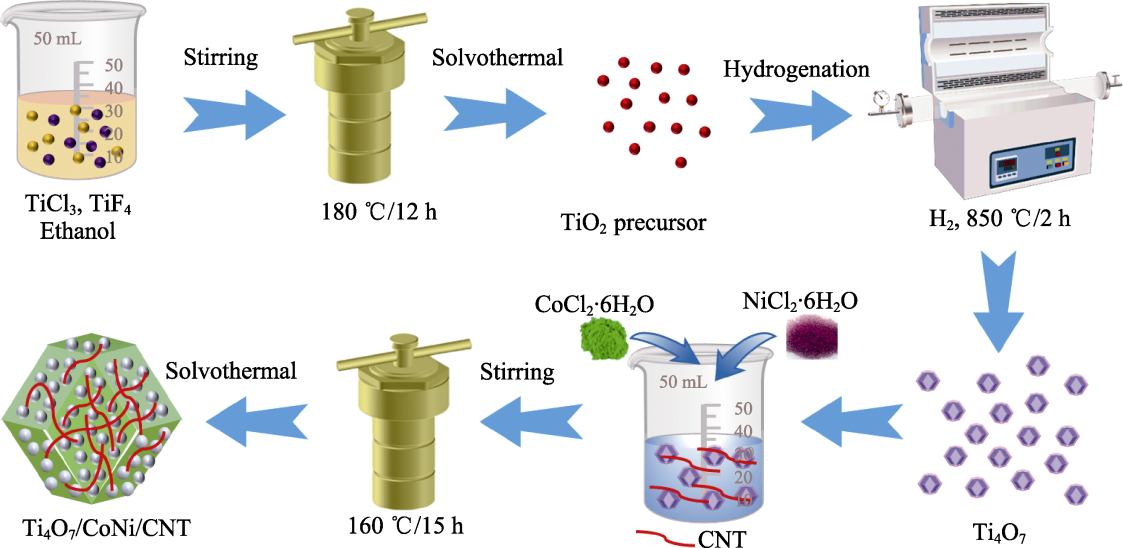
图1 Ti4O7/CoNi/CNT复合吸收剂的合成过程示意图
Fig. 1 Schematic diagram of the synthesis process of Ti4O7/CoNi/CNT absorbents
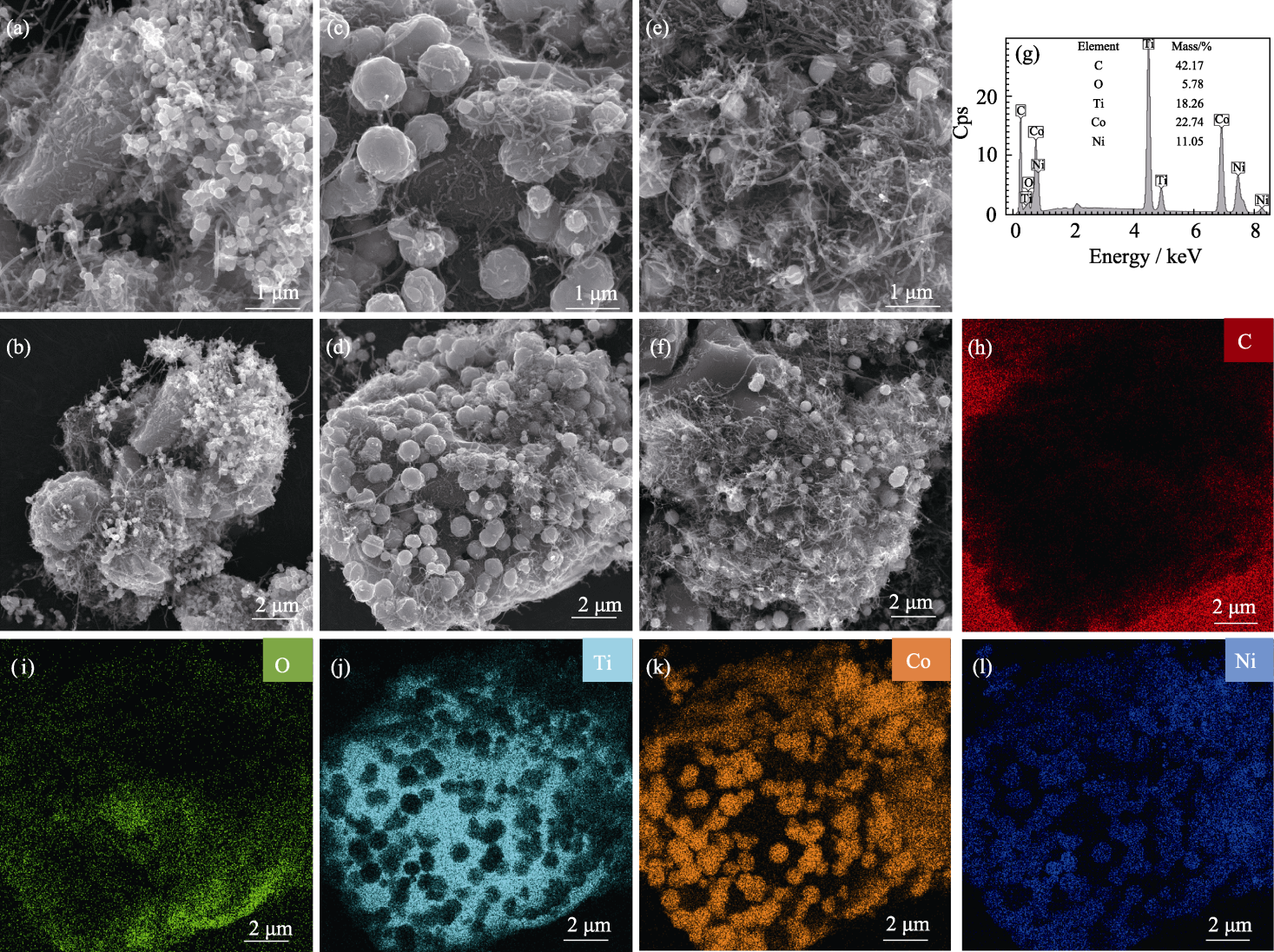
图2 (a, b) TCNC-2、(c, d) TCNC-4和(e, f) TCNC-6样品的SEM照片; (g~l) TCNC-4样品的EDS图谱
Fig. 2 (a-f) SEM images of (a, b) TCNC-2, (c, d) TCNC-4, and (e, f) TCNC-6 samples; (g-l) EDS mappings of TCNC-4 sample
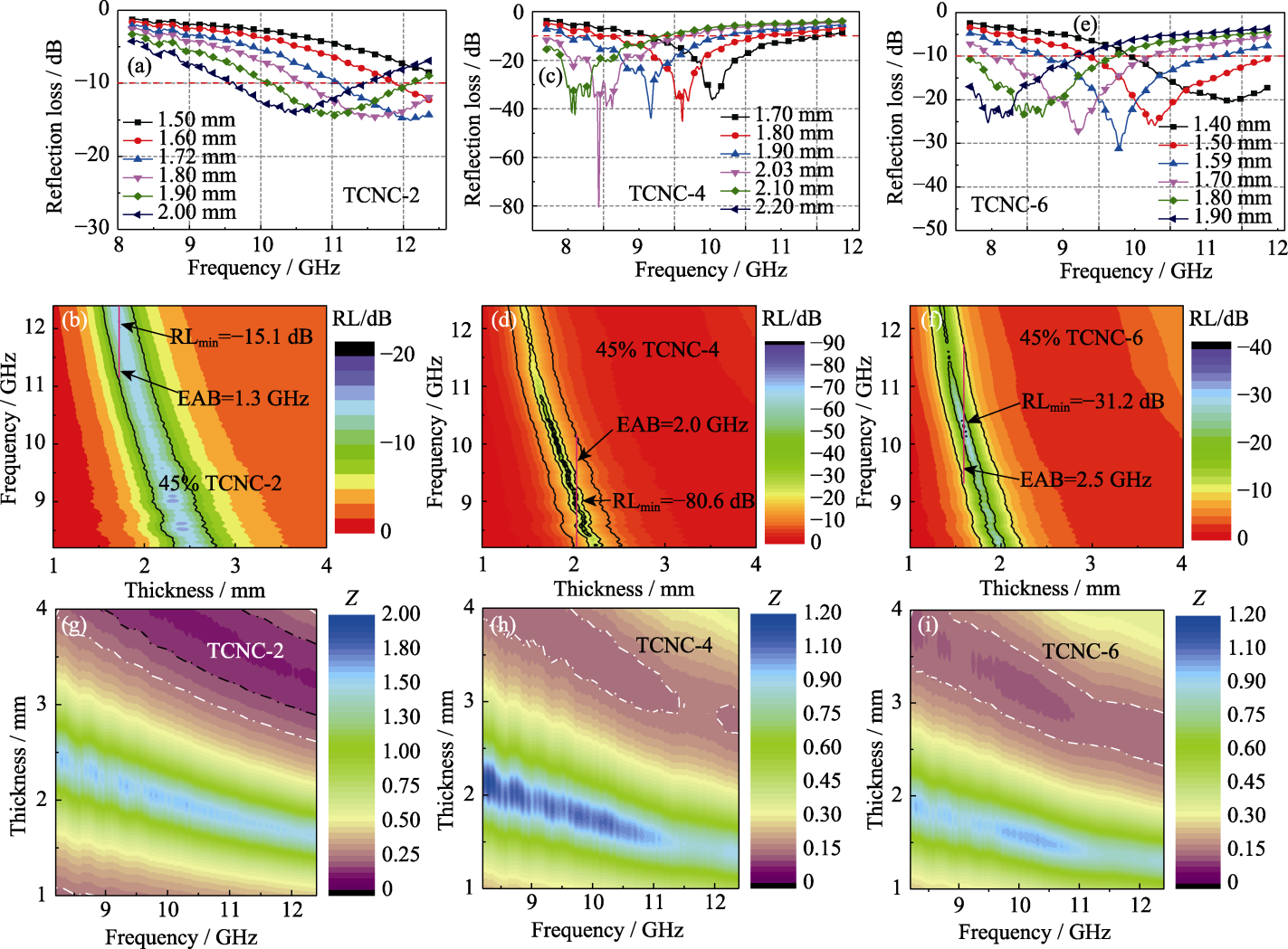
图3 不同Ti4O7/CoNi/CNT样品的反射损耗
Fig. 3 Reflection loss of different Ti4O7/CoNi/CNT samples (a, b) TCNC-2; (c, d) TCNC-4; (e, f) TCNC-6; (g-i) 2D impedance matching of different Ti4O7/CoNi/CNT samples. Colorful figures are available on website
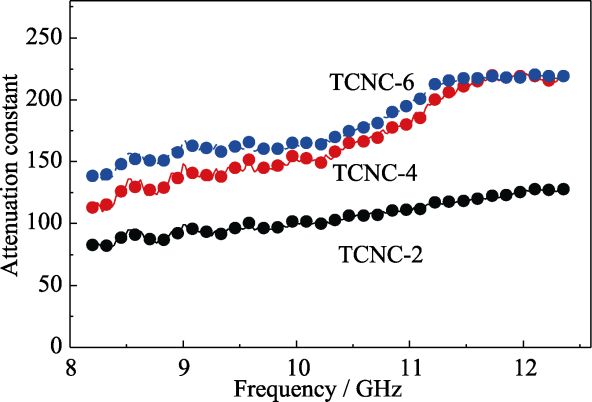
图4 Ti4O7/CoNi/CNT样品的衰减常数
Fig. 4 Attenuation constants of Ti4O7/CoNi/CNT samples
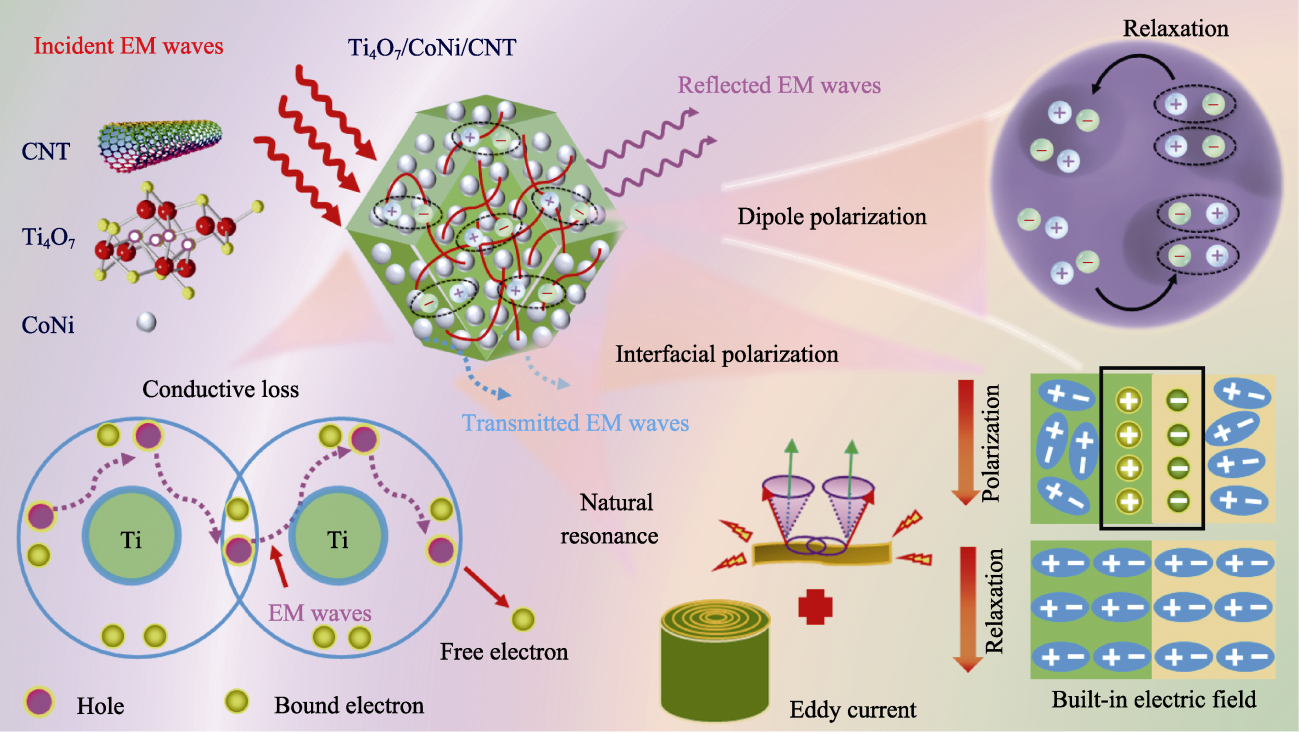
图5 Ti4O7/CoNi/CNT样品可能的电磁波吸收机理示意图
Fig. 5 Schematic diagram of possible electromagnetic wave absorption mechanism of Ti4O7/CoNi/CNT sample
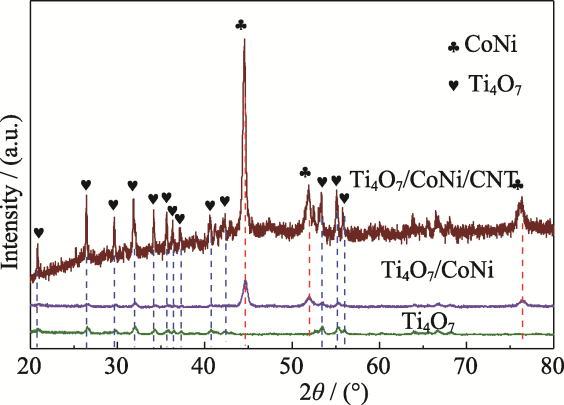
图S1 TCNC-4样品的XRD图谱
Fig. S1 XRD pattern of TCNC-4 sample
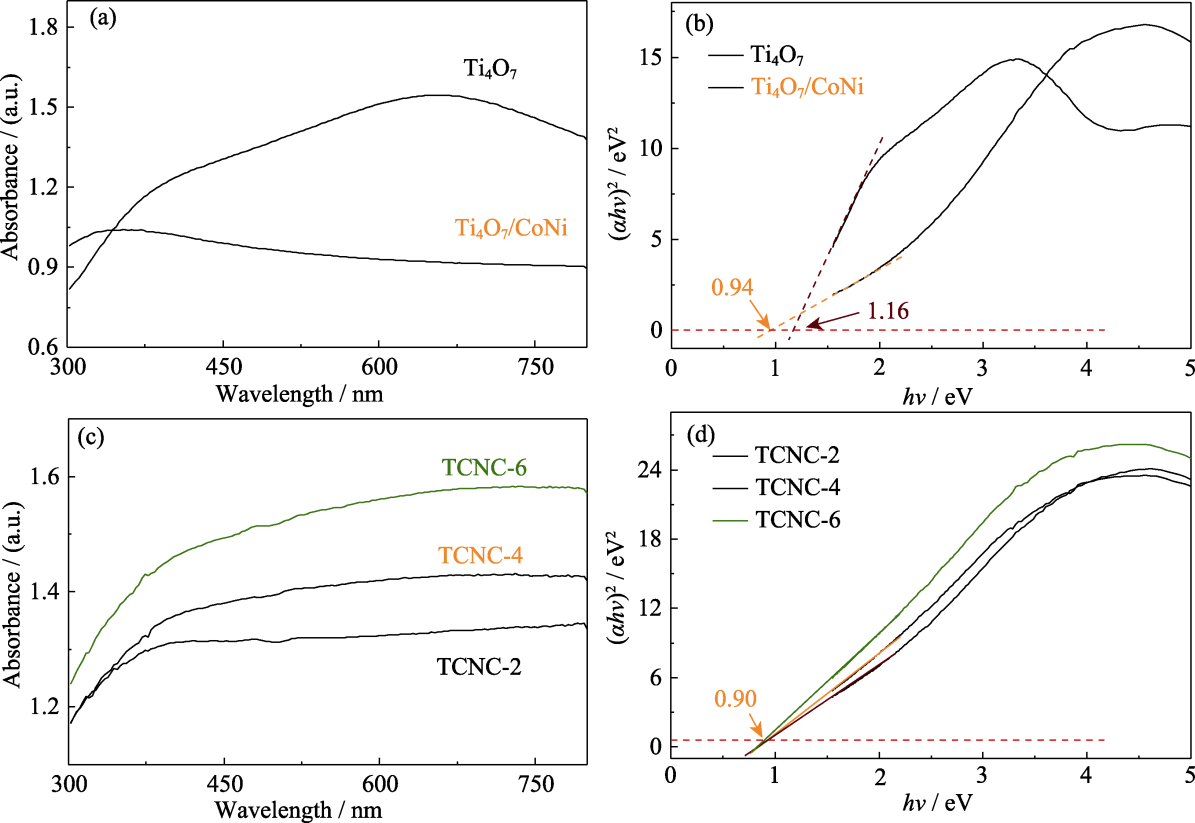
图S2 Ti4O7、Ti4O7/CoNi和不同Ti4O7/CoNi/CNT样品的禁带宽度
Fig. S2 Bandgap widths of Ti4O7, Ti4O7/CoNi and different Ti4O7/CoNi/CNT samples (a) UV-Vis spectra and (b) Tauc plots of Ti4O7 and Ti4O7/CoNi samples; (c) UV-Vis spectra and (d) Tauc plots of different Ti4O7/CoNi/CNT samples
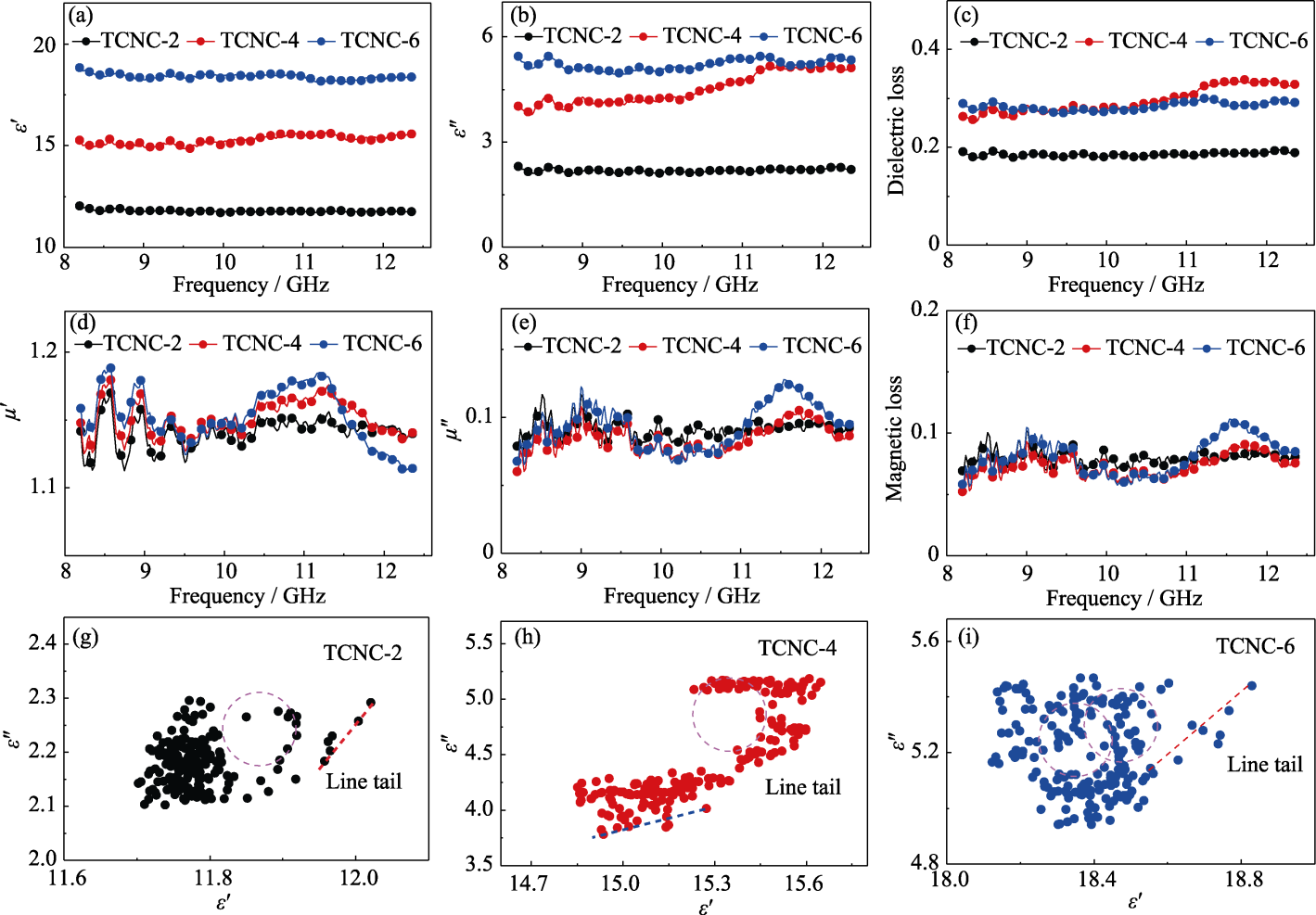
图S3 不同Ti4O7/CoNi/CNT样品的电磁参数
Fig. S3 Electromagnetic parameters of different Ti4O7/CoNi/CNT samples (a) ε'; (b) ε″; (c) Dielectric loss tangent value; (d) μ'; (e) μ″; (f) Magnetic loss tangent value;(g-i) Cole-Cole curves of (g) TCNC-2, (h) TCNC-4 and (i) TCNC-6 samples
| Sample | Filler content/% (in mass) | Thickness/mm | RLmin/dB | EAB/GHz | Ref. |
|---|---|---|---|---|---|
| Fe3O4/TiO2-x | 50 | 2.90 | −47.6 | 6.5-12.2 | [ |
| TixO2x-1/CNT | 40 | 2.04 | −63.8 | 9.4-12.4 | [ |
| Ti4O7 | 50 | 1.77 | −46.2 | 10.0-12.4 | [ |
| Ti4O7/Ni | 50 | 1.65 | −20.2 | 8.5-10.4 | [ |
| Ti4O7/CoNi | 50 | 1.85 | −69.1 | 8.2-10.8 | [ |
| TixO2x-1/Ti3C2Tx | 40 | 2.12 | −36.7 | 8.3-11.0 | [ |
| Ti2O3 | 50 | 3.00 | −37.6 | 18.6-20.6 | [ |
| Ti2O3/C | 50 | 3.00 | −26.8 | 19.0-22.2 | [ |
| Ti4O7/CoNi/CNT | 45 | 2.03 | −80.6 | 8.2-10.2 | This work |
表S1 钛氧化物基复合吸收剂的电磁波吸收性能对比[18,20,23 -25,32,43]
Table S1 Comparison of microwave capability of titanium oxide-based absorbents[18,20,23 -25,32,43]
| Sample | Filler content/% (in mass) | Thickness/mm | RLmin/dB | EAB/GHz | Ref. |
|---|---|---|---|---|---|
| Fe3O4/TiO2-x | 50 | 2.90 | −47.6 | 6.5-12.2 | [ |
| TixO2x-1/CNT | 40 | 2.04 | −63.8 | 9.4-12.4 | [ |
| Ti4O7 | 50 | 1.77 | −46.2 | 10.0-12.4 | [ |
| Ti4O7/Ni | 50 | 1.65 | −20.2 | 8.5-10.4 | [ |
| Ti4O7/CoNi | 50 | 1.85 | −69.1 | 8.2-10.8 | [ |
| TixO2x-1/Ti3C2Tx | 40 | 2.12 | −36.7 | 8.3-11.0 | [ |
| Ti2O3 | 50 | 3.00 | −37.6 | 18.6-20.6 | [ |
| Ti2O3/C | 50 | 3.00 | −26.8 | 19.0-22.2 | [ |
| Ti4O7/CoNi/CNT | 45 | 2.03 | −80.6 | 8.2-10.2 | This work |
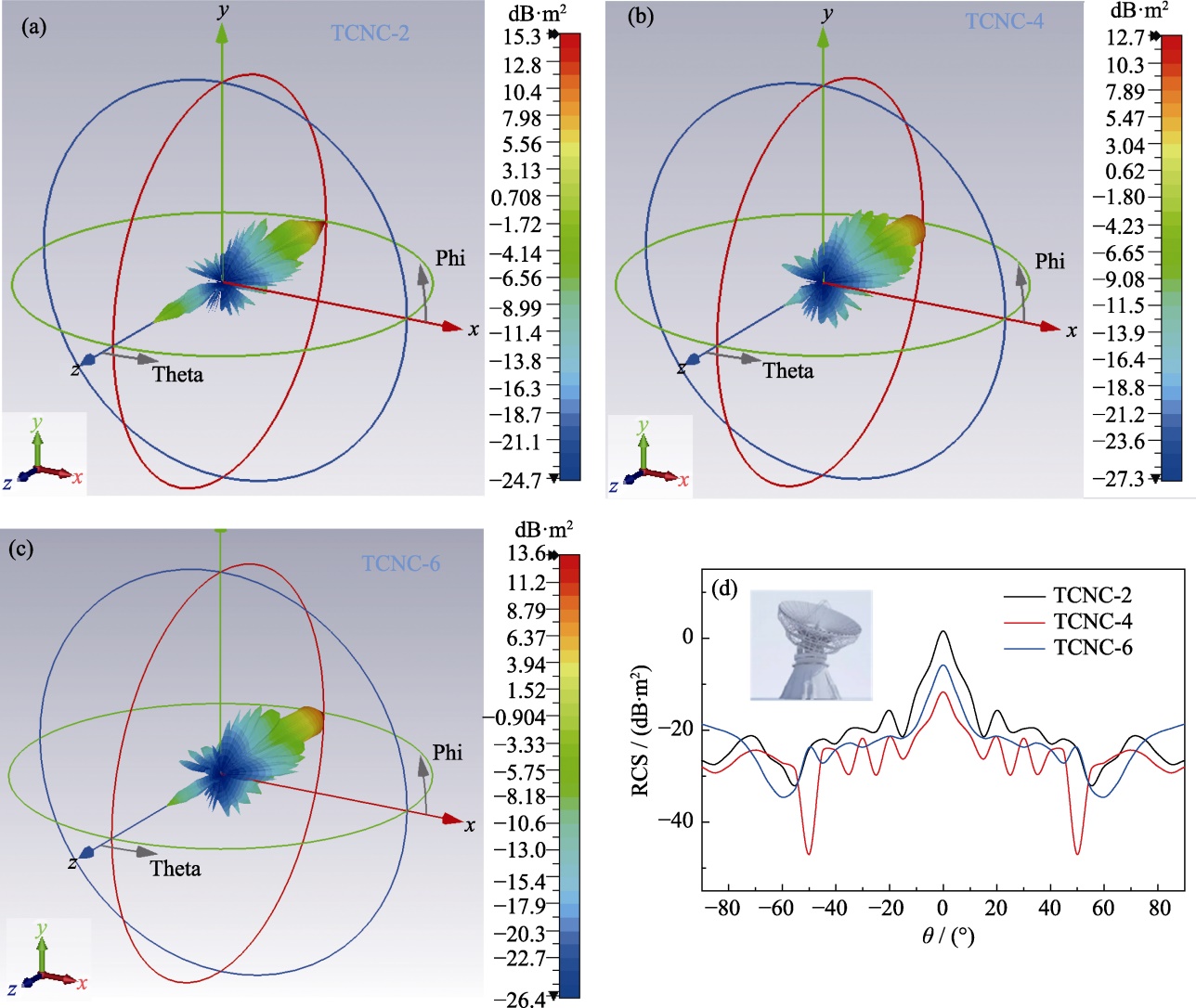
图S4 不同Ti4O7/CoNi/CNT样品的RCS模拟结果
Fig. S4 RCS simulation results of different Ti4O7/CoNi/CNT samples (a) TCNC-2; (b) TCNC-4; (c) TCNC-6; (d) RCS values at different angles
| [1] | 李英豪, 廖擎玮, 殷宇翔, 等. 多波段兼容隐身材料的研究进展. 现代技术陶瓷, 2025, 46(5): 431. |
| [2] |
CHEN H Y, TANG Z P, YIN L J, et al. Low-frequency microwave absorption of CIPs@Mn0.8Zn0.2Fe2O4-CNTs composites. Journal of Inorganic Materials, 2024, 39(1): 71.
DOI URL |
| [3] |
WAN H J, XIAO X. Terahertz electromagnetic shielding and absorbing of MXenes and their composites. Journal of Inorganic Materials, 2024, 39(2): 129.
DOI URL |
| [4] | 李明展, 李恩, 潘亚敏, 等. 电磁屏蔽导电涂料的研究与应用进展. 复合材料学报, 2024, 41(2): 572. |
| [5] |
GUAN H Y, ZHANG L, JING K K, et al. Interfacial mechanical properties of the domestic 3rd generation 2.5D SiCf/SiC composite. Journal of Inorganic Materials, 2024, 39(3): 259.
DOI URL |
| [6] | 王江涛, 陈帅, 沈承, 等. 吸波材料/结构及吸波-承载功能一体化结构研究进展. 复合材料学报, 2024, 41(8): 3866. |
| [7] | 徐俊杰, 王岭, 王晓猛, 等. 耐高温吸波材料的研究进展. 现代技术陶瓷, 2024, 45: 189. |
| [8] |
KOLBRECKA K, PRZYLUSKI J. Sub-stoichiometric titanium oxides as ceramic electrodes for oxygen evolution—structural aspects of the voltammetric behaviour of TinO2n-1. Electrochimica Acta, 1994, 39(11/12): 1591.
DOI URL |
| [9] | 李阳, 高振良, 卿玉长, 等. TixO2x-1基电磁波吸收剂的研究现状与设计展望. 现代技术陶瓷, 2025, 46(S1): 327. |
| [10] | ANDERSSON S, MAGNÉLI A. Diskrete titanoxydphasen im zusammensetzungsbereich TiO1.75-TiO1.90. Naturwissenschaften, 1956, 43(21): 495. |
| [11] |
XIA T, ZHANG C, OYLER N A, et al. Hydrogenated TiO2 nanocrystals: a novel microwave absorbing material. Advanced Materials, 2013, 25(47): 6905.
DOI URL |
| [12] | XIA T, CAO Y H, OYLER N A, et al. Strong microwave absorption of hydrogenated wide bandgap semiconductor nanoparticles. ACS Applied Materials & Interfaces, 2015, 7(19): 10407. |
| [13] |
GREEN M, XIANG P, LIU Z Q, et al. Microwave absorption of aluminum/hydrogen treated titanium dioxide nanoparticles. Journal of Materiomics, 2019, 5(1): 133.
DOI URL |
| [14] |
GREEN M, VAN TRAN A T, SMEDLEY R, et al. Microwave absorption of magnesium/hydrogen-treated titanium dioxide nanoparticles. Nano Materials Science, 2019, 1(1): 48.
DOI URL |
| [15] |
XU J L, QI X S, LUO C Z, et al. Synthesis and enhanced microwave absorption properties: a strongly hydrogenated TiO2 nanomaterial. Nanotechnology, 2017, 28(42): 425701.
DOI |
| [16] |
XU J L, SUN L, QI X S, et al. A novel strategy to enhance the multiple interface effect using amorphous carbon packaged hydrogenated TiO2 for stable and effective microwave absorption. Journal of Materials Chemistry C, 2019, 7(20): 6152.
DOI URL |
| [17] |
SHI S Q, HAO S J, YANG C, et al. Enhanced microwave absorption properties of reduced graphene oxide/TiO2 nanowire composites synthesized via simultaneous carbonation and hydrogenation. Journal of Materials Chemistry C, 2022, 10(25): 9586.
DOI URL |
| [18] |
SHI X F, LIU Z W, LI X, et al. Enhanced dielectric polarization from disorder-engineered Fe3O4@black TiO2-x heterostructure for broadband microwave absorption. Chemical Engineering Journal, 2021, 419: 130020.
DOI URL |
| [19] |
YANG P J, LI T H, LI H, et al. Effect of graphene on graphitization, electrical and mechanical properties of epoxy resin carbon foam. Journal of Inorganic Materials, 2024, 39(1): 107.
DOI URL |
| [20] |
LI Y, QING Y C, CAO Y R, et al. Positive charge holes revealed by energy band theory in multiphase TixO2x-1 and exploration of its microscopic electromagnetic loss mechanism. Small, 2023, 19(41): 2302769.
DOI URL |
| [21] | 彭夏文, 张景钦, 陈凌云, 等. 雷达和红外隐身材料的最新研究进展及挑战. 材料研究与应用, 2025, 19(1): 15. |
| [22] |
LUO W, JIANG X, LIU Y, et al. Entropy-driven morphology regulation of MAX phase solid solutions with enhanced microwave absorption and thermal insulation performance. Small, 2024, 20(8): 2305453.
DOI URL |
| [23] |
QING Y C, LI Y, LI W, et al. Ti3+ self-doped dark TiO2 nanoparticles with tunable and unique dielectric properties for electromagnetic applications. Journal of Materials Chemistry C, 2021, 9(4): 1205.
DOI URL |
| [24] |
LI Y, QING Y C, LI W, et al. Novel Magnéli Ti4O7/Ni/poly(vinylidene fluoride) hybrids for high-performance electromagnetic wave absorption. Advanced Composites and Hybrid Materials, 2021, 4(4): 1027.
DOI |
| [25] |
LI Y, QING Y C, ZHAO B, et al. Tunable magnetic coupling and dipole polarization of core-shell Magnéli Ti4O7 ceramic/magnetic metal possessing broadband microwave absorption properties. Ceramics International, 2021, 47(23): 33373.
DOI URL |
| [26] |
WANG L, YU X F, LI X, et al. MOF-derived yolk-shell Ni@C@ZnO Schottky contact structure for enhanced microwave absorption. Chemical Engineering Journal, 2020, 383: 123099.
DOI URL |
| [27] | WU Z C, YANG Z Q, JIN C, et al. Accurately engineering 2D/2D/0D heterojunction in hierarchical Ti3C2Tx MXene nanoarchitectures for electromagnetic wave absorption and shielding. ACS Applied Materials & Interfaces, 2021, 13(4): 5866. |
| [28] | HE M K, ZHANG K Y, QIU H, et al. Low-frequency microwave absorption composites. Advanced Science, 2025, 12(35): e11580. |
| [29] |
QU N, SUN H X, SUN Y Y, et al. 2D/2D coupled MOF/Fe composite metamaterials enable robust ultra-broadband microwave absorption. Nature Communications, 2024, 15: 5642.
DOI PMID |
| [30] | LU X K, LI X, CAO Y C, et al. 1D CNT-expanded 3D carbon foam/Si3N4 sandwich heterostructure: utilizing the polarization compensation effect for keeping stable electromagnetic absorption performance at elevated temperature. ACS Applied Materials & Interfaces, 2022, 14(34): 39188. |
| [31] |
LI Y, QING Y C, ZHANG Y R, et al. Simultaneously tuning structural defects and crystal phase in accordion-like TixO2x-1 derived from Ti3C2Tx MXene for enhanced electromagnetic attenuation. Journal of Advanced Ceramics, 2023, 12(10): 1946.
DOI URL |
| [32] | FU X, YANG B, CHEN W, et al. Electromagnetic wave absorption performance of Ti2O3 and vacancy enhancement effective bandwidth. Journal of Materials Science & Technology, 2021, 76: 166. |
| [33] |
XIAO J X, ZHAN B B, HE M K, et al. Mechanically robust and thermal insulating nanofiber elastomer for hydrophobic, corrosion- resistant, and flexible multifunctional electromagnetic wave absorbers. Advanced Functional Materials, 2025, 35(14): 2419266.
DOI URL |
| [34] | 吴海华, 傅文鑫, 刘少康, 等. ZnO-石墨烯-TPU/PLA复合材料的制备及吸波性能. 复合材料学报, 2024, 41(3): 1316. |
| [35] |
QIAN J J, MA D D, ZHOU X L, et al. Synthesis of SiOC@C ceramic nanospheres with tunable electromagnetic wave absorption performance. Journal of Advanced Ceramics, 2024, 13(9): 1394.
DOI URL |
| [36] |
LI X, WANG X L, LI M H, et al. Built-in electric field enhancement strategy induced by cross-dimensional nano- heterointerface design for electromagnetic wave absorption. Advanced Functional Materials, 2025, 35(18): 2407217.
DOI URL |
| [37] |
CHEN Y Q, CHEN M, LEI H Y, et al. Microwave-assisted synthesis of high-performance TaC nanorods for enhanced electromagnetic wave absorption. Journal of Advanced Ceramics, 2025, 14(8): 9221130.
DOI URL |
| [38] |
LI Y, QING Y C, ZHOU Y F, et al. Unique nanoporous structure derived from Co3O4-C and Co/CoO-C composites towards the ultra-strong electromagnetic absorption. Composites Part B: Engineering, 2021, 213: 108731.
DOI URL |
| [39] |
YANG L Y, WANG L M, DONG S, et al. Lightweight Cf/HC-SiBCN composite for multifunctional applications. Journal of Advanced Ceramics, 2025, 14(5): 9221068.
DOI URL |
| [40] | 王腾飞, 刘博宇, 庞青, 等. 缺陷介孔TiO2的制备及其吸波性能研究. 材料研究与应用, 2025, 19(1): 72. |
| [41] |
YUAN M Y, LI B X, DU Y Q, et al. Programmable electromagnetic wave absorption via tailored metal single atom- support interactions. Advanced Materials, 2025, 37(8): 2417580.
DOI URL |
| [42] |
LIANG Q Q, HE M K, ZHAN B B, et al. Yolk-shell CoNi@N-doped carbon-CoNi@CNTs for enhanced microwave absorption, photothermal, anti-corrosion, and antimicrobial properties. Nano-Micro Letters, 2025, 17(1): 167.
DOI PMID |
| [43] |
CHE R C, M PENG L, DUAN X F, et al. Microwave absorption enhancement and complex permittivity and permeability of Fe encapsulated within carbon nanotubes. Advanced Materials, 2004, 16(5): 401.
DOI URL |
| [44] | YAO L, DANG J, XIAO J X, et al. Metal chelate-derived and catalytical strategy to produce CoFe/C@bamboo-like carbon nanotubes for microwave absorption, hydrophobicity, and corrosion resistance. Journal of Materials Science & Technology, 2026, 240: 190. |
| [1] | 张晓民, 仝粮语, 高红洁, 陈垿, 闫虎虎, 高阳. 3D网络结构粉煤灰微珠@碳纳米管微球的制备及吸波性能研究[J]. 无机材料学报, 2026, 41(2): 208-216. |
| [2] | 王家虎, 王文馨, 杜鹏, 胡芳东, 姜晓蕾, 杨剑. Na3V2(PO4)2F3@V2O5-x复合材料的制备及储钠性能研究[J]. 无机材料学报, 2019, 34(10): 1097-1102. |
| [3] | 何永钦, 李晓云, 张景贤, 李晓光. 原位裂解碳对氮化铝基微波衰减陶瓷性能的影响[J]. 无机材料学报, 2018, 33(4): 421-426. |
| [4] | 卢 青, 华罗光, 陈亦琳, 高碧芬, 林碧洲. 氧缺陷Bi2WO6-x可见光催化剂的制备和性能[J]. 无机材料学报, 2015, 30(4): 413-419. |
| [5] | 操小鑫, 陈亦琳, 林碧洲, 高碧芬. 氧缺陷型TiO2-x可见光催化性能的研究[J]. 无机材料学报, 2012, 27(12): 1301-1305. |
| [6] | 杨 雁, 李盛涛. 共沉淀法制备CaCu3Ti4O12陶瓷[J]. 无机材料学报, 2010, 25(8): 835-839. |
| [7] | 毕 成, 朱美芳, 张青红, 李耀刚, 王宏志. 电磁波吸收剂BaTiO3/MWCNT及其与PAN杂化纤维的制备与性能研究[J]. 无机材料学报, 2010, 25(8): 829-834. |
| [8] | 向长淑,杨炯,朱勇,潘裕柏,郭景坤. 碳纳米管/石英复合材料的电磁波吸收性能[J]. 无机材料学报, 2007, 22(1): 101-105. |
| [9] | 何燕飞,龚荣洲,李享成,王鲜,何华辉. 多层复合吸波材料的制备及其吸波性能[J]. 无机材料学报, 2006, 21(6): 1449-1453. |
| [10] | 李玲霞,郭炜,吴霞宛,王洪儒,张志萍,余昊明. 添加Na+对ANT系统介电性能的影响[J]. 无机材料学报, 2004, 19(4): 823-826. |
| [11] | 王康宋,罗澜,陈玮,张干城. Al2O3添加剂对合成MgTiO3陶瓷相组成及介电性能的影响[J]. 无机材料学报, 2002, 17(3): 509-514. |
| [12] | 齐兵,何夕云,丁爱丽,仇萍荪,陈先同,罗维根. 水基溶胶-凝胶法制备Ba0.5Sr0.5TiO3薄膜及其介电性能研究[J]. 无机材料学报, 1998, 13(3): 389-395. |
| 阅读次数 | ||||||
|
全文 |
|
|||||
|
摘要 |
|
|||||